Maternal & Child Health
Decrease the infant mortality rate (IMR) in Adams County from 9.0 per 1,000 live births (2018-2022) to 8.5 per 1,000 live births by 2030 (2026-2030)
| Infant mortality rate per 1,000 live births |
| 2017-2021 |
9.5 |
| 2018-2022 |
9.0 |
| 2019-2023 |
8.6 |
| 2020-2024 |
6.9 |
May include unstable rates

Trauma and Injury Prevention and Education
Decrease the rate of non-fatal hospitalizations due to unintentional falls among Adams County residents from 224.6 per 100,000 (2022) to 220 per 100,000 (2028).
| Fall-related hospitalizations per 100,000 |
| 2022 |
224.6 |
| 2023 |
212.2 |
| 2024 |
259.7 |
Crude rate per 100,000

Child and Adult Immunizations
Increase the rate of children in Adams County completing the DTaP immunization series from 66.9% (Q4 2024) to 67.9% (2027).
| Childhood DTap immunization series completions |
| 2023 |
67.8% |
| 2024 |
66.9% |
Data pulled Q4 yearly
County Health Scorecard Local Health Department Website
These counties received enhanced funding due to small population or lower life expectancy and/or higher needs, such as housing, transportation and income.
Opted out of Health First Indiana for 2026.

Childhood Lead Screenings and Case Management
Increase the blood lead level screening rate among Allen County children 0-6 years of age from 10.25% (2022) to 20% (2030).
| Children tested for elevated blood lead levels |
| 2021 |
9.8% |
| 2022 |
10.3% |
| 2023 |
16.9% |
| 2024 |
15.5% |

Maternal and Child Health, Testing/Counseling for HIV, HCV, STI
Decrease the percentage of pregnant Allen County residents who do not receive first trimester prenatal care from 33% (2022) to 20% (2030).
| No early prenatal care |
| 2021 |
33.6% |
| 2022 |
33.2% |
| 2023 |
30.4% |
| 2024 |
30.9% |
Child and Adult Immunizations
Increase the number of children under the age of 3 years who have completed the recommended childhood vaccine series from 61.6% (2023 Q4) to 70% (2030).
| Childhood immunization series completion |
| 2023 |
61.6% |
| 2024 |
59.9% |
Data pulled Q4 yearly
County Health Scorecard Local Health Department Website
These counties received enhanced funding due to small population or lower life expectancy and/or higher needs, such as housing, transportation and income.
Opted out of Health First Indiana for 2026.

Chronic disease prevention and reduction
Decrease the food insecurity rate in Bartholomew County from 13.7% (2022) to 12.0% (2027)
| Food insecurity rate |
| 2021 |
10.4% |
| 2022 |
13.7% |
| 2023 |
14.8% |
Maternal and Child Health
Decrease the preterm birth rate in Bartholomew County from 10.7% (2022) to 10.0% (2027)
| Preterm birth rates |
| 2021 |
10.4% |
| 2022 |
10.7% |
| 2023 |
8.9% |
| 2024 |
11.2% |

Trauma and Injury Prevention and Education, Fatality Review (child, suicide, overdose)
Decrease the rate of unintentional injury deaths among children aged 0–17 years in Bartholomew County from 9.9 per 100,000 (2023) to 9.2 per 100,000 (2027)
| Child injury-related deaths per 100,000 |
| 2022 |
10 |
| 2023 |
9.9 |
| 2024 |
15 |
These counties received enhanced funding due to small population or lower life expectancy and/or higher needs, such as housing, transportation and income.
Opted out of Health First Indiana for 2026.
Trauma and Injury Prevention and Education
Reduce the number of non-fatal ED visits due to unintentional motor vehicle traffic injury from 66 in 2022 to 55 in 2030.
| Motor vehicle injury-related ED visits |
| 2022 |
66 |
| 2023 |
64 |
| 2024 |
63 |
Reduce the number of non-fatal hospitalizations due to unintentional falls from 30 in 2022 to 25 by 2030.
| Fall-related hospitalizations |
| 2022 |
30 |
| 2023 |
26 |
| 2024 |
30 |
Chronic Disease Prevention and Reduction
Decrease the adult obesity prevalence in Benton County from 47.2% (2018-2023) to 46% by 2034 (2029-2034).
| Adult obesity |
| 2018-2023 |
47.2% |
County Health ScorecardLocal Health Department Website
These counties received enhanced funding due to small population or lower life expectancy and/or higher needs, such as housing, transportation and income.
Opted out of Health First Indiana for 2026.
Trauma and Injury Prevention and Education, Fatality Review (child, suicide, overdose)
Decrease the suicide rate in Blackford County from 23.4 per 100,000 (2018-2022) to 16.8 per 100,000 by 2030 (2026-2030)
| Suicide deaths per 100,000 |
| 2018-2022 |
23.4 |
| 2019-2023 |
25.1 |
| 2020-2024 |
25.1 |
Crude rate per 100,000
May include unstable rates
Fatality Review (child, suicide, overdose), Maternal and Child Health
Reduce the infant mortality rate in Blackford County from 8.0 per 1,000 live births (2018-2022) to 6.0 per 1,000 live births by 2030 (2026-2030)
| Infant mortality rate per 1,000 live births |
| 2017-2021 |
10.8 |
| 2018-2022 |
8.0 |
| 2019-2023 |
10.0 |
| 2020-2024 |
13.2 |
May include unstable rates
Chronic Disease Prevention and Reduction
Increase the percentage of physically active adults in Blackford County from 69% (2022) to 71% by 2027
| Physical activity |
| 2021 |
68.0% |
| 2022 |
69.0% |
| 2023 |
71.0% |
Age-adjusted percentage
County Health ScorecardLocal Health Department Website
These counties received enhanced funding due to small population or lower life expectancy and/or higher needs, such as housing, transportation and income.
Opted out of Health First Indiana for 2026.
Childhood Lead Screenings and Case Management
Increase the percentage of children ages 0-6 years living in Boone County tested for elevated blood lead levels (EBLL) from 16.7% (2023) to 20% by 2030
| Children tested for elevated blood lead levels |
| 2021 |
6.8% |
| 2022 |
8.2% |
| 2023 |
16.7% |
| 2024 |
16.2% |
Trauma and Injury Prevention and Education, Fatality Review (child, suicide, overdose)
Decrease the rate of fatal overdoses in Boone County from 18.9 per 100,000 (2022) to 15 per 100,000 by 2027
| All drug overdose deaths per 100,000 |
| 2021 |
31.5 |
| 2022 |
18.9 |
| 2023 |
25.0 |
| 2024 |
12.7 |
Crude rate per 100,000
May include unstable rates
Child and Adult Immunizations
Increase immunization rates for series completion 4:3:1:3:3:1:4 among children ages 19-35 months in Boone County from 69.5% (Q4 2024) to 79.5% by 2027
| Childhood immunization series completion |
| 2023 |
62.3% |
| 2024 |
69.5% |
Data pulled Q4 yearly
County Health ScorecardLocal Health Department Website
These counties received enhanced funding due to small population or lower life expectancy and/or higher needs, such as housing, transportation and income.
Opted out of Health First Indiana for 2026.
Trauma and injury prevention and education, Fatality review (child, suicide, overdose)
Decrease the suicide rate in Brown County from 35.2 per 100,000 (2018-2022) to 33.9 per 100,000 (2023–2027)
| Suicide deaths per 100,000 |
| 2018-2022 |
35.2 |
| 2019-2023 |
37.5 |
| 2020-2024 |
33.4 |
Crude rate per 100,000
Chronic Disease Prevention and Reduction
Increase the number of chronic disease screenings (blood pressure, A1C, BMI and blood glucose checks) performed at the BCHD from 85 (2023) to 125 (2026)
| Chronic disease screenings |
| 2021 |
37 |
| 2022 |
67 |
| 2023 |
85 |
| 2024 |
70 |
| 2025 |
299* |
LHD/Partner Data
*Preliminary

Student Health
Decrease the number of vaping citations given at Brown County High School from 38 (2024-2025) to 34 (2027-2028)
LHD/Partner Data
*Preliminary
County Health ScorecardLocal Health Department Website
These counties received enhanced funding due to small population or lower life expectancy and/or higher needs, such as housing, transportation and income.
Opted out of Health First Indiana for 2026.
Trauma and Injury Prevention Education, Fatality Review (child, suicide, overdose)
Decrease the suicide rate in Carroll County from 14.8 per 100,000 (2018-2022) to 10 per 100,000 by 2029 (2025-2029)
| Suicide deaths per 100,000 |
| 2018-2022 |
14.8 |
| 2019-2023 |
13.7 |
| 2020-2024 |
10.7 |
Crude rate per 100,000
May include unstable rates
Maternal and Child Health
Increase the percentage of women receiving first trimester prenatal care from 72.2% (2022) to 77% by 2027.
| Women receiving first trimester prenatal care |
| 2021 |
74.2% |
| 2022 |
72.2% |
| 2023 |
81.3% |
| 2024 |
83.7% |
Chronic Disease Prevention and Reduction
Decrease the percentage of Carroll County adults aged 20 and above with diagnosed diabetes from 11.2% (2023) to 10.7% by 2030
| Adult diagnosed diabetes |
| 2021 |
8.0% |
| 2022 |
8.3% |
| 2023 |
11.2% |
| 2024 |
11.2% |
Age-adjusted percentage
Child and Adult Immunizations
Increase the rate of children under three years of age receiving the recommended vaccine series from 69.3% (Q4 2024) to 72% in 2030.
| Childhood immunization series completion |
| 2023 |
62.6% |
| 2024 |
69.3% |
Data pulled Q4 yearly
County Health ScorecardLocal Health Department Website
These counties received enhanced funding due to small population or lower life expectancy and/or higher needs, such as housing, transportation and income.
Opted out of Health First Indiana for 2026.
Maternal and Child Health
Reduce the infant mortality rate in Cass County from 8.6 per 1,000 live births (2018-2022) to 5 per 1,000 live births by 2027 (2023-2027).
| Infant mortality rate per 1,000 live births |
| 2017-2021 |
7 |
| 2018-2022 |
8.6 |
| 2019-2023 |
8.3 |
| 2020-2024 |
8.1 |
May include unstable rates
Student Health
Increase the number of schools with a non-punitive tobacco policy from 0 schools in 2025 to 1 school in 2026
| Schools with a non-punitive tobacco policy |
| Not Started |
LHD/Partner Data
Testing/counseling for HIV, HCV, STI
Decrease the number of syphilis cases in Cass County from 12 in 2023 to 9 by 2027
| Syphilis cases |
| 2021 |
5 |
| 2022 |
10 |
| 2023 |
12 |
| 2024 |
10 |
County Health ScorecardLocal Health Department Website
These counties received enhanced funding due to small population or lower life expectancy and/or higher needs, such as housing, transportation and income.
Opted out of Health First Indiana for 2026.
Trauma and injury prevention and education, Fatality Review (child, suicide, overdose)
Decrease the suicide rate in Clark County from 17.2 per 100,000 (2018-2022) to 15.0 per 100,000 (2023–2027)
| Suicide deaths per 100,000 |
| 2017-2021 |
NA |
| 2018-2022 |
17.2 |
| 2019-2023 |
16.8 |
| 2020-2024 |
17.7 |
Crude rate per 100,000
Decrease the rate of opioid overdose deaths in Clark County from 47.2 per 100,000 (2023) to 34.0 per 100,000 (2027)
| Opioid overdose deaths per 100,000 |
| 2021 |
46.3 |
| 2022 |
44.6 |
| 2023 |
47.2 |
| 2024 |
34.8 |
Age-adjusted rate per 100,000
Maternal and Child Health
Decrease the percentage of non-Hispanic Black women reporting no early prenatal care in Clark County from 28.5% (2023) to 27.1% (2027)
| No early prenatal care |
| 2021 |
27.9% |
| 2022 |
31.8% |
| 2023 |
28.5% |
| 2024 |
28.3% |
Decrease the percentage of Hispanic women reporting no early prenatal care in Clark County from 38.8% (2023) to 36.9% (2027)
| No early prenatal care |
| 2021 |
38.6% |
| 2022 |
44.1% |
| 2023 |
38.8% |
| 2024 |
35.4% |
Chronic Disease Prevention and Reduction
Decrease the prevalence of diabetes among adults aged 20 years and older in Clark County from 9.3% (2021) to 9.0% (2028)
| Adult diabetes |
| 2021 |
9.3% |
| 2022 |
9.2% |
| 2023 |
9.9% |
| 2024 |
9.9% |
Decrease the death rate due to hypertension among adults aged 18 years and older in Clark County from 47.7 per 100,000 (2022) to 33.6 per 100,000 (2028)
| Hypertension-related deaths per 100,000 |
| 2021 |
77.4 |
| 2022 |
47.7 |
| 2023 |
38.1 |
County Health ScorecardLocal Health Department Website
These counties received enhanced funding due to small population or lower life expectancy and/or higher needs, such as housing, transportation and income.
Opted out of Health First Indiana for 2026.
Fatality Review (child, suicide, overdose), Maternal and Child Health
Decrease the infant mortality rate (IMR) in Clay County from 10 per 1,000 live births (2018-2022) to 8 per 1,000 live births by 2030 (2026-2030)
| Infant mortality rate per 1,000 live births |
| 2017-2021 |
10.4 |
| 2018-2022 |
10.0 |
| 2019-2023 |
10.3 |
| 2020-2024 |
12.8 |
May include unstable rates
Childhood Lead Screenings and Case Management
Increase the number of children ages 0-6 years living in Clay County tested for elevated blood lead levels by 15% from 266 (2022) to 306 by 2027
| Children tested for elevated blood lead levels |
| 2021 |
246 |
| 2022 |
266 |
| 2023 |
362 |
| 2024 |
301 |
Chronic Disease Prevention and Reduction, Referrals to Clinical Care
Reduce the adult obesity prevalence in Clay County from 50.3% (2018-2023) to 49% by 2030 (2025-2030)
| Adult obesity |
| 2018-2023 |
49.0% |
County Health ScorecardLocal Health Department Website
These counties received enhanced funding due to small population or lower life expectancy and/or higher needs, such as housing, transportation and income.
Opted out of Health First Indiana for 2026.
Maternal and Child Health
Decrease the teen birth rate in Clinton County from 26.5 per 1,000 (2019-2023) to 23.5 per 1,000 by 2027 (2023-2027)
| Teen births per 1,000 |
| 2017-2021 |
28.0 |
| 2018-2022 |
27.2 |
| 2019-2023 |
26.5 |
| 2020-2024 |
28.3 |
Child and Adult Immunizations
Increase the completion rate of children < 3 years old completing the recommended vaccine series from 67.9% in Q4 2024 to 71.3% in 2028
| Childhood immunization series completion |
| 2023 |
67.4% |
| 2024 |
67.9% |
*Data pulled Q4 yearly
Chronic Disease Prevention and Reduction
Decrease the adult obesity rate from 48.0% (2018-2023) to 47.0% by 2035 (2030-2035).
| Adult obesity |
| 2018-2023 |
48.0% |
County Health ScorecardLocal Health Department Website
These counties received enhanced funding due to small population or lower life expectancy and/or higher needs, such as housing, transportation and income.
Opted out of Health First Indiana for 2026.
Trauma and Injury Prevention and Education, Fatality Review (child, suicide, overdose)
Decrease the rate of all injury deaths in Crawford County from 108.8 per 100,000 (2019-2023) to 106.6 per 100,000 (2023–2027)
| Injury-related deaths per 100,000 |
| 2018-2022 |
106.2 |
| 2019-2023 |
108.8 |
| 2020-2024 |
110.5 |
Age-adjusted rate per 100,000
Maternal and Child Health
Decrease the smoking during pregnancy rate in Crawford County from 12.9% (2023) to 12.6% (2027)
| Smoking during pregnancy |
| 2021 |
24.8% |
| 2022 |
20.4% |
| 2023 |
12.9% |
| 2024 |
9.9% |
May include unstable rates
Child and Adult Immunizations, Student Health
Increase the school immunization coverage rate among sixth graders in Crawford County from 69.69% (2024-2025) to 71.00% (2027-2028)
| 6th grade immunization coverage |
| 2020-2021 |
59.0% |
| 2021-2022 |
68.9% |
| 2022-2023 |
80.0% |
| 2023-2024 |
69.7% |
| 2024-2025 |
69.7% |
| 2025-2026 |
67.8% |
County Health ScorecardLocal Health Department Website
These counties received enhanced funding due to small population or lower life expectancy and/or higher needs, such as housing, transportation and income.
Opted out of Health First Indiana for 2026.
Maternal and Child Health
Decrease the percentage of women who do not receive early prenatal care in Daviess County from 42.1% (2022) to 30.0% (2027)
| No early prenatal care |
| 2021 |
39.6% |
| 2022 |
42.1% |
| 2023 |
38.1% |
| 2024 |
39.1% |
Increase the number of parents/caregivers of infants under age 1 who participate in DCHD safe sleep program from 15 (2024) to 35 (2027)
| Participation in DCHD safe sleep program |
| 2023 |
20 |
| 2024 |
15 |
| 2025 |
21* |
LHD/Partner Data
*Preliminary
Childhood Lead Screenings and Case Management
Increase the number of children aged 0–6 years tested for lead poisoning in Daviess County from 312 (2023) to 624 (2027)
| Children tested for elevated blood lead levels |
| 2021 |
145 |
| 2022 |
196 |
| 2023 |
312 |
| 2024 |
339 |
County Health ScorecardLocal Health Department Website
These counties received enhanced funding due to small population or lower life expectancy and/or higher needs, such as housing, transportation and income.
Opted out of Health First Indiana for 2026.
Trauma and Injury Prevention and Education
Decrease the number of emergency department visits due to falls among adults aged 65 years and older in Dearborn County from 483 (2023) to 400 (2027)
| Fall-related ED visits |
| 2022 |
429 |
| 2023 |
483 |
| 2024 |
588 |
Testing/counseling for HIV, HCV, STI, Infectious disease prevention and control
Decrease the number of newly reported cases of hepatitis C in Dearborn County from 56 (2023) to 29 (2027)
| Hepatitis C cases |
| 2021 |
55 |
| 2022 |
41 |
| 2023 |
56 |
| 2024 |
24 |
| 2025 |
10* |
*Preliminary
Chronic Disease Prevention and Reduction
Decrease the prevalence of obesity among adults in Dearborn County from 38.1% (2022) to 36.1% (2034)
| Adult obesity |
| 2021 |
36.7% |
| 2022 |
38.1% |
| 2023 |
35.4% |
County Health ScorecardLocal Health Department Website
These counties received enhanced funding due to small population or lower life expectancy and/or higher needs, such as housing, transportation and income.
Opted out of Health First Indiana for 2026.
Trauma and Injury Prevention and Education, Fatality Review (child, suicide, overdose)
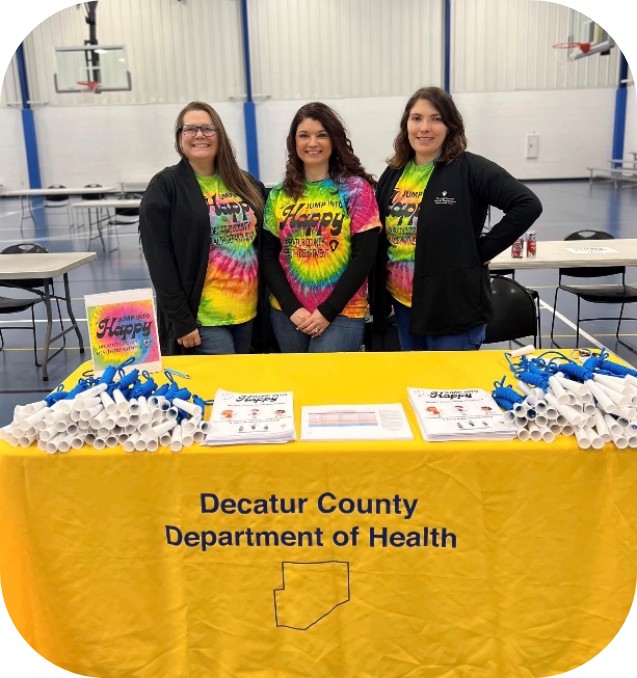
Decrease the rate of opioid overdose deaths in Decatur County from 21.8 per 100,000 (2018-2022) to 20.7 per 100,000 (2026–2030)
| Opioid overdose deaths per 100,000 |
| 2017-2021 |
22.6 |
| 2018-2022 |
21.9 |
| 2019-2023 |
21.9 |
| 2020-2024 |
21.2 |
Crude rate per 100,000
Maternal and Child Health, Fatality Review (child, suicide, overdose)
Decrease the infant mortality rate (IMR) in Decatur County from 8.48 per 1,000 live births (2019-2023) to 8.00 per 1,000 live births (2026–2030)
| Infant mortality rate per 1,000 live births |
| 2017-2021 |
7.7 |
| 2018-2022 |
7.8 |
| 2019-2023 |
8.5 |
| 2020-2024 |
6.4 |
May include unstable rates
Decrease the smoking during pregnancy rate in Decatur County from 11.5% (2023) to 10.0% (2030)
| Smoking during pregnancy |
| 2021 |
17.9% |
| 2022 |
14.7% |
| 2023 |
11.5% |
| 2024 |
9.4% |
Chronic Disease Prevention and Reduction
Decrease the prevalence of obesity among adults in Decatur County from 46.4% (2018-2023) to 42.0% (2025–2030)
| Adult obesity |
| 2018-2023 |
46.4% |
County Health ScorecardLocal Health Department Website
These counties received enhanced funding due to small population or lower life expectancy and/or higher needs, such as housing, transportation and income.
Opted out of Health First Indiana for 2026.
Trauma and Injury Prevention and Education, Fatality Review (child, suicide, overdose)
Decrease the suicide rate in DeKalb County from 14.7 per 100,000 (2018-2022) to 12.7 per 100,000 by 2029 (2025-2029).
| Suicide deaths per 100,000 |
| 2018-2022 |
14.7 |
| 2019-2023 |
16.1 |
| 2020-2024 |
19.2 |
Crude rate per 100,000
Chronic Disease Prevention and Reduction
Increase the average age of death due to heart disease from 75 years (2019-2023) to 77 years by 2035 (2031-2035)
| Average age of death due to heart disease |
| 2017-2021 |
75.0 |
| 2018-2022 |
75.1 |
| 2019-2023 |
75.0 |
Decrease the adult obesity rate in DeKalb County from 45.3% in 2018-2023 to 43% in 2028-2033.
| Adult obesity |
| 2018-2023 |
45.3% |
County Health ScorecardLocal Health Department Website
These counties received enhanced funding due to small population or lower life expectancy and/or higher needs, such as housing, transportation and income.
Opted out of Health First Indiana for 2026.
Trauma and Injury Prevention and Education, Fatality Review (child, suicide, overdose)
Reduce the rate of opioid overdose deaths from 56.8 per 100,000 (2022) to 45.4 per 100,000 in 2030
| Opioid overdose deaths per 100,000 |
| 2021 |
79.8 |
| 2022 |
56.8 |
| 2023 |
43.3 |
| 2024 |
36.3 |
Age-adjusted rate per 100,000
Maternal and Child Health
Decrease the rate of smoking during pregnancy in Delaware County from 13.7% (2022) to 8.7% in 2030
| Smoking during pregnancy |
| 2021 |
15.6% |
| 2022 |
13.7% |
| 2023 |
8.3% |
| 2024 |
7.3% |
Testing/counseling for HIV, HCV, STI
Decrease the rate of newly diagnosed chlamydia cases from 567 cases per 100,000 (2023) to 461.4 cases per 100,000 in 2030
| Chlamydia incidence cases per 100,000 |
| 2021 |
578 |
| 2022 |
638 |
| 2023 |
567 |
| 2024 |
498 |
County Health ScorecardLocal Health Department Website
These counties received enhanced funding due to small population or lower life expectancy and/or higher needs, such as housing, transportation and income.
Opted out of Health First Indiana for 2026.
Trauma and Injury Prevention and Education
Decrease the number of nonfatal hospitalizations due to unintentional falls in Dubois County from 103 (2022) to 100 (2030)
| Fall-related hospitalizations |
| 2022 |
103 |
| 2023 |
118 |
| 2024 |
123 |
Student Health
Increase the number of Dubois County students in fifth and sixth grade who receive e-cigarette/vaping prevention education from 0 (2023) to 600 (2030)
| E-cigarette/vaping prevention education students |
| 2023 |
0 |
| 2024 |
370 |
| 2025 |
506* |
LHD/Partner Data
*Preliminary
Child and Adult Immunizations, Student Health
Increase the school immunization coverage rate among sixth graders in Dubois County from 81.6% (2023-2024) to 85.6% (2030-2031)
| 6th grade immunization coverage |
| 2020-2021 |
81.4% |
| 2021-2022 |
78.9% |
| 2022-2023 |
81.6% |
| 2023-2024 |
81.6% |
| 2024-2025 |
92.3% |
| 2025-2026 |
93.4% |
Increase the school immunization coverage rate among twelfth graders in Dubois County from 75.8% (2023-2024) to 79.5% (2030-2031)
| 12th grade immunization coverage |
| 2020-2021 |
56.9% |
| 2021-2022 |
67.0% |
| 2022-2023 |
77.4% |
| 2023-2024 |
75.8% |
| 2024-2025 |
78.4% |
| 2025-2026 |
84.1% |
County Health ScorecardLocal Health Department Website
These counties received enhanced funding due to small population or lower life expectancy and/or higher needs, such as housing, transportation and income.
Opted out of Health First Indiana for 2026.
Trauma and Injury Prevention and Education, Student Health, Fatality Review (child, suicide, overdose)
Decrease the suicide rate in Elkhart County from 11.8 per 100,000 (2018-2022) to 8.9 per 100,000 by 2027 (2023-2027)
| Suicide deaths per 100,000 |
| 2018-2022 |
11.8 |
| 2019-2023 |
12.6 |
| 2020-2024 |
11.3 |
Crude rate per 100,000
Maternal and Child Health
Decrease the percentage of women not receiving early prenatal care from 37.6% in 2022 to 35% by 2027
| No early prenatal care |
| 2021 |
37.8% |
| 2022 |
37.6% |
| 2023 |
32.5% |
| 2024 |
29.9% |
Testing/counseling for HIV, HCV, STI
Decrease the total number of syphilis cases among adults aged 18-64 in Elkhart County by 10%, from 41 cases in 2023 to 36 cases by 2027.
| Syphilis cases among adults |
| 2021 |
37 |
| 2022 |
42 |
| 2023 |
41 |
| 2024 |
24 |
County Health ScorecardLocal Health Department Website
These counties received enhanced funding due to small population or lower life expectancy and/or higher needs, such as housing, transportation and income.
Opted out of Health First Indiana for 2026.
Trauma and Injury Prevention and Education, Fatality Review (child, suicide, overdose)
Reduce the rate of fatal overdoses in Fayette County from 77.5 per 100,000 (2018-2022) to 39.1 per 100,000 by 2030 (2026-2030)
| All drug overdose deaths per 100,000 |
| 2018-2022 |
77.5 |
| 2019-2023 |
75.5 |
| 2020-2024 |
63.6 |
Crude rate per 100,000
Childhood Lead Screenings and Case Management
Increase the percentage of children ages 0-6 years living in Fayette County tested for elevated blood lead levels (EBLL) from 23.1% (2023) to 28.7% by 2030
| Children tested for elevated blood lead levels |
| 2021 |
17.5% |
| 2022 |
20.6% |
| 2023 |
23.1% |
| 2024 |
20.5% |
Child and Adult Immunizations
Increase the vaccination completion rate among children ages 19-35 months in Fayette County from 68.7% (Q4 2024) to 75% by 2030
| Childhood immunization series completion |
| 2023 |
72.4% |
| 2024 |
68.7% |
Data pulled Q4 yearly
County Health ScorecardLocal Health Department Website
These counties received enhanced funding due to small population or lower life expectancy and/or higher needs, such as housing, transportation and income.
Opted out of Health First Indiana for 2026.
Trauma and Injury Prevention and Education, Fatality Review (child, suicide, overdose)
Decrease the suicide rate in Floyd County from 15.8 per 100,000 (2018-2022) to 15.4 per 100,000 (2023–2027)
| Suicide deaths per 100,000 |
| 2018-2022 |
15.8 |
| 2019-2023 |
16.2 |
| 2020-2024 |
17.1 |
Crude rate per 100,000
Decrease the rate of all-drug overdose deaths in Floyd County from 47.4 per 100,000 (2018-2022) to 35.0 per 100,000 (2023–2027)
| All drug overdose deaths per 100,000 |
| 2018-2022 |
47.4 |
| 2019-2023 |
50.6 |
| 2020-2024 |
49.8 |
Age-adjusted rate per 100,000
Decrease the number of nonfatal emergency department visits due to unintentional falls in Floyd County from 2,246 (2023) to 1,941 (2027)
| Fall-related ED visits |
| 2022 |
2043 |
| 2023 |
2246 |
| 2024 |
2299 |
Increase the number of Floyd County residents trained in CPR by the FCHD from 0 (2023) to 404 (2027)
| Residents trained in CPR |
| 2023 |
0 |
| 2024 |
51 |
LHD/Partner Data
County Health ScorecardLocal Health Department Website
These counties received enhanced funding due to small population or lower life expectancy and/or higher needs, such as housing, transportation and income.
Opted out of Health First Indiana for 2026.
Chronic Disease Prevention and Reduction
Reduce the mortality rate of cancer in Fountain County from 234.7 per 100,000 in 2016-2020 to 224 per 100,000 in 2025-2029.
| Cancer mortality per 100,000 |
| 2017-2021 |
233.8 |
| 2018-2022 |
232.8 |
Age-adjusted rate per 100,000
Decrease the adult obesity rate in Fountain County from 48.2% in 2018-2023 to 47.2% by 2029-2034.
| Adult obesity |
| 2018-2023 |
48.2% |
Childhood Lead Screenings and Case Management
Increase the percentage of Fountain County children ages 0-6 years tested for elevated blood lead levels from 20.1% in 2023 to 22.0% in 2025.
| Children tested for elevated blood lead levels |
| 2021 |
9.7% |
| 2022 |
11.6% |
| 2023 |
20.1% |
| 2024 |
16.3% |
Maternal and Child Health
Reduce the preterm birth rate from 12.9% in 2022 to 11.9% in 2027.
| Preterm birth rates |
| 2021 |
13.1% |
| 2022 |
12.9% |
| 2023 |
9.1% |
| 2024 |
8.5% |
County Health ScorecardLocal Health Department Website
These counties received enhanced funding due to small population or lower life expectancy and/or higher needs, such as housing, transportation and income.
Opted out of Health First Indiana for 2026.
Trauma and Injury Prevention and Education, Fatality Review (child, suicide, overdose)
Decrease the suicide rate in Franklin County from 19.2 per 100,000 (2018-2022) to 17.2 per 100,000 (2023–2027)
| Suicide deaths per 100,000 |
| 2018-2022 |
19.2 |
| 2019-2023 |
23.6 |
| 2020-2024 |
25.2 |
Crude rate per 100,000
*Preliminary
Child and Adult Immunizations
Increase the immunization coverage for the recommended vaccine series among children aged 19–35 months in Franklin County from 54.5% (2024 Q3) to 56.5% (2027)
| Childhood immunization series completion |
| 2023 |
61.4% |
| 2024 |
54.5% |
| 2025 |
52.2% |
Data pulled Q3 yearly
Chronic Disease Prevention and Reduction
Decrease the prevalence of obesity among adults in Franklin County from 46.6% (2018-2023) to 46.1% (2029–2034)
| Adult obesity |
| 2018-2023 |
46.6% |
County Health ScorecardLocal Health Department Website
These counties received enhanced funding due to small population or lower life expectancy and/or higher needs, such as housing, transportation and income.
Opted out of Health First Indiana for 2026.
Trauma and Injury Prevention and Education, Fatality Review (child, suicide, overdose)
Decrease the suicide rate in Fulton County from 21.7 per 100,000 (2018-2022) to 20.0 per 100,000 by 2027 (2023-2027).
| Suicide deaths per 100,000 |
| 2018-2022 |
21.7 |
| 2019-2023 |
22.7 |
| 2020-2024 |
24.6 |
Crude rate per 100,000
Maternal and Child Health
Decrease the percentage of women smoking during pregnancy from 11.3% in 2022 to 10.0% in 2027.
| Smoking during pregnancy |
| 2021 |
16.2% |
| 2022 |
11.3% |
| 2023 |
10.8% |
| 2024 |
5.3% |
May include unstable rates
Childhood Lead Screenings and Case Management
Increase the percentage of children ages 0-6 years in Fulton County tested for elevated blood lead levels from 10.4% in 2023 to 16.5% in 2027.
| Children tested for elevated blood lead levels |
| 2021 |
8.6% |
| 2022 |
7.6% |
| 2023 |
10.4% |
| 2024 |
12.0% |
County Health ScorecardLocal Health Department Website
These counties received enhanced funding due to small population or lower life expectancy and/or higher needs, such as housing, transportation and income.
Opted out of Health First Indiana for 2026.
Trauma and Injury Prevention and Education, Fatality Review (child, suicide, overdose)
Decrease the suicide rate in Gibson County from 22.1 per 100,000 (2018-2022) to 20.0 per 100,000 (2025–2029)
| Suicide deaths per 100,000 |
| 2018-2022 |
22.3 |
| 2019-2023 |
22.4 |
| 2020-2024 |
25.5 |
Crude rate per 100,000
*Preliminary
Maternal and Child Health
Decrease the smoking during pregnancy rate in Gibson County from 8.0% (2022) to 7.0% (2028)
| Smoking during pregnancy |
| 2021 |
10.0% |
| 2022 |
8.0% |
| 2023 |
5.3% |
| 2024 |
4.5% |
May include unstable rates
Chronic Disease Prevention and Reduction
Decrease the prevalence of obesity among adults in Gibson County from 46.3% (2018-2023) to 45.0% (2029–2034)
| Adult obesity |
| 2018-2023 |
46.3% |
County Health ScorecardLocal Health Department Website
These counties received enhanced funding due to small population or lower life expectancy and/or higher needs, such as housing, transportation and income.
Opted out of Health First Indiana for 2026.
Fatality Review (child, suicide, overdose), Maternal and Child Health
Decrease the infant mortality rate in Grant County from 9.4 per 1,000 live births (2018-2022) to 7.0 per 1,000 live births by 2030 (2026-2030)
| Infant mortality rate per 1,000 live births |
| 2017-2021 |
8.9 |
| 2018-2022 |
9.4 |
| 2019-2023 |
9.7 |
| 2020-2024 |
10.7 |
May include unstable rates
Maternal and Child Health
Reduce the smoking rate of pregnant women in Grant County from 15.4% (2023) to 11% by 2030
| Smoking during pregnancy |
| 2021 |
22.6% |
| 2022 |
17.0% |
| 2023 |
15.4% |
| 2024 |
9.3% |
Trauma and Injury Prevention and Education, Fatality Review (child, suicide, overdose)
Reduce the rate of fatal overdoses in Grant County from 69.7 per 100,000 (2022) to 40 per 100,000 by 2030
| All drug overdose deaths per 100,000 |
| 2021 |
80.0 |
| 2022 |
69.7 |
| 2023 |
65.0 |
| 2024 |
34.6 |
Crude rate per 100,000
County Health ScorecardLocal Health Department Website
These counties received enhanced funding due to small population or lower life expectancy and/or higher needs, such as housing, transportation and income.
Opted out of Health First Indiana for 2026.
Trauma and Injury Prevention and Education, Fatality Review (child, suicide, overdose)
Reduce the rate of fatal overdoses in Greene County from 19.8 per 100,000 (2018-2022) to 16.1 per 100,000 by 2027 (2023-2027)
| All drug overdose deaths per 100,000 |
| 2018-2022 |
19.8 |
| 2019-2023 |
21.2 |
| 2020-2024 |
21.1 |
Crude rate per 100,000
Childhood Lead Screenings and Case Management
Increase the percentage of children ages 0-6 years living in Greene County tested for elevated blood lead levels (EBLL) from 19.1% (2023) to 23.5% by 2030
| Children tested for elevated blood lead levels |
| 2021 |
17.8% |
| 2022 |
15.2% |
| 2023 |
19.1% |
| 2024 |
22.3% |
Maternal and Child Health
Decrease the percentage of mothers who smoke while pregnant in Greene County from 11.5% (2022) to 8.5% by 2030
| Smoking during pregnancy |
| 2021 |
15.5% |
| 2022 |
11.5% |
| 2023 |
11.1% |
| 2024 |
9.0% |
May include unstable rates
Chronic Disease Prevention and Reduction
Decrease the adult obesity prevalence in Greene County from 48.2% (2018-2023) to 47.2% by 2030 (2025-2030)
| Adult obesity |
| 2018-2023 |
48.2% |
Child and Adult Immunizations, Student Health
Increase the overall immunization rate among 12th graders in Greene County from 74.13% (2023-2024 school year) to 79.3% by 2030
| 12th grade immunization coverage |
| 2020-2021 |
58.6% |
| 2021-2022 |
66.3% |
| 2022-2023 |
80.4% |
| 2023-2024 |
74.1% |
| 2024-2025 |
83.1% |
| 2025-2026 |
88.1% |
County Health ScorecardLocal Health Department Website
These counties received enhanced funding due to small population or lower life expectancy and/or higher needs, such as housing, transportation and income.
Opted out of Health First Indiana for 2026.

Referrals to Clinical Care
Decrease the crisis assessment admission rate from 54% (2020) to 52% (2027) through implementation of a self-assessment and patient navigation continuum of care and county-based assessment system implementation and annual review of Community Health Network's emergency psychiatric services data.
| Crisis assessment admission |
| 2021 |
NA |
| 2022 |
NA |
| 2023 |
NA |
| 2024 |
NA |
| 2025 |
NA |
Data pending from Hamilton County Health Department
Chronic Disease Prevention and Reduction
Decrease the adult physical inactivity rate from 17% (2021) to 16% by 2027
| Physical inactivity |
| 2021 |
17.0% |
| 2022 |
17.0% |
| 2023 |
16.0% |
Age-adjusted percentage
Trauma and Injury Prevention and Education
Reduce the rate of fall-related ED visits in older adults (65+) from 5209.4 per 100,000 (2022) to 5000 per 100,000 by 2027
| Fall-related ED visits per 100,000 |
| 2022 |
5209.4` |
| 2023 |
5857.4 |
| 2024 |
6061.8 |
County Health ScorecardLocal Health Department Website
These counties received enhanced funding due to small population or lower life expectancy and/or higher needs, such as housing, transportation and income.
Opted out of Health First Indiana for 2026.
Trauma and Injury Prevention and Education, Fatality Review (child, suicide, overdose)
Reduce the suicide rate in Hancock County from 14.5 per 100,000 (2018-2022) to 11 per 100,000 by 2030 (2026-2030)
| Suicide deaths per 100,000 |
| 2018-2022 |
14.5 |
| 2019-2023 |
14.2 |
| 2020-2024 |
15.0 |
Reduce the rate of fatal overdoses in Hancock County from 25.3 per 100,000 (2022) to 19.3 per 100,000 by 2030
| All drug overdose deaths per 100,000 |
| 2021 |
29.3 |
| 2022 |
25.3 |
| 2023 |
24.4 |
| 2024 |
22.5 |
Crude rate per 100,000
Chronic Disease Prevention and Reduction
Decrease the adult obesity prevalence in Hancock County from 44.9% (2018-2023) to 44.6% by 2030 (2025-2030)
| Adult obesity |
| 2018-2023 |
44.9% |
County Health ScorecardLocal Health Department Website
These counties received enhanced funding due to small population or lower life expectancy and/or higher needs, such as housing, transportation and income.
Opted out of Health First Indiana for 2026.
Maternal and Child Health
Decrease the smoking during pregnancy rate in Harrison County from 9.9% (2022) to 8.9% (2035)
| Smoking during pregnancy |
| 2021 |
13.7% |
| 2022 |
9.9% |
| 2023 |
7.7% |
| 2024 |
5.5% |
Trauma and Injury Prevention and Education, Fatality Review (child, suicide, overdose)
Decrease the number of emergency department visits due to falls among adults aged 65 years and older in Harrison County from 575 (2023) to 518 (2035)
| Fall-related ED visits |
| 2022 |
512 |
| 2023 |
575 |
| 2024 |
647 |
Chronic Disease Prevention and Reduction
Decrease the prevalence of type 2 diabetes among adults aged 18 years and older in Harrison County from 8.9% (2019-2024) to 8.0% (2030–2035)
| Adult diabetes |
| 2019-2024 |
8.9% |
County Health ScorecardLocal Health Department Website
These counties received enhanced funding due to small population or lower life expectancy and/or higher needs, such as housing, transportation and income.
Opted out of Health First Indiana for 2026.
Trauma and Injury Prevention and Education, Fatality Review (child, suicide, overdose)
Reduce the rate of fatal overdoses in Hendricks County from 21.4 per 100,000 (2022) to 15 per 100,000 by 2030
| All drug overdose deaths per 100,000 |
| 2021 |
26.8 |
| 2022 |
21.4 |
| 2023 |
19.9 |
| 2024 |
10.5 |
Crude rate per 100,000
Child and Adult Immunizations, Student Health
Increase the compliance of the kindergarten immunization series within Hendricks County from 83.29% (2023-2024 school year) to 90% by 2029
| Kindergarten immunization series completion |
| 2020-2021 |
82.1% |
| 2021-2022 |
81.3% |
| 2022-2023 |
81.5% |
| 2023-2024 |
83.3% |
| 2024-2025 |
87.0% |
Increase the compliance of the 6th grade immunization series within Hendricks County from 76.6% (2023-2024 school year) to 90% by 2029
| 6th grade immunization coverage |
| 2020-2021 |
72.0% |
| 2021-2022 |
70.8% |
| 2022-2023 |
75.3% |
| 2023-2024 |
76.6% |
| 2024-2025 |
90.8% |
| 2025-2026 |
90.1% |
Child and Adult Immunizations
Increase the completion rate of the childhood immunization series for all children ages 19-35 months within Hendricks County from 59.9% (Q3 2024) to 75% by 2029
| Childhood immunization series completion |
| 2023 |
57.4% |
| 2024 |
59.9% |
| 2025 |
66.5% |
Data pulled Q3 yearly
County Health ScorecardLocal Health Department Website
These counties received enhanced funding due to small population or lower life expectancy and/or higher needs, such as housing, transportation and income.
Opted out of Health First Indiana for 2026.
Trauma and Injury Prevention and Education, Fatality Review (child, suicide, overdose)
Reduce the rate of fatal overdoses in Henry County from 23.5 per 100,000 (2018-2022) to 19.5 per 100,000 by 2030 (2026-2030)
| All drug overdose deaths per 100,000 |
| 2018-2022 |
23.5 |
| 2019-2023 |
26.7 |
| 2020-2024 |
27.9 |
Crude rate per 100,000
Student Health
Reduce the use of nicotine via vaping/electronic cigarettes among eleventh graders at New Castle High School from 11.4% (2023) to 9.4% by 2026
| 11th grade nicotine vaping/electronic cigarette use |
| 2023 |
11.4% |
| 2024 |
8.1% |
Maternal and Child Health, Referrals to Clinical Care
Reduce the smoking rate of pregnant women in Henry County from 11% (2022) to 9% by 2026
| Smoking during pregnancy |
| 2021 |
13.5% |
| 2022 |
11.0% |
| 2023 |
8.8% |
| 2024 |
7.5% |
County Health ScorecardLocal Health Department Website
These counties received enhanced funding due to small population or lower life expectancy and/or higher needs, such as housing, transportation and income.
Opted out of Health First Indiana for 2026.
Chronic Disease Prevention and Reduction
Decrease the percentage of adults aged 20 and above with diagnosed diabetes in Howard County from 11.5% (age-adjusted, 2021) to 10.4% by 2030
| Adult diabetes |
| 2021 |
11.5% |
| 2022 |
9.3% |
| 2023 |
11.0% |
| 2024 |
11.1% |
Age-adjusted percentage
Decrease the rate of obesity among children ages 2-19 in Howard County from 26.4% (2018-2023) to 25.4% (2025-2030)
| Childhood obesity |
| 2018-2023 |
26.4% |
Trauma and Injury Prevention and Education, Fatality Review (child, suicide, overdose)
Reduce the age-adjusted rate of fatal drug overdoses in Howard County from 46.9 per 100,000 (2023) to 44.0 per 100,000 by the end of 2028
| All drug overdose deaths per 100,000 |
| 2021 |
58.1 |
| 2022 |
54.8 |
| 2023 |
46.9 |
| 2024 |
38.8 |
Age-adjusted rate per 100,000
County Health ScorecardLocal Health Department Website
These counties received enhanced funding due to small population or lower life expectancy and/or higher needs, such as housing, transportation and income.
Opted out of Health First Indiana for 2026.
Chronic Disease Prevention and Reduction, Student Health
Reduce the rate of hospitalizations due to asthma from 3.6 per 10,000 in 2021 to 3.2 per 10,000 by the end of 2028.
| Asthma-related hospitalizations per 10,000 |
| 2021 |
3.6 |
| 2022 |
2.6 |
| 2023 |
3.6 |
Age-adjusted rate per 10,000
Maternal and Child Health
Reduce the percentage of mothers smoking during pregnancy from 11.8% in 2022 to 10% in 2028.
| Smoking during pregnancy |
| 2021 |
12.9% |
| 2022 |
11.8% |
| 2023 |
6.6% |
| 2024 |
6.7% |
Trauma and injury prevention and education, Fatality review (child, suicide, overdose)
Decrease the fatal opioid overdose rate from 27.3 per 100,000 (2018-2022) to 25 per 100,000 by 2028 (2024-2028).
| Opioid overdose deaths |
| 2017-2021 |
NA |
| 2018-2022 |
27.3 |
| 2019-2023 |
26.7 |
| 2020-2024 |
26.7 |
Crude rate per 100,000
County Health ScorecardLocal Health Department Website
These counties received enhanced funding due to small population or lower life expectancy and/or higher needs, such as housing, transportation and income.
Opted out of Health First Indiana for 2026.
Trauma and Injury Prevention and Education, Fatality Review (child, suicide, overdose)
Decrease the rate of opioid overdose deaths in Jackson County from 25.3 per 100,000 (2018-2022) to 20.0 per 100,000 (2026–2030)
| Opioid overdose deaths per 100,000 |
| 2017-2021 |
26.5 |
| 2018-2022 |
25.3 |
| 2019-2023 |
22.4 |
| 2020-2024 |
21.3 |
Crude rate per 100,000
Maternal and Child Health
Decrease the smoking during pregnancy rate in Jackson County from 8.5% (2022) to 7.5% (2029)
| Smoking during pregnancy |
| 2021 |
14.6% |
| 2022 |
8.5% |
| 2023 |
7.4% |
| 2024 |
3.5% |
Chronic Disease Prevention and Reduction
Decrease the prevalence of obesity among adults in Jackson County from 47.5% (2018-2023) to 47.0% (2029–2034)
| Adult obesity |
| 2018-2023 |
47.5% |
Age-adjusted percentage
Child and Adult Immunizations
Increase the immunization coverage for the recommended vaccine series among children aged 19–35 months in Jackson County from 62.5% (2024 Q3) to 75.0% (2028)
| Childhood immunization series completion |
| 2023 |
52.6% |
| 2024 |
62.5% |
| 2025 |
69.9% |
Data pulled Q3 yearly
County Health ScorecardLocal Health Department Website
These counties received enhanced funding due to small population or lower life expectancy and/or higher needs, such as housing, transportation and income.
Opted out of Health First Indiana for 2026.
Trauma and Injury Prevention and Education, Fatality Review (child, suicide, overdose)
Decrease the suicide rate in Jasper County from 22.2 per 100,000 (2019-2023) to 20.0 per 100,000 by 2030 (2026-2030).
| Suicide deaths per 100,000 |
| 2018-2022 |
18.7 |
| 2019-2023 |
22.2 |
| 2020-2024 |
21.7 |
Crude rate per 100,000
Decrease the number of deaths due to drug overdose (all intents) from 40 (2018-2022) to 35 (2024-2028).
| All drug overdose deaths |
| 2018-2022 |
40 |
| 2019-2023 |
40 |
| 2020-2024 |
41 |
Child and Adult Immunizations
Decrease the average age for infants in Jasper County to receive their first DTaP vaccine from 4.23 months in 2024 to 3.9 months in 2027.
| Average age of first DTaP vaccine |
| 2024 |
4.23 |
| 2025 |
2.12 |
County Health ScorecardLocal Health Department Website
These counties received enhanced funding due to small population or lower life expectancy and/or higher needs, such as housing, transportation and income.
Opted out of Health First Indiana for 2026.
Fatality Review (child, suicide, overdose), Maternal and Child Health
Reduce the infant mortality rate from 8.75 per 1,000 live births (2018-2022) to 5 per 1,000 live births by 2030 (2026-2030)
| Infant mortality rate per 1,000 live births |
| 2017-2021 |
8.7 |
| 2018-2022 |
8.8 |
| 2019-2023 |
6.8 |
| 2020-2024 |
9.4 |
May include unstable rates
Chronic Disease Prevention and Reduction
Decrease the percentage of adults aged 20 and older with diagnosed diabetes in Jay County from 10.4% (2023) to 9.9% by 2030
| Adult diabetes |
| 2021 |
8.3% |
| 2022 |
9.7% |
| 2023 |
10.4% |
| 2024 |
10.7% |
Age-adjusted percentage
Trauma and Injury Prevention and Education
Reduce the number of non-fatal hospitalizations due to unintentional fall from 72 (2023) to 62 by 2030
| Fall-related hospitalizations |
| 2022 |
71 |
| 2023 |
72 |
| 2024 |
76 |
County Health ScorecardLocal Health Department Website
These counties received enhanced funding due to small population or lower life expectancy and/or higher needs, such as housing, transportation and income.
Opted out of Health First Indiana for 2026.
Maternal and Child Health
Decrease the smoking during pregnancy rate in Jefferson County from 16.4% (2022) to 15.0% (2027)
| Smoking during pregnancy |
| 2021 |
18.0% |
| 2022 |
16.4% |
| 2023 |
13.0% |
| 2024 |
9.4% |
Chronic Disease Prevention and Reduction
Decrease the percentage of residents reporting physical inactivity in Jefferson County from 28% (2021) to 27% (2027)
| Physical inactivity |
| 2021 |
28.0% |
| 2022 |
29.0% |
| 2023 |
24.0% |
Decrease the prevalence of obesity among adults in Jefferson County from 48.1% (2018-2023) to 47.1% (2030–2035)
| Adult obesity |
| 2018-2023 |
48.1% |
County Health ScorecardLocal Health Department Website
These counties received enhanced funding due to small population or lower life expectancy and/or higher needs, such as housing, transportation and income.
Opted out of Health First Indiana for 2026.
Trauma and Injury Prevention and Education, Fatality Review (child, suicide, overdose)
Decrease the suicide rate in Jennings County from 23.9 per 100,000 (2018-2022) to 22.9 per 100,000 (2023–2027)
| Suicide deaths per 100,000 |
| 2018-2022 |
23.9 |
| 2019-2023 |
21.8 |
| 2020-2024 |
24 |
Crude rate per 100,000
Decrease the rate of opioid overdose deaths in Jennings County from 26.1 per 100,000 (2018-2022) to 24.0 per 100,000 (2023–2027)
| Opioid overdose deaths per 100,000 |
| 2017-2021 |
17.4 |
| 2018-2022 |
26.1 |
| 2019-2023 |
33.4 |
| 2020-2024 |
31.2 |
Crude rate per 100,000
Chronic Disease Prevention and Reduction
Decrease the food insecurity rate in Jennings County from 15.5% (2022) to 14.0% (2027)
| Food insecurity rate |
| 2021 |
11.6% |
| 2022 |
15.5% |
| 2023 |
16.0% |
County Health ScorecardLocal Health Department Website
These counties received enhanced funding due to small population or lower life expectancy and/or higher needs, such as housing, transportation and income.
Opted out of Health First Indiana for 2026.
Trauma and Injury Prevention and Education, Fatality Review (child, suicide, overdose)
Decrease the rate of fatal overdoses in Johnson County from 36.2 per 100,000 (2022) to 30.2 per 100,000 by 2030
| All drug overdose deaths per 100,000 |
| 2021 |
35.9 |
| 2022 |
36.2 |
| 2023 |
25.6 |
| 2024 |
25.2 |
Crude rate per 100,000
Decrease the suicide rate in Johnson County from 14.5 per 100,000 (2022) to 12.1 per 100,000 by 2027
| Suicide deaths per 100,000 |
| 2021 |
17.0 |
| 2022 |
14.5 |
| 2023 |
20.3 |
| 2024 |
14.1 |
Crude rate per 100,000
Child and Adult Immunizations
Increase the vaccination completion rate among children ages 19-35 months in Johnson County from 66.2% (Q3 2024) to 70% by 2027
| Childhood immunization series completion |
| 2023 |
58.5% |
| 2024 |
66.2% |
| 2025 |
66.2% |
Data pulled Q3 yearly
County Health ScorecardLocal Health Department Website
These counties received enhanced funding due to small population or lower life expectancy and/or higher needs, such as housing, transportation and income.
Opted out of Health First Indiana for 2026.
Childhood Lead Screenings and Case Management
Increase the percentage of children aged 0-6 years tested for elevated blood lead levels (EBLL) in Knox County from 13.50% (2024) to 14.50% (2027)
| Children tested for elevated blood lead levels |
| 2021 |
8.4% |
| 2022 |
10.3% |
| 2023 |
14.8% |
| 2024 |
13.5% |
Maternal and Child Health
Decrease the smoking during pregnancy rate in Knox County from 12.0% (2022) to 11.0% (2027)
| Smoking during pregnancy |
| 2021 |
15.7% |
| 2022 |
12.0% |
| 2023 |
10.3% |
| 2024 |
7.4% |
Chronic Disease Prevention and Reduction
Decrease the food insecurity rate in Knox County from 15.4% (2022) to 13.4% (2028)
| Food insecurity rate |
| 2021 |
12.8% |
| 2022 |
15.4% |
| 2023 |
16.7% |
Child and Adult Immunizations
Increase the HPV vaccination coverage rate (up-to-date) among 9–12-year-olds in Knox County from 3.64% (2024 Q3) to 5.00% (2027)
| HPV immunization coverage rate |
| 2023 |
4.7% |
| 2024 |
3.6% |
| 2025 |
2.8% |
Data pulled Q3 yearly
County Health ScorecardLocal Health Department Website
These counties received enhanced funding due to small population or lower life expectancy and/or higher needs, such as housing, transportation and income.
Opted out of Health First Indiana for 2026.
Chronic Disease Prevention and Reduction
Increase the average age of death related to heart disease from 76.2 years in 2019-2023 to 78.2 years in 2025-2029
| Average age of death due to heart disease |
| 2017-2021 |
75.7 |
| 2018-2022 |
75.5 |
| 2019-2023 |
76.2 |
Testing/counseling for HIV, HCV, STI
Decrease the number of early syphilis cases identified in Kosciusko County (primary, secondary, early latent syphilis) from seven in 2020 to four in 2029
| Syphilis cases |
| 2021 |
6 |
| 2022 |
< 5* |
| 2023 |
< 5* |
| 2024 |
< 5* |
*Suppressed
Maternal and Child Health
Decrease the rate of women not receiving early prenatal care from 30.5% in 2022 to 26.5% by 2027.
| No early prenatal care |
| 2021 |
40.0% |
| 2022 |
30.5% |
| 2023 |
25.8% |
| 2024 |
24.3% |
Maternal and Child Health, Student Health
Decrease the rate of teen births from 18.8 per 1,000 in 2022 to 16.9 per 1,000 by 2028.
| Teen births per 1,000 |
| 2021 |
23.7 |
| 2022 |
18.8 |
| 2023 |
18.2 |
| 2024 |
17.4% |
County Health ScorecardLocal Health Department Website
These counties received enhanced funding due to small population or lower life expectancy and/or higher needs, such as housing, transportation and income.
Opted out of Health First Indiana for 2026.
Infectious Disease Prevention and Control
Decrease the number of vaccine preventable pertussis cases from 29 in 2024 to 22 in 2028
| Pertussis cases |
| 2021 |
0 |
| 2022 |
0 |
| 2023 |
23 |
| 2024 |
29 |
| 2025 |
21 |
Maternal and Child Health
Decrease the percentage of mothers not receiving early prenatal care from 48.1% (2022) to 45% by 2028.
| No early prenatal care |
| 2021 |
55.8% |
| 2022 |
48.1% |
| 2023 |
43.9% |
| 2024 |
35.7% |
Trauma and Injury Prevention and Education
Decrease the count of non-fatal hospitalizations due to unintentional fall from 63 in 2024 to 58 in 2028.
| Motor vehicle injury-related hospitalizations |
| 2022 |
61 |
| 2023 |
96 |
| 2024 |
63 |
Chronic Disease Prevention and Reduction
Decrease the adult obesity prevalence from 44.1% (2018-2023) to 41% by 2033 (2028-2033).
| Adult obesity |
| 2018-2023 |
44.1% |
Child and Adult Immunizations
Increase the completion rate of immunization series for children ages 19-35 months from 35.8% (Q2 2024) to 40% by 2028.
| Childhood immunization series completion |
| 2023 |
32.8% |
| 2024 |
35.8% |
| 2025 |
40.0% |
Data pulled Q2 yearly
County Health ScorecardLocal Health Department Website
These counties received enhanced funding due to small population or lower life expectancy and/or higher needs, such as housing, transportation and income.
Opted out of Health First Indiana for 2026.
Trauma and Injury Prevention and Education, Fatality Review (child, suicide, overdose)
Decrease the rate of opioid overdose deaths by 15% from 27.5 per 100,000 in 2018-2022 to 23.4 per 100,000 in 2025-2029
| Opioid overdose deaths per 100,000 |
| 2018-2022 |
27.5 |
| 2019-2023 |
28.8 |
| 2020-2024 |
26.8 |
Crude rate per 100,000
Maternal and Child Health
Decrease the rate of mothers not receiving early prenatal care from 33.7% in 2022 to 28% in 2027
| No early prenatal care |
| 2021 |
34.5% |
| 2022 |
33.7% |
| 2023 |
29.8% |
| 2024 |
32.4% |
Testing/counseling for HIV, HCV, STI
Decrease the number of congenital syphilis cases in Lake County from 4 in 2023 to 0 in 2027.
| Congenital syphilis cases |
| 2021 |
< 5* |
| 2022 |
< 5* |
| 2023 |
< 5* |
| 2024 |
< 5* |
*Suppressed
Child and Adult Immunizations
Increase the rate of children under 3 receiving the recommended vaccine series from 46.7% (Q3 2024) to 50% by 2027.
| Childhood immunization series completion |
| 2023 |
41.9% |
| 2024 |
46.7% |
| 2025 |
44.7% |
Data pulled Q3 yearly
County Health Scorecard Local Health Department Website
These counties received enhanced funding due to small population or lower life expectancy and/or higher needs, such as housing, transportation and income.
Opted out of Health First Indiana for 2026.
Maternal and Child Health
Reduce the percentage of mothers smoking during pregnancy from 12.1% (2022) to 10% (2027).
| Smoking during pregnancy |
| 2021 |
14.3% |
| 2022 |
12.1% |
| 2023 |
8.2% |
| 2024 |
7.0% |
Trauma and Injury Prevention and Education, Fatality Review (child, suicide, overdose)
Decrease the suicide rate in LaPorte County by 14%, from 18.8 per 100,000 in 2022 to 16.1 per 100,000 by 2029.
| Suicide deaths per 100,000 |
| 2021 |
28.5 |
| 2022 |
18.8 |
| 2023 |
28.6 |
| 2024 |
15.3 |
Crude rate per 100,000
Child and Adult Immunizations
Increase the rate of children under 3 completing the recommended vaccine series from 52.9% (Q4 2024) to 56% in 2029.
| Childhood immunization series completion |
| 2023 |
54.4% |
| 2024 |
52.9% |
Data pulled Q4 yearly
County Health ScorecardLocal Health Department Website
These counties received enhanced funding due to small population or lower life expectancy and/or higher needs, such as housing, transportation and income.
Opted out of Health First Indiana for 2026.
Trauma and Injury Prevention and Education, Fatality Review (child, suicide, overdose)
Decrease the number of drug overdose deaths in Lawrence County from 18 (2023) to 16 (2029)
| All drug overdose deaths |
| 2021 |
17 |
| 2022 |
15 |
| 2023 |
18 |
| 2024 |
13 |
Chronic Disease Prevention and Reduction
Decrease the prevalence of obesity among adults in Lawrence County from 39.7% (2022) to 38.7% (2034)
| Adult obesity |
| 2021 |
42.1% |
| 2022 |
39.7% |
| 2023 |
42.0% |
Maternal and Child Health
Decrease the smoking during pregnancy rate in Lawrence County from 16.6% (2021) to 15.8% (2030)
| Smoking during pregnancy |
| 2021 |
16.6% |
| 2022 |
14.2% |
| 2023 |
11.4% |
| 2024 |
6.7% |
County Health ScorecardLocal Health Department Website
These counties received enhanced funding due to small population or lower life expectancy and/or higher needs, such as housing, transportation and income.
Opted out of Health First Indiana for 2026.
Trauma and Injury Prevention and Education, Fatality Review (child, suicide, overdose)
Decrease the rate of fatal overdoses in Madison County from 45.1 per 100,000 (2019-2023) to 40.0 per 100,000 by 2030 (2026-2030)
| All drug overdose deaths per 100,000 |
| 2018-2022 |
42.2 |
| 2019-2023 |
45.1 |
| 2020-2024 |
45.0 |
Crude rate per 100,000
Decrease the number of non-fatal ED visits due to unintentional fall in older adults (65+) from 2,069 (2024) to 1,759 by 2030.
| Fall-related ED visits |
| 2022 |
1614 |
| 2023 |
1962 |
| 2024 |
2069 |
Maternal and Child Health, Referrals to Clinical Care
Increase the percentage of non-Hispanic Black women residing in Madison County who received prenatal care within the first trimester from 66.7% (2022) to 76.7% by 2030
| Prenatal care |
| 2021 |
70.3% |
| 2022 |
66.7% |
| 2023 |
73.2% |
| 2024 |
71.3% |
Chronic Disease Prevention and Reduction
Decrease the percentage of adults aged 20 and older with diagnosed diabetes in Madison County from 11.2% (2021) to 10% by 2030
| Adult diabetes |
| 2021 |
11.2% |
| 2022 |
12.3% |
| 2023 |
12.6% |
| 2024 |
12.2% |
Age-adjusted percentage
Decrease the adult obesity prevalence in Madison County from 46.4% (2018-2023) to 45% by 2030 (2025-2030)
| Adult obesity |
| 2018-2023 |
46.4% |
County Health ScorecardLocal Health Department Website
These counties received enhanced funding due to small population or lower life expectancy and/or higher needs, such as housing, transportation and income.
Opted out of Health First Indiana for 2026.
Fatality Review (child, suicide, overdose), Maternal and Child Health
Reduce infant mortality rate from 8.1 infant deaths per 1,000 live births (2018-2022) to 6.1 by December 31, 2030 (2026-2030)
| Infant mortality rate per 1,000 live births |
| 2017-2021 |
7.6 |
| 2018-2022 |
8.1 |
| 2019-2023 |
8.2 |
| 2020-2024 |
8.4 |
Maternal and Child Health, Testing/counseling for HIV, HCV, STI
Reduce the number of congenital syphilis cases by at least 10% from 27 (2023) to 24.3 by December 31, 2027
| Congenital syphilis cases |
| 2021 |
10 |
| 2022 |
21 |
| 2023 |
27 |
| 2024 |
34 |
Trauma and Injury Prevention and Education, Fatality Review (child, suicide, overdose)
Increase harm reduction efforts in Marion County to reduce the number of unintentional overdose deaths from 685 (2021) to 616 by December 31, 2030
| All drug overdose deaths |
| 2021 |
685 |
| 2022 |
669 |
| 2023 |
545 |
| 2024 |
392 |
County Health ScorecardLocal Health Department Website
These counties received enhanced funding due to small population or lower life expectancy and/or higher needs, such as housing, transportation and income.
Opted out of Health First Indiana for 2026.
Trauma and Injury Prevention and Education, Fatality Review (child, suicide, overdose)
Decrease the suicide rate in Marshall County from 19.0 per 100,000 (2018-2022) to 15.7 per 100,000 (2023-2027).
| Suicide deaths per 100,000 |
| 2018-2022 |
19.0 |
| 2019-2023 |
17.3 |
| 2020-2024 |
16.4 |
Crude rate per 100,000
Child and Adult Immunizations
Increase the rate of immunizations in children less than 3 years old from 59.2% (Q3 2024) to 62.9% by 2027
| Childhood immunization series completion |
| 2023 |
46.6% |
| 2024 |
59.2% |
| 2025 |
57.5% |
Data pulled Q3 yearly
Maternal and Child Health
Decrease the rate of mothers not receiving early prenatal care from 32.6% in 2022 to 28.8% by 2027
| No early prenatal care |
| 2021 |
32.7% |
| 2022 |
32.6% |
| 2023 |
30.8% |
| 2024 |
30.5% |
County Health ScorecardLocal Health Department Website
These counties received enhanced funding due to small population or lower life expectancy and/or higher needs, such as housing, transportation and income.
Opted out of Health First Indiana for 2026.
Trauma and Injury Prevention and Education, Fatality Review (child, suicide, overdose)
Decrease the suicide rate in Martin County from 19.9 per 100,000 (2018-2022) to 18.0 per 100,000 (2023–2027)
| Suicide deaths per 100,000 |
| 2018-2022 |
19.9 |
| 2019-2023 |
26.3 |
| 2020-2024 |
28.5 |
Crude rate per 100,000
*Preliminary
May include unstable rates
Chronic Disease Prevention and Reduction
Decrease the prevalence of obesity among adults in Martin County from 46.4% (2018-2023) to 45.9% (2029–2034)
| Adult obesity |
| 2018-2023 |
46.4% |
Child and Adult Immunizations
Increase the immunization coverage for the recommended vaccine series among children aged 19–35 months in Martin County from 42.2% (2024 Q2) to 50.0% (2027)
| Childhood immunization series completion |
| 2023 |
51.8% |
| 2024 |
42.2% |
| 2025 |
43.5% |
Data pulled Q2 yearly
County Health ScorecardLocal Health Department Website
These counties received enhanced funding due to small population or lower life expectancy and/or higher needs, such as housing, transportation and income.
Opted out of Health First Indiana for 2026.
Childhood Lead Screenings and Case Management
Increase the percentage of Miami County children ages 0-6 years tested for elevated blood lead levels from 13.0% in 2023 to 14.5% in 2025.
| Children tested for elevated blood lead levels |
| 2021 |
10.3% |
| 2022 |
9.0% |
| 2023 |
13.0% |
| 2024 |
15.4% |
Chronic Disease Prevention and Reduction
Decrease the adult obesity prevalence in Miami County from 47.8% (2018-2023) to 45.8% by 2035 (2030-2035).
| Adult obesity |
| 2018-2023 |
47.8% |
Decrease the adult physical inactivity rate from 29% in 2022 to 27% in 2035.
| Physical inactivity |
| 2021 |
29.0% |
| 2022 |
29.0% |
| 2023 |
27.0% |
County Health ScorecardLocal Health Department Website
These counties received enhanced funding due to small population or lower life expectancy and/or higher needs, such as housing, transportation and income.
Opted out of Health First Indiana for 2026.
Maternal and Child Health
Decrease the preterm birth rate in Monroe County from 9.3% (2023) to 8.5% (2027)
| Preterm birth rates |
| 2021 |
10.2% |
| 2022 |
10.0% |
| 2023 |
9.3% |
| 2024 |
10.5% |
Decrease the smoking during pregnancy rate in Monroe County from 6.8% (2022) to 6.0% (2026)
| Smoking during pregnancy |
| 2021 |
9.2% |
| 2022 |
6.8% |
| 2023 |
5.9% |
| 2024 |
6.2% |
Infectious Disease Prevention and Control, Testing/counseling for HIV, HCV, STI
Increase the proportion of Monroe County syphilis cases who are treated from 86.67% (2024) to 88.67% (2027)
| Syphilis cases |
| 2022 |
84.6% |
| 2023 |
93.8% |
| 2024 |
86.7% |
Trauma and Injury Prevention and Education
Decrease the rate of nonfatal hospitalizations due to unintentional falls among adults aged 45 years and older in Monroe County from 582 per 100,000 (2023) to 524 per 100,000 (2027)
| Fall-related hospitalizations per 100,000 |
| 2022 |
495.5 |
| 2023 |
582 |
| 2024 |
600.7 |

Orders for Decontamination of Property Used to Illegally Manufacture Controlled Substances
Decrease the number of meth-contaminated homes in Monroe County from 13 (2024) to 0 (2027)
| Meth-contaminated homes |
| 2021 |
13 |
| 2022 |
13 |
| 2023 |
13 |
| 2024 |
13 |
| 2024 |
1 |
LHD/Partner Data
Fatality Review (child, suicide, overdose), Trauma and Injury Prevention and Education
Decrease the rate of drug-related poisoning fatalities in Monroe County from 41.5 per 100,000 (2022) to 37.4 per 100,000 (2027)
| All drug overdose deaths per 100,000 |
| 2021 |
34.3 |
| 2022 |
41.5 |
| 2023 |
42.3 |
| 2024 |
32.7 |
Crude rate per 100,000
County Health ScorecardLocal Health Department Website
These counties received enhanced funding due to small population or lower life expectancy and/or higher needs, such as housing, transportation and income.
Opted out of Health First Indiana for 2026.
Trauma and Injury Prevention and Education
Decrease the rate of opioid overdose deaths from 21.4 per 100,000 in 2018-2022 to 19 per 100,000 in 2027-2031.
| Opioid overdose deaths per 100,000 |
| 2018-2022 |
21.4 |
| 2019-2023 |
19.8 |
| 2020-2024 |
17.2 |
Crude rate per 100,000
Trauma and Injury Prevention and Education, Fatality Review (child, suicide, overdose)
Decrease the suicide rate in Montgomery County from 18.9 per 100,000 (2018-2022) to 16.8 per 100,000 (2026-2030).
| Suicide deaths per 100,000 |
| 2018-2022 |
18.9 |
| 2019-2023 |
16.2 |
| 2020-2024 |
18.8 |
Crude rate per 100,000
Maternal and Child Health
Decrease the smoking rate during pregnancy from 15.7% in 2022 to 13% in 2027
| Smoking during pregnancy |
| 2021 |
14.1% |
| 2022 |
15.7% |
| 2023 |
9.0% |
| 2024 |
6.9% |
County Health ScorecardLocal Health Department Website
These counties received enhanced funding due to small population or lower life expectancy and/or higher needs, such as housing, transportation and income.
Montgomery Success Story
Opted out of Health First Indiana for 2026.
Trauma and Injury Prevention and Education
Decrease the number of non-fatal hospitalizations due to unintentional fall among Morgan County residents from 211 (2022) to 180 in 2027
| Fall-related hospitalizations |
| 2022 |
211 |
| 2023 |
180 |
| 2024 |
216 |
Chronic Disease Prevention and Reduction
Decrease the percentage of adults aged 20 and older with diagnosed diabetes in Morgan County from 13.6% (2021) to 9% by 2030
| Adult diabetes |
| 2021 |
13.6% |
| 2022 |
13.2% |
| 2023 |
13.9% |
| 2024 |
12.2% |
Age-adjusted percentage
Increase the percentage of physically active adults in Morgan County from 73% (2021) to 80% by 2030
| Physical activity |
| 2021 |
73.0% |
| 2022 |
72.0% |
| 2023 |
77.0% |
Age-adjusted percentage
Maternal and Child Health
Decrease the rate of smoking during pregnancy in Morgan County from 10.3% (2022) to 5% in 2027
| Smoking during pregnancy |
| 2021 |
12.0% |
| 2022 |
10.3% |
| 2023 |
9.4% |
| 2024 |
7.1% |
Child and Adult Immunizations
Increase immunization rates for series completion 4:3:1:3:3:1:4 among children ages 19-35 months in Morgan County from 61.9% (Q3 2024) to 65.9% by 2027
| Childhood immunization series completion |
| 2023 |
55.7% |
| 2024 |
61.9% |
| 2025 |
67.7% |
Data pulled Q3 yearly
County Health ScorecardLocal Health Department Website
These counties received enhanced funding due to small population or lower life expectancy and/or higher needs, such as housing, transportation and income.
Opted out of Health First Indiana for 2026.
Trauma and Injury Prevention and Education, Fatality Review (child, suicide, overdose)
Decrease the suicide rate in Newton County from 18.7 per 100,000 (2018-2022) to 15.9 per 100,000 by 2027 (2023-2027).
| Suicide deaths per 100,000 |
| 2018-2022 |
18.7 |
| 2019-2023 |
20.2 |
| 2020-2024 |
20.1 |
Crude rate per 100,000
May include unstable rates
Childhood Lead Screenings and Case Management
Increase the number of children ages 0-6 years tested for elevated blood lead levels from 126 in 2023 to 140 in 2025
| Children tested for elevated blood lead levels |
| 2021 |
86 |
| 2022 |
78 |
| 2023 |
126 |
| 2024 |
157 |
Child and Adult Immunizations
Increase the vaccination rate in Newton County for children < 3 years old completing recommended vaccine series from 37.8% in Q3 2023 to 41% by 2027.
| Childhood immunization series completion |
| 2023 |
37.8% |
| 2024 |
47.8% |
| 2025 |
42.9% |
Data pulled Q3 yearly
County Health ScorecardLocal Health Department Website
These counties received enhanced funding due to small population or lower life expectancy and/or higher needs, such as housing, transportation and income.
Opted out of Health First Indiana for 2026.
Chronic Disease Prevention and Reduction
Increase the average age of death related to heart disease from 76.7 years (2019-2023) to 77.7 years (2025-2029).
| Average age of death due to heart disease |
| 2017-2021 |
77.3 |
| 2018-2022 |
76.9 |
| 2019-2023 |
76.7 |
Trauma and Injury Prevention and Education
Reduce the rate of hospitalizations due to unintentional fall in Noble County from 220.7 per 100,000 (2022) to 200.0 per 100,000 (2027).
| Fall-related hospitalizations per 100,000 |
| 2022 |
220.7 |
| 2023 |
191.8 |
| 2024 |
218.4 |
Crude rate per 100,000
Maternal and Child Health
Increase the percentage of mothers receiving prenatal care during the first trimester from 66.7% (2022) to 72.0% (2027).
| Prenatal care |
| 2021 |
63.9% |
| 2022 |
66.7% |
| 2023 |
68.9% |
| 2024 |
73.2% |
County Health ScorecardLocal Health Department Website
These counties received enhanced funding due to small population or lower life expectancy and/or higher needs, such as housing, transportation and income.
Opted out of Health First Indiana for 2026.
Chronic Disease Prevention and Reduction
Decrease the prevalence of hypertension among adults aged 18 years and older in Ohio County from 47.0% (2020-2024) to 46.1% (2031–2035)
| Adult hypertension prevalence |
| 2020-2024 |
47% |
Decrease the prevalence of obesity among adults in Ohio County from 44.7% (2018-2023) to 44.0% (2030–2035)
| Adult obesity |
| 2018-2023 |
44.7% |
Child and Adult Immunizations, Student Health
Increase the tetanus, diphtheria, and pertussis (Tdap) immunization coverage among sixth graders in Ohio County from 85.0% (2024-2025) to 86.7% (2027-2028)
| 6th grade Tdap immunization coverage |
| 2020-2021 |
81.3% |
| 2021-2022 |
98.5% |
| 2022-2023 |
97.3% |
| 2023-2024 |
91.2% |
| 2024-2025 |
85.0% |
| 2025-2026 |
50.0% |
Increase the meningococcal (MCV4) immunization coverage among sixth graders in Ohio County from 83.3% (2024-2025) to 85.0% (2027-2028)
| 6th grade MCV4 immunization coverage |
| 2020-2021 |
82.8% |
| 2021-2022 |
0.0% |
| 2022-2023 |
97.3% |
| 2023-2024 |
89.5% |
| 2024-2025 |
83.3% |
| 2025-2026 |
50.0% |
County Health ScorecardLocal Health Department Website
These counties received enhanced funding due to small population or lower life expectancy and/or higher needs, such as housing, transportation and income.
Ohio success story
Opted out of Health First Indiana for 2026.
Chronic Disease Prevention and Reduction
Decrease the prevalence of hypertension among adults aged 18 years and older in Orange County from 77.2% (2020-2024) to 76.7% (2023–2027)
| Adult hypertension prevalence |
| 2020-2024 |
77.2% |
Maternal and Child Health
Decrease the preterm birth rate in Orange County from 13.5% (2022) to 12.5% (2027)
| Preterm birth rates |
| 2021 |
10.7% |
| 2022 |
13.5% |
| 2023 |
8.8% |
| 2024 |
12.7% |
Infectious Disease Prevention and Control, Testing/counseling for HIV, HCV, STI
Decrease the combined STI incidence rate of reported adult syphilis (all stages), gonorrhea and chlamydia in Orange County from 280.1 per 100,000 (2023) to 224.1 per 100,000 (2030)
| Adult syphilis, gonorrhea, and chlamydia incidence per 100,000 |
| 2021 |
338 |
| 2022 |
290 |
| 2023 |
280 |
| 2024 |
222 |
County Health ScorecardLocal Health Department Website
These counties received enhanced funding due to small population or lower life expectancy and/or higher needs, such as housing, transportation and income.
Opted out of Health First Indiana for 2026.
Childhood Lead Screenings and Case Management
Increase the number of children ages 0-6 years living in Owen County tested for elevated blood lead levels from 313 (2023) to 360 by 2030
| Children tested for elevated blood lead levels |
| 2021 |
331 |
| 2022 |
250 |
| 2023 |
313 |
| 2024 |
345 |
Trauma and Injury Prevention and Education
Reduce the rate of non-fatal ED visits due to unintentional fall in Owen County from 3142.2 per 100,000 (2022) to 2745.7 by 2030
| Fall-related ED visits per 100,000 |
| 2022 |
3142.2 |
| 2023 |
3729.3 |
| 2024 |
3478.1 |
Crude rate per 100,000
Maternal and Child Health, Referrals to Clinical Care
Increase the percentage of women in Owen County receiving early prenatal care from 77.5% (2023) to 85% by 2030
| Prenatal care |
| 2021 |
76.7% |
| 2022 |
80.6% |
| 2023 |
77.5% |
| 2024 |
76.1% |
County Health ScorecardLocal Health Department Website
These counties received enhanced funding due to small population or lower life expectancy and/or higher needs, such as housing, transportation and income.
Opted out of Health First Indiana for 2026.
Childhood Lead Screenings and Case Management
Increase the percentage of children ages 0-6 years living in Parke County tested for elevated blood lead levels (EBLL) from 12.9% (2023) to 16.8% by 2030
| Children tested for elevated blood lead levels |
| 2021 |
10.0% |
| 2022 |
6.9% |
| 2023 |
12.9% |
| 2024 |
12.0% |
Chronic Disease Prevention and Reduction
Reduce the rate of deaths due to heart attacks in Parke County from 69.7 per 100,000 (2022) to 62.7 per 100,000 in 2035
| Heart attack-related deaths per 100,000 |
| 2021 |
54.4 |
| 2022 |
65.6 |
| 2023 |
35.0 |
| 2024 |
28.5 |
Age-adjusted rate per 100,000
Child and Adult Immunizations, Student Health
Increase the compliance of the 6th grade immunization series in Parke County from 92.1% (2025–2026 school year) to 97% by 2030
| 6th grade immunization coverage |
| 2023-2024 |
78.7% |
| 2024-2025 |
93.1% |
| 2025-2026 |
92.1% |
Data pulled Q3 yearly
County Health ScorecardLocal Health Department Website
Parke success story
These counties received enhanced funding due to small population or lower life expectancy and/or higher needs, such as housing, transportation and income.
Opted out of Health First Indiana for 2026.
Maternal and Child Health
Decrease the preterm birth rate in Perry County from 11.7% (2022) to 10.7% (2027)
| Preterm birth rates |
| 2021 |
10.9% |
| 2022 |
11.7% |
| 2023 |
8.8% |
| 2024 |
14.0% |
Chronic Disease Prevention and Reduction
Decrease the prevalence of obesity among adults in Perry County from 47.9% (2018-2023) to 46.9% (2022–2027)
| Adult obesity |
| 2018-2023 |
47.9% |
Child and Adult Immunizations
Increase the immunization coverage for the recommended vaccine series among children aged 19–35 months in Perry County from 71.4% (2024 Q3) to 73.0% (2027)
| Childhood immunization series completion |
| 2023 |
71.2% |
| 2024 |
71.4% |
| 2025 |
71.3% |
Data pulled Q3 yearly
County Health ScorecardLocal Health Department Website
These counties received enhanced funding due to small population or lower life expectancy and/or higher needs, such as housing, transportation and income.
Opted out of Health First Indiana for 2026.
Trauma and Injury Prevention and Education, Fatality Review (child, suicide, overdose)
Decrease the suicide rate in Pike County from 21.1 per 100,000 (2018-2022) to 20.1 per 100,000 (2023–2027)
| Suicide deaths per 100,000 |
| 2018-2022 |
21.1 |
| 2019-2023 |
19.7 |
| 2020-2024 |
19.7 |
Crude rate per 100,000
*Preliminary
May include unstable rates
Maternal and Child Health
Decrease the preterm birth rate in Pike County from 11.8% (2022) to 10.8% (2027)
| Preterm birth rates |
| 2021 |
11.2% |
| 2022 |
11.8% |
| 2023 |
13.5% |
| 2024 |
6.5% |
Chronic Disease Prevention and Reduction
Decrease the prevalence of diabetes among adults aged 45-64 years in Pike County from 12.2% (2018) to 11.2% (2027)
| Adult diabetes |
| 2021 |
11.8% |
| 2022 |
11.7% |
| 2023 |
15.1% |
| 2024 |
14.4% |
County Health ScorecardLocal Health Department Website
These counties received enhanced funding due to small population or lower life expectancy and/or higher needs, such as housing, transportation and income.
Opted out of Health First Indiana for 2026.
Trauma and Injury Prevention and Education, Fatality Review (child, suicide, overdose)
Decrease the suicide rate in Porter County from 16.0 per 100,000 in 2022 to 14.0 per 100,000 by 2027
| Suicide deaths per 100,000 |
| 2021 |
17.8 |
| 2022 |
16.0 |
| 2023 |
15.4 |
| 2024 |
17.6 |
Crude rate per 100,000
Chronic Disease Prevention and Reduction
Decrease the adult obesity rate (>20 years old) from 42.6% (2018-2023) to 40.3% (2028-2033)
| Adult obesity |
| 2018-2023 |
42.6% |
Child and Adult Immunizations
Increase the immunization rate in Porter County for children < 3 years old completing the required vaccine series from 64.3% (Q3 2024) to 66.0% by 2027.
| Childhood immunization series completion |
| 2023 |
61.9% |
| 2024 |
64.3% |
| 2025 |
61.7% |
Data pulled Q3 yearly
County Health ScorecardLocal Health Department Website
These counties received enhanced funding due to small population or lower life expectancy and/or higher needs, such as housing, transportation and income.
Opted out of Health First Indiana for 2026.
Maternal and Child Health
Decrease the infant mortality rate (IMR) in Posey County from 5.90 per 1,000 live births (2019-2023) to 4.90 per 1,000 live births (2023–2027)
| Infant mortality rate per 1,000 live births |
| 2017-2021 |
3.2 (S) |
| 2018-2022 |
4.8 |
| 2019-2023 |
5.9 |
| 2020-2024 |
5.8 |
May include unstable rates
(S) Suppressed
Chronic Disease Prevention and Reduction
Decrease the prevalence of obesity among adults in Posey County from 36.6% (2022) to 35.0% (2034)
| Adult obesity |
| 2021 |
38.1% |
| 2022 |
36.6% |
| 2023 |
40.4% |
Trauma and Injury Prevention and Education
Decrease the rate of nonfatal hospitalizations due to unintentional falls in Posey County from 189.2 per 100,000 (2022) to 179.0 per 100,000 (2027)
| Fall-related hospitalizations per 100,000 |
| 2022 |
189.2 |
| 2023 |
183.2 |
| 2024 |
197.3 |
Age-adjusted rate per 100,000
County Health ScorecardLocal Health Department Website
These counties received enhanced funding due to small population or lower life expectancy and/or higher needs, such as housing, transportation and income.
Opted out of Health First Indiana for 2026.
Trauma and Injury Prevention and Education, Fatality Review (child, suicide, overdose)
Decrease the suicide rate in Pulaski County from 25.8 per 100,000 (2018-2022) to 12.9 per 100,000 (2025-2029).
| Suicide deaths per 100,000 |
| 2018-2022 |
25.8 |
| 2019-2023 |
24.2 |
| 2020-2024 |
24.1 |
Crude rate per 100,000
May include unstable rates
Student Health
Increase the number of schools with a non-punitive tobacco policy from 0 schools in 2025 to 2 schools in 2027.
| Schools with a non-punitive tobacco policy |
| 2021 |
0 |
| 2022 |
0 |
| 2023 |
0 |
| 2024 |
0 |
| 2025 |
0 |
LHD/Partner Data
Chronic Disease Prevention and Reduction
Decrease the adult obesity prevalence from 46.6% in 2018-2023 to 45.6% in 2028-2033
| Adult obesity |
| 2018-2023 |
46.6% |
County Health ScorecardLocal Health Department Website
These counties received enhanced funding due to small population or lower life expectancy and/or higher needs, such as housing, transportation and income.
Opted out of Health First Indiana for 2026.
Trauma and Injury Prevention and Education, Fatality Review (child, suicide, overdose)
Reduce the age-adjusted rate of suicide deaths from 27.0 per 100,000 (2019-2023) to 20.2 per 100,000 by 2030 (2026-2030)
| Suicide deaths per 100,000 |
| 2018-2022 |
21.9 |
| 2019-2023 |
27.0 |
| 2020-2024 |
27.6 |
Age-adjusted rate per 100,000
Chronic Disease Prevention and Reduction
Decrease the prevalence of physical inactivity among adults aged 18 years and older in Putnam County from 25.9% (2022) to 21% by 2030
| Physical inactivity |
| 2021 |
26.5% |
| 2022 |
25.9% |
| 2023 |
24.2% |
Age-adjusted percentage
Trauma and Injury Prevention and Education
Reduce the number of non-fatal ED visits due to unintentional fall by 10%, from 1,257 (2022) to 1,131 in 2030
| Fall-related ED visits |
| 2022 |
1257 |
| 2023 |
1278 |
| 2024 |
1250 |
County Health ScorecardLocal Health Department Website
These counties received enhanced funding due to small population or lower life expectancy and/or higher needs, such as housing, transportation and income.
Opted out of Health First Indiana for 2026.
Trauma and Injury Prevention and Education, Fatality Review (child, suicide, overdose)
Reduce the suicide rate in Randolph County from 19.6 per 100,000 (2018-2022) to 17.0 per 100,000 by 2030 (2026-2030)
| Suicide deaths per 100,000 |
| 2018-2022 |
19.6 |
| 2019-2023 |
20.5 |
| 2020-2024 |
18.9 |
Crude rate per 100,000
Reduce the rate of fatal overdoses in Randolph County from 50.5 per 100,000 (2018-2022) to 40.0 per 100,000 by 2030 (2026-2030)
| All drug overdose deaths per 100,000 |
| 2018-2022 |
50.5 |
| 2019-2023 |
52.4 |
| 2020-2024 |
50.9 |
Crude rate per 100,000
Child and Adult Immunizations, Student Health
Increase the adolescent vaccination rate among 13-18 year olds in Randolph County from 78.81% (Q4 2024) to 88.81% by 2027
| Adolescent immunization coverage |
| 2023 |
78.1% |
| 2024 |
78.8% |
Data pulled Q4 yearly
County Health ScorecardLocal Health Department Website
These counties received enhanced funding due to small population or lower life expectancy and/or higher needs, such as housing, transportation and income.
Opted out of Health First Indiana for 2026.
Trauma and Injury Prevention and Education, Fatality Review (child, suicide, overdose)
Decrease the rate of opioid overdose deaths in Ripley County from 20.9 per 100,000 (2018-2022) to 17.7 per 100,000 (2023–2027)
| Opioid overdose deaths per 100,000 |
| 2017-2021 |
23.8 |
| 2018-2022 |
20.9 |
| 2019-2023 |
19.4 |
| 2020-2024 |
16.5 |
Crude rate per 100,000
Maternal and Child Health
Decrease the preterm birth rate in Ripley County from 8.5% (2022) to 8.0% (2027)
| Preterm birth rates |
| 2021 |
5.8% |
| 2022 |
8.5% |
| 2023 |
10.5% |
| 2024 |
8.6% |
Decrease the not breastfeeding rate in Ripley County from 27.1% (2024) to 25.7% (2027)
| Women not breastfeeding |
| 2021 |
24.8% |
| 2022 |
21.2% |
| 2023 |
24.3% |
| 2022 |
27.1% |
Child and Adult Immunizations
Increase the pneumococcal (PCV) immunization coverage rate among adults aged 65-100 years in Ripley County from 42.5% (2025 Q4) to 44.6% (2030)
| Adult PCV immunization coverage |
| 2023 |
40.8% |
| 2024 |
36.5% |
| 2025 |
42.5% |
Data pulled in Q4 yearly
Chronic Disease Prevention and Reduction
Decrease the prevalence of obesity among adults in Ripley County from 47.5% (2018-2023) to 46.6% (2029-2034)
| Adult obesity |
| 2018-2023 |
47.5% |
County Health ScorecardLocal Health Department Website
These counties received enhanced funding due to small population or lower life expectancy and/or higher needs, such as housing, transportation and income.
Opted out of Health First Indiana for 2026.
Childhood Lead Screenings and Case Management
Increase the percentage of children ages 0-6 years living in Rush County tested for elevated blood lead levels from 21.5% (2023) to 29.2% by 2030
| Children tested for elevated blood lead levels |
| 2021 |
11.0% |
| 2022 |
12.5% |
| 2023 |
21.5% |
| 2024 |
22.1% |
Chronic Disease Prevention and Reduction
Decrease the adult obesity prevalence in Rush County from 48.6% (2018-2023) to 47.6% by 2030 (2025-2030)
| Adult obesity |
| 2018-2023 |
48.6% |
Child and Adult Immunizations
Increase the vaccination completion rate among children ages 19-35 months in Rush County from 73.4% (Q4 2024) to 80% by 2030
| Childhood immunization series completion |
| 2023 |
73.5% |
| 2024 |
73.4% |
Data pulled Q4 yearly
County Health ScorecardLocal Health Department Website
These counties received enhanced funding due to small population or lower life expectancy and/or higher needs, such as housing, transportation and income.
Opted out of Health First Indiana for 2026.
Chronic Disease Prevention and Reduction
Decrease the incidence rate of lung and bronchus cancer in Scott County from 89.6 per 100,000 (2016-2020) to 86.0 per 100,000 (2023–2027)
| Lung and bronchus cancer incidence rate per 100,000 |
| 2017-2021 |
101 |
| 2018-2022 |
102.7 |
| 2019-2023 |
106.5 |
Age-adjusted rate per 100,000
Decrease the number of deaths due to heart disease among adults aged 35 years and older in Scott County from 86 (2021) to 84 (2027)
| Heart disease deaths |
| 2021 |
86 |
| 2022 |
97 |
| 2023 |
72 |
Trauma and Injury Prevention and Education
Decrease the number of emergency department visits due to all-terrain vehicle (ATV) and other off-road motor vehicle accidents in Scott County from 21 (2022) to 20 (2027)
| ATV and off-road motor vehicle accident-related ED visits |
| 2022 |
21 |
| 2023 |
29 |
| 2024 |
26 |
Maternal and Child Health
Decrease the smoking during pregnancy rate in Scott County from 17.8% (2022) to 16.9% (2027)
| Smoking during pregnancy |
| 2021 |
18.3% |
| 2022 |
17.8% |
| 2023 |
10.2% |
| 2024 |
7.4% |
County Health ScorecardLocal Health Department Website
These counties received enhanced funding due to small population or lower life expectancy and/or higher needs, such as housing, transportation and income.
Opted out of Health First Indiana for 2026.
Trauma and Injury Prevention and Education, Fatality Review (child, suicide, overdose)
Reduce the rate of fatal overdoses in Shelby County from 35.2 per 100,000 (2018-2022) to 30 per 100,000 by 2027 (2023-2027)
| All drug overdose deaths per 100,000 |
| 2018-2022 |
35.2 |
| 2019-2023 |
36.0 |
| 2020-2024 |
36.3 |
Crude rate per 100,000
Reduce the suicide rate in Shelby County from 19.6 per 100,000 (2018-2022) to 16.8 per 100,000 by 2030 (2026-2030)
| Suicide deaths per 100,000 |
| 2018-2022 |
19.6 |
| 2019-2023 |
18.7 |
| 2020-2024 |
18.6 |
Crude rate per 100,000
Fatality Review (child, suicide, overdose), Maternal and Child Health
Reduce the infant mortality rate in Shelby County from 6.27 per 1,000 live births (2018-2022) to 4 per 1,000 live births by 2027 (2023-2027)
| Infant mortality rate per 1,000 live births |
| 2017-2021 |
8.3 |
| 2018-2022 |
6.3 |
| 2019-2023 |
3.8 |
| 2020-2024 |
2.9 |
May include unstable rates
County Health ScorecardLocal Health Department Website
These counties received enhanced funding due to small population or lower life expectancy and/or higher needs, such as housing, transportation and income.
Opted out of Health First Indiana for 2026.

TB Control and Case Management
Increase the proportion of patients with latent TB infection with treatment completed in Spencer County from 25.00% (2024) to 25.25% (2026)
| Latent TB treatment completion |
| 2022 |
100.0% |
| 2023 |
67.0% |
| 2024 |
25.0% |
Childhood Lead Screenings and Case Management
Increase the percentage of children aged 0–6 years tested for elevated blood lead levels (EBLL) in Spencer County from 21.80% (2023) to 23.98% (2028)
| Children tested for elevated blood lead levels |
| 2021 |
12.7% |
| 2022 |
10.4% |
| 2023 |
21.8% |
| 2024 |
14.5% |
Child and Adult Immunizations
Increase the immunization coverage for the recommended vaccine series among children aged 19–35 months in Spencer County from 74.6% (2024 Q4) to 75.3% (2028)
| Childhood immunization series completion |
| 2023 |
79.3% |
| 2024 |
74.6% |
| 2025 |
76.9% |
Data pulled Q4 yearly
County Health ScorecardLocal Health Department Website
These counties received enhanced funding due to small population or lower life expectancy and/or higher needs, such as housing, transportation and income.
Opted out of Health First Indiana for 2026.
Maternal and Child Health, Trauma and Injury Prevention Education, Fatality Review (child, suicide, overdose)
Decrease the sudden unexpected infant death (SUID) rate in St. Joseph County from 138.8 per 100,000 (2018-2022) to 134.8 per 100,000 (2023-2027).
| Sudden unexpected infant deaths per 100,000 |
| 2017-2021 |
171.9 |
| 2018-2022 |
138.8 |
| 2019-2023 |
160.8 |
| 2020-2024 |
151.9 |
Childhood Lead Screenings and Case Management
Increase the percentage of children ages 6 years and under tested for elevated blood lead levels in St. Joseph County from 15.4% in 2023 to 20% in 2027.
| Children tested for elevated blood lead levels |
| 2021 |
13.7% |
| 2022 |
14.5% |
| 2023 |
15.4% |
| 2024 |
18.0% |
Child and Adult Immunizations
Increase the vaccination rate in children aged 19-35 months from 57.7% in Q4 2024 to 62.7% by 2027.
| Childhood immunization series completion |
| 2023 |
52.5% |
| 2024 |
57.7% |
Data pulled Q4 yearly
County Health ScorecardLocal Health Department Website
These counties received enhanced funding due to small population or lower life expectancy and/or higher needs, such as housing, transportation and income.
Opted out of Health First Indiana for 2026.
Chronic Disease Prevention and Reduction
Reduce the cancer mortality rate in Starke County from 186.5 per 100,000 (2016-2020) to 176 per 100,000 by 2029 (2025-2029).
| Cancer mortality rate per 100,000 |
| 2017-2021 |
205.9 |
| 2018-2022 |
203.2 |
| 2019-2023 |
199.5 |
Age-adjusted rate per 100,000
Reduce the rate of food insecurity from 15.6% (2022) to 14% by 2028.
| Food insecurity rate |
| 2021 |
12.4 |
| 2022 |
15.6 |
| 2023 |
16.8 |
Trauma and Injury Prevention and Education, Fatality Review (child, suicide, overdose)
Reduce the number of deaths due to overdose from 10 (2023) to 6 by 2028.
| All drug overdose deaths |
| 2021 |
14 |
| 2022 |
17 |
| 2023 |
10 |
| 2024 |
9 |
County Health ScorecardLocal Health Department Website
These counties received enhanced funding due to small population or lower life expectancy and/or higher needs, such as housing, transportation and income.
Opted out of Health First Indiana for 2026.
Trauma and Injury Prevention and Education, Fatality Review (child, suicide, overdose)
Decrease the suicide rate in Steuben County from 20.2 per 100,000 (2018-2022) to 15 per 100,000 in 2030 (2026-2030).
| Suicide deaths per 100,000 |
| 2018-2022 |
20.2 |
| 2019-2023 |
22.5 |
| 2020-2024 |
19.6 |
Crude rate per 100,000
Maternal and Child Health
Decrease the percentage of maternal smoking during pregnancy in Steuben County from 20.9% in June of 2024 to 15% by June 1 of 2026 with quarterly reporting from Steuben County WIC on pregnancy and risk factors.
| Smoking during pregnancy |
| 2021 |
20.4% |
| 2022 |
16.2% |
| 2023 |
20.6% |
| 2024 |
20.9% |
Child and Adult Immunizations
Increase the compliance rate of children under the age of 3 years old completing the recommended vaccine series from 63% (Q4 2023) to 67% by January 1 of 2026.
| Childhood immunization series completion |
| 2023 |
63.0% |
| 2024 |
63.8% |
Data pulled Q4 yearly
County Health ScorecardLocal Health Department Website
These counties received enhanced funding due to small population or lower life expectancy and/or higher needs, such as housing, transportation and income.
Opted out of Health First Indiana for 2026.
Trauma and Injury Prevention and Education, Fatality Review (child, suicide, overdose)
Decrease the suicide rate in Sullivan County from 19.3 per 100,000 (2018-2022) to 17.5 per 100,000 by 2030 (2026-2030)
| Suicide deaths per 100,000 |
| 2018-2022 |
19.3 |
| 2019-2023 |
19.3 |
| 2020-2024 |
24.1 |
Crude rate per 100,000
Childhood Lead Screenings and Case Management
Increase the percentage of children ages 0-6 years living in Sullivan County tested for elevated blood lead levels (EBLL) from 19.9% (2023) to 28.2% per year by 2027
| Children tested for elevated blood lead levels |
| 2021 |
10.8% |
| 2022 |
14.4% |
| 2023 |
19.9% |
| 2024 |
14.8% |
Chronic Disease Prevention and Reduction
Decrease the adult obesity prevalence in Sullivan County from 47.9% (2018-2023) to 46.9% by 2030 (2025-2030)
| Adult obesity |
| 2018-2023 |
47.9% |
Child and Adult Immunizations
Increase the vaccination coverage rate for 1 dose of the MMR vaccine among children ages 19-35 months in Sullivan County from 81% (Q1 2023) to 90% by 2027
| Childhood immunization series completion |
| 2023 |
81.0% |
| 2024 |
85.0% |
| 2025 |
88.8% |
| 2026 |
87.3% |
Data pulled Q1 yearly
County Health ScorecardLocal Health Department Website
These counties received enhanced funding due to small population or lower life expectancy and/or higher needs, such as housing, transportation and income.
Opted out of Health First Indiana for 2026.
Chronic Disease Prevention and Reduction
Increase the number of chronic cardiovascular and metabolic disease screenings conducted through the SCHD from 343 (2024) to 450 (2026)
| Cardiovascular and metabolic disease screenings |
| 2021 |
32 |
| 2022 |
314 |
| 2023 |
49 |
| 2024 |
343 |
| 2025 |
405 |
LHD/Partner Data
Childhood Lead Screenings and Case Management
Increase the percentage of children aged 0–6 years tested for elevated blood lead levels (EBLL) in Switzerland County from 7.60% (2023) to 8.00% (2027)
| Children tested for elevated blood lead levels |
| 2021 |
5.4% |
| 2022 |
5.6% |
| 2023 |
7.6% |
| 2024 |
15.8% |
Maternal and Child Health
Ensure 100% of Switzerland County BLOOM active participants have completed all age-appropriate well-child checks and immunizations by June 30, 2026 (the end of pilot project)
| BLOOM participants completion of all age-appropriate well child checks and immunizations |
| 2021 |
NA |
| 2022 |
NA |
| 2023 |
NA |
| 2024 |
NA |
| 2025 |
NA |
LHD/Partner Data
County Health ScorecardLocal Health Department Website
These counties received enhanced funding due to small population or lower life expectancy and/or higher needs, such as housing, transportation and income.
Opted out of Health First Indiana for 2026.
Maternal and Child Health
Decrease the percentage of mothers not receiving early prenatal care from 25.4% in 2022 to 22.5% by 2027.
| No early prenatal care |
| 2021 |
25.7% |
| 2022 |
25.4% |
| 2023 |
22.5% |
| 2024 |
21.7% |
Trauma and Injury Prevention and Education
Reduce the number of non-fatal hospitalizations due to unintentional fall from 355 in 2022 to 340 (4% decrease) by 2027.
| Fall-related hospitalizations |
| 2022 |
355 |
| 2023 |
370 |
| 2024 |
388 |
Reduce the number of deaths due to suicide from 23 in 2022 to 20 in 2027
| Suicide deaths |
| 2021 |
34 |
| 2022 |
23 |
| 2023 |
25 |
| 2024 |
27 |
Child and Adult Immunizations
Increase the vaccination rate for children under the age of 3 from 56% (Q3 2024) to 58% starting in 2027.
| Childhood immunization series completion |
| 2023 |
57.1% |
| 2024 |
56.0% |
| 2025 |
55.9% |
Data pulled Q3 yearly
County Health ScorecardLocal Health Department Website
These counties received enhanced funding due to small population or lower life expectancy and/or higher needs, such as housing, transportation and income.
Opted out of Health First Indiana for 2026.
Trauma and Injury Prevention and Education, Fatality Review (child, suicide, overdose)
Decrease the suicide rate in Tipton County from 28.8 per 100,000 (2018-2022) to 20.0 per 100,000 by 2030 (2026-2030)
| Suicide deaths per 100,000 |
| 2018-2022 |
28.8 |
| 2019-2023 |
28.8 |
| 2020-2024 |
24.8 |
Crude rate per 100,000
Trauma and Injury Prevention and Education
Decrease the number of non-fatal ED visits due to unintentional fall from 635 (2023) to 585 by 2030
| Fall-related ED visits |
| 2022 |
571 |
| 2023 |
635 |
| 2024 |
654 |
Chronic Disease Prevention and Reduction
Decrease the adult obesity prevalence in Tipton County from 47.9% (2018-2023) to 46.9% by 2030 (2025-2030)
| Adult obesity |
| 2018-2023 |
47.9% |
County Health ScorecardLocal Health Department Website
These counties received enhanced funding due to small population or lower life expectancy and/or higher needs, such as housing, transportation and income.
Opted out of Health First Indiana for 2026.
Trauma and Injury Prevention and Education, Fatality Review (child, suicide, overdose)
Decrease the suicide rate in Union County from 25.6 per 100,000 (2018-2022) to 23.5 per 100,000 by 2030 (2026-2030)
| Suicide deaths per 100,000 |
| 2018-2022 |
25.6 |
| 2019-2023 |
22.8 |
| 2020-2024 |
22.9 |
Crude rate per 100,000
May include unstable rates
Decrease the rate of fatal overdoses in Union County from 34.2 per 100,000 (2019-2023) to 28.4 per 100,000 by 2030 (2026-2030)
| All drug overdose deaths per 100,000 |
| 2018-2022 |
45.5 |
| 2019-2023 |
34.2 |
| 2020-2024 |
37.2 |
Crude rate per 100,000
May include unstable rates
Chronic Disease Prevention and Reduction
Decrease the incidence rate of all cancer types in Union County from 536 per 100,000 (2016-2020) to 492 per 100,000 by 2030 (2026-2030)
| Cancer incidence per 100,000 |
| 2017-2021 |
513.7 |
| 2018-2022 |
511.9 |
Age-adjusted rate
County Health ScorecardLocal Health Department Website
These counties received enhanced funding due to small population or lower life expectancy and/or higher needs, such as housing, transportation and income.
Opted out of Health First Indiana for 2026.
Trauma and Injury Prevention and Education
Decrease the rate of nonfatal emergency department visits due to unintentional falls among adults aged 65 years and older in Vanderburgh County from 5,630.2 per 100,000 (2022) to 5,573.9 per 100,000 (2026)
| Fall-related ED visits per 100,000 |
| 2022 |
5630.2 |
| 2023 |
5695.2 |
| 2024 |
5271.6 |
Childhood Lead Screenings and Case Management
Increase the percentage of children aged 0–6 years tested for elevated blood lead levels (EBLL) in Vanderburgh County from 23.39% (2023) to 26.91% (2026)
| Children tested for elevated blood lead levels |
| 2021 |
15.9% |
| 2022 |
17.2% |
| 2023 |
23.4% |
| 2024 |
21.6% |
Infectious disease prevention and control, Testing/counseling for HIV, HCV, STI
Decrease the number of STI-related emergency department visits in Vanderburgh County from 479 (2021) to 359 (2026)
| STI-related ED visits |
| 2021 |
479 |
| 2022 |
464 |
| 2023 |
397 |
LHD/Partner Data
County Health ScorecardLocal Health Department Website
These counties received enhanced funding due to small population or lower life expectancy and/or higher needs, such as housing, transportation and income.
Opted out of Health First Indiana for 2026.
Trauma and Injury Prevention and Education, Fatality Review (child, suicide, overdose)
Decrease the suicide rate in Vermillion County from 27.2 per 100,000 (2018-2022) to 25.8 per 100,000 by 2030 (2026-2030)
| Suicide deaths per 100,000 |
| 2018-2022 |
27.2 |
| 2019-2023 |
31.1 |
| 2020-2024 |
36.3 |
Crude rate per 100,000
Trauma and Injury Prevention and Education
Reduce the number of non-fatal ED visits due to unintentional fall in adults aged 55+ from 326 in 2024 to 310 by 2030.
| Fall-related ED visits |
| 2022 |
284 |
| 2023 |
296 |
| 2024 |
326 |
Chronic Disease Prevention and Reduction
Decrease the adult obesity prevalence in Vermillion County from 51% (2018-2023) to 50% by 2030 (2025-2030)
| Adult obesity |
| 2018-2023 |
51.0% |
County Health ScorecardLocal Health Department Website
These counties received enhanced funding due to small population or lower life expectancy and/or higher needs, such as housing, transportation and income.
Opted out of Health First Indiana for 2026.
Childhood Lead Screenings and Case Management
Increase the percentage of children ages 0-6 years living in Vigo County tested for elevated blood lead levels (EBLL) from 21.3% (2023) to 25% per year by 2027
| Children tested for elevated blood lead levels |
| 2021 |
17.0% |
| 2022 |
16.5% |
| 2023 |
21.3% |
| 2024 |
21.3% |
Chronic Disease Prevention and Reduction
Decrease the percentage of adults aged 20 and above with diagnosed diabetes from 11.7% (2021) to 9% by December 31, 2030
| Adult diabetes |
| 2021 |
11.7% |
| 2022 |
11.4% |
| 2023 |
11.4% |
| 2024 |
14.4% |
Age-adjusted percentage
Decrease the heart disease death rate by 8% from 262.2 per 100,000 (2023) to 241.2 per 100,000 by December 31, 2030
| Heart disease death rate per 100,000 |
| 2021 |
259.8 |
| 2022 |
259.0 |
| 2023 |
262.2 |
Age-adjusted rate
Decrease the adult obesity prevalence in Vigo County from 46.9% (2018-2023) to 45.9% by December 31, 2030 (2025-2030)
| Adult obesity |
| 2018-2023 |
46.9% |
Child and Adult Immunizations
Increase immunization rates for series completion 4:3:1:3:3:1:4 among children ages 19-35 months in Vigo County from 60.3% (Q1 2023) to 80% by December 31, 2030
| Childhood immunization series completion |
| 2023 |
60.3% |
| 2024 |
58.4% |
| 2025 |
70.0% |
| 2026 |
71.2% |
Data pulled Q1 yearly
County Health ScorecardLocal Health Department Website
These counties received enhanced funding due to small population or lower life expectancy and/or higher needs, such as housing, transportation and income.
Opted out of Health First Indiana for 2026.
Trauma and Injury Prevention and Education
Decrease the rate of deaths due to unintentional fall in Wabash County from 13.7 per 100,000 (2018-2022) to 10 per 100,000 (2026-2030).
| Fall-related deaths per 100,000 |
| 2018-2022 |
13.7 |
| 2019-2023 |
13.7 |
| 2020-2024 |
11.7 |
Age-adjusted rate per 100,000
Chronic Disease Prevention and Reduction, Student Health
Decrease the adult physical inactivity percentage in Wabash County from 27% (2022) to 23% in 2030.
| Physical inactivity |
| 2021 |
27.0% |
| 2022 |
27.0% |
| 2023 |
25.0% |
Age-adjusted percentage
Decrease the adult obesity prevalence in Wabash County from 47.4% (2018-2023) to 45.4% by 2035 (2030-2035).
| Adult obesity |
| 2018-2023 |
47.4% |
County Health ScorecardLocal Health Department Website
These counties received enhanced funding due to small population or lower life expectancy and/or higher needs, such as housing, transportation and income.
Opted out of Health First Indiana for 2026.
Chronic Disease Prevention and Reduction
Decrease the adult physical inactivity rate from 26% in 2022 to 23.8% in 2035
| Physical inactivity |
| 2021 |
25.0% |
| 2022 |
26.0% |
| 2023 |
25.0% |
Age-adjusted percentage
Decrease the obesity rate from 47.1% (2018-2023) to 45.1% by 2028-2033
| Adult obesity |
| 2018-2023 |
47.1% |
Trauma and Injury Prevention and Education
Reduce the rate of non-fatal ED visits due to unintentional fall from 2,742 per 100,000 in 2022 to 2,364 per 100,000 in 2026.
| Fall-related ED visits per 100,000 |
| 2022 |
2742.0 |
| 2023 |
2606.2 |
| 2024 |
2757.1 |
Crude rate per 100,000
County Health ScorecardLocal Health Department Website
These counties received enhanced funding due to small population or lower life expectancy and/or higher needs, such as housing, transportation and income.
Opted out of Health First Indiana for 2026.
Maternal and Child Health
Decrease the infant mortality rate (IMR) in Warrick County from 5.74 per 1,000 live births (2018-2022) to 5.70 per 1,000 live births (2023–2027)
| Infant mortality rate per 1,000 live births |
| 2017-2021 |
5.1 |
| 2018-2022 |
5.7 |
| 2019-2023 |
6.3 |
| 2020-2024 |
5.3 |
May include unstable rates
Trauma and Injury Prevention and Education
Decrease the rate of hospitalizations due to unintentional falls in females over the age of 65 in Warrick County from 1,865.5 per 100,000 (2023) to 1,805.8 per 100,000 (2027)
| Fall-related hospitalizations per 100,000 |
| 2022 |
2078.7 |
| 2023 |
1865.5 |
| 2024 |
1595.7 |
Chronic Disease Prevention and Reduction
Decrease the prevalence of obesity among adults in Warrick County from 45.2% (2018-2023) to 44.2% (2027–2032)
| Adult obesity |
| 2018-2023 |
45.2% |
County Health ScorecardLocal Health Department Website
These counties received enhanced funding due to small population or lower life expectancy and/or higher needs, such as housing, transportation and income.
Opted out of Health First Indiana for 2026.
Chronic Disease Prevention and Reduction
Decrease the prevalence of obesity among adults in Washington County from 50.6% (2018-2023) to 49.5% (2029–2034)
| Adult obesity |
| 2018-2023 |
50.6% |
Child and Adult Immunizations
Increase the immunization coverage for the recommended vaccine series among children aged 19–35 months in Washington County from 65.8% (2024 Q3) to 70.0% (2027)
| Childhood immunization series completion |
| 2023 |
64.3% |
| 2024 |
65.8% |
| 2025 |
68.6% |
Data pulled Q3 yearly
Increase the pneumococcal (PCV) immunization coverage rate among adults aged 65–100 years in Washington County from 48.2% (2024) to 49.5% (2027)
| Adult PCV immunization coverage |
| 2023 |
50.9% |
| 2024 |
48.2% |
| 2025 |
53.5% |
Data pulled in Q4 yearly
Increase the tetanus, diphtheria, and pertussis (Tdap/Td) immunization coverage rate among adults aged 65–100 years in Washington County from 25.6% (2024) to 27.3% (2029)
| Adult Tdap immunization coverage |
| 2023 |
30.6% |
| 2024 |
25.6% |
| 2025 |
40.5% |
Data pulled in Q4 yearly
County Health ScorecardLocal Health Department Website
These counties received enhanced funding due to small population or lower life expectancy and/or higher needs, such as housing, transportation and income.
Opted out of Health First Indiana for 2026.
Fatality Review (child, suicide, overdose), Maternal and Child Health
Decrease the infant mortality rate in Wayne County from 7.4 per 1,000 live births (2018-2022) to 6.8 per 1,000 live births by 2027 (2023-2027)
| Infant mortality rate per 1,000 live births |
| 2017-2021 |
7.4 |
| 2018-2022 |
7.4 |
| 2019-2023 |
7.5 |
| 2020-2024 |
8.7 |
May include unstable rates
Testing/Counseling for HIV, HCV, STI
Decrease the number of adult syphilis cases in Wayne County from 28 (2023) to 5 by 2030
| Syphilis cases |
| 2021 |
17 |
| 2022 |
18 |
| 2023 |
28 |
| 2024 |
15 |
Trauma and Injury Prevention and Education, Fatality Review (child, suicide, overdose)
Decrease the rate of fatal overdoses in Wayne County from 52.9 per 100,000 (2023) to 45.4 per 100,000 by 2030
| All drug overdose deaths per 100,000 |
| 2021 |
88.8 |
| 2022 |
69.4 |
| 2023 |
52.9 |
| 2024 |
57.2 |
Crude rate per 100,000
County Health ScorecardLocal Health Department Website
These counties received enhanced funding due to small population or lower life expectancy and/or higher needs, such as housing, transportation and income.
Opted out of Health First Indiana for 2026.
Trauma and Injury Prevention and Education, Fatality Review (child, suicide, overdose)
Decrease the fatal opioid overdose rate from 19.1 per 100,000 in 2018-2022 to 10.5 per 100,000 by 2029 (2025-2029)
| Opioid overdose deaths per 100,000 |
| 2018-2022 |
19.1 |
| 2019-2023 |
19.1 |
| 2020-2024 |
14.8 |
Crude rate per 100,000
Maternal and Child Health
Decrease the smoking rate during pregnancy from 11% in 2022 to 9% by 2027
| Smoking during pregnancy |
| 2021 |
12.6% |
| 2022 |
11.0% |
| 2023 |
7.4% |
| 2024 |
5.0% |
May include unstable rates
Chronic Disease Prevention and Reduction
Decrease the adult obesity rate from 46.3% in 2018-2023 to 45.3% in 2029 (2024-2029).
| Adult obesity |
| 2018-2023 |
46.3% |
County Health ScorecardLocal Health Department Website
These counties received enhanced funding due to small population or lower life expectancy and/or higher needs, such as housing, transportation and income.
Opted out of Health First Indiana for 2026.
Childhood Lead Screenings and Case Management
Increase the number of children ages 0-6 years tested for elevated blood lead levels from 336 children (2022) to 1000 children by 2026
| Children tested for elevated blood lead levels |
| 2021 |
282 |
| 2022 |
336 |
| 2023 |
513 |
| 2024 |
578 |
Maternal and Child Health
Decrease the percentage of women not receiving early prenatal care from 33.9% (2022) to 29.1% by 2026
| No early prenatal care |
| 2021 |
29.0% |
| 2022 |
33.9% |
| 2023 |
18.4% |
| 2024 |
21.9% |
Chronic Disease Prevention and Reduction
Decrease the adult obesity prevalence in White County from 48.3% in 2018-2023 to 47.3% in 2033 (2028-2033).
| Adult obesity |
| 2018-2023 |
48.3% |
County Health ScorecardLocal Health Department Website
These counties received enhanced funding due to small population or lower life expectancy and/or higher needs, such as housing, transportation and income.
Opted out of Health First Indiana for 2026.
Trauma and Injury Prevention and Education, Fatality Review (child, suicide, overdose)
Decrease the number of overdose-related deaths in Whitley County from 28 (2018-2022) to 25 (2023-2027).
| All drug overdose deaths |
| 2018-2022 |
28 |
| 2019-2023 |
34 |
| 2020-2024 |
33 |
Maternal and Child Health
Decrease the percentage of women not receiving early prenatal care from 27.2% in 2022 to 23% in 2027.
| No early prenatal care |
| 2021 |
24.5% |
| 2022 |
27.2% |
| 2023 |
20.4% |
| 2024 |
19.7% |
Chronic Disease Prevention and Reduction
Decrease the percentage of adults aged 20 and older with diagnosed diabetes from 8.8% (2023) to 7.0% by 2027
| Adult diabetes |
| 2021 |
7.8% |
| 2022 |
7.3% |
| 2023 |
8.8% |
| 2024 |
9.3% |
Age-adjusted percentage
County Health ScorecardLocal Health Department Website
These counties received enhanced funding due to small population or lower life expectancy and/or higher needs, such as housing, transportation and income.
Opted out of Health First Indiana for 2026.