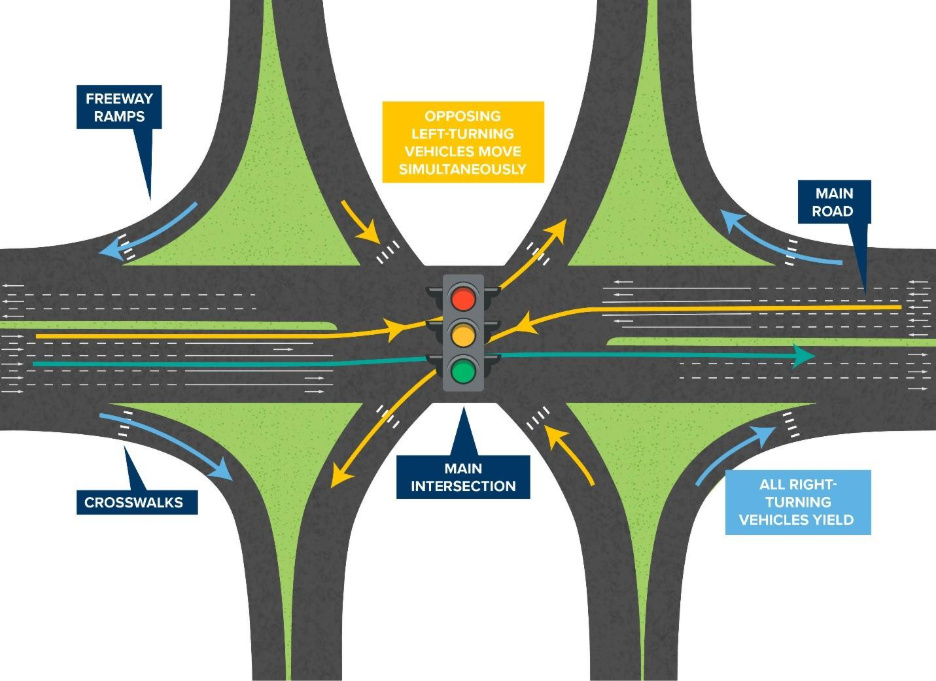
The Single Point Urban Interchange (SPUI) is a variant of the standard diamond interchange and was first constructed in 1970 to improve traffic capacity and operations while requiring less right-of-way than the traditional diamond interchange. A SPUI is a grade-separated interchange design where all freeway ramps begin or end at a single signalized intersection on the arterial.
The design allows for left-turning vehicles coming from opposing directions to turn simultaneously, without crossing paths. This enhances safety by reducing the number of places where vehicles cross paths and improves efficiency by allowing more vehicles to drive through the intersection during a signal cycle. Right-turn movements onto and off the freeway ramps are guided by stop or yield signs, away from the main intersection. A SPUI can be designed with the freeway passing over or under the intersection. Pedestrians use marked crosswalks to safely cross the freeway ramps, and bicyclists may use pedestrian paths or follow the flow of traffic.
Locations
A SPUI design is effective for interchange locations with:
- Heavy left-turning traffic volumes
- Limited right-of-way
- A need for increased vehicle capacity
INDOT has several Single Point Urban Interchanges built and operational statewide. Some of the notable ones are:
- I-70 at US 27/Chester Blvd in Wayne County
- I-465 at Allisonville Road in Marion County
- I-465 at Emerson Avenue in Marion County
Benefits
- Improved safety: Vehicles cross paths at only one signalized intersection rather than two at a conventional diamond interchange, which reduces the risk of potential vehicle crashes.
- Increased efficiency: The traffic signal at a SPUI operates in three phases as opposed to four phases at conventional interchanges, which increases available green time and reduces overall interchange delay. Dual turning lanes and more gradual turns also allow for higher left turn throughput, and more space for large vehicles to navigate.
- Reduced right-of-way impacts: SPUIs have a smaller footprint than conventional interchanges, which reduces the impact on nearby businesses and residences.