This page provides an overview of the Dynamic Wireless Power Transfer project, featuring the project timeline, frequently asked questions, and contact details.
Project Overview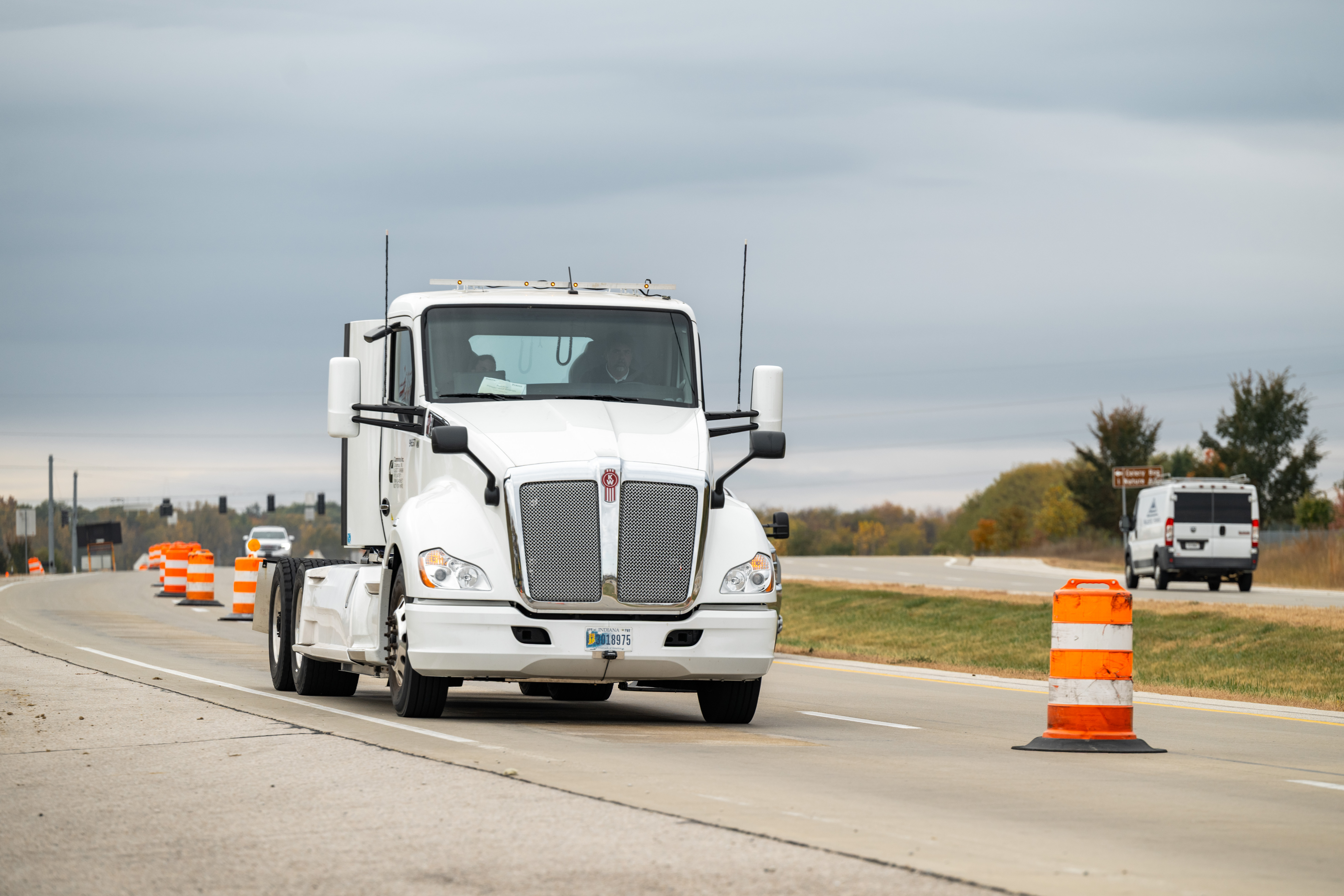
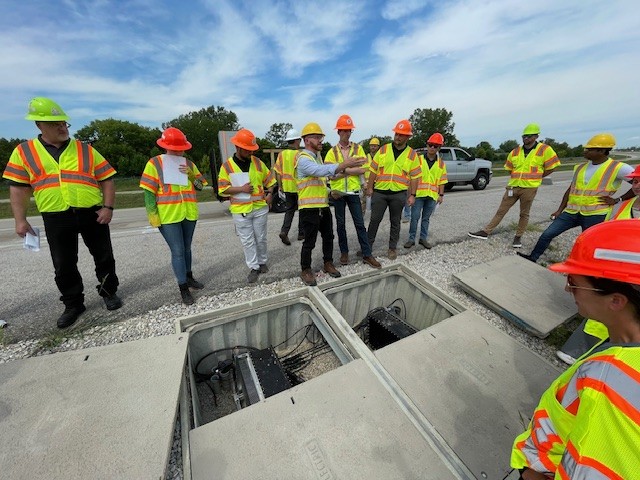 INDOT, in partnership with (ASPIRE), is supporting Purdue University and the Joint Transportation Research Program (JTRP) has engineered a roadway testbed that's one of the first of its kind - a dynamic (in-motion) wireless power transfer technology (DWPT) to deliver power to vehicles while in motion - even a loaded semi truck!
The project began in 2018 and has gone through multiple levels of research and study. This includes assessing the technical and financial feasibility of electric roadways in Indiana, designing a DWPT testbed and understanding of the interaction between the embedded DWPT system and the pavement structure.
The results of the project could unlock opportunities to deliver high power to longer stretches of pavement at highway speeds and equip electric vehicles (EVs) to receive that power.
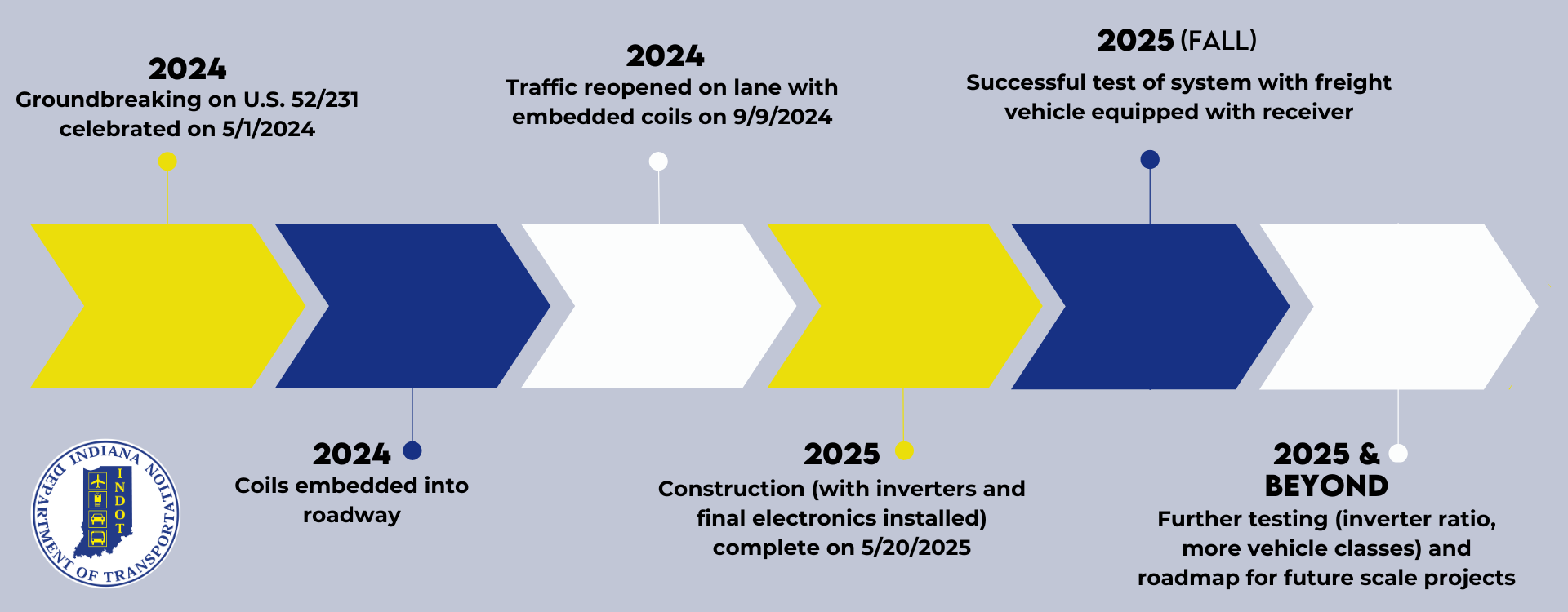
In spring 2024, construction began on a quarter-mile testbed to provide power to heavy-duty trucks on U.S. 52/231 in West Lafayette. Construction was completed and the full roadway was reopened to traffic for the following winter. Testing resumed, culminating with actual high-level power delivery on the testbed to a battery electric vehicle equipped with the system’s receiver and travelling at 65 mph!
For this project, Purdue researchers are focusing first on testing how well the technology transfers power to electric trucks. Electric freight vehicles are more limited than smaller EVs in travel range due to the size and weight of their batteries. If electric trucks could charge using highways, their batteries could be reduced in size, allowing them to carry more freight, significantly reducing costs, and potentially - increasing profits.
Charging EV's like Smartphones?
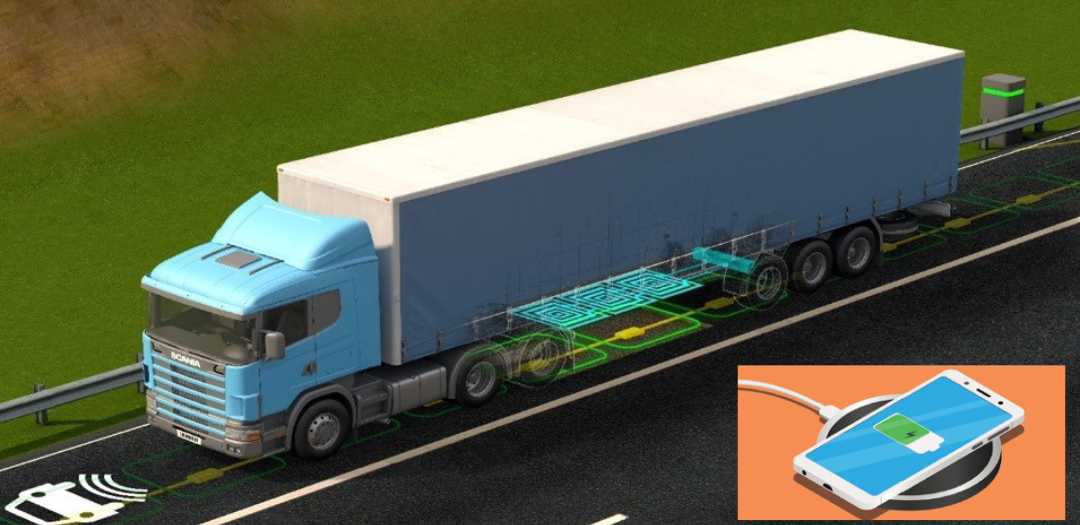 The technology used in the DWPT project would enable the pavement to provide power to EVs similarly to how
 newer smartphones use magnetic fields to wirelessly charge when placed on a charging pad.
“If you have a cellphone and you place it on a charger, there is what’s called magnetic fields that are coming up from the charger into that phone. We’re doing something similar,” said Steve Pekarek, Professor of Electrical and Computer Engineering at Purdue University, in an episode of “American Innovators.” The only thing that’s different is the power levels are higher, and you’re going out across a large distance from the roadway to the vehicle. This is a simple solution. There are complicated parts of it, and that we leave to the vehicle manufacturers.”
Project Documents
Project Timeline
DWPT in the News
Research in Indiana lays groundwork for highways that recharge EVs of all sizes across the nation.
Highway segment in West Lafayette becomes the first to wirelessly power an electric heavy-duty truck in motion.
George McCue, INDOT Emerging Mobility Assistant Director at the Indiana Department of Transportation, and Dr. Steven Pekarek, Professor of Electrical and Computer Engineering at Purdue University, discuss DWPT, the science behind the project, partnerships, and what it could mean for the future of EVs.
A team of Purdue University researchers has received the Technology Innovation Award at the 2025 IEEE PES Energy and Policy Forum Innovation Showcase for their work on Dynamic Wireless Power Transfer (DWPT). The technology allows electric vehicles to receive power directly from the roadway while in motion, potentially transforming how we approach charging electric vehicles (EVs).
The lack of easily accessed electric vehicle charging systems and the accompanying “range anxiety” that your battery might be depleted before you reach your destination are some of the greatest roadblocks to widespread adoption of EVs. But what if there was a way to recharge your EV that was not only as easy as refueling your gas-powered vehicle, but in fact even easier?
At the “Crossroads of America,” Purdue University engineers and the Indiana Department of Transportation (INDOT) are working to make it possible for electric vehicles ranging from tractor-trailers to passenger cars to wirelessly charge while driving on highways.
Electric vehicles are taking up an increasing percentage of the overall auto market share every year — rising from 4% in 2020 to 14% in 2024. Among the holdouts, a lack of charging infrastructure seems to be one of consumers' most common reasons for not switching from gas to electric vehicles.
Frequently Asked Questions
Dynamic Wireless Power Transfer refers to a means of sending power to electric vehicles as they move without using any electrical connection (wires). The power is sent from transmitter coils buried within the roadway and delivered to a receiver coil placed at the underside of the vehicle. The power is intended to mainly be used by the vehicle’s propulsion drive to move the vehicle. It can also be used to charge the battery. If placed appropriately, DWPT has the potential to greatly reduce the size of the battery in electric vehicles (EVs), and thus cost. It also has the potential to provide a strong return on investment for those who put forth the capital to install and use an electrified roadway.
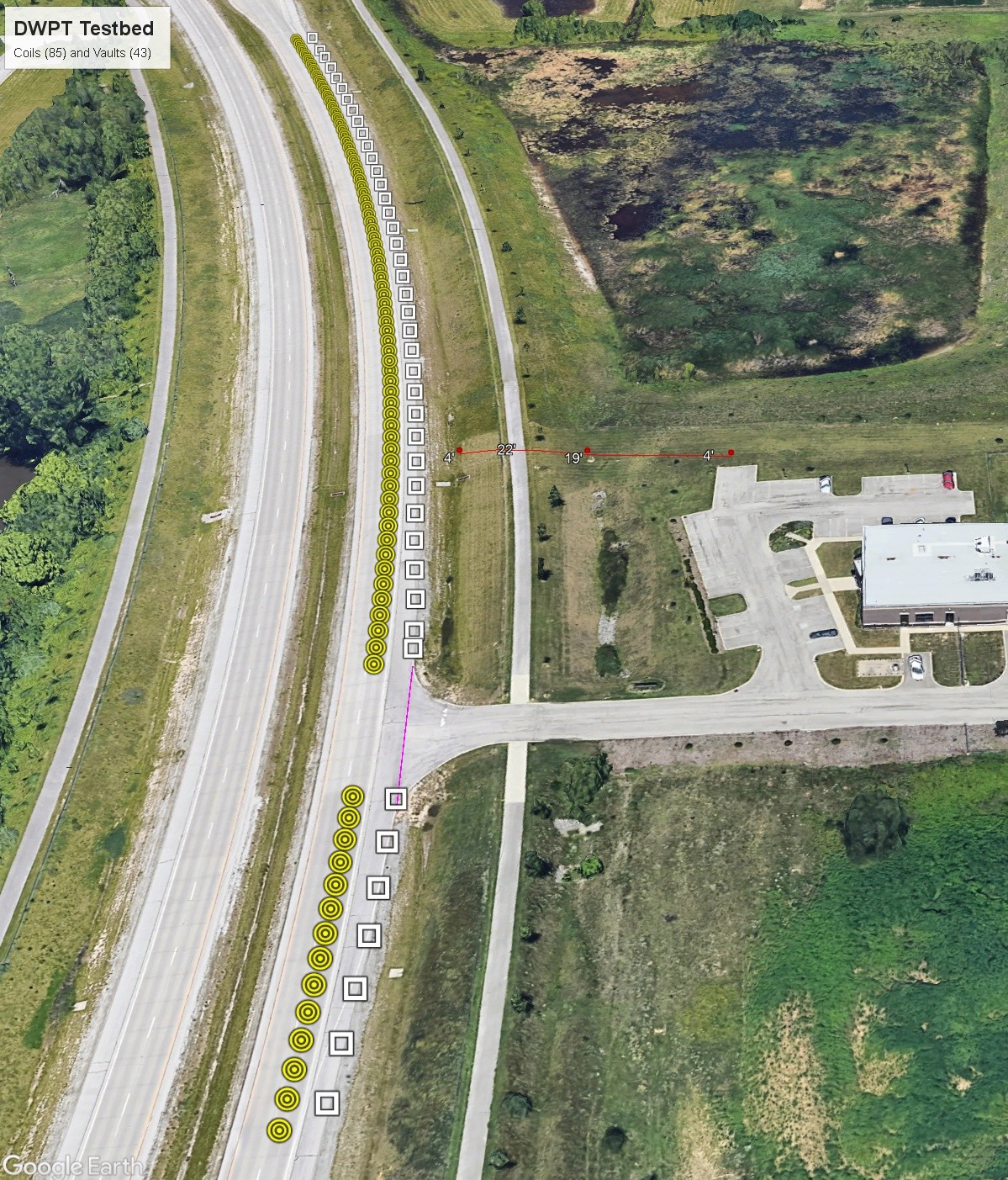
The Purdue–INDOT pilot is the first U.S. highway project designed to demonstrate DWPT at the high-power levels required to operate heavy-duty vehicles (Class 8 trucks) at highway speeds. A section of the northbound lane of US-52/231 west of the Purdue University campus has 85 transmitter coils embedded roughly 2.5” beneath the pavement surface. These coils are energized by the team while they are performing tests. We utilize test vehicles retrofitted with a receiver that can receive power while driving. The tests are helping to evaluate practical questions surrounding electrified roadways such as:
- How to optimally construct and maintain
- How does the pavement and equipment behave under the construction stages, seasonal environmental changes, and a host of traffic loads
- How do test vehicles perform over a range of vehicle speeds and commanded power levels, etc.
Beneath the surface of the roadway are 85 specially designed transmitter coils that receive their power from electronics placed within vaults at the side of the road. When the roadway is undergoing testing and a vehicle with a receiver drives over a transmitter coil, the transmitter coil energizes. A temporary magnetic field forms in the space between the transmitter coil and the receiver coil. The electrons within the vehicle receiver coil responds to the magnetic field which allows power to be delivered to the vehicle propulsion and battery systems.
The power level of the roadway was selected to serve a wide range of vehicles classes (from light to heavy duty) including semi-trucks. To be clear, only vehicles retrofitted with a receiver can trigger the turn-on of transmitter coils, and this can only occur when during roadway testing is being performed. During testing, the roadway section embedded with transmitters is closed to non-test vehicles.
If you drive a regular, non-equipped vehicle over the electrified lane, the roadway will be in a completely de-energized state. The transmitters will not turn on; you will not receive any power, and your vehicle will behave exactly as it does on any roadway. Only authorized, equipped vehicles can interact.
Modern DWPT systems are engineered to be highly efficient across a wide range of operating conditions. Within the Purdue – INDOT testbed, we have measured end-to-end efficiency — from the DC bus of the roadway inverters to the DC bus of the vehicle — of approximately 85% at rated power. Importantly, this efficiency does not depend on vehicle speed. The wireless power transfer process is governed by electromagnetic coupling and power electronics control, not by how fast the vehicle is moving. In more recent demonstrations including testing at an outdoor track at Utah State University and in controlled laboratory environments, even higher efficiencies have been achieved under comparable coil separation and power levels.
We are often asked about battery charging rates. The system’s goal is, at minimum, a vehicle will maintain its state of charge when on the roadway. The roadway will provide the necessary energy to power the drivetrain to keep the vehicle moving, so energy from the battery is not needed. In the event that a battery enters the roadway and the battery needs charging, the roadway can supply the difference between the rated roadway power (~200 kW) and the power being used by the propulsion drive.
Power vs. Energy: A common misconception about DWPT is that a vehicle must travel over transmitter coils for some minimum distance before it can “receive the full power” of the roadway. This is not correct.
Power is an instantaneous measure of the rate at which energy is transferred. In contrast, energy is the quantity accumulated over time. While power is typically expressed in kilowatts (kW), battery energy is measured in kilowatt-hours (kWh), which represents power delivered over a finite duration.
When an equipped vehicle is above an active transmitter, the roadway immediately delivers its rated power level. The amount of energy transferred depends on how long the receiver remains over the transmitter, not on any required minimum distance to “unlock” the power.
In practical operation, DWPT roadways are designed so that most or all of the roadway power is used directly by the vehicle’s electric drivetrain to maintain speed. That would result in no net power flow into or out of the battery while driving. If excess roadway power is available beyond what the propulsion system requires, that surplus can be used to slowly charge the battery (as opposed to rapidly charging it).
For the current Purdue–INDOT test vehicles, the lowest point of the receiver hardware is approximately 8 inches above the ground, which is consistent with the underbody clearance of many heavy-duty vehicles. The receiver coils themselves are positioned higher than the lowest hardware, with a typical separation distance of approximately 10–11 inches between the roadway transmitter coils and the vehicle receiver coils.
This spacing allows the system to operate efficiently while maintaining sufficient ground clearance for normal vehicle operation, suspension travel, and road-way irregularities. Receiver configuration is vehicle-specific, and future commercial designs can be adapted to different vehicle classes while preserving the required clearance.
No. The power delivered by the DWPT roadway is not limited by vehicle speed. When a vehicle is positioned over an active transmitter coil, the roadway can de-liver its rated power immediately, independent of whether the vehicle is moving slowly, traveling at highway speed, or stopped.
Vehicle speed only affects the total energy received over a given roadway length, not the instantaneous power level. At lower speeds, the receiver simply remains over each transmitter coil for a longer duration, which can actually increase the total energy transferred over that segment of roadway.
In the existing pilot, the power is provided by a portable battery system. When the technology advances to commercial application, we expect DWPT will help smooth vehicle charging demands by spreading energy use along a route rather than concentrating it at individual high-power charging locations. A goal of the DWPT pilot is to collect real operational data so grid planners can accurately assess future deployment scenarios.
DWPT infrastructure includes coils, conduits, sensors, and power electronics; so it has a higher upfront cost compared with a conventional pavement section. Pilot projects such as the Purdue–INDOT demonstration are supported through a partnership of transportation agencies, research institutions, federal programs, and private industry partners. The project aims to assess the true construction and maintenance costs, and then compare DWPT with alternatives such as installing additional fast chargers, increased EV battery sizes, battery swapping, etc.
Yes. DWPT systems are designed to meet strict electrical safety standards. When energized, the magnetic fields are well below established exposure limits for people and animals. In addition, there is no risk of electric shock from the roadway surface, even during rain or snow, because there is no direct electrical contact. Medical implants such as pacemakers, smartphones, and vehicle electronics will not be affected. The system remains de-energized when not in use and can be shut down rapidly.
The pilot is studying how the technology performs under real midwestern weather conditions. Pavement design and testing evaluate structural performance under traffic loads, freeze–thaw cycles, snow plowing, resurfacing operations, and the maintainability of embedded components. Understanding pavement durability and long-term maintenance requirements is a core research objective of the project.
For everyday drivers, the road functions like any other highway. The electrified lane is not continuously energized; it is powered only during scheduled testing. No special actions are required from the public, and the roadway can be used as normal.
The pilot is designed to gather data on achievable power levels, efficiency at speed, durability and maintainability of embedded pavement systems, construction and operating costs, vehicle performance, and the long-term feasibility of expanding DWPT technology. Findings will be shared publicly, and these results will help guide future standards, inform vehicle and infrastructure designs, and support decisions about the potential expansion of electrified roadway corridors.
Contact Us