A Quadrant Roadway intersection is a type of intersection in which some, or all left turning movements are made using a connector roadway and two sub-intersections. Left turning traff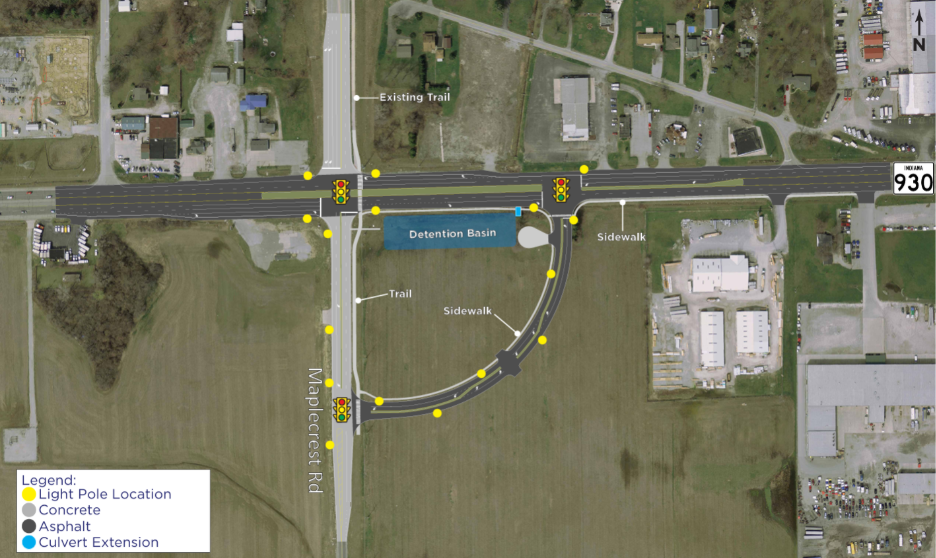 ic is rerouted to the connector roadway and sub-intersections, which eliminates the need for dedicated signal time for left turns at the main traffic signal. The main intersection still serves thru- and right-turning traffic normally. The main intersection and sub-intersections are signalized and operate in a coordinated manner. The sub-intersections are T-intersections, which improves their operational efficiency as fewer movements must be served.
Some quadrant roadway intersections replace the at-grade main intersection with a grade-separation, eliminating the need for a traffic signal at that location. This is common at several locations in Indiana where one of the roadways parallels a railroad, and a bridge is constructed that carries the crossroad over both roadways.
Intersections of this type are common and have performed well in other states including Ohio, Michigan, Georgia, and North Carolina. Quadrant roadway intersections reduce delay at high-volume locations by rerouting left turning traffic to the connector roadway. This eliminates the additional time necessary to accommodate left turns at a traditional intersection. The quadrant roadway provides reduced delay and improved operation at high volume intersections and can often be achieved for lower cost and impact when compared with a grade-separated interchange. Additionally, a quadrant roadway has 30 conflict points where crashes could occur, in comparison with 32 conflict points at a traditional intersection. This helps to improve safety by reducing the potential for crashes when compared with a traditional intersection.
INDOT has several quadrant roadway intersections constructed, and several more in various phases of project development. INDOT’s policy is to use innovative intersections, including the quadrant roadway, where appropriate to support its ongoing commitment to improve safety and operational efficiency through innovation and cost-effective investments.