Demographics of Yorktown, Indiana
Yorktown is a thriving community with a balanced mix of families, professionals, and long-term residents. Its demographic profile reflects a stable and growing town where residents enjoy strong community connections, high educational attainment, and quality of life.
Explore Yorktown’s Demographic Data
Additional demographic, housing, income, education, and population information is available through these public resources:
- U.S. Census Bureau QuickFacts: Yorktown, Indiana
A concise overview of Yorktown’s population, housing, education, income, transportation, and other community statistics. - Explore Census Data
Search detailed American Community Survey and decennial census tables. Enter “Yorktown town, Indiana” to ensure the results reflect the incorporated town. - STATS Indiana
Indiana’s public data utility, maintained by the Indiana Business Research Center at Indiana University’s Kelley School of Business, provides population, workforce, income, housing, and economic information. - Data USA: Yorktown, Indiana
Interactive charts covering Yorktown’s population, employment, housing, income, education, transportation, and health data. Data USA currently reports the same Census-derived homeownership, home value, income, and population measures used above.
Population
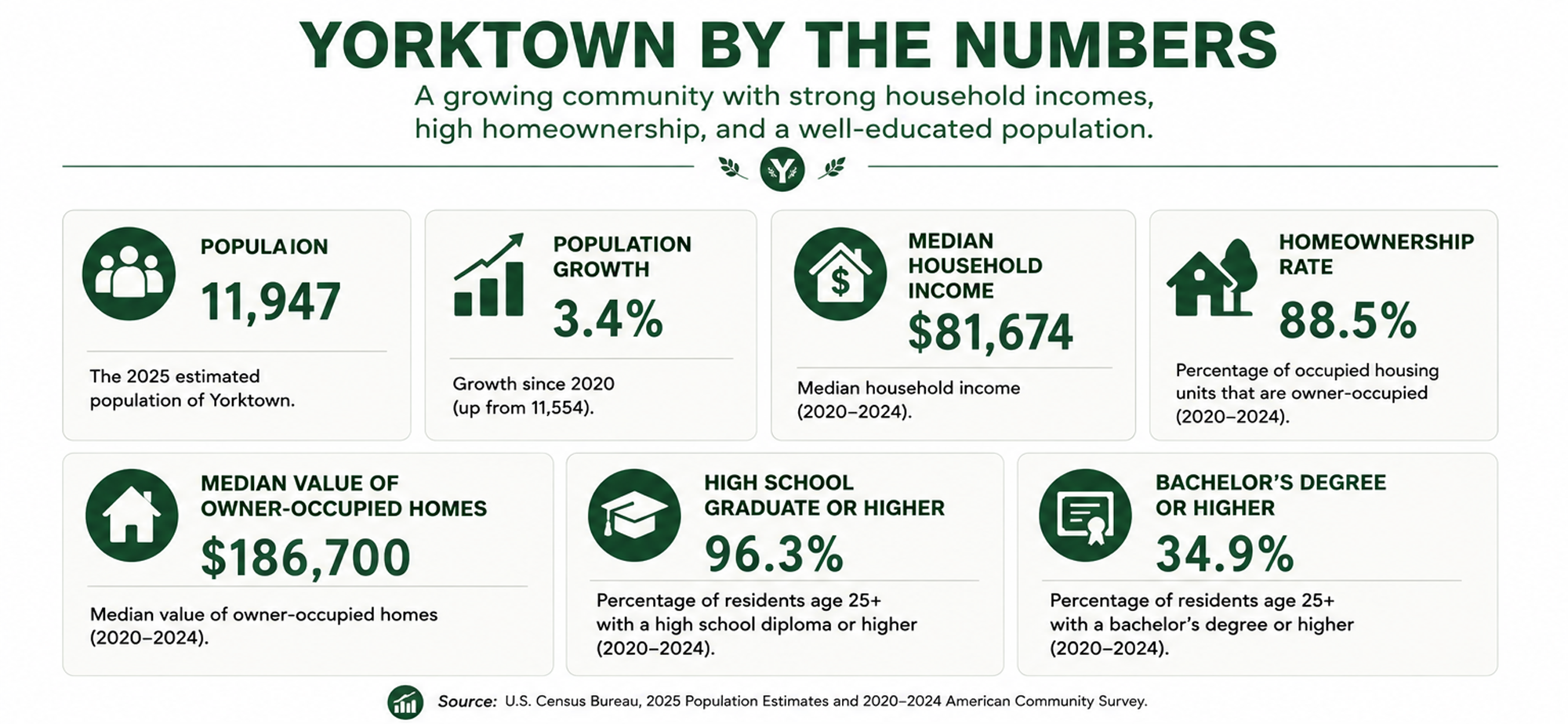
- Population: Approximately 11,947 residents live in Yorktown, and it continues to grow steadily year-to-year.
- Growth: Since 2020, the population increased modestly by 3.4%, reflecting ongoing residential stability and appeal.
Age & Households
- Median age: About 41 years, indicating a mature community with a blend of young families, established professionals, and older adults.
- Household size: Average household size aligns with regional norms, with many households made up of families and couples.
Diversity
Yorktown’s population is predominantly White, with residents identifying with multiple racial and ethnic backgrounds:
- White: Around 92–93% of the population.
- Two or more races: Approximately 4–5%.
- Asian and other races: Smaller but meaningful representation of Asian, African American, and other backgrounds.
- English is the primary language spoken at home for most residents.
Income & Economic Status
- Median household income: About $81,765, significantly higher than many regional averages.
- Per capita income: Reflects a strong economic base for a town of Yorktown’s size.
- Poverty rate: Relatively low, with only a small percentage of residents living below the poverty line.
Education & Workforce
Yorktown residents enjoy high levels of educational achievement and steady labor force participation:
- A large majority of adults have completed high school or higher education, and a notable share hold college degrees.
- The town’s workforce reports average commute times consistent with small-town living and regional job markets.
Housing & Living
- Homeownership: Strong homeownership is a hallmark of Yorktown, with a high percentage of occupied owner-occupied housing units.
- Housing value: Median home values reflect Yorktown’s desirability as a residential community within the region.
Community Snapshot
Yorktown’s demographic profile paints a picture of a growing, stable town with:
- A balanced age distribution that supports schools, families, and active adult lifestyles.
- A strong sense of community identity and economic resilience.
- A town where residents enjoy both a high quality of life and a welcoming, small-town environment.