What is the Lactation After Loss Program?
Lactation After Loss (LAL) is a program from the Indiana Department of Health (IDOH) to support families and healthcare providers.
The program goals include:
1. Educating parents about lactation options after a loss due to miscarriage (16-weeks gestation or later), stillbirth, or infant loss
2. Educating providers to increase knowledge surrounding lactation options after a loss and comfortability in having these conversations with families
3. Providing support regarding lactation to grieving mothers
What comes in a Lactation After Loss kit?
A Lactation After Loss kit comes with a variety of items that will help mom with whatever she decides to do with her milk supply. Whether that is donating her milk in honor of her baby or drying up her supply, our lactation kits will give mom the tools she needs. Kits include education about options for families, a breast pump to help with expression or comfort during suppression and pumping supplies.
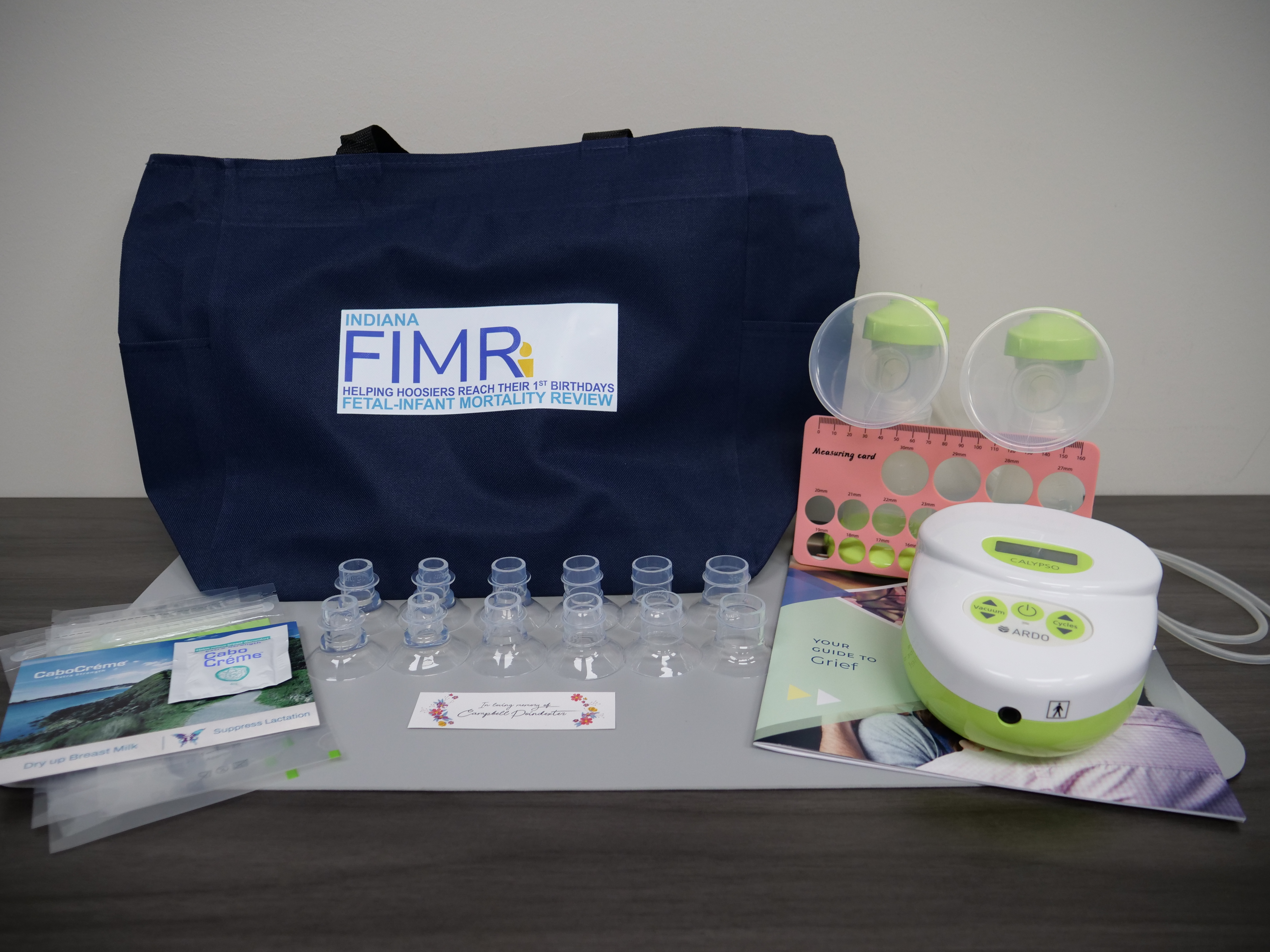
Also in the kits are resource folders that include the booklet “Your Guide to Grief,” a letter from a mom who has experienced a loss, a nipple measuring guide, a sample of CaboCrème to assist with engorgement, information about the program and how to take care of yourself after a loss, as well as a sympathy card. The resource folders are available to all families experiencing a loss, whether they decide to take an entire kit.

Meet the Poindexter Family
Lactation After Loss was developed after hearing from the Poindexter Family about their experience losing their daughter Campbell. The family was contacted by their local Fetal Infant Mortality Review (FIMR) Coordinator for a family interview and asked what could be done to improve the care families receive after losing a child to late term miscarriage, stillbirth, or infant death. Annabelle, Campbell’s mom, said that she did not expect her body to lactate after her loss and that it would have been helpful to know what to expect with her milk supply and about resources available once her supply came in. From that interview, Lactation After Loss was developed.
After their loss, Annabelle became a milk donor with The Milk Bank – helping save infant lives. Click here to learn more about The Milk Bank’s bereavement program and to listen to Annabelle and Logan courageously share their daughter Campbell’s story.
- Letter of Hope by Annabelle Poindexter

What are the options available to moms?
Whatever decision you make, is the right decision. Here are some options to consider when deciding what to do with your milk supply.
1. Dry up your milk supply. If you choose to suppress your milk and not lactate it is suggested that you wear a well-fitting sports bra (tight binding is not recommended), apply cold compresses to your breasts, or place cold cabbage leaves around your breasts to reduce inflammation and discomfort. You should try not to express milk, because that will prolong the time it takes to dry up your supply. If you must express milk for comfort, you should do it for only a few minutes – just enough to feel some relief.
2. Donate your milk in honor of your baby. It is important when choosing this option that you pump and store the milk correctly. (See FAQs on the correct way to store milk)
Connect with The Milk Bank to start this process. Click here to be taken to The Milk Bank’s site.
Drying Up Supply:
| Dos | Don'ts |
|---|---|
| Do only express milk if you feel discomfort | Don't bind your breasts tightly - this can cause mastitis (an infection) that can be painful. If you think you have developed an infection, reach out to your doctor |
| Do apply a cold compress to reduce swelling | |
| Do have good breast support, try a comfortable and supportive bra | |
| Do insert washcloths or breast pads in your bra to catch leaking milk | |
| Do reach out to The Milk Bank for help drying up your supply |
Donating Your milk:
| Dos | Don'ts |
|---|---|
| Do reach out to The Milk Bank to discuss how to start the process of milk donation | Don’t feel obligated to donate once you have a conversation with The Milk Bank. You may decide that milk donation is not the best option for you or your family once you have more information, and that is okay. Do know that we want you to make the best choice for you |
| Do start hand expressing or pumping and storing your milk | |
| Do know that the more often you hand express or pump, the more milk you are likely to produce |
Family Resources:
- Guide to Grief
- About LAL: English | Spanish | French | Arabic | Burmese | Korean
- Measuring Guide: English | Spanish | French | Arabic | Burmese | Korean
- Letter to our loss families, by Annabelle Poindexter
- Family Letter
Frequently Asked Questions
Have a question that you think would be helpful to add here? Email IDOHFIMR@health.in.gov
Just email us at IDOHFIMR@health.in.gov
The kit is completely free to families that have experienced a loss. We want to ensure that every grieving family has access to a breast pump and other supplies so they can make the decision of what to do with mom’s milk supply that is best for them.
Avoid Stimulation: Try not to pump. Hand express only to relieve pain/engorgement. Avoid water in the shower hitting your breasts directly or other stimulation.
Provide Gentle Compression: Wear a tight (but not painful) sports bra or other supportive bra. Some women use cold cabbage leaves placed inside the bra (changing every few hours) for comfort and help with swelling/inflammation.
Use Cold Therapy for Swelling: Use of cold compresses or ice packs for 15-20 minutes every few hours can help reduce engorgement and discomfort. Avoid heat – it can increase inflammation.
Pain Management: Ibuprofen or acetaminophen can help with discomfort. Consult your healthcare provider about this. If pain is severe, contact a healthcare professional and have them check for infection.
Watch for Complications: Watch for signs of breast infection (mastitis): pain, swelling, fever, an area of the breast that may appear red on some skin tones, and worsening pain. If you notice these things, seek help from your healthcare provider quickly.
Please reach out to The Milk Bank at 317-536-1670 or via their website to discuss what milk donation in honor of your baby looks like.
You can find many businesses that create different styles of breastmilk jewelry online.
Find more information here Know Your Rights
You may still be eligible for Women, Infants, and Children (WIC) benefits, including lactation support, for up to six months after your delivery.
Please reach out with any questions: 1-800-522-0874 or find your local WIC clinic at wic.in.gov
Please call 988 to reach the Suicide & Crisis Lifeline and speak with a trained crisis specialist 24/7. Visit 988indiana.org.
You can find support in different places. Here are a few:
- Postpartum Support International offers 24/7 support options that can be found on their website, or you can call their hotline at 1-800-944-4773 (4PPD)
- Health Resources and Services Administration (HRSA) Maternal Mental Health Hotline – Call or text 1-833-TLC-MAMA (1-833-852-6262)
- Or reach out to grief@health.in.gov and we will do our best to connect you with resources in your area.
Countertop Encimera o mesa ≤ 77 °F (25 °C) | Refrigerator Refrigerador ≤ 40 °F (4 °C) | Freezer Congelador ≤ 0 °F (-18 °C) | |
|---|---|---|---|
| Fresh Leche fresca | Up to 4 hours Hasta 4 Horas | Up to 4 Days Hasta 4 Días | Within 6 months is best. Up to 12 months is acceptable. |
| Thawed Leche descongelada | 1-2 Hours 1 a 2 Horas | Up to 1 Day (24 hours) Hasta 1 Día (24 horas) | NEVER refreeze breastmilk that has already been thawed. NUNCA se vuelva a congelar la leche materna que ya fue descongelada. |
Our Partners