Digital delivery in transportation refers to a model-based project delivery method that replaces traditional 2D paper plans with 3D-engineered models and structured data as the primary source of truth throughout the project lifecycle. Instead of static PDFs, contractors, designers, and inspectors work from integrated digital models that include geometry, attributes, and linked documentation. This approach enables:
- Improved design quality and visualization (e.g., seeing road and bridge designs together in 3D).
- Better collaboration and communication across design, construction, and asset management.
- Reduced change orders and RFIs, lowering project costs and delays.
- Enhanced asset management through digital as-builts and lifecycle data integration.
- Data-driven decision-making and automation for quantity takeoffs, cost estimation, and GIS integration.
CLICK HERE TO SUBMIT FEEDBACK ABOUT DIGITAL DELIVERY
- What is Digital Delivery?
Digital Delivery is a transition from paper/PDF plans to 3D model-based designs as the legal document (Model as a Legal Document – MALD). It includes digital data for design, construction, and asset management.
- Why are DOTs adopting Digital Delivery?
- Enhance collaboration and communication.
- Improve design accuracy and quality.
- Reduce RFIs and change orders.
- What are the benefits?
- Design Phase: Better visualization, clash detection, and cost estimation.
- Construction Phase: Streamlined workflows, machine control, and digital as-builts.
- Asset Management: Real-time updates, digital twins for predictive maintenance.
- Who is impacted?
- All disciplines: roadway, drainage, bridges, utilities, environmental, real estate, and construction teams.
- Contractors and consultants must adapt to new workflows and tools.
- How do I get involved?
- Use the feedback link for general correspondence to the digital delivery team on this webpage and provide your contact information
- Contribute via existing Indiana Transportation Team group (i.e. ACEC and ICI)
- Will Digital Delivery be mandatory?
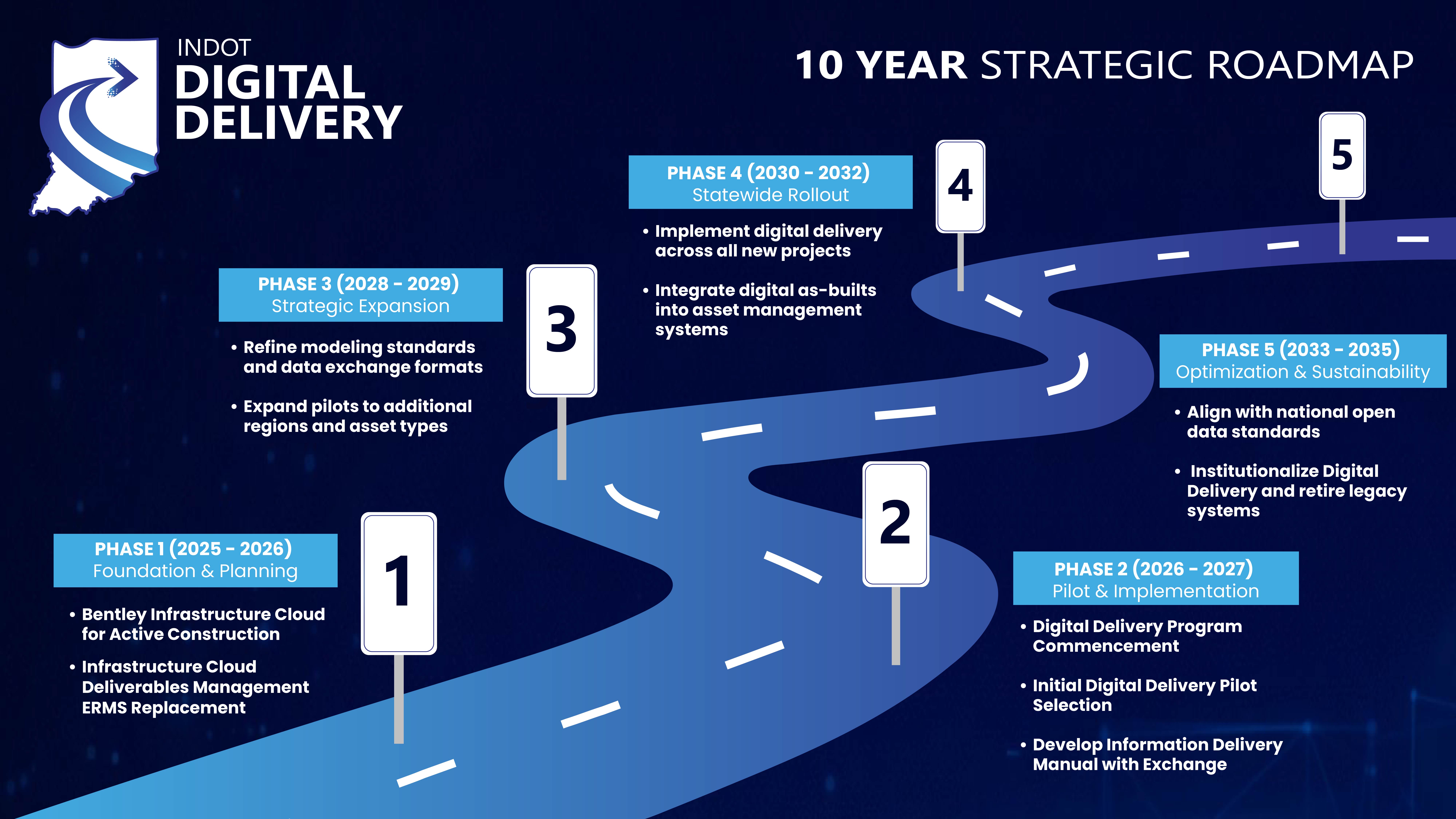
- Gradual implementation through pilot projects.
- Full adoption targeted by 2030–2035 for INDOT.
- What deliverables are required?
- PDF Plan sets will continue to be the legal document as model requirements are being developed
- Signed/sealed 3D model with file naming conventions and metadata standards.
- Data-rich item types for asset management.
- Open Data Standards such as IFC for interoperability.
- What tools and platforms are used?
- Bentley OpenRoads Designer, ProjectWise/Infrastructure Cloud, Synchro, AWP, HaulHub, and GIS integrations.
- Cloud-based collaboration environments for document, plans, and model review.
- How does Digital Delivery relate to Digital Twins?
- Digital twins provide real-time asset performance monitoring and predictive maintenance.
- Supports lifecycle management beyond construction.