Accountability Overview
Jump to SectionAccountability Overview
Grade 12 Deep Dive
Jump to SectionGrade 12 Deep Dive
Students with Significant Cognitive Disabilities
Students with Significant Cognitive DisabilitiesStudents with Significant Cognitive Disabilities
FAQ
Jump to SectionFAQ
Accountability Overview
511 IAC 6.2-12-44
School-Level A-F Letter Grade
A school's A-F letter grade is the weighted average of final scores across all applicable assessed grade spans, weighted by the count of eligible students in each grade span (or Grade 12 cohort count for the Grade 12 span).
Grade 3 accountability overview — Section 44(b)
Passing IREAD is the gateway indicator — students must pass it before additional Student Success Indicator points are unlocked.
| Academic Mastery | No IREAD pass | Newcomer EL, No IREAD pass, WIDA met | Passed IREAD, no additional Student Success Indicators | Passed IREAD + 1 or more Student Success Indicators |
|---|---|---|---|---|
| At or Above Expectations | 75 | 85 | 95 | 100 |
| Approaching Expectations | 65 | 75 | 85 | 95 |
| Below Expectations | 0 | 45 | 65 | 75 |
| Academic Mastery | Points |
|---|---|
| I AM — At Proficiency | 100 (all cases) |
| I AM — Approaching Proficiency | 75 (all cases) |
| I AM — Below Proficiency | 0 (all cases) |
Student Success Indicators — Grade 3
| Indicator | Definition |
|---|---|
| Reading Proficiency (IREAD) | Achieve a passing score on the IREAD by the end of grade 3, including the summer retest window. Gateway indicator — must be passed before other Student Success Indicator points are unlocked. A grade 2 passing score is banked and applied in grade 3. |
| Foundational Reading Growth (based on IREAD) | Student was designated off-track on IREAD in grade 2 and then achieves a passing score by the end of grade 3, including the summer retest window. |
| Regular School Attendance | Present for at least 94% of enrolled instructional days during the accountable year (Days Present ÷ Days Enrolled). |
| Meeting English-Language Proficiency Goal (WIDA) | Meet expected growth or reach language proficiency on the WIDA ACCESS assessment. Newcomer EL students may earn this indicator even without passing the IREAD. |
Grades 4–8 accountability overview — Section 44(c), (d), (e)
Eligible students with Academic Growth Rating
| Academic Mastery | 0 Student Success Indicators | 1 Student Success Indicators | 2 Student Success Indicators | 3+ Student Success Indicators |
|---|---|---|---|---|
| At or Above Expectations | 90 | 95 | 95 | 100 |
| Approaching Expectations | 45 | 65 | 80 | 90 |
| Below Expectations | 0 | 45 | 65 | 75 |
Eligible students without Academic Growth Rating
| Academic Mastery | 0 Student Success Indicators | 1 Student Success Indicators | 2 Student Success Indicators |
|---|---|---|---|
| At or Above Expectations | 90 | 95 | 100 |
| Approaching Expectations | 45 | 80 | 90 |
| Below Expectations | 0 | 65 | 75 |
I AM
| Mastery Level | Points |
|---|---|
| I AM - At Proficiency | 100 (all cases) |
| I AM - Approaching Proficiency | 75 (all cases) |
| I AM - Below Proficiency | 0 (all cases) |
Student Success Indicators — Grades 4–8
| Indicator | Definition |
|---|---|
| One Year of Academic Progress | Student Growth Percentile (SGP) of 45 or greater, calculated separately for ELA and math. |
| Accelerated Academic Progress | SGP of 65 or greater, calculated separately for ELA and math. |
| Excellence in Academic Progress | Student scored Approaching or Below Expectations on ILEARN and met their individual student growth target. |
| Regular School Attendance | Present for at least 94% of enrolled instructional days (Days Present ÷ Days Enrolled). |
| Adolescent Reading Proficiency (IREAD) | Student did not pass IREAD by end of grade 3 and later achieves a passing score in grades 4-6. |
| Proficiency in Science (ILEARN) (grades 4 and 6) | Achieve At Proficiency or above on the ILEARN Science assessment. |
| Proficiency in Social Studies (ILEARN) (grade 5) | Achieve At Proficiency or above on the ILEARN Social Studies assessment. |
| Completing a Graduation Plan (grade 7) | Complete the graduation plan described in IC 20-30-4 by the end of the school year, with written parent or guardian approval. |
| High School-Level Coursework/Credit (grade 8) | Complete 2 credits of approved Indiana Diploma coursework with a grade of "C" or higher. Can be earned any time from grade 7 through the summer after grade 8. |
| Meeting English-Language Proficiency Goal (WIDA) | Meet expected growth or reach language proficiency on the WIDA ACCESS assessment. |
Grade 10 accountability overview — Section 44(f)
Academic Mastery for Grade 10 is based on 9th Grade on Track
9th Grade On Track — What It Means
- Being “On Track” means a student has earned enough key high‑school credits by the end of 9th grade to stay on pace for graduation.
- Another path to meet expectations:
- If a student isn’t on track after Grade 9, they can still reach “At Expectations” by earning 20+ high school credits by the end of Grade 10.
| 9th Grade on Track Status | 0 Student Success Indicators | 1 Student Success Indicators | 2 Student Success Indicators | 3+ Student Success Indicators |
|---|---|---|---|---|
| Above Expectations (14+ credits, including at least 2 ELA, 2 Math, and 2 Science, Social Studies, or Foreign Language credits) | 75 | 85 | 95 | 100 |
| At Expectations (10–13 credits with the same credit requirements as above, or back on track by end of Grade 10 with 20+ credits including 4 ELA, 4 Math, and 4 Science, Social Studies, or Foreign Language credits) | 65 | 75 | 85 | 95 |
| Below Expectations (fewer than 10 credits, or does not meet ELA, Math, Science, Social Studies, or Foreign Language credit requirements†) | 0 | 25 | 55 | 65 |
†Or failed to meet directed core-credit requirements.
Student Success Indicators — Grade 10
| Indicator | Definition |
|---|---|
| College & Career Coursework | Complete two credits of dual credit, AP, IB, or Cambridge International with a grade of C or higher by end of grade 10; or complete two credits worth of CTE Principles or above coursework with a grade of C or higher by end of grade 10. |
| Advanced CTE Coursework | Complete at least three non-duplicative CTE courses (excluding introductory level), including at least one advanced CTE course (e.g., concentrator or capstone), with a grade of C or higher by end of grade 10. |
| Proficiency on ILEARN Biology End of Course Assessment (ECA) | Achieve at-proficiency or above on the ILEARN Biology ECA. |
| Meet Benchmark on PSAT/NMSQT | Achieve the aggregate national college-ready benchmark on the PSAT/NMSQT. Only the 10th grade NMSQT administration is used. |
| Regular School Attendance | Present for at least 94% of enrolled instructional days in grade 9 or grade 10. Met at either grade counts. |
| Meeting English-Language Proficiency Goal (WIDA) | Meet expected growth or reach language proficiency on the WIDA ACCESS assessment in grade 9 or grade 10. Met at either grade counts. |
For school leaders: High school credits earned in middle school (grades 7 or 8) that appear on the high school transcript count toward the grade 9 credit total.
Grade 12 accountability overview — Section 44(g) and (h)
The Grade 12 final numeric rating combines three weighted components:
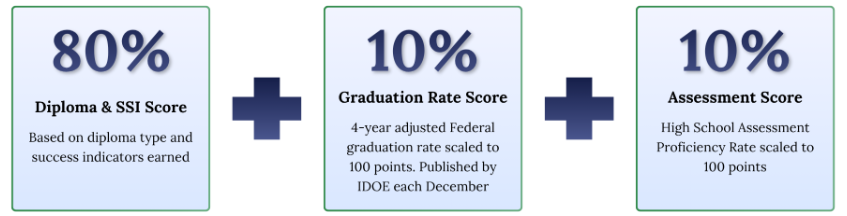
Student Success Indicators — Grade 12
| Indicator | Definition |
|---|---|
| Work-Based Learning | Complete 150 hours of work-based learning (up to 3 qualifying WBL experiences). Reported via InTERS. |
| Credential of Value | Earn an IDOE-approved industry-recognized or postsecondary credential. Only credentials approved for the Enrollment Honors Plus or Employment Honors Seal qualify. |
| College & Career Coursework | Complete at least one college and career course requirement outlined in 511 IAC 6-7.2-21(b)(1)(G) — includes dual credit, AP, IB, Cambridge International. |
| Proficiency on ILEARN U.S. Government ECA | Achieve a passing score on the U.S. Government course final exam at any point prior to graduation. |
| Regular School Attendance | Present for at least 94% of enrolled instructional days in grade 11 or grade 12. Met at either grade counts. |
| Proficiency on ILEARN Biology End of Course Assessment (ECA) | Achieve at-proficiency or above on the ILEARN Biology ECA. |
| Meet English Benchmark on ACT or CLT | Achieve the college-ready benchmark on the English section of the ACT or verbal reasoning section of the CLT. |
| Meet Mathematics Benchmark on ACT, or CLT | Achieve the college-ready benchmark on the math section of the ACT or quantitative reasoning section of the CLT. |
| Meeting English-Language Proficiency Goal (WIDA) | Meet expected growth or reach language proficiency on the WIDA Consortium ACCESS assessment in grade 11 or grade 12. |
See the Grade 12 Deep Dive tab for the full diploma/Student Success Indicators point matrices covering both the transition period (2025-2026 through 2028-2029) and the permanent model (2029-2030 and beyond).
Grade 12 Deep Dive
511 IAC 6.2-12-44(g) and (h)
Transition Period and Permanent Model
The transition period applies for 2025-2026 through 2028-2029, accommodating the shift from Core 40 diplomas to the new Indiana Diploma structure.
The permanent model takes effect beginning with the 2029-2030 accountability year.
Diploma/Student Success Indicators Point Matrix — All Diploma Types
| Diploma Category | 0 Student Success Indicators | 1 Student Success Indicators | 2 Student Success Indicators | 3+ Student Success Indicators |
|---|---|---|---|---|
| Enrollment, Enlistment, Employment Honors Plus Seals | — | — | 95 | 100 |
| Enrollment, Enlistment, Employment Honors Seals | — | 75 | 85 | 90 |
| Indiana Diploma, No Seal / Alternate Diploma | 50 | 65 | 75 | 85 |
Legacy Core 40 Diplomas — Transition Period Only (2025-2026 through 2028-2029)
| Diploma Category | 0 Student Success Indicators | 1 Student Success Indicators | 2 Students Success Indicators | 3+ Student Success Indicators |
|---|---|---|---|---|
| Core 40 with Academic or Technical Honors | — | 75 | 85 | 100 |
| Core 40 | 55 | 65 | 75 | 85 |
| General Diploma / Alternate Diploma | 25 | 55 | 65 | 75 |
Students with Significant Cognitive Disabilities
This section covers how I AM alternate assessment results for Students with Significant Cognitive Disabilities flow into the accountability calculation at each grade span.
I AM Alternate Assessment (Grades 3 and 4–8)
Students with an IEP who take the I AM are included in the accountability calculation through a dedicated scoring table, not the standard Academic Mastery grid. Their results run through a parallel model and are averaged into the grade span score weighted by student count.
| I AM performance level | Points Assigned | Applies to |
|---|---|---|
| At Proficiency | 100 points | Grades 3 and 4–8 |
| Approaching Proficiency | 75 points | Grades 3 and 4–8 |
| Below Proficiency | 0 points | Grades 3 and 4–8 |
Can I AM students earn Student Success Indicators?
| Grade span | Student Success Indicators available to I AM students |
|---|---|
| Grade 3 | Attendance target. IREAD is not applicable to I AM takers — passing IREAD is not required and not counted. |
| Grades 4–8 | Attendance target; science assessment; social studies assessment; graduation plan (Grade 7); advanced coursework (Grade 8). SGP-based growth SSIs are not available to I AM takers. |
| Grade 10 |
The rule does not establish a separate I AM pathway for the Grade 10 assessed grade span. Grade 10 Academic Mastery is based on the 9th Grade on Track credit calculation. Attendance target, Biology assessment. |
| Grade 12 | Students earning an Alternate Diploma are treated as graduates with no seal for the diploma/Student Success Indicator matrix. Applicable Student Success Indicators (attendance target, WBL, credential of value) may still be earned. |
Frequently Asked Questions
An elementary school serving only K, Grade 1, or Grade 2 is a feeder school. For accountability purposes, a school MUST serve Grade 2 students as a maximum to receive a grade and its grade is based on the weighted average of Grade 3 final numeric ratings for its former students in up to five receiving schools (those with the highest census of feeder school students). If no eligible receiving schools exist, the feeder school receives a "null" category.
A school with at least 10 but fewer than 30 eligible students uses a cumulative aggregate, adding prior years' data until 30 students are reached. A school with fewer than 10 eligible students receives a "null" category. A school with fewer than 30 students and no prior data to aggregate also receives "null."
Schools are assessed on the grade spans applicable to the grades they serve. A K–6 school is assessed on the Grade 3 and Grades 4–8 spans (for Grades 4–6) and will receive 3 grades total — a 3rd grade score, a 4–8 grade score, and a total weighted average.
A 7–12 school is assessed on the Grades 4–8 span (for Grades 7–8), Grade 10, and Grade 12 spans and will receive 4 grades total — a 4–8 grade score, a 10th grade score, a 12th grade score, and a total weighted average.
Buildings serving only K–2 are assessed as feeder schools.
An eligible student must be enrolled at the school for at least 162 days or 90% of instructional days in the school calendar, whichever is less. Students who transfer in after this threshold may not be counted as eligible students for that accountability year.
How eligibility applies by grade span:
| Grade Span | Eligible student definition |
|---|---|
| Grade 3 | Any Grade 3 student enrolled for at least 162 days (or 90% of instructional days) with a valid ILEARN or I AM score. Newcomer EL students enrolled in U.S. schools for fewer than 12 months are excluded from the eligible student pool entirely and do not count toward the school's accountability score. |
| Grades 4–8 | Any student in grades 4–8 enrolled for at least 162 days with a valid ILEARN or I AM score. Newcomer EL students enrolled in U.S. schools for fewer than 12 months are excluded from the eligible student pool entirely. |
| Grade 10 | Students in the Grade 10 cohort enrolled for at least 162 days. Academic Mastery is based on high school credits earned through the end of Grade 9 (or Grade 10 for back-on-track students). Newcomer EL students enrolled in U.S. schools for fewer than 12 months are excluded from the eligible student pool entirely. |
| Grade 12 | All graduates from the preceding year's cohort. Students earning an Alternate Diploma are counted as graduates with no seal. The newcomer EL exclusion applies to eligible students in the assessment components of the Grade 12 formula (Grade 10 and 11 mandatory assessment score), but not to the graduation cohort itself — a newcomer EL graduate is still counted in the cohort. |
No. Superscoring SAT results across multiple test administrations is not permitted. The SAT test results from the school day test administration are only utilized for the Accountability Grade.
Completing 150 hours of work-based learning is a separate Student Success Indicator from earning a diploma seal. Earning a seal contributes to a graduate's Academic Mastery base points; completing 150 WBL hours earns a separate Student Success Indicator. These are distinct components treated independently in the calculation.
Yes.
Students earning an Alternate Diploma are treated as graduates with no seal for purposes of the Grade 12 diploma/Student Success Indicator calculation.
An I AM test taker, scoring below proficiency, and also a newcomer English learner (enrolled in U.S. schools for more than 12 months and less than 24 months) is scored using the dedicated I AM point table. For meeting their WIDA language proficiency target, they earn 45 points — reflected in the newcomer EL column of the Grade 3 point matrix.
Yes. Students with a GCE — including those with an EL GCE — are still counted in the school accountability model, provided they meet the standard eligibility criteria. All students in grades 3–8 are included if they:
- Were enrolled for at least 162 days,
- Have a valid ILEARN or I AM score, and
- Are not English learners who have been in U.S. schools for fewer than 12 months.
A GCE does not remove a student from the accountability pool. The exemption applies to grade retention decisions, not to accountability inclusion. Schools should not assume that a GCE student is excluded from contributing to the school's Accountability Grade.
The Grade 12 table always runs one year behind because graduation rate data is not finalized until the end of the calendar year. The 2026 state accountability grades (released in late fall 2026) will use the 2025 cohort for the Grade 12 table. The 2026 cohort will then appear in the Grade 12 table for the 2027 state accountability grades.
The Grade 10 table uses the current year's 10th grade cohort. For example, the 2028 cohort will be included in the 2025–2026 state accountability grades in the Grade 10 table.
This also means the Grade 12 table includes all graduates in the applicable cohort — not only those who opted into the new Indiana Diploma. Students on the old Core 40 diploma track remain fully included in the Grade 12 table and are eligible to earn Student Success Indicator bonus points during the transition period (2025-2026 through 2028-2029).
| Accountability Table | 2025–2026 Year | General Rule |
|---|---|---|
| 3rd Grade Table | 2025–2026 3rd Graders | Current year 3rd Graders |
| 4th–8th Grade Table | 2025–2026 4th–8th Graders | Current year 4th–8th Graders |
| 10th Grade Table | 2028 cohort (uses 9th grade course data from 2024–2025 and 10th grade data from 2025–2026) | Current year 10th grade cohort |
| 12th Grade Table | 2025 cohort | Prior year 12th grade cohort |
2026 growth timing
2026 growth will be calculated after the 2026 ILEARN scores are complete and validated. There will be some delay due to standard setting. Schools should not expect 2026 SGP data to be available at the same time as raw ILEARN score releases.
How SGP works
A SGP describes a student's learning compared to other Indiana students with the same prior assessment history — their academic peers. A growth target (SGP goal) is also calculated, representing the growth a student needs each year to reach proficiency within four years. For Grades 4–8, growth can contribute to up to three Student Success Indicators:
- One Year of Academic Progress: SGP of 45 or greater.
- Accelerated Academic Progress: SGP of 65 or greater.
- Excellence in Academic Progress: Student was Approaching or Below Expectations and met their individual SGP growth target.
ELA and Math are separate
SGPs are calculated independently for ELA and Math. A student may qualify for a growth Student Success Indicator in one subject but not the other. Both subject tables are used — the student's growth in ELA contributes to their ELA point total, and growth in Math contributes to their Math point total.
WIDA growth (EL students)
"Meeting English Language Proficiency Goal" means a student has met their WIDA SGP target — the amount of growth needed each year to reach English language proficiency within six years. This is separate from the ILEARN-based SGP.