The Basics
Jump to SectionThe Basics
A-F Scale
Jump to SectionA-F Scale
By Grade Level
Jump to SectionBy Grade Level
Students with Significant Cognitive Disabilities
Jump to SectionStudents with Significant Cognitive Disabilities
FAQ
Jump to SectionFAQ
The Basics
Indiana's accountability model is a statewide system that measures how well each school is helping its students learn, grow, and prepare for life after graduation, and turns that into a single A–F grade so families can transparently see how their school is performing at a glance.
Every year, students grow in what they know and can do.
|
A Strong Foundation Students show what they’ve learned through regular measurements that help you and their teachers see where they started and how much they’ve grown. |
Other Signs of Growth Things like showing up to school regularly, taking tougher classes, and working hard in different ways also help us see how a student is growing. |
The Big Picture When we put ALL this together, we get a clearer picture of how the whole school is doing, what’s working, and where kids might need more support. |
|---|
Here’s the big thing: every single student matters. A school’s grade comes from the average, so helping all kids grow, not just the ones already at the top, makes a real difference for everyone.
What is Indiana's new accountability framework?
Beginning with the 2025-2026 school year, Indiana will use a new framework (Academic Mastery and Student Success Indicators) to assess the performance of schools across the state. Under this framework, every school will receive an A–F accountability rating. School grades under this model will first be issued late in 2026.
This framework applies to:
- All public schools
- State-accredited nonpublic schools
- Third-party accredited nonpublic schools participating in the choice scholarship program
Two components drive the school grade
- Academic Mastery — Key outcomes that measure a student's academic readiness at each grade level
- Student Success Indicators — Additional measures that reflect college and career readiness, attendance, and skill development that allow students to demonstrate preparedness
Both components are calculated at the individual student level and averaged across the school.
How the calculation works
The school generates points for each student. The point total is based on two factors:
- Base points — Determined by the individual student's Academic Mastery level
- Additional points — Earned for each Student Success Indicator the student completes
The school's final numeric rating is the average of all eligible students' individual point totals.*
*For Grade 12, the final score also incorporates the school's graduation rate and performance on the state assessment, weighted separately.
Four assessed grade spans
The framework assesses performance across four grade spans. Grades with more students have a bigger impact on the school’s overall score.
| Grade Span | Academic Mastery Measure |
|---|---|
| Grades K-3 | The essential building blocks: Literacy and Math |
| Grades 4–8 | Foundational Knowledge and Skill Development |
| Grades 9-10 | Knowledge and Skill Development + Career Engagement |
| Grades 11-12 | Knowledge and Skill Development + Credentials & Experiences |
A-F Accountability Scale
Initial Grading Scale
The first year of letter grades (2025-2026) will be referred to as "year zero," and it sets the starting point for how schools will be measured. After this year, the accountability scale applies moving forward.
To keep the system fair and challenging, if 25% of schools earn an A, the bar for getting an A will be slightly raised by 2.5 points the next year. This can occur up to two times, until the final A range becomes 90-100.
When grades are released, detailed information will be included for each school.
The A–F Accountability Scale 2025–2026 and beyond
| A 100-85 |
B 84.99-75 |
C 74.99-65 |
D 64.99-55 |
F 54.99-0 |
|---|
By Grade Level
Grades K-3
Essential Building Blocks: Literacy & Math
Academic Mastery Measure: Performance on ILEARN English/Language Arts (ELA) and Mathematics
Students earn points based on whether they perform Above Expectations, At Expectations, Approaching Expectations, or Below Expectations, using cut scores established by the State Board of Education.
With an emphasis on essential literacy and math skills, a grade 3 student earns a point total based on their Academic Mastery level and the Student Success Indicators they complete. ELA point totals and mathematics point totals are calculated separately and then averaged. Passing IREAD is the prioritized success indicator for all students.
Grade 3 Calculation
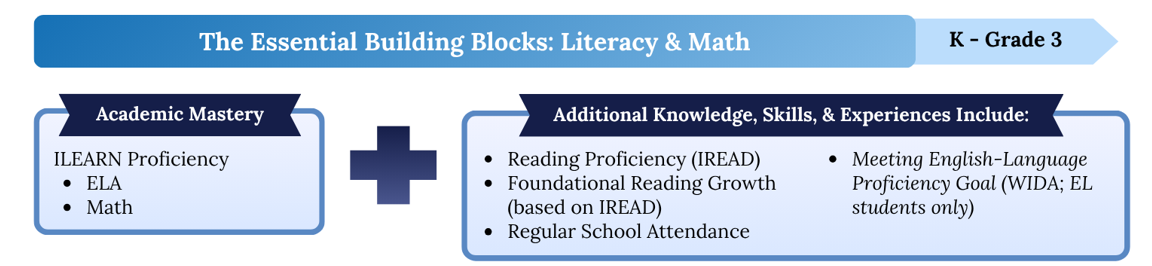
Student Success Indicators — Grade 3
| Indicator | Definition |
|---|---|
| Reading Proficiency (IREAD) | Achieve a passing score on the IREAD by the end of grade 3, including the summer retest window. Gateway indicator — must be passed before other Student Success Indicator points are unlocked. A grade 2 passing score is banked and applied in grade 3. |
| Foundational Reading Growth (based on IREAD) | Student was designated off-track on IREAD in grade 2 and then achieves a passing score by the end of grade 3, including the summer retest window. |
| Regular School Attendance | Present for at least 94% of enrolled instructional days during the accountable year (Days Present ÷ Days Enrolled). |
| Meeting English-Language Proficiency Goal (WIDA) | Meet expected growth or reach language proficiency on the WIDA ACCESS assessment. |
Grades 4–8
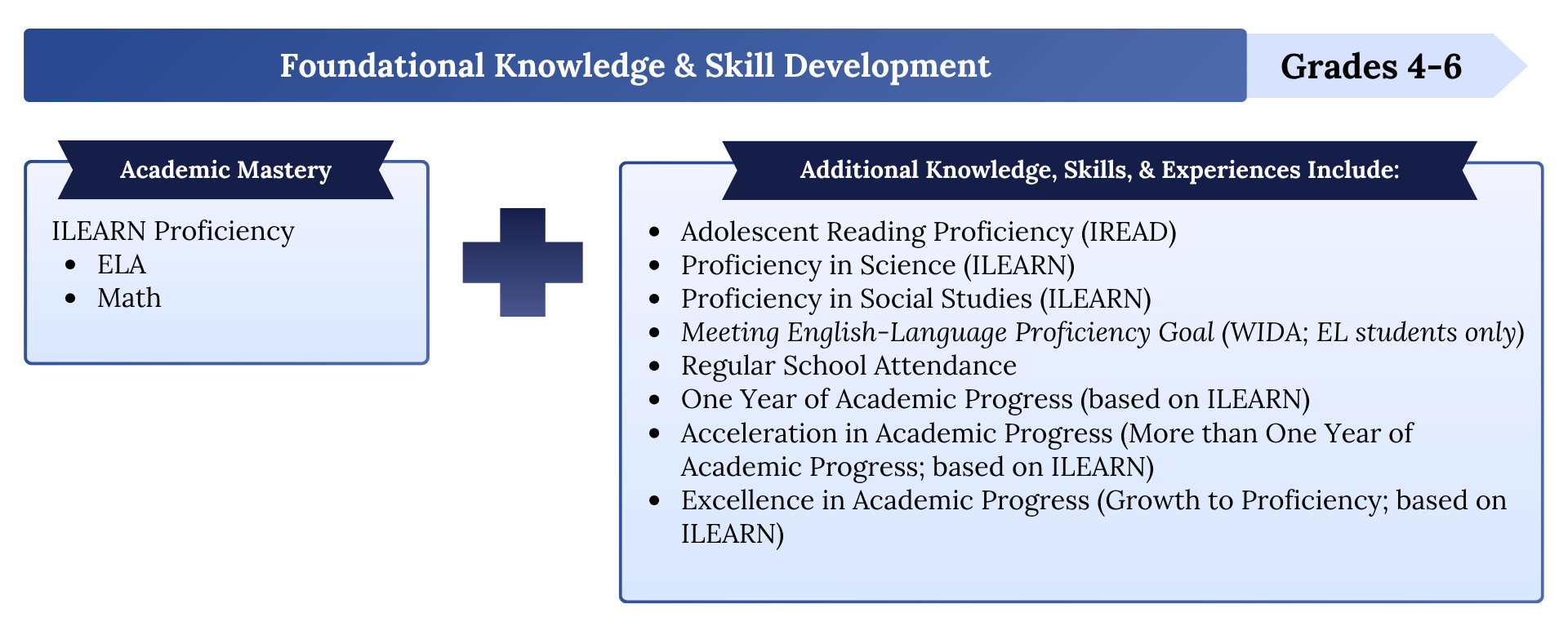
Foundational Knowledge and Skill Development
Academic Mastery Measure: Performance on ILEARN English/Language Arts (ELA) and Mathematics
Students earn points based on whether they perform Above Expectations, At Expectations, Approaching Expectations, or Below Expectations, using cut scores established by the State Board of
Education.
Grade 4-6 Calculation
Grade 7-8 Calculation
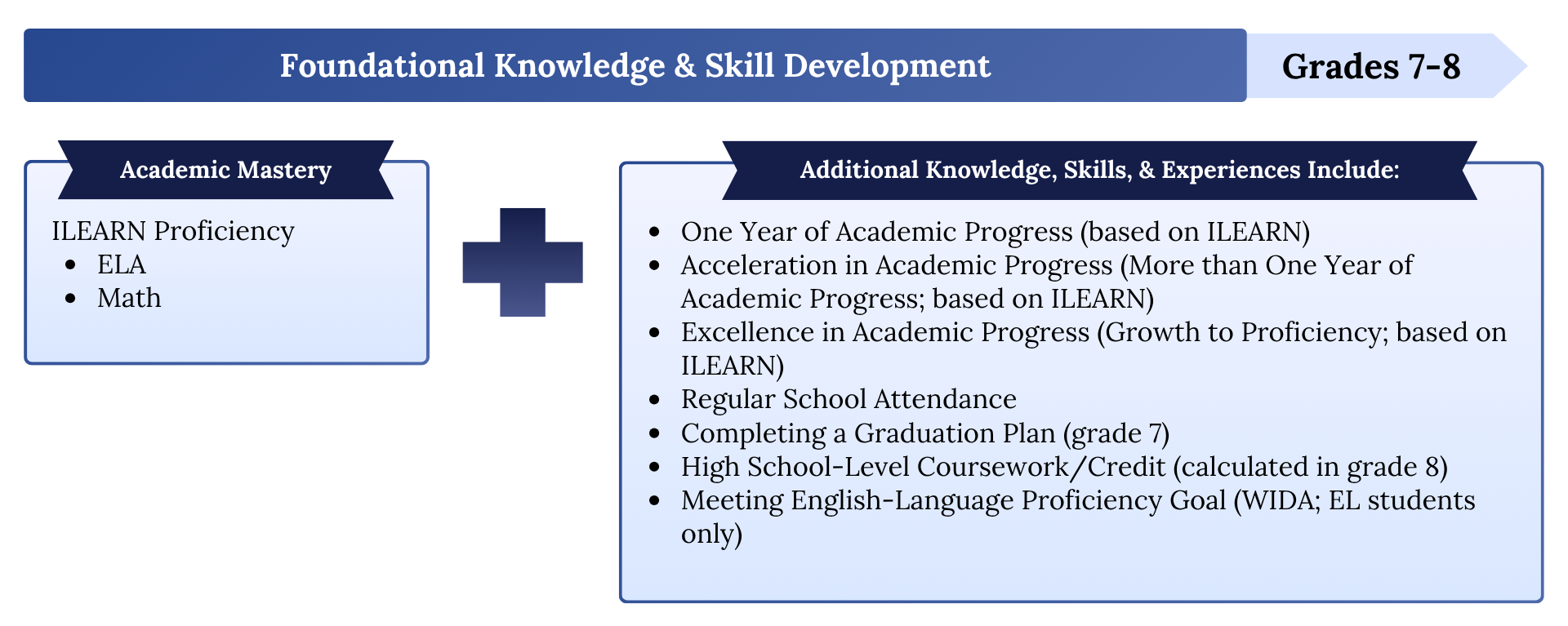
Student Success Indicators — Grades 4–8
| Indicator | Definition |
|---|---|
| One Year of Academic Progress | Student Growth Percentile (SGP) of 45 or greater, calculated separately for ELA and math. |
| Accelerated Academic Progress | SGP of 65 or greater, calculated separately for ELA and math. |
| Excellence in Academic Progress | Student scored Approaching or Below Expectations on ILEARN and met their individual student growth target. |
| Regular School Attendance | Present for at least 94% of enrolled instructional days (Days Present ÷ Days Enrolled). |
| Adolescent Reading Proficiency (IREAD) | Student did not pass IREAD by end of grade 3 and later achieves a passing score in grades 4–6. |
| Proficiency in Science (ILEARN) (Grades 4 & 6 only) | Achieve At Proficiency or Above Proficiency on the ILEARN Science assessment. |
| Proficiency in Social Studies (ILEARN) (grade 5) | Achieve At Proficiency or Above Proficiency on the ILEARN Social Studies assessment. |
| Completing a Graduation Plan (Grade 7) | Complete the graduation plan described in IC 20-30-4 by the end of the school year, with written parent or guardian approval. (Grade 7 students only) |
| High School-Level Coursework/Credit (grade 8) | Complete 2 credits of approved Indiana Diploma coursework with a grade of C or higher. Can be earned any time from grade 7 through the summer after grade 8. (Grade 8 students only) |
| Meeting English-Language Proficiency Goal (WIDA) | Meet expected growth or reach language proficiency on the WIDA Consortium ACCESS assessment. (ELs only) |
Grades 9-10
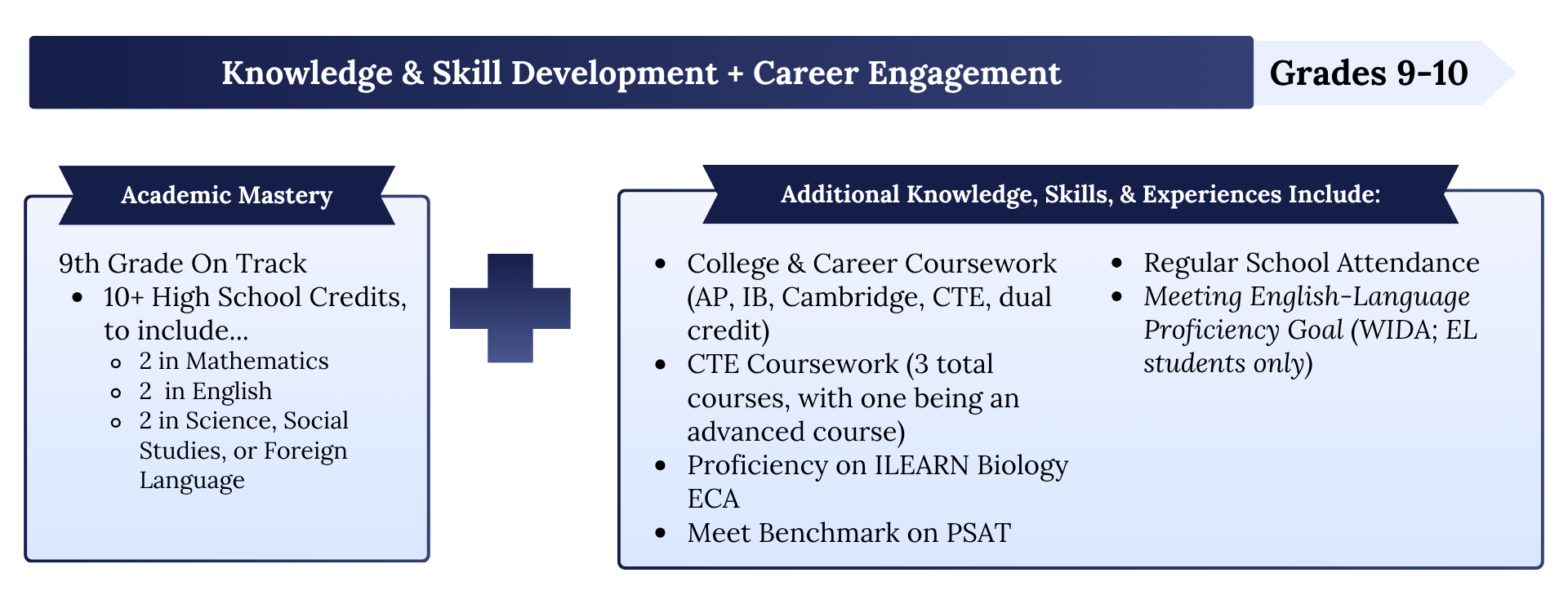
Knowledge and Skill Development + Career Engagement
Academic Mastery Measure: 9th Grade On Track — What It Means
- Being “On Track” means a student has earned enough key high‑school credits by the end of 9th grade to stay on pace for graduation.
- Another path to meet expectations: If a student isn’t on track after Grade 9, they can still reach “At Expectations” by:
- Earning 20+ high school credits by the end of Grade 10.
Point matrix — Grade 10
9th Grade on Track — performance categories
| Category | Credit requirement |
|---|---|
| Above Expectations | At least 14 credits by end of Grade 9, including at least 2 ELA, 2 mathematics, and 2 in any combination of science, social studies, or foreign language |
| At Expectations | At least 10 but fewer than 14 credits by end of Grade 9, including at least 2 ELA, 2 mathematics, and 2 in any combination of science, social studies, or foreign language; or at least 20 credits by end of Grade 10 including 4 ELA, 4 mathematics, and 4 science/social studies/foreign language |
| Approaching / Below Expectations | Fewer than 10 credits and/or the credits do not meet the core credit requirements by end of Grade 9; or fewer than 20 credits and/or credits do not meet core credit requirements by end of Grade 10† |
†Or failed to meet directed core-credit requirements.
Student Success Indicators — Grade 10
| Indicator | Definition |
|---|---|
| College & Career Coursework | Complete 2 credits of dual credit, AP, IB, or Cambridge International with a grade of "C" or higher by end of grade 10. |
| Advanced CTE Coursework | Complete at least 3 non-duplicative CTE courses (excluding introductory-level), including at least 1 advanced CTE course, with a grade of "C" or higher by end of grade 10. |
| Proficiency on ILEARN Biology ECA | Achieve At Proficiency or Above Proficiency on the ILEARN Biology End of Course Assessment. |
| Meet Benchmark on PSAT/NMSQT | Achieve the aggregate national college-ready benchmark on the PSAT/NMSQT, administered by College Board. |
| Regular School Attendance | Present for at least 94% of enrolled instructional days in grade 9 or grade 10. Met at either grade counts. |
| Meeting English-Language Proficiency Goal (WIDA) | Meet expected growth or reach language proficiency on the WIDA Consortium ACCESS assessment in grade 9 or grade 10. |
For families: High school credits earned in middle school (Grades 7 or 8) that appear on the high school transcript count toward the Grade 9 credit total used for this calculation.
Grades 11-12
Knowledge and Skill Development + Credentials & Experiences
Academic Mastery Measures:
The Grade 12 final numeric rating combines three components:
- A diploma and Student Success Indicator score;
- A graduation rate score; and
- A mandatory statewide assessment score.
Grades 11–12 accountability overview
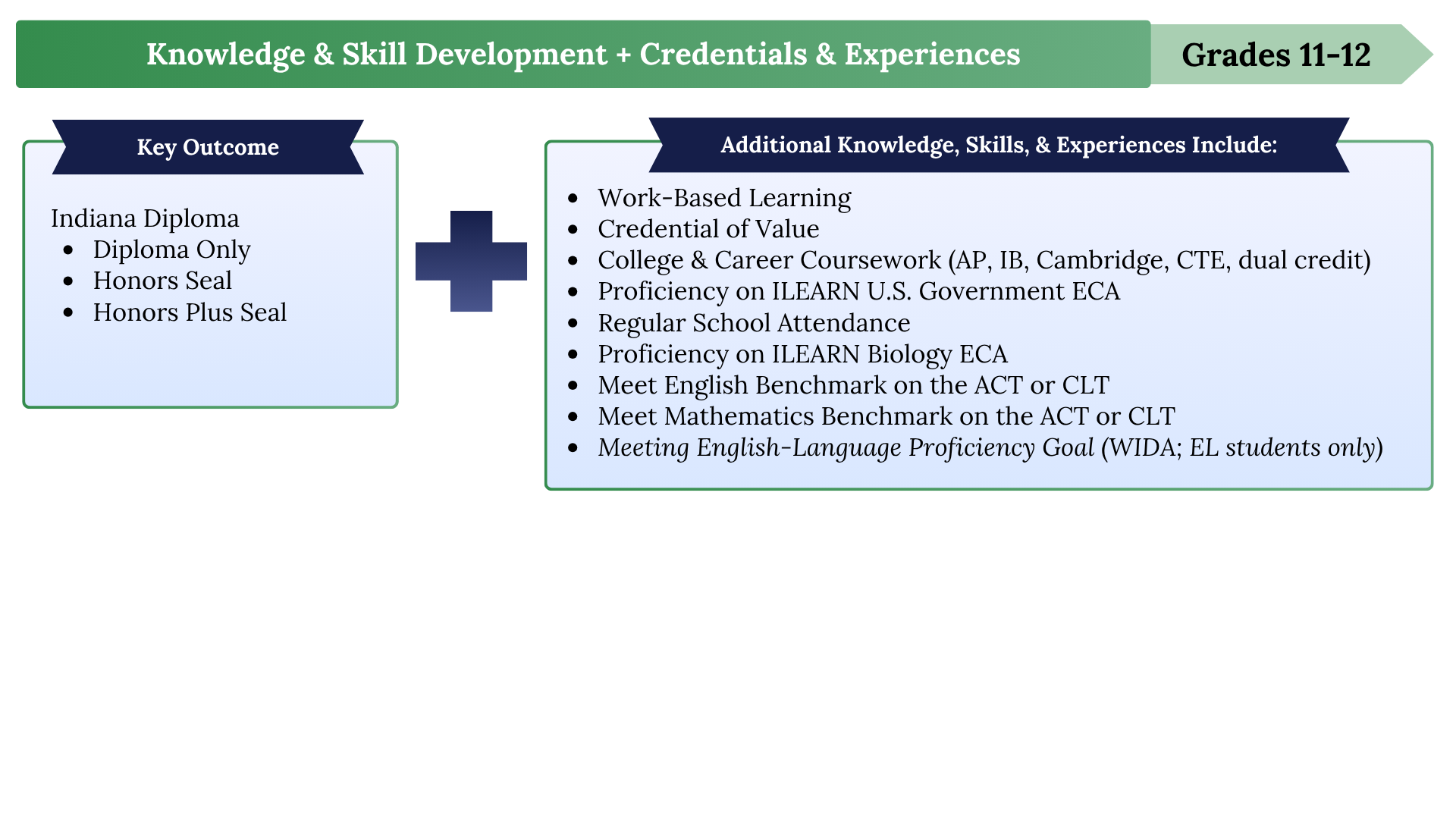
Student Success Indicators — Grade 12
| Indicator | Definition |
|---|---|
| Work-Based Learning (WBL) | Complete 150 hours of work-based learning (up to 3 qualifying WBL experiences). Reported via InTERS. |
| Credential of Value | Earn an IDOE-approved industry-recognized or postsecondary credential. Only credentials approved for the Enrollment Honors Plus or Employment Honors Seal qualify. |
| College & Career Coursework | Complete at least one college and career course requirement outlined in 511 IAC 6-7.2-21(b)(1)(G) — includes dual credit, AP, IB, Cambridge International, and eligible CTE pathways. This does not include ACT or SAT scores. |
| Proficiency on ILEARN U.S. Government ECA | Achieve a passing score on the U.S. Government course final exam at any point prior to graduation. |
| Regular School Attendance | Present for at least 94% of enrolled instructional days in grade 11 or grade 12. Met at either grade counts. |
| Proficiency on ILEARN Biology ECA | Achieve At Proficiency or Above Proficiency on the ILEARN Biology End of Course Assessment. |
| Meet English Benchmark on ACT or CLT | Achieve the college-ready benchmark on the English section of the ACT or verbal reasoning section of the CLT. |
| Meet Mathematics Benchmark on ACT or CLT | Achieve the college-ready benchmark on the math section of the ACT or quantitative reasoning section of the CLT. |
| Meeting English-Language Proficiency Goal (WIDA) | Meet the Student Growth Percentile (SGP) target on the WIDA ACCESS assessment in grade 11 or grade 12. The SGP target represents the growth needed each year to reach English language proficiency within six years, based on norm- and criterion-referenced analysis by the National Center for the Improvement of Educational Assessment. Note: WIDA ACCESS composite scores across different test versions are not directly comparable, but the 1.0–6.0 proficiency scale remains consistent across administrations. |
Students with Significant Cognitive Disabilities
How I AM scores translate to points
The I AM dedicated scoring table has three outcomes for accountability purposes:
| I AM Score | Points earned | What it means |
|---|---|---|
| At Proficiency | 100 points | Your child demonstrated proficiency on the alternate assessment — the maximum points available to any student in the framework. |
| Approaching Proficiency | 75 points | Your child is working toward proficiency. |
| Below Proficiency | 0 points | Your child is below the approaching threshold on I AM. |
Grade 10
The Grade 10 Academic Mastery measure for most students is based on 9th Grade On-Track status, which reflects the number of high school credits completed by the end of grade 9. For students who take the I AM assessment and complete Applied Units instead of traditional coursework, those Applied Units will also count toward being on track, ensuring they are evaluated in the same way as non–I AM test takers.
Grades 11- 12
Students who earn an Alternate Diploma are fully counted in the Grade 12 accountability cohort as graduates — they are not excluded, and every Student Success Indicator they earn increases their contribution to the school's grade.
How the Alternate Diploma is categorized in the point matrix depends on the school year. Indiana is currently transitioning from the legacy Core 40 diploma structure to the new Indiana Diploma, so there are two different formulas — one in effect now through 2028-2029, and a permanent formula beginning in 2029-2030. Both are explained below.
The bottom line for families:
- During the transition period (through 2028-2029), the Alternate Diploma starts at 25 base points because it is grouped with the General Diploma — students who graduate without any qualifying diploma designation.
- After 2028-2029, the Alternate Diploma gets its own row with a higher starting point of 50 base points, reflecting the shift to the new Indiana Diploma structure.
- In both periods, earning Student Success Indicators has a significant impact on the final score.
FAQ
Yes. Grade 7 students can earn a Student Success Indicator by completing a graduation plan by the end of the school year. The plan must include written parent or guardian approval to count toward the school's accountability score. Your school's counselor will lead this process and can provide the required documentation.
No. Each Student Success Indicator a student earns increases that student's individual point total. Students earn whichever indicators are applicable to their grade level and student population. The formula counts how many indicators a student earns — it does not require completion of all available indicators. Students earn maximum points in this model by earning at least three Student Success Indicators available at their Academic Mastery level.
The attendance target requires a student to be present for at least 94% of instructional days during the accountable year while enrolled in the school. Attendance is calculated based on total days enrolled at the school, accommodating students who transfer during the year.
School accountability grades based on 2025-2026 school year data will be issued late in 2026. The 2025-2026 school year is the first year of data collection under this framework.
Indiana's accountability model encourages Academic Mastery for all students by ensuring grade 3-8 and grade 10 students participating in the I AM assessment can earn points for Academic Mastery, with those who demonstrate proficiency earning the maximum possible points. Academic Mastery for grade 10 students is based on 9th Grade On-Track status, not "At Proficiency" on I AM.