Radioactive Materials Control Program
 317-232-2222
 rmcp@dhs.in.gov
Nuclear Agreement State Signing
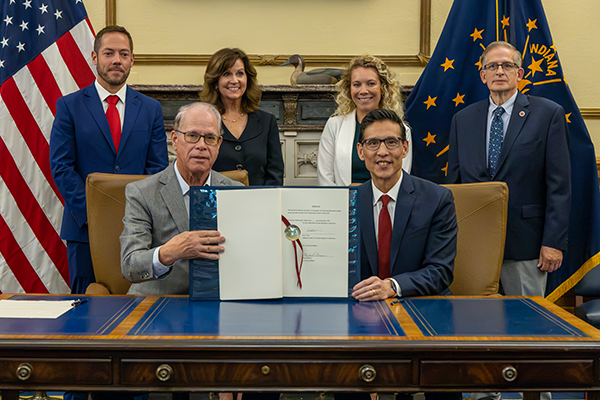
Gov. Mike Braun and the Nuclear Regulatory Commission Chairman Ho K. Nieh signed a formal agreement Thursday, Sept. 24 to adopt state-led responsibility for regulating radioactive materials across the state.
Indiana is now the 41st state to adopt state-led responsibility. The state will oversee licenses covering the use of radioactive materials in medical, academic and industrial settings. The state will also be responsible for licensing, inspection and enforcement.
About the Radioactive Materials Control Program
Effective Oct. 1, 2026, Indiana entered into an agreement with the United States Nuclear Regulatory Commission (NRC) to establish programs that assume NRC regulatory authority under the Atomic Energy Act of 1954.
Under this agreement, the NRC will discontinue its oversight of specific radioactive materials within Indiana, and the State will assume responsibility for licensing and regulatory activities previously handled at the federal level.
As outlined in Indiana Code § 10‑19‑12‑5, the Indiana Department of Homeland Security (IDHS) is designated as the agency responsible for implementing the agreement and overseeing the associated regulatory programs. The agreement transfers authority to the State of Indiana for regulation of the following materials:
- Byproduct materials as defined in 42 U.S.C. § 2014(e)(l);
- Byproduct materials as defined in 42 U.S.C. § 2014( e )(3);
- Byproduct materials as defined in 42 U.S.C. § 2014(e)(4); and
- Special nuclear materials in quantities not sufficient to form a critical mass.
Per the NRC, "Agreement States have entered into agreements with the NRC that give them the authority to license and inspect byproduct, source or special nuclear materials used or possessed within their borders."
Radioactive Materials Control Program Fee Collection Portal
The Radioactive Materials Control Program Fee Collection Portal is an online fee payment system provided by IDHS as a convenient way to pay various fees online. Portal instructions along with a list of program codes with fee categories and fee amounts can be found below:
Step 1: Open the Payment Form
Access the IDHS Radioactive Materials Control Program Fee Collection page using the button below:
Radioactive Materials Control Program Fee Collection Portal
Step 2: Enter Submitter Information
You must fill in all required fields.
- First Name of Submitter
- Last Name of Submitter
- Email Address
- Phone Number
Step 3: Enter License Holder Information
Fill out the required information for the license holder (usually the business or entity).
- Name of License Holder
- Address
- City
- State
- Zip Code
Step 4: Enter License Number
If you have a license number, enter it in the license number (License #) field.
Step 5: Choose the Type of Fees You Want to Pay
Select all fees that apply to your situation. Options include:
- Initial Application Fee
- Renewal/Addition Application Fees
- Annual Application Fees
- Reciprocity Fees
- Penalties
- If you are given a penalty, please pay using your order number.
- Financial Assurance
- If financial assurance is applicable, please submit documentation here. Financial assurance instrumentation including surety, insurance, or guarantee mechanisms and Decommissioning Funding plans should be submitted at intervals not to exceed 3 years, or when changes to the possession limits prompt new requirements. Anti-bankruptcy waiver will also be submitted here that guarantees payment in the event of bankruptcy.
Step 6: Review Your Information
Make sure all required fields are complete and correct. The form will show an alert if anything is missing.
Step 7: Check Out and Pay
Once all required fields and fee selections are complete, click the “Check Out & Pay” button. Follow the prompts to complete your payment.
IDHS Radioactive Materials Control Program Fee Collection Portal
Click the button below to submit fees to IDHS.
Visit the Fee PortalIDHS Radioactive Materials Control Program Fee Collection Portal
A payment portal used to submit any fees required by IDHS.
Regulations, Reporting, Forms & Other Information
Information regarding state and federal regulations can be found below. Additionally, a list of forms relating to the Radioactive Materials Control Program are provided here as well.
Links to the various regulations relating to the Radioactive Materials Control Program can be found in the following document:
The NRC also provides a list of regulations on the NRC website linked below:
Reporting Requirements
The reporting timeline specified in 10 CFR 20.2201(a)(1)(ii) and 20.2201(b)(1)) is modified from thirty (30) to fifteen (15) days. Certain materials regulated under 10 CFR 20.402 also require immediate notification when a loss or theft is discovered.
In case of an emergency, or when an immediate or a twenty-four (24) hour notification is required, the notification shall be made telephonically to (317) 233-6611. Reports shall be submitted electronically in writing and addressed to the department at RMCP@dhs.in.gov. Submissions made by paper shall be made out to:
Indiana Department of Homeland Security Radioactive Materials Control Program
302 W. Washington St., Rm. E208
Indianapolis, IN 46204
Immediate notification to the Local Law Enforcement Agency (LLEA) is required after determining that an unauthorized entry resulted in an actual or attempted theft, sabotage, or diversion of a category 1 or category 2 quantity of radioactive material. The department should be notified no later than 4 hours after the discovery via phone.
For a thorough breakdown of the procedure for reporting events, see the document provided below:
Patient‑Related Event Notifications
In addition to federal reporting obligations, licensees must follow specific state requirements related to events involving patients or human research subjects under 10 CFR 35 Subpart M. The department must be notified by telephone upon discovery, but not later than the next business day if: (1) a patient or human research subject has departed from the licensee's facility without authorization under 10 CFR 35.75; or (2) a patient or human research subject containing radioactive material has died, and it is possible that any individual could receive an effective dose equivalent to exceeding the dose limits set forth in 10 CFR 20.1301 as a result of the deceased's body. In addition to the requirements outlined in 10 CFR 35 Subpart M, the licensee shall submit a written report to the department within thirty (30) days after the discovery of the above.
Various forms relating to the Radioactive Materials Control Program can be found below:
- Application for Radioactive Materials License (RMCP 313)
- Depleted Uranium Registration
- Cumulative Dose History (RMCP 4)
- Occupational Dose Record (RMCP 5)
- Notification of Reciprocity (RMCP 241)
- Training, Experience and Preceptor Attestations:
- Authorized Medical Physicist or Ophthalmic Physicist (RMCP 313A AMP)
- Authorized Nuclear Pharmacist (RMCP 313A ANP)
- Authorized User (RMCP 313A AUD)
- For uses defined under 35.100, 35.200, and 35.500 [10 CFR 35.57, 35.190, 35.290, and 35.590]
- Authorized User (RMCP 313A AUS)
- For uses defined under 35.400 and 35.600 [10 CFR 35.57, 35.490, 35.491, and 35.690]
- Authorized User (RMCP 313A AUT)
- Radiation Safety Officer or Associate Radiation Safety Officer (RMCP 313A RSO)
- Disposition of Materials (RMCP 314)
- In-Vitro Testing Registration (RMCP 483)
- Certification of Small Entity Status (RMCP-526)
- Inspection Report (RMCP-591M)
- Inspection Record (RMCP-592M)
United States Nuclear Regulatory Commission (NRC) NUREGs
Directory of Certificates of Compliance for Radioactive Materials Packages
- Certificates of Compliance, NUREG-0383, Volume 2, Revision 28
- Report of NRC-Approved Quality Assurance Programs for Radioactive Materials Packages, Certificates of Compliance, NUREG-0383, Volume 3, Revision 24
General Information on Radon
The Indiana Department of Environmental Management (IDEM) website provides good information on radon, a radioactive gas that can be found all over the United States.
Radioactive Waste Broker Decontamination Services
A list of radioactive waste broker decontamination services provided by the Conference of Radiation Control Program Directors (CRCPD) can be found below:
NRC Web-Based Licensing
NRC's Web-Based Licensing offers applicants and existing NRC byproduct materials licensees a modern, secure, and convenient online portal to manage their licensing needs.
Frequently Asked Questions
IDHS has provided the following list of frequently asked questions surrounding the Radioactive Materials Control Program. Click each question below to see the answer.
Inspections for radioactive materials licensees will follow the same structure as the Nuclear Regulatory Commission’s inspection frequency. The inspection frequency is based on the program code assigned to the license. This frequency is determined by priority, corresponding to associated risk. The most recent list of program codes and inspection frequencies can be found in the Material Licensee Toolkit.
Indiana has incorporated the Nuclear Regulatory Commission regulations (10 CFR 170 and 10 CFR 171) by reference into the RMCP webpage under 290 IAC 3-18-3 Fees.
The annual license fees due to IDHS will be the same fees previously due to the NRC. These fees will continue to be billed on the anniversary date of the license each year. You will receive an invoice with payment instructions, including an option for streamlined online payment.
More information on fee can be found in the above Nuclear Regulation Program Fee Collection Portal section.
The State will honor licenses issued by the NRC for Indiana after the agreement becomes effective Sept. 30, 2026. The Radiation Section will convert all licenses to Indiana licenses. An Indiana license will be issued to all active licensees with addresses of use or storage in Indiana. Licensees do not need to request an amendment to change their license from NRC-issued to Indiana-issued. This conversion should occur automatically once a license is renewed.
For any new application, amendment or renewal, submit Form 313, “Application for a Radioactive Materials License,” along with any applicable forms and attachments. Each request must be accompanied by a formal letter on company letterhead. A license renewal application must contain all information required for an initial license of the same program code(s), including any tie-down conditions referenced in prior license amendments.
Licenses will expire 15 years from the issuance date. Ninety days before the license expiration date, the licensee will be notified and informed that a renewal application postmarked at least 30 days prior to expiration will be considered timely.
Forms and correspondence may be submitted by email to RMCP@dhs.in.gov or by mail to:
302 W. Washington St., Rm. E208
Indianapolis, IN 46204
Attn: Radioactive Materials Control Program
All fees and financial assurance requirements will be fulfilled through the online fee portal.
For reciprocity, at least three days before engaging in each activity for the first time in a calendar year, submit Form 241, “Notification of Reciprocity,” a copy of the Agreement State or NRC license and evidence that fee requirements will be met. The preferred submission method is email to RMCP@dhs.in.gov.
Reciprocity fees should be paid through the online fee portal.
For a change report, submit Form 241 via email to RMCP@dhs.in.gov.
No, State Form 49771 is no longer needed from facilities that hold an Indiana license to have radioactive material.
Upcoming Events
Note: Not all events on the IDHS calendar are organized, hosted or sponsored by IDHS or other state agencies. Some events are included for informational purposes as events that the public or first responders may find beneficial.
Resources
IDHS has collected a wide range of resources relating to the Radioactive Materials Control Program or similar topics. Click each category below to see the respective list of resources.
Nuclear Regulatory Commission (NRC)
The Commission as a collegial body formulates policies, develops regulations governing nuclear reactor and nuclear material safety, issues orders to licensees and adjudicates legal matters.
Consolidated Guidance About Materials Licenses (NUREG-1556)
NUREG-1556 is a collection of publications that offer guidance about materials licenses.
NRC Regulation Guides
The Regulatory Guide series provides guidance to licensees and applicants on implementing specific parts of the NRC's regulations, techniques used by the NRC staff in evaluating specific problems or postulated accidents, and data needed by the staff in its review of applications for permits or licenses.
NRC General Communications
To stay current with news and information from the NRC, you may subscribe to e-mail updates via the Granicus Communications subscription service on multiple topics related to Generic Communications.
NRC Office of State and Tribal Programs
State & Tribal Programs at the NRC encompass certain areas of the United States. More information about these programs can be found on the NRC website.
NRC Office of State and Tribal Programs
NRC Information Notices
Information notices communicate operating or analytical experience to the nuclear industry. Information notices may also communicate the results of recently completed research.
U.S. Department of Energy
The mission of the Energy Department is to ensure America’s security and prosperity by addressing its energy, environmental and nuclear challenges through transformative science and technology solutions.
U.S. Environmental Protection Agency
The mission of the Environmental Protection Agency is to protect human health and the environment by working to ensure Americans have clean air, land and water among other notable efforts.
U.S. Environmental Protection Agency
Federal Emergency Management Agency
FEMA's mission is to help people before, during and after disasters. The agency works across the country every day before disasters happen to help people and communities understand and prepare for possible risks.
Federal Emergency Management Agency
Centers for Disease Control and Prevention: Radiation Emergencies
Interested parties can learn about the different types of radiation emergencies on the Centers for Disease Control website.
Centers for Disease Control and Prevention
U.S. Food and Drug Administration
Interested parties can learn about radiation-emitting products on the U.S. Food and Drug Administration website.
U.S. Food and Drug Administration
International Atomic Energy Agency
The International Atomic Energy Agency is the world's central intergovernmental forum for scientific and technical cooperation in the nuclear field. It works for the safe, secure and peaceful uses of nuclear science and technology, contributing to international peace and security and the United Nations' Sustainable Development Goals.
Council of Radiation Control Program Directors
The Conference of Radiation Control Program Directors, Inc. is a 501(c) (3) nonprofit, non-governmental, professional organization whose primary membership is comprised of radiation professionals in State and local government that regulate the use of radiation sources. However, any individual with an interest in radiation protection may become an Affiliate or International member.
Council of Radiation Control Program Directors
Health Physics Society
The Health Physics Society, formed in 1956, is a scientific organization of professionals who specialize in radiation safety. Its mission is excellence in the science, practice, communication and application of radiation safety and protection.
American Nuclear Society
The American Nuclear Society (ANS) is the premier organization for those that embrace the nuclear sciences and technologies for their vital contributions to improving people’s lives and preserving the planet. ANS membership is open to all and consists of individuals from all walks of life, including engineers, doctors, students, educators, scientists, soldiers, advocates, government employees and others.
Organizations of Agreement States
The Organizations of Agreement States (OAS) is a nonprofit, voluntary, scientific and professional society incorporated in the District of Columbia. The membership of OAS consists of state radiation control directors and staff from all Agreement States who are responsible for implementation of their respective Agreement State programs.
Organizations of Agreement States
International Commission on Radiological Protection (ICRP)
The International Commission on Radiological Protection is an independent, international organization that advances for the public benefit the science of radiological protection, in particular by providing recommendations and guidance on all aspects of protection against ionizing radiation
International Commission on Radiological Protection
National Council on Radiation Protection and Measurements
The National Council on Radiation Protection and Measurements seeks to formulate and widely disseminate information, guidance, and recommendations on radiation protection and measurements, which represent the consensus of leading scientific thinking.
American Association of Physicists in Medicine
The American Association of Physicists in Medicine is a scientific and professional organization, founded in 1958, composed of more than 8000 scientists whose clinical practice is dedicated to ensuring accuracy, safety and quality in the use of radiation in medical procedures such as medical imaging and radiation therapy.
American Association of Physicists in Medicine
American College of Radiology
Founded in 1923, the American College of Radiology is at the forefront of radiology evolution, representing more than 39,000 diagnostic and interventional radiologists, radiation oncologists, nuclear medicine physicians and medical physicists.
Society of Nuclear Medicine and Molecular Imaging
The Society of Nuclear Medicine and Molecular Imaging is a global nonprofit organization dedicated to advancing nuclear medicine, molecular imaging, and theranostics through its education and research programs.
Society of Nuclear Medicine and Molecular Imaging
The American Registry of Radiological Technologists (ARRT)
A leading credentialing organization, the American Registry of Radiological Technologists offers certification and registration in a wide range of radiologic disciplines, helping people who work in medical imaging and radiation therapy to develop their careers.
The American Registry of Radiological Technologists
International Society of Radiographers and Radiological Technologists (ISRRT)
The International Society of Radiographers and Radiological Technologists was founded in 1962 as a non-profit organization and is the only organization representing all disciplines of Medical Radiation Technologists internationally.
International Society of Radiographers and Radiological Technologists
American Society for Nondestructive Testing
As global leaders in nondestructive testing (NDT), the American Society for Nondestructive Testing (ASNT) fosters excellence and innovation, empowering NDT professionals to secure the safety and reliability of structures and systems worldwide.