
2026 Tree Sale
The sale is a fundraiser that helps the Allies fulfill their mission to encourage the planting, care, and preservation of trees in the Clermont area. Please consider donating a tree to the town (select "Donate a Tree" and choose a quantity on the order form).
Details
- Sale dates: September 1 to October 12 (pickup October 17 at Miller Park from 7 to 9 a.m.)
- Prices: All trees are only $35 and come with a trunk protector.
- Tree sizes: 1-3 feet minimum*
- Tree species: 15 types to choose from, including two evergreens. All are native to the local environment and were grown at a locally owned nursery in central Indiana.
*The reason you should buy a smaller tree is because it is more affordable and your new tree should have a greater chance of survival. A smaller tree has a less stressful time re-establishing its roots in its new home, and it is said that they recover from transplant shock and start to grow quicker than a larger tree, which may take a few extra years to get re-established before it can produce significant above-ground growth.
Ordering Instructions
- Review the tree species information below to learn what is available and if they are a good fit for your property. You can also review the Frequently Asked Questions section.
- Open the order form.
- Select the type and quantity of trees you want to buy.
- Enter your payment information.
- Save your receipt (confirmation email).
- On the week of tree distribution, the Tree Allies will contact you to remind you that your order will be ready for pickup in Clermont (tentatively Saturday, October 17, 2026). Bring your receipt (confirmation email) with you to the distribution event, and a volunteer will assist you and provide you with your order.
Questions or tips
The Clermont Tree Allies can help! Contact treeallies@clermont.in.gov or 317-937-4066 to connect with a knowledgeable volunteer.
Tree Species Information
Fifteen species of trees are available for the 2026 sale.
Notable Facts
- Oak trees provide the most value to wildlife and are some of the longest-living trees, usually living for at least 100 years. White oaks live 200 years on average!
- Several of these trees offer food you can eat! Check out the hazelnut (nuts), Allegheny serviceberry (berries), and nannyberry (berries).
- The Princeton elm tree is a cultivar of the American elm tree that retains the species' attractive vase-shaped form and has resistance to both the elm leaf beetle and Dutch Elm Disease.
- The tulip poplar is Indiana's state tree.
SHADE TREES
 Chinquapin Oak
 Kentucky Coffee Tree
 White Oak
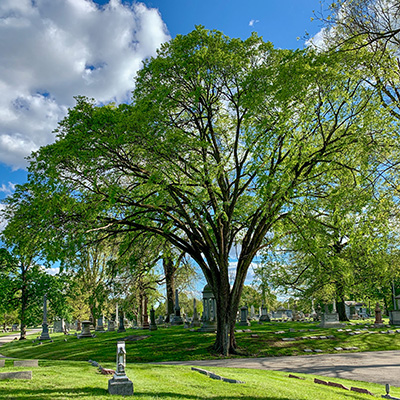 Princeton Elm
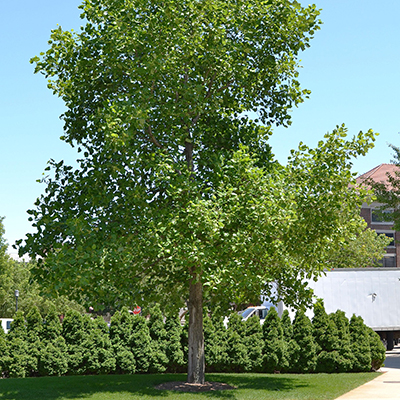 Tulip Poplar
 River Birch
EVERGREEN TREES
 Northern White Cedar (Arborvitae)
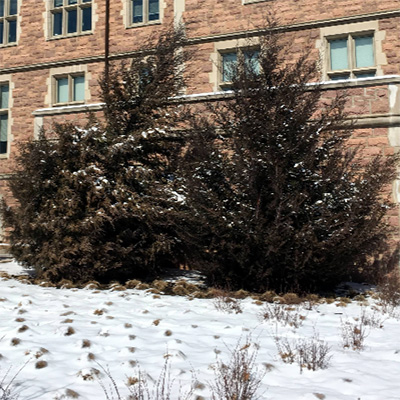 Eastern Red Cedar
"BUSH-LIKE" TREES
 Allegheny Serviceberry
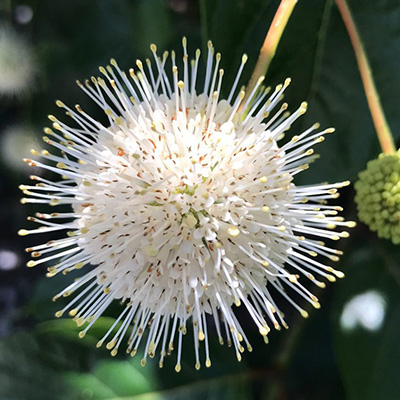 Buttonbush
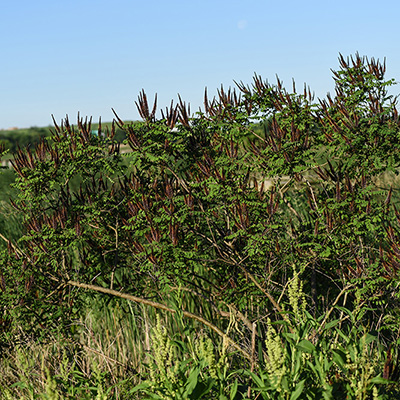 Indigo Bush
 Strawberry Bush
SMALL TREES
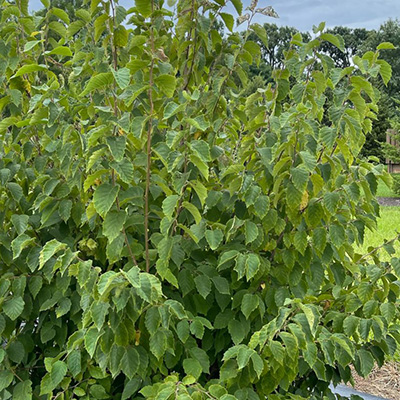 Hazelnut
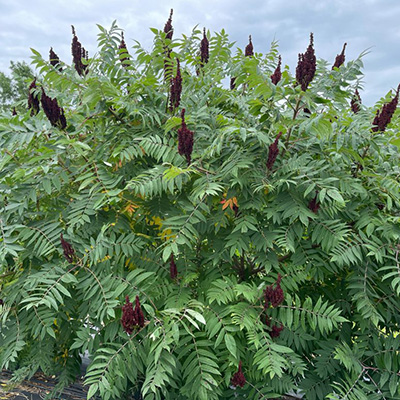 Smooth Sumac
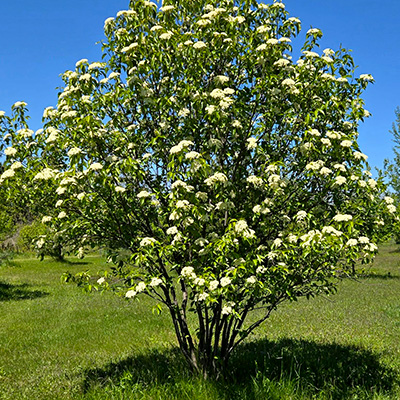 Nannyberry
| Name (photos) | Notes | Size | Growth Rate | Max Height | Max Width | Sunlight | Soil (Drainage) |
|---|---|---|---|---|---|---|---|
Allegheny Serviceberry  | White flowers March-May. Good fall color. Red berries are edible. | Small | Medium | 15-25 ft | 15-25 ft |
Full sun, part shade | Well-drained |
Buttonbush | Beautiful white flowers that attract pollinators. Does well in wet soil but not in dry conditions. Attracts more than 24 species of birds and many species of butterflies. | Small | Medium | 5-10 ft | 5-10 ft |
Full sun, part shade, full shade | Well-drained, wet-to-medium, wet |
Chinquapin Oak | Pyramidal when young but crown becomes rounded with age. Leaves have coarse, gland-tipped teeth and are downy underneath. | Large | Medium | 40-80 ft | 40-80 ft | Full sun | Well-drained, medium-to-dry, dry |
Eastern Red Cedar | Evergreen. Very hardy. May grow tiny blue-green fruits that attract birds. | Medium | Medium | 30-60 ft | 10-20 ft | Full sun, part shade, full shade | All except wet |
Hazelnut | Kaleidoscope of fall color. Edible nuts in the fall that attract birds. | Small | Medium | 6-12 ft | 6-12 ft |
Full sun, part shade, full shade | Well-drained, medium-to-dry, wet-to-medium |
Indigo Bush | Showy purple flowers in summer. Birds use for nesting when planted in mass. | Small | Medium | 5-15 ft | 5-15 ft |
Full sun, part shade, full shade | All except dry |
Kentucky Coffee Tree | Tropical-like leaves and ornamental bark. Grows leathery, red-brown seed pods. | Large | Slow | 60-80 ft | 40-60 ft | Full sun | Dry, well-drained, medium-to-dry |
Nannyberry | Dark green leaves turn maroon-red in the fall. Has sweet, raisin-like berries (dark blue-black color) in fall that persist into winter. | Small | Medium | 10-20 ft | 5-15 ft |
Full sun, part shade, shade | Dry, well-drained, medium-to-dry, wet, wet-to-medium |
Northern White Cedar | Evergreen. Small oblong cones in spring. Needs sheltered position. Susceptible to deer browse. Average life: 300 years. | Large | Slow | 20-60 ft | 10-15 ft |
Full sun, part shade, shade | Well-drained, medium-to-dry, wet-to-medium |
Princeton Elm | Vase-shaped, majestic tree whose small spring flowers are used by bees and whose seeds are used by birds and other wildlife. Has resistance to Dutch Elm Disease and elm leaf borer. | Large | Fast | 60-100 ft | 40-80 ft | Full sun | Well-drained, medium-to-dry, wet-to-medium |
River Birch | Salmon-pink to reddish-brown flaky bark. Dark green leaves becomes yellow in the fall. | Medium | Fast | 40-80 ft | 40-60 ft | Full sun | Well-drained, moist, wet |
Smooth Sumac | Colonizing shrub. Has persistent red seeds that are eaten by songbirds throughout winter. | Small | Medium | 10-15 ft | 10-15 ft | Full sun, part shade, shade | Dry, well-drained, medium-to-dry |
|
Strawberry Bush | Spring flowers are small and unusual, resembling bursting hearts. Green year round. | Small | Medium | 3-6 ft | 3-6 ft | Full sun, part shade, shade | Well-drained, medium-to-dry, wet-to-medium |
|
Tulip Poplar | Grows fast and straight. Has magnolia-like flowers in late spring with a gradient of green and yellow with orange inside. | Large | Fast | 60-120 ft | 30-60 ft | Full sun, part shade | Well-drained, moist |
White Oak | Yellow green catkins in spring. Large shade tree. Leaves do not drop until mid-winter. High wildlife value. Average life: 200 years. | Large | Slow | 50-120 ft | 50-80 ft | Full sun | Well-drained, moist |
Frequently Asked Questions
- Which tree should I pick?
Email treeallies@clermont.in.gov if you are not sure and want an opinion.
Things to Consider
- The future: Most trees can live for decades and even hundreds of years! Think about what makes sense for your property in the short term but also 50 years from now. Future residents will appreciate your thoughtfulness!
- Where the tree will go: Locate a tree in the right soil and sunlight conditions (see species chart) for its best chance to grow strong and healthy. Also keep in mind the potential height and width of the tree when it is full grown so you do not put the tree at risk of being trimmed too harshly. Note: The heights and widths for each species are under ideal conditions. Competition from other trees will affect growing habits.
- Why you are buying the tree: Trees have many benefits. Are you buying a tree for its flowers in the spring? For its edible fruits or nuts? For the wildlife habitat it provides? For the heating and cooling effects that can save you energy costs? For sheer beauty?
- How do I plant a tree?
Just dig a hole and throw it in there? Well, not quite!
A shovel is likely all you need, and it should only take you 15 minutes to plant a tree if the ground is easy to work, but there are several things to keep in mind:
- Create a hole wide enough and deep enough for the new tree's roots to have space to grow properly.
- Make sure the new tree's trunk is straight (vertical). Walk around it to make sure it's straight from every angle.
- The tree's trunk has a flare toward its base, which is the biggest root. This flare should be above the soil when planted.
- When backfilling soil to close the hole, be sure to compress it somewhat (step around it) and water the soil thoroughly!
Check out the resources below (including a video) on how to plant a tree right.
Tree Planting and Mulching
- Proper Tree Planting
- How to Plant a Tree (video by Keep Indianapolis Beautiful)
- How to Plant a Tree - Coniferous (infographic)
- How to Plant a Tree - Deciduous (infographic)
- How to Mulch a Tree (infographic)
- Proper Mulching
- Why are the trees so small?
The trees offered in this sale are relatively small (generally between 1 and 5 feet). There are good reasons for this. Perhaps one of the most important is an increased chance of survival! The larger a tree is when it is dug up and replanted, the greater the risk that the tree could fail. Transplanting can be stressful for trees. As they age, their root systems develop structure and get larger (naturally). When a tree is dug up, oftentimes a portion of the roots is removed to allow the tree to be transported more easily. If not done properly, the removal of roots can be excessive and the remaining roots may have a hard time sustaining all the growth that has been built over time.
Benefits of Planting a Tree While Small
- Easier to plant (smaller hole, less effect on other plants)
- Increased chance of survival
- Shorter time for the tree to establish itself and start adding above-ground growth
- Roots have not had time to develop issues such as encircling (girdling) roots
- Lower cost
- How were the tree species selected?
All species offered in this sale are natives, which means they developed naturally in the North American ecosystem over many years. Native trees are the most well-suited for survival in this area and will provide the most benefits for the environment.
- Is the fall a good time to plant trees?
Trees can be planted almost any time of year, but the fall is the perfect time to plant trees! The trees stop their growth cycle and begin their process of "hibernation" before winter arrives. The sun is less harsh in fall, and so the trees need less watering as they go dormant for the winter.
Just be sure to get the trees in the ground before it freezes for the winter.
- Why should I plant a tree at all?
Remember that trees are not just for your own enjoyment — they are for everyone, including people who will live in Clermont in the future! Even if you will be moving in a few years, the trees will stay and benefit the next person and the neighborhood overall for many years.
They say the best time to plant a tree was 10 years ago; the next best time is now.
- Do I need to stake the tree?
Probably not. Staking is generally unnecessary unless conditions are extremely windy or the tree is unable to stay upright on its own (possibly a sign the tree was planted too shallow). Trees are smart and their roots will grow properly to compensate for windy conditions. If you decide to stake your tree, make sure that nothing is rubbing or scratching the tree's bark to damage it, and remove the staking within a year or two. There is no need for the tree to be staked after its roots have established themselves after a couple years.
- Do I need to protect the trunk?
It depends.
If your tree is in a fenced area where there is low likelihood of animals damaging its bark, you may not need to protect it.
If your tree is "free range" and rabbits, squirrels, or deer are likely to try to nibble at it, you may want to purchase a trunk guard and use it for a few years until the tree is about 5-6 feet tall. At that point, a tree should be strong enough to recover from any minor damage that would be caused by animals.
Caution: Weed eaters are a young tree's worst enemy! If you will be weed eating close to your tree, get a trunk guard to protect it from yourself!