NIRPC is the federally designated Metropolitan Planning Organization and the federally designated Economic Development District for Northwest Indiana |
|
February 2026
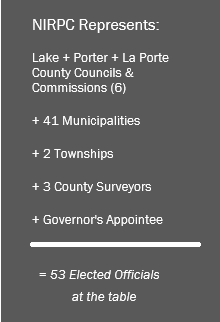
The Northwestern Indiana Regional Planning Commission is where 41 municipalities and 3 counties all come together to talk about issues larger than any one community. NIRPC is on the cutting edge of infrastructure for the region's transformation into a quality-of-place talent attractor, leveraging our access to the Chicago economy with our unique coastline containing Indiana's only National Park. The elected officials on the Commission represent nearly 800,000 Indiana residents.
- Transportation Reauthorization
As the Bipartisan Infrastructure Law (also the Infrastructure Investment and Jobs Act, or IIJA) comes up for renewal in the fall of 2026, an ongoing, sustainable funding source is still needed to maintain the Highway Trust Fund. We need to actively seek an ongoing solution — not merely by shuffling money around from other sources when we find them (which is how the HTF was funded under the BIL), but by either (a) making the unpopular move of raising the federal gas tax or (b) by finding a better way to keep the HTF solvent that can take advantage of modern technology while equalizing fees for electric vehicles and combustion-based engines alike, such as implementing Road User Charges (RUC) or Mileage Based User Fees (MBUF). There are simply no other viable solutions that have been identified for adequately maintaining our transportation infrastructure.
NIRPC supports the Surface Transportation Reauthorization Priorities established by the National Association of Regional Councils as summarized at this link: https://narc.org/wp-content/uploads/2025/09/NARC-Surface-Transportation-Reauthorization-One-Pager.pdf
Further, NIRPC's transportation priorities are reflected in the recently introduced BASICS Act (H.R. 7437) as developed by the Local Officials in Transportation (LOT) Coalition, a collaboration of the National Association of Regional Councils (NARC), the National League of Cities (NLC), the National Association of Counties (NACO), the Association of Metropolitan Planning Organizations (AMPO), the National Association of Development Organizations (NADO), and the U.S Conference of Mayors. See NARC's press release here and the NIRPC Commission's resolution urging the adoption of the BASICS Act here.
- Clearing Blocked Railroad Crossings
Since the Indiana Supreme Court struck down the ability of Hoosier municipalities to give citations to trains that block railroad crossings for more than 10 minutes, Northwest Indiana — with more railroad crossings than any other region in the state — has seen an increase in the time trains cut off access within communities, blocking commerce, emergency services, and, in some cases, forcing children to crawl under or over the couplings of stopped trains to get to school. The Class I railroads have shielded themselves behind federal pre-emption to be mostly unresponsive to the needs of Indiana communities. Funding overpasses for grade separation is the most helpful but also the most expensive option. Federal intervention is needed to force the railroads to the table to find effective solutions and work cooperatively with constituent communities.
- Designating the Calumet National Heritage Area
While there are over 60 national heritage areas nationwide, Indiana currently has none. The designation of the Calumet National Heritage Area through the National Park Service would promote economic development opportunities and cultural tourism in an area bookended by the Indiana Dunes National Park and the Pullman National Monument in Illinois, with negligible cost. The designation is an add-value to visitor and tourism activities in the region, and, as proven by the Rivers of Steel National Heritage Area in and around Pittsburgh, PA — a close analogue to the Calumet region — there is a significant multiplier of return in revenue generated as a result of heritage area designation. A Feasibility Study for the Calumet National Heritage Area has already been accepted by the NPS; however, the designation itself must be approved by Congress.
In 2021, the Northwestern Indiana Regional Planning Commission unanimously adopted Resolution 21-18, urging the designation of the Calumet National Heritage Area.
The Commission therefore strongly supports S.3501, the Calumet Heritage Area Act.
- Appropriating Funding through the EDA
After two decades, the U.S. Economic Development Administration of the Department of Commerce was finally reauthorized in January 2025 with bipartisan support. The EDA was instrumental in helping to sustain local economies during the COVID era, and EDA-designated Economic Development Districts (EDDs) such as NIRPC have served as the local “boots on the ground” entity facilitating economic investment for sustaining the local economy. The Partnership Planning funds that the EDDs currently receive from the EDA are not enough to maintain the staffing necessary to do this work — not even with the new 60/40 distribution of federal/local funds (versus the prior 50/50). To function adequately and strategically to ensure a significant return on investment and keep pace with inflation, the EDA’s Partnership Planning funding should (a) be increased from $70,000 to $200,000 and (b) offered at 100% federal funding to these federally-designated districts with no local match.
- Federal Partnering in NIRPC's Comprehensive Economic Development Strategy
In May of 2025, the Commission adopted its new Comprehensive Economic Development Strategy, a responsibility of NIRPC's federal designation as an Economic Development District. Developed with no less than 33 different Northwest Indiana organizations from the areas of workforce, manufacturing, business, and other economic interests, the primary thrusts of this strategy include:
- Economic Diversification and Innovation: In addition to emphasizing support for Northwest Indiana's primary industrial clusters of Primary Metals Manufacturing, Machinery Manufacturing, and Chemicals/Glass and Ceramics (including Pharmaceuticals), NIRPC's strategy includes a focus on growing a new Advanced Computing and Quantum cluster within these industrial clusters. NIRPC understands this to be the first and perhaps only CEDS in the country to include Quantum technologies in its economic strategy.
- Workforce Resiliency: This strategy focuses on growing a workforce trained and ready for the emerging industries in the region. Already, NIRPC is working with the Chicago Quantum Exchange housed in the University of Chicago to identify the skills training needed for the emerging Advanced Computing and Quantum industry cluster.
- Quality of Place: This strategy focuses on enhancing Quality of Place in the region, largely through increasing housing options and reclaiming brownfield sites in Northwest Indiana. These two challenges in particular create prime opportunities for working with our federal partners. The impact of federal regulation on housing is significant, and the need for brownfield remediation is keenly felt in the region while industrial brownfields cleanup remains costly and difficult.
What NIRPC Does
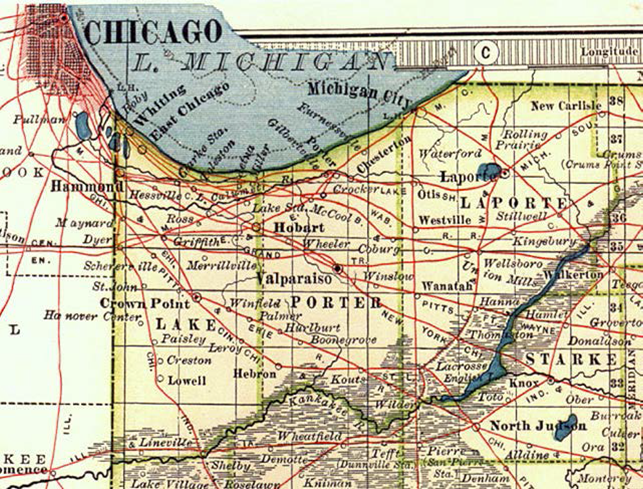
NIRPC is the official Council of Governments and the federally-designated Metropolitan Planning Organization and Economic Development District for Northwest Indiana. Though not a state agency, NIRPC's purpose and structure is enumerated in Indiana Code 36-7-7.6. Its mission is to foster regional cooperation and develop solutions for transportation, environmental, and economic development issues in Lake, Porter, and La Porte counties as it works collaboratively with its communities to create a shared vision for the future.