Quarterly Report FY 2026, Quarter 1
October 1 – December 31, 2025
Prepared for
Mental Health Advisory Council (MHAC) Meeting on March 4, 2026
Indiana Protection and Advocacy Services (IPAS) Commission Meeting on March 6, 2026
IDR's Mission: To uphold, promote, and advance the rights of individuals with disabilities through empowerment and advocacy to achieve a more equitable society.
Table of Contents
Executive Director's Note
FY 2026 Budget Passed with Level Funding for P&A Programs
Congress passed a budget with level funding based on the FY 2025 budget for P&A programs. To date, we have received almost $900,000 of the $3.08 million authorized. We should receive the remaining $2.18 million in the next few weeks. The passage of this budget allows us to move forward with planning and implementing our 2026 activities and priorities. It also allows us to resume normal case acceptance for all programs except PADD. Our PADD program continues to experience significant spend down as the primary program for our education access and Medicaid waiver cases. (P&O 2.1)
 IDR Staffing Updates and Opportunities
We are excited to announce that IDR will bring on Michael Dalrymple full-time as our Legal Director starting in April. Michael has run his own law practice for over 16 years, focusing on employment law, disability law, and estate planning. Prior to that, he spent five years working for Ice Miller in employment law. Michael is an active member of the Indiana State Bar Association, Practitioner in Residence at IU Maurer School of Law, and takes an active role in several local organizations, including the Indiana School for the Blind and Visually Impaired.
IDR is also taking applications for summer legal interns. The partnerships developed with the IU Mauer and McKinney law schools as well as the Fehribach Center allow us to both benefit from additional assistance from students as well as help train the next generation of disability advocates. (P&O 3.2)
Indiana Advisory Committee Releases Report and Policy Brief Centered on Hate Crime
I was honored to be part of the Indiana Advisory Committee to the U.S. Commission on Civil Rights, which recently released its report, Rethinking Hate Crime in Indiana. This report outlines the limitations in Indiana’s 2019 hate crime law, including significant gaps in enforcement, data collection, and protections. The report offers practical, actionable recommendations to strengthen hate crime protection in Indiana and at all levels of government. To really improve outcomes for Hoosiers, a more comprehensive approach to hate crimes is needed: stronger enforcement, clearer laws, and community-based prevention and support. (P&O 3.2)
Read the press release.
Read the Policy Brief.
Read the full report.
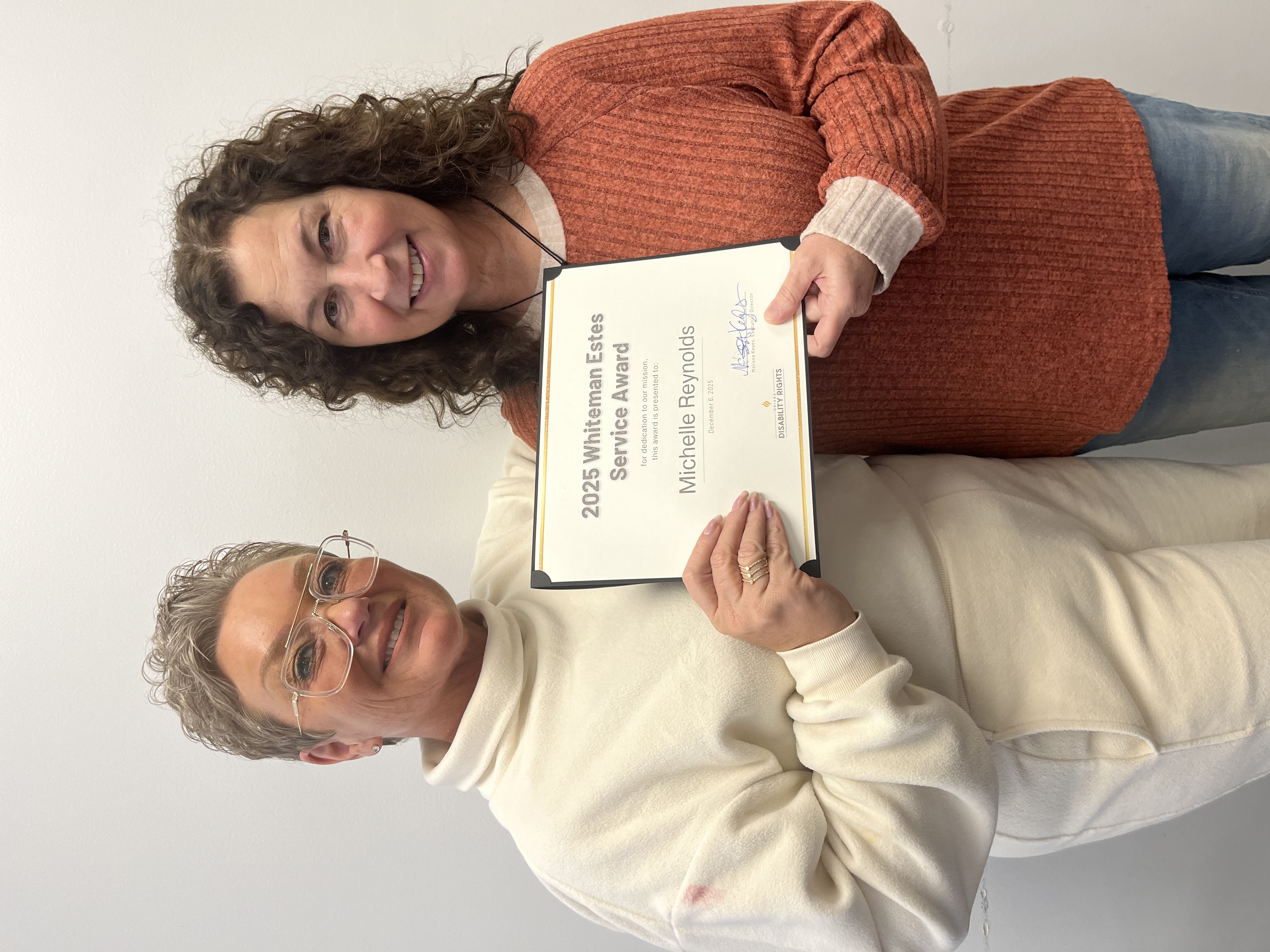 IDR's Whiteman-Estes Service Award Winner Announced
In December, IDR staff gathered to reflect on the year’s achievements. An honored tradition is the announcement of the winner of the peer-nominated Whiteman-Estes Service Award, to a staff member who has demonstrated outstanding service to the agency and our clients. This award honors Terry Whiteman and Steve Estes, passionate advocates who truly went above and beyond to serve individuals with disabilities. The 2025 recipient of the Whiteman-Estes Distinguished Peer Award was Michelle Reynolds. Michelle was chosen by her colleagues for her 36 years of service to people with disabilities in southern Indiana. As one colleague noted, “Michelle has consistently worked hard for our clients. She is a great listener and a gem of a person whose agreeable nature is a blessing to work alongside.” Michelle retired in December 2025 leaving a legacy of compassion and care, especially to the folks receiving services at Madison State Hospital. (P&O 1.1)
Team Updates
Abuse, Neglect, & Discharge Team
Monitor and Investigate
IDR Exposes Safety Risks and Intervenes to Shield Youth from Grooming
IDR investigators conducted four monitoring visits at private secure facilities. Their findings led to two formal licensing complaints, both of which triggered official investigations. Advocates also alerted CPS to signs of potential grooming involving a female youth, prompting swift action to safeguard her from possible abuse. (P&O 1.1)
Advocate
Plain Language Resources Support Self-Advocacy
During this quarter’s facility monitoring visits, advocates distributed 260 plain language rights resources to residents. When sharing materials such as the Know Your Rights Coloring Book and the new Know Your Voting Rights fact sheet, advocates walked individuals through how to use each tool and where to seek additional support. These resources strengthen self-advocacy by giving people clear, accessible information about their rights and how to act on them. (P&O 1.1, 3.1)
Educate
New Tool Helps Individuals Understand Their Rights While Receiving Inpatient Mental Health Treatment
IDR recently launched a redesigned resource, formerly known as “The Purple Book,” to empower individuals to better understand and advocate for their rights while receiving inpatient treatment in a mental health facility. The resource, Know Your Rights: Adults Receiving Inpatient Mental Health Treatment in Indiana is available now, and free to download, print, and share. “Navigating the complexities of the mental health system can be daunting, and too often, patient rights are misunderstood,” said Melissa Keyes, Executive Director. “This tool is more than just a list of rules and rights. It is a guide to reclaim one’s voice. We believe every individual should have the opportunity to participate in their care, and this resource provides practical help to empower people to do just that.” (P&O 1.1, 3.1)
Explore the Know Your Rights series.
Patient Rights Training Reinforces Staff's Legal and Ethical Responsibilities
In the first quarter, IDR investigators delivered three patient rights trainings for newly hired staff at state facilities, equipping staff with a clear understanding of disability rights laws, IDR’s access authority, and their legal and ethical obligations to the people they serve. By reinforcing these standards from day one, the trainings not only support patient safety and outcomes, but also make clear that IDR is actively present in the facility to monitor and protect patients’ rights. (P&O 1.1)
Success Story
Coordinated Investigation Uncovers Safety Failures in Group Home After Abuse Allegation
“Eric,” a resident of a group home, was the subject of an abuse allegation involving a housemate. IDR investigated the report and referred the concerns to IDOH, prompting a deeper review. State investigators identified multiple deficiencies within the home, including inadequate documentation practices and insufficient staff training. The combined efforts of IDR and IDOH brought critical safety issues to light and advanced protections for residents. (P&O 1.1)
Monitoring Team
Monitor and Investigate
Protection of Youth with Complex Medical Needs
IDR advised a facility for youth with complex medical needs to address a critical gap: eighteen residents had no court-appointed guardians to support them in decision-making or sign essential paperwork on their behalf. After IDR’s guidance, the facility contacted families, and many have begun responding. Securing decision-making supports ensures each youth has someone legally empowered to manage their care and protect their rights. (P&O 1.1)
Success Story
IDR Strengthens Self-Advocacy Through Targeted Monitoring and Technical Assistance
IDR staff completed 25 monitoring visits across 9 facilities this quarter, delivering technical assistance (TA) 61 times—an average of 2-3 TA activities per visit. Each interaction equips individuals with a clearer understanding of their rights, empowering them to self-advocate and ensuring their voices are heard and respected. (P&O 1.1, 2.1)
Rep Payee Team
Monitor and Investigate
IDR Advances Key Safeguards for Social Security Beneficiaries
This quarter, IDR staff completed 77 appointments, opened 15 new cases, continued work on 21 ongoing cases, and closed 10 cases. These efforts support the Strengthening Protections for Social Security Beneficiaries Act of 2018, helping ensure essential safeguards for Social Security recipients. (P&O 1.1)
Success Story
IDR Intervenes to Protect a Child's Misused Benefits
IDR investigated a report that a minor, “Edward’s,” Social Security benefits were being kept by his mother, while extended family provided his daily care. IDR’s review confirmed that for at least two years, none of the benefits were used for Edward or given to his caregivers, and the assigned payee had no relationship with him and refused to engage. IDR recommended that Edward’s aunt, who provides his day-to-day care, be appointed as the new payee. She has since contacted SSA to begin the change, ensuring Edward’s benefits are finally used for his needs and well-being. (P&O 2.1)
Civil Rights Team
Advocate
Addressing "Pet Fees" for a Service Animal
“Evan” was inappropriately charged pet fees for his service animal, despite a request for a reasonable accommodation. IDR informed the landlord of Evan’s rights leading to approval of his accommodation request and a refund of the improper pet fees. (P&O 2.1)
IDR Joins Assisted Outpatient Treatment Pilot as Interested Stakeholder
IDR's Executive Director attended a meeting to kick off a program to expand the use of Assisted Outpatient Treatment as an alternative to institutionalizations for people with serious mental illness. IDR will receive updates from program participants and assist with review and feedback of the program with the goal to expand the program statewide. (P&O 2.1, 2.3)
Legislative Advocacy
Movement to Modernize Indiana's HIV Criminalization Laws
IDR supported Indiana’s HIV Modernization Movement with a letter regarding the impact criminalization of HIV has on people living with HIV. Unfortunately, a bill supported by the HIV community, SB 280, did not pass. (P&O 3.2)
Success Stories
IDR Intervenes When HOA Refuses to Allow Wheelchair Ramp
“Everett” was unable to enter or exit his home or use his yard safely. His Homeowners Association (HOA) denied his request to build a wheelchair ramp and patio. IDR intervened on Everett’s behalf, which resulted in the HOA approving Everett’s request. Everett can now enter and exit his home safely and enjoy sitting in his yard. (P&O 2.1)
Education Team
Advocate
IDR Ensures School Support for Ethan's Learning Needs
"Ethan’s” mother reached out to IDR because his IEP wasn’t being followed. An IDR advocate represented Ethan at his Case Conference Committee meeting, where the team agreed to conduct a Functional Behavior Assessment and to have his SLP and OTP provide additional visual supports. These steps will help ensure Ethan receives the services he needs to succeed in schools. (P&O 2.1)
Educate
IDR Expertise Offered at WFYI Special Education Webinar
In November, WFYI hosted a two-part webinar series focused on special education. In Part 2, School Discipline and Children with Disabilities, IDR Attorney Jim Hutton was featured in an interactive panel discussion which helped families understand the impact of school discipline on students with disabilities. Panelists offered insight about students’ rights, IEPs, and practical ways parents can support and advocate for their children at school. Feedback from attendees was very positive. One parent commented, “"I really benefited from this information and appreciate the time." Access the webinar recording. (P&O 2.1, 3.1)
Success Story
A Student Could Not Access Education for More Than a Year
“Elias” had been out of school since 2023 after his Teacher of Record left and the district failed to provide a replacement, leaving him without instruction for more than a year. His mother contacted IDR, and an advocate intervened at the Case Conference. Thanks to IDR’s advocacy, the school agreed to place Elias in the most appropriate, least restrictive setting with the services and supports he needs to return to school and resume his education. (P&O 2.1)
Employment Team
Advocate
IDR Helps Etta Work with VR
“Etta” contacted IDR for help obtaining an Assistive Technology (AT) assessment from VR and obtaining a new employment service provider. IDR staff helped Etta understand her rights and clarify her request to VR. Thanks to IDR’s advocacy, VR amended Etta’s IPE with a new employment goal aligned to her informed choices and agreed to a new AT assessment. These steps align Etta’s employment plan and services to her goals and needs. (P&O 2.1, 2.2)
Success Story
IDR Secures Justice After Employer Forces Early Retirement
After taking approved medical leave, “Eloise” returned with full clearance to work. Instead of reinstating her, her employer of 20 years terminated her and pressured her into retiring months earlier than planned. IDR intervened on her behalf, leading to a settlement that held the employer accountable and supported Eloise’s rights in the workplace. (P&O 2.1, 2.2)
Health Care Team
Monitor
Addressing Concerns Regarding Changes to the PathWays for Aging Waiver
In November, Emily Munson met with a representative from Humana to discuss the frequency and type of concerns raised by Hoosiers with disabilities participating in the PathWays for Aging Waiver. (P&O 2.3, 3.2)
IDR Engages in Coalition Effort to Protect Home Care Services
Staff participated in Healthcare Justice Coalition meetings on October 10 and December 12 to address concerns about BDS's pending termination of the Person-Directed Home Care Service without offering alternative services and supports to participants. The Coalition is also working to grow its membership to include more experienced disability advocates in the Medicaid system. (P&O 2.1, 2.3)
Advocate
IDR Helps Everett Establish a Health Care Representative to Advocate with Him
“Everett” needed to appoint a Health Care Representative (HCR) to seek an appeal for a denial of prior authorization for in-home nursing services. With IDR's assistance, the Court granted Everett’s request that his mother act as his HCR and awarded Everett 14 hours of daily in-home care. (P&O 2.3)
Self-Determination Team
Monitor
Court Monitoring Pilot Project Moves Forward
Melissa Keyes and Justin Shrock continued to support the CMPP Advisory Board, which this quarter finalized several policies designed to protect participants. The Board continues to monitor cases for potential participants in the program. Judges outside of Fountain County continue to express interest in developing similar projects in their areas. (P&O 2.4)
Advocate
IDR Ends Exploitation and Helps Elaine Restore Her Rights
“Elaine” and her support team contacted IDR with concerns that her father—her guardian and representative payee—was financially exploiting her. Although APS had raised the issue, the court made only minimal changes. IDR’s investigation showed Elaine did not need a guardian, and IDR successfully petitioned to end the guardianship, restoring her full legal rights. IDR also required her father to submit a Final Accounting and helped Elaine challenge it, resulting in a court order for him to pay restitution. (P&O 2.1, 2.4)
Educate
IDR Educates Stakeholders on Alternatives to Guardianship
This quarter, Justin Schrock presented alternatives to guardianship, including supported decision-making, to individuals who were part of the Traumatic Brain Injury Advisory Board & Stakeholder quarterly meeting in November. (P&O 2.4, 3.2)
Technical Assistance
Technical Assistance Supports Individuals, Organizations, and Partners
This quarter, IDR offered technical assistance to 12 organizations and community partners, including another P&A. Technical assistance is essentially offering individuals or organizations the knowledge and skills they need to solve a problem or assert their rights on their own. It's guidance, not full representation, but it can be incredibly empowering. Some examples of technical assistance include:
- Explaining legal rights in clear, practical terms
- Helping someone understand their options and what steps they can take
- Coaching them on how to communicate with a school, employer, service provider, or agency
- Providing sample language or documents they can use in letters, requests, or appeals
- Clarifying relevant laws or policies so the person knows what their rights are
- Offering strategies for resolving an issue without needing formal advocacy. (P&O 2.4, 3.2)
Success Story
IDR Named to Proposed Guardianship Code Revision Task Force
Due to IDR’s ongoing advocacy involving revising Indiana’s guardianship code, IDR was named as a member of the proposed Guardianship Code Revision Task Force as defined in SB 71. The bill passed the Senate and House with an amendment, sending it to conference committee. (P&O 2.4, 3.2)
Policy & Special Projects Team
Legislative Advocacy
IDR and HSRI Elevate Underrepresented Voices in DDARS Waiver Reset Listening Session
On November 18, IDR partnered with HSRI to host a listening session for DDARS’s announced Waiver Reset. The session included eight individuals with various physical disabilities, including cerebral palsy, muscular dystrophy, spinal cord injury, and limb loss, as HSRI identified Waiver participants with physical disabilities as underrepresented in DDARS outreach. (P&O 2.3, 3.2)
Monitor
IDR Continues to Monitor Transition of CIH and FS Waiver Participants to CIE
In November, Melissa Keyes and Emily Munson met with CPR and DDARS leaders about the progress achieved in transitioning CIH and FS Waiver Participants to competitive integrated employment (CIE). IDR and CPR continued to encourage DDARS to capture robust data to determine whether participants are opting for new CIE-related services or whether there may be hidden barriers in the current transition plan’s design. (P&O 3.1)
Voting
Educate
IDR Educates Election Officials on Election Accessibility
Sam Adams presented on election accessibility to election officials from around Indiana at the November session of the Certificate in Election Administration, Technology, and Security (CEATS) Program offered by the Voting System Technical Oversight Program (VSTOP). Educating election officials ensures elections are administered accessibly for all voters, including voters with disabilities. (P&O 2.6, 3.2)
IDR Attends Hoosiers Vote Summit
Thanks to connections from IPAS Commission Chair, Jalyn Radziminski, in November, IDR staff attended the Hoosiers Vote Summit to connect with other organizations working on voting rights advocacy. IDR staff will attend the second Hoosiers Vote Summit in late February. (P&O 2.6)
Education & Outreach
Educate
Statewide Employment Awareness Trainings Support CIE
IDR completed a series of Indiana Institute on Disability and Community (IIDC)’s Family Employment Awareness Trainings in October. These sessions were a great opportunity to educate individuals with disabilities pursuing competitive integrated employment about their employment rights and the supports available to them, while raising awareness of IDR and other organizations’ services. (P&O 3.1, 3.2)
Funding Instability Limits IDR Outreach
Due to ongoing funding uncertainty, IDR significantly reduced event participation and presentations beginning in July 2025. This quarter, IDR was unable to fulfill five presentation requests. Even with limited capacity, staff delivered six previously scheduled presentations on voting rights, supported decision-making, school discipline in special education, and IDR services. These presentations were attended by 474 individuals with disabilities, family members, advocates, support staff, and community partners. The team continues to support requests creatively and hopes to resume a fuller schedule of educational opportunities for self‑advocates in the coming months. (P&O 3.1)
Press
News Coverage Focused on Special Education
IDR was mentioned in two news stories this quarter, each addressing concerns of parents of students with IEPs, especially regarding school discipline. Both stories outlined practical advocacy strategies parents can employ to ensure their students receive appropriate supports in the least restrictive environment. (P&O 3.1)
Success Story
Executive Director Launches Mentorship Program for Lawyers with ADHD
IDR’s Executive Director, Melissa Keyes, worked with the Indiana State Bar Association to create a mentoring group for lawyers with ADHD and other neurodiverse identities. The group meets monthly and has an online platform through ISBA’s Mentor City. Keyes is also working with ISBA’s Diversity Committee to host CLEs about ADHD and neurodiversity in the law. (P&O 3.2)
Supplemental Information
IDR Staff
Current Grant Programs
- CAP – Client Assistance Program
- PAAT – Protection & Advocacy for Obtaining Assistive Technology
- PABSS – Protection & Advocacy for Beneficiaries of Social Security
- PADD – Protection & Advocacy for Persons with Developmental Disabilities
- PAIMI – Protection & Advocacy for Individuals with Mental Illness
- PAIR - Protection & Advocacy for Individual Rights
- PATBI - Protection & Advocacy for Persons with Traumatic Brain Injury
- PAVA - Protection & Advocacy for Voting Access
State Hospitals
- EPCC – Evansville Psychiatric Children’s Center
- ESH – Evansville State Hospital
- LSH – Logansport State Hospital
- MSH – Madison State Hospital
- NDI – NeuroDiagnostic Institute
- RSH – Richmond State Hospital