Mathematics
Mathematics is foundational for success, providing students with both the critical thinking skills to engage with and understand STEM concepts and with the knowledge needed to solve complex, cross-disciplinary problems. Ensuring students have the opportunity to build strong mathematical foundations is crucial when considering broader STEM achievement. Mathematics is not just an academic subject; it is a vital life skill that directly impacts career opportunities, predicts economic success, and equips us with the powerful ability to navigate the world quantitatively.1,2 More broadly, mathematics is essential to STEM disciplines and serves as the fundamental language and toolkit that enables STEM literacy and achievement.3
Mathematics Mission Statement
The Indiana Department of Education (IDOE) envisions a future where every student thrives through evidence-based, high-quality mathematics instruction supported by an integrated system of teaching and assessment. By providing clear, research-driven guidance and resources aligned to the Indiana Academic Standards, IDOE empowers educators to foster deep understanding, critical thinking, and lasting student growth. This work supports schools, families, and communities in ensuring every student has access to rigorous and meaningful math learning.
IDOE collaborates with national partners, statewide educators, and key stakeholders to promote effective instructional practices and data‑informed next steps for instruction and intervention. Through professional learning and resources, IDOE equips educators to develop students’ problem‑solving and innovative thinking skills. Ongoing communication and regular standards review help maintain a math education system that is strong, forward‑thinking, and responsive to the needs of Indiana’s schools and communities.
Evidence-Based, High-Quality Mathematics Instruction
Evidence-based, high-quality mathematics instruction uses research-proven strategies to teach math concepts. This approach often employs a Concrete-Representational-Abstract (CRA) sequence to build deeper, lasting understanding, along with schema-based instruction, metacognitive strategies, visual representations, and educator-guided modeling.4
Grounded in a robust body of research, evidence-based mathematics instruction reflects multiple fields of expertise, diverse forms of evidence, and a comprehensive vision of what it means to learn and do mathematics.5 Rather than relying on a single pedagogical approach or a narrow definition of “scientific” evidence, it draws from well-established research across mathematics education, cognitive science, developmental psychology, and related disciplines to support the full range of mathematical learning goals.6
This approach prioritizes the development of conceptual understanding, procedural fluency, mathematical reasoning, and problem-solving capacity, while also fostering positive mathematical identities and the ability to use mathematics purposefully in everyday life.5 Evidence-based instruction is further characterized by the eight Effective Mathematics Teaching Practices outlined in NCTM’s Principles to Actions, which include:
- Establishing mathematical goals to focus learning
- Implementing tasks that promote reasoning and problem-solving
- Using and connecting mathematical representations
- Facilitating meaningful mathematics discourse
- Posing purposeful questions
- Building procedural fluency from conceptual understanding
- Supporting productive struggle in learning mathematics
- Eliciting and using evidence of student thinking7
Importantly, evidence-based mathematics instruction recognizes that students have multiple developmental trajectories, competencies, and knowledge bases. It therefore requires a balanced, flexible approach that incorporates multiple evidence-based practices appropriate for different students in different situations—rather than a one-size-fits-all solution.5,6
References:
¹Werner, K., Acs, G., Blagg, K., & Income and Benefits Policy Center. (2024). Comparing the Long-Term impacts of different Child Well-Being improvements. https://www.urban.org/sites/default/files/2024-03/Comparing_the_Long-Term_Impacts_of_Different_Child_Well-Being_Improvements.pdf
² Hein, V., Smerdon, B., Quill Research Associates, LLC, Sambolt, M., & American Institutes for Research. (2013). Predictors of postsecondary success. In COLLEGE & CAREER READINESS & SUCCESS Center at American Institutes for Research.
3 Maass, K., Geiger, V., Ariza, M.R., & Goos, M. (2019). The Role of Mathematics in interdisciplinary STEM education. ZDM, 50(6), 869-884.
4 Fuchs, L.S., Newman-Gonchar, R., Schumacher, R., Dougherty, B., Bucka, N., Karp, K.S., Woodward, J., Clarke, B., Jordan, N. C., Gersten, R., Jayanthi, M., Keating, B., and Morgan, S. (2021). Assisting Students Struggling with Mathematics: Intervention in the Elementary Grades (WWC 2021006). Washington, DC: National Center for Education Evaluation and Regional Assistance (NCEE), Institute of Education Sciences, U.S. Department of Education. Retrieved from http://whatworks.ed.gov/.
5 Association of Mathematics Teacher Educators (AMTE). (2025). Evidence-based Math Instruction. https://amte.net/sites/amte.net/files/Evidence-based%20Math%20Instruction_V4.pdf
6 NCSM: Leadership in Mathematics Education. (2025). Strengthening Research-informed Decision Making for Mathematics Education: A Position Statement.
7 National Council of Teachers of Mathematics (NCTM). (2014). Principles to Actions: Ensuring Mathematical Success for All. https://www.nctm.org/uploadedFiles/Conferences_and_Professional_Development/Institutes/Facilitating_Meaningful_Mathematical_Discourse/DiscourseGrade6-8_handouts.pdf
Theory of Action
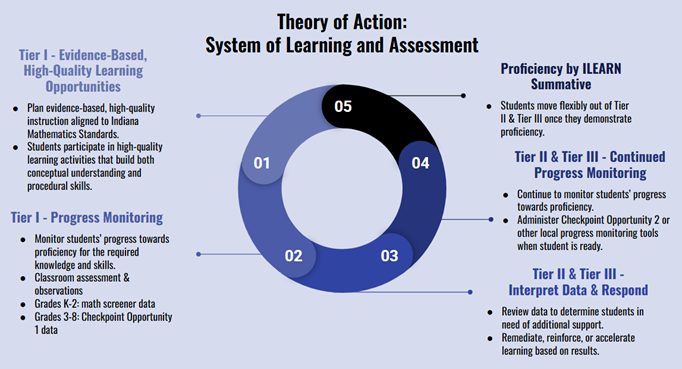
IDOE has intentionally incorporated a common theory of action across systems (i.e., ILEARN Through Year Assessment, Tiered Systems of Support). Strong mathematics instruction begins with high-quality, research-based core instruction that provides strong learning opportunities for all students.
Continuous progress monitoring through various formative and summative assessments, including the ILEARN Math Checkpoints, provides data to pinpoint student learning along standards-based learning progressions. Students who are identified as needing additional support in accessing grade-level content receive targeted, differentiated, high-quality small group instruction. This instruction is fluid and flexible as educators provide opportunities for students to interact, show progress, and demonstrate understanding with rigorous grade-level content.
Frequent progress monitoring and adjustments to instruction based on student progress allow students to move in and out of tiered instruction as needed. As this cycle of instruction, assessment, targeted instruction, and continued assessment continues throughout the year, students move toward mastery of grade-level standards, demonstrating proficiency on the ILEARN Summative Assessment in the spring.
General Resources
- Advancing K-12 Indiana Mathematics for Indiana Students Initiatives summarizes educator, student, and family support due to 2025 legislation, upcoming updates to instructional and assessment frameworks, and future additional supports for educators and families.
- The 2023 Indiana Academic Standards for Mathematics outline the prioritized, legally required learning expectations and highlight essential grade‑level content to ensure all students develop the knowledge and skills needed for future employment, enrollment, or enlistment.
- The Mathematics Instructional Frameworks collection contains the 2023 Math Frameworks aligned to the Indiana Academic Standards. The instructional frameworks also linked on IDOE’s website are intended to guide best practices in instruction and translate standards into learning opportunities for students through the breakdown of evidence and clarification statements, academic vocabulary, common misconceptions, prior knowledge skills, instructional resources, universal supports for all learners, and a skill-based breakdown of the Performance Level Descriptors (PLDs).
- The Indiana Assessment Framework for Mathematics provides a cohesive place for all instructional resources related to assessment, including Test Blueprints, Item Specifications, Performance Level Descriptors (PLDs), and example items for all assessments. For further information on how to use the PLDs, please reference the Guide to the 2023 ILEARN Performance Level Descriptors.
- The Five Strands of Mathematical Proficiency (The National Research Council) are the essential skills that allow students to engage with, explore, and apply mathematical concepts in a meaningful way.
- IDOE’s High-Quality Curricular Materials Advisory Lists supports schools in identifying high-quality curriculum for the teaching of Mathematics that is aligned with the 2023 Indiana Academic Standards (IAS) for Mathematics and has satisfied all required criteria as outlined in the evaluation rubrics.
- The Effective Teaching Practices for Mathematics resource summarizes eight effective mathematics teaching practices adapted from NCTM’s Principles to Actions and connects them with practical Indiana supports, including professional learning courses and instructional routines. Teachers can use this document to strengthen lesson design, promote reasoning and discourse, and use evidence of student thinking to enhance daily instruction.
Resource Collections
The Indiana Department of Education (IDOE) provides a curated collection of mathematics resources designed to support high-quality instruction, aligned initiatives, and educator professional learning. Explore the materials below to access tools, guidance, and supports that strengthen mathematics teaching and learning across Indiana.
- IDOE’s Early Learning webpage
- Early Learning Instructional Frameworks: These frameworks are intended to be a resource for educators to support and enhance children’s learning and development while using the 2023 Indiana Early Learning Standards. While not an exhaustive list, these frameworks are meant to support a child’s development at different levels of learning and promote fluid movement between developmental stages.
- Meaningful Early Math Experiences Collection: Explore this collection of meaningful early math experiences with a focus on numeracy, computation, measurement, and geometry. Gain deeper knowledge about the standards and walk away with easy-to-implement ideas you can use in your learning environment immediately.
- Parent and Family Support Hub Birth-Grade 2: Featuring vetted resources, including websites, videos, workshops, and other content to support families of young children at home.
- Learning & Teaching with Learning Trajectories (Early Math, Birth - Grade 3): Explore how children naturally develop mathematical thinking through learning trajectories, and discover strategies for designing lessons and activities that intentionally guide them along these paths.
- ISPROUT Assessment: The Indiana Student Performance Readiness and Observation of Understanding Tool (ISPROUT) is currently utilized to measure skill development in children from infancy to kindergarten. ISPROUT provides a snapshot of children’s abilities at the beginning of kindergarten from an evaluation of eight domains.
- IKRA: The Indiana Kindergarten Readiness Assessment (IKRA) is a developmentally-appropriate instrument that measures a child’s school readiness across multiple domains. Understanding a child’s school readiness helps kindergarten educators best meet the child’s needs and helps schools, families, communities, and policymakers know how best to support young children as they enter the K-12 environment.
- Access additional information for families and educators here regarding the transition from early childhood learning to a school learning environment.
- Universal Mathematics Screener Guidance for Kindergarten through Grade Two: This guidance document is designed to support the implementation of the 2026–2027 mathematics legislation on universal mathematics screeners and tiered intervention. Resources include an Individual Mathematics Plan template for documenting student needs, interventions, and progress, along with strategies for intensifying Tier I instruction. An editable Individual Math Plan is available in the resources section of the guidance.
- ILEARN Through‑Year Mathematics Guidance: Using Checkpoint Data to Identify and Support All Students (Grades 3–8) : This guidance document is designed to support the implementation of the 2026–2027 mathematics legislation on tiered intervention. Resources include an Individual Mathematics Plan template for documenting student needs, interventions, and progress; guidance on beginning intervention cycles prior to Checkpoint 1; and strategies for intensifying Tier I instruction. An editable Individual Math Plan template is available in the Additional Resources and Information section of the guidance.
- Indiana Tiered System of Supports Toolkit for Mathematics Courses (K-2): The IDOE Tiered System of Supports Toolkit for Mathematics Courses is an asynchronous learning course designed to provide educators with practical, evidence-based strategies that strengthen mathematics instruction and intervention to support all learners.
- Proficiency Level Descriptors: Mathematics Grades K-2: The K–2 Classroom Assessment Performance Level Descriptors (PLDs) outline learning progressions for each standard, reflecting students’ natural skill development and levels of thinking. Organized into four proficiency levels—Below, Approaching, At, and Above Proficiency—they help educators assess where students are along the continuum and tailor instruction accordingly. This vertical articulation across Kindergarten through grade two supports consistent expectations and targeted growth both within and across grade levels.
- Indiana Tiered System of Supports Toolkit for Mathematics Courses (3-5): The IDOE Tiered System of Supports Toolkit for Mathematics Courses is an asynchronous learning course designed to provide educators with practical, evidence-based strategies that strengthen mathematics instruction and intervention to support all learners.
- Learning & Teaching with Learning Trajectories (Early Math, Birth - Grade 3): Explore how children naturally develop mathematical thinking through learning trajectories, and discover strategies for designing lessons and activities that intentionally guide them along these paths.
- Effective Mathematics Teaching Practices: Middle School (Self-Paced Course): This self-paced course provides specific guidance for grades 6, 7, and 8 educators and leaders on how to apply effective mathematics teaching practices in Tier I instruction.
- ILEARN Through‑Year Mathematics Guidance: Using Checkpoint Data to Identify and Support All Students (Grades 3–8): This guidance document is designed to support the implementation of the 2026–2027 mathematics legislation on tiered intervention. Resources include an Individual Mathematics Plan template for documenting student needs, interventions, and progress; guidance on beginning intervention cycles prior to Checkpoint 1; and strategies for intensifying Tier I instruction. An editable Individual Math Plan is available in the Additional Resources and Information section of the guidance.
- Indiana Tiered System of Supports Toolkit for Mathematics Courses (6-8): The IDOE Tiered System of Supports Toolkit for Mathematics Courses is an asynchronous learning course designed to provide educators with practical, evidence-based strategies that strengthen mathematics instruction and intervention to support all learners.
- Advanced Math Course Automatic Enrollment
- Additional information regarding the middle school requirements under Indiana Code (IC) 20-30-18-3 can be found in the frequently asked questions document.
- A sample caregiver notification and opt-out form can be found here.
- Implementing Advanced Middle School Mathematics: This guide provides administrators and school leaders a structured resource for evaluating local needs, planning, and selecting feasible models that promote high‑quality advanced math experiences. It also serves as a shared reference for administrators, counselors, and teachers to align on advanced math goals.
- Data Science:
- Indiana’s Priorities for Data Science: Indiana is prioritizing Data Science education to prepare students for a workplace and world driven by data. This report summarizes feedback from Indiana’s Data Science Summit, held in December 2025, and the initial response to 2026 legislation regarding the creation of a Data Science Math Pathway.
- Indiana Learning Lab Session Summarizing Data Science Report : This session discusses Indiana’s progress and next steps in Data Science education, including a proposal for a data science pilot program for the 2027-2028 school year.
- Effective Mathematics Teaching Practices: High School (Self-Paced Course): This self-paced course provides specific guidance for high school educators and leaders on how to apply effective mathematics teaching practices in Tier I instruction.
- Algebra II
- Teaching Modernized Algebra II Learning Lab Recording
- Algebra II Instructional Planning Guide
- Algebra II Course Guide
- PRIME Mathematics
- PRIME Webinar Recording for Counselors & Administrators and Educators
- PRIME Math & the New Indiana Diploma resource
Learning Lab Learning and Assessment Hub
- Video: Overview of ILEARN Through-Year Assessment
- 2025 ILEARN Through Year Webinar
- Indiana Assessment Framework for Mathematics
- Example Grade-Level Learning Progressions
- Summative Proficiency Level Descriptors: Mathematics (Grades 3-5)
- Summative Proficiency Level Descriptors: Mathematics (Grades 6-8)
Tiered System of Supports for Mathematics
Mathematics in Public Policy
Indiana continues to be a leader in establishing comprehensive math policy that is aimed to create optimal conditions for all students to thrive mathematically.
The following policies take effect beginning with the 2026-2027 school year:
- K-2 Universal Mathematics Screener (IC 20-32-6.5-2): Requires math screening for all students in kindergarten through grade 2. If a student is at risk of not achieving grade-level proficiency, teachers shall provide targeted, differentiated, and evidence-based intervention until the student no longer has a need. Information and evidence-based resources will also be provided to parents and caregivers to support students at home.
- K-8 Tiered System of Supports (IC 20-32-6.5-3): Requires any student in kindergarten through grade eight who is at risk of not achieving grade-level proficiency in mathematics to receive a multi-tiered system of support. This support shall be through Tier II and/or Tier III supports that are aligned and supplemental to Tier I instruction.
- Parent Notification (IC 20-32-6.5-3): Requires schools serving students in kindergarten through grade eight to provide notice to parents no later than 15 days after a student is identified as being at risk. The notice may contain specific information about the student’s math performance, the intervention the student will receive at school, and/or a list of recommended resources for use at home to support growth in mathematics.
- K-5 60-Minute Math Block and 20-Minute Intervention Block ( IC 20-32-6.5-4 ): Requires all students in kindergarten through grade 5 to receive a minimum of 60 minutes of Tier I math instruction each day, along with 20 minutes of mathematics intervention.
- Middle School Advanced Math Auto-Enrollment (IC 20-30-18-3): Requires all public and charter middle schools to automatically enroll any middle school student who achieves “above proficiency” on the ILEARN Mathematics assessment and who earns a grade of “C” or higher in their mathematics coursework in an advanced math course for the subsequent school year.
- Data Science Math Sequence Development (IC 20-19-3-42): Requires IDOE to develop a data science sequence of courses in high school that prepares students for emerging workforce demands by December 1, 2026
Other legislative policies include:
- New High School Diploma Requirements (20-19-2-21): The Indiana State Board, in consultation with IDOE, established new high school diploma requirements effective for all students beginning with the class of 2029. The new Indiana diploma establishes designations (seals) that indicate a student is adequately prepared for direct entry into the workforce upon graduation, postsecondary education aligned to the student’s chosen career path, and/or enlistment into the military. https://www.in.gov/doe/diplomas/
- High Quality Curricular Materials (20-20-5.5-2): IDOE will evaluate, approve, and publish a list of high-quality curricular materials no later than July 1, 2027, and each July 1 thereafter. Click here to access the High-Quality Curricular Materials list of vendors and the associated rubric for mathematics.
- Postsecondary Ready Investigative Mathematics Experience (HB 1001): Each fiscal year, STEM program alignment funds are allocated for IDOE to partner with the commission for higher education to provide professional development and technical assistance to schools that pilot the Postsecondary Ready Investigative Mathematics Experience (PRIME) course for students transitioning from secondary to postsecondary education.
- Educator Preparation Programs (IC 20-28-3-3.2): Requires the Indiana Department of Education (IDOE) to develop guidelines for accredited teacher preparation programs regarding the use of curriculum or content that prepares elementary school teacher candidates to effectively teach foundational mathematics skills aligned with evidence-based instructional strategies. These instructional strategies shall promote conceptual understanding, procedural fluency, and real-world problem solving. Guidelines will also be developed by IDOE for Educator Preparation Programs regarding the use of curriculum or content that prepares elementary school teacher candidates to implement math instruction using high-quality instructional material and understand and use student data to make instructional decisions.