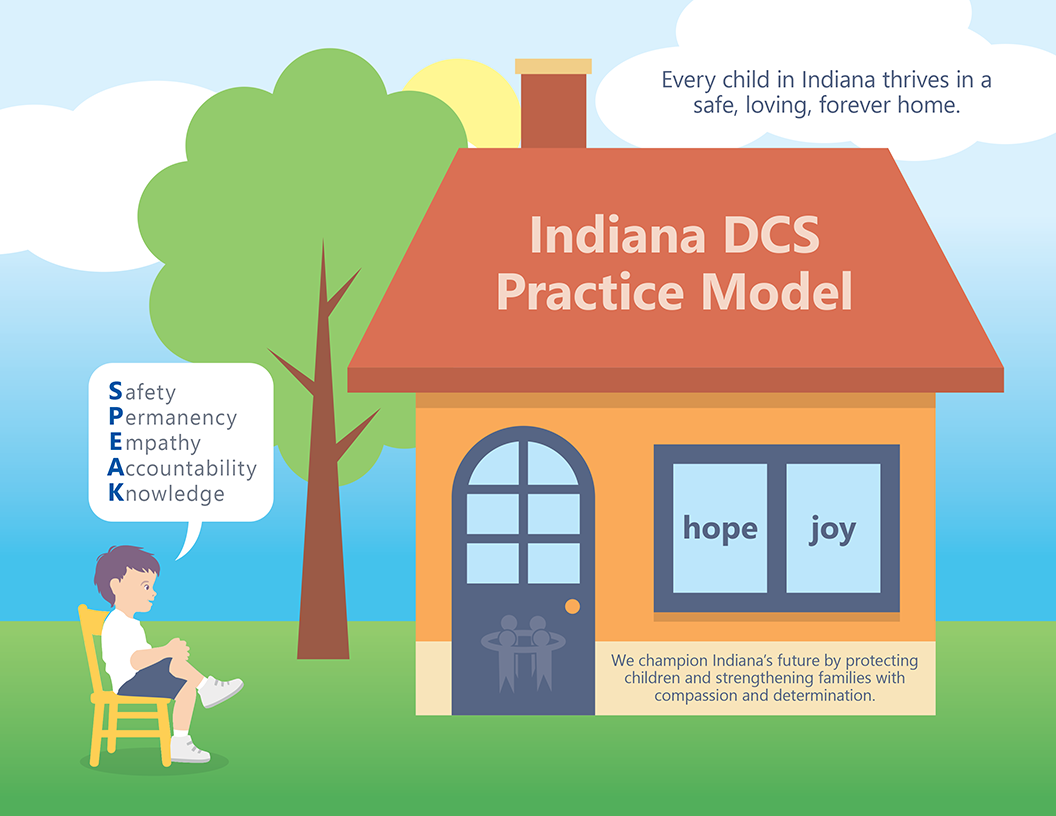
DCS’ Practice Model is a blend of skills and values that support the agency’s mission, vision and purpose.
It is represented in the above image by a house. DCS' "Foundational Phrase" is printed across the foundation: "Safe Children, Strong Families." The words "hope" and "joy" appear on the windows. This stands for the DCS purpose statement: "Ignite hope. Cultivate joy." On a cloud in the sky above the house is the DCS vision statement: "Every child in Indiana thrives in a safe, loving, forever home." On the grass in front of the house is the DCS mission statement: "We champion Indiana’s future by protecting children and strengthening families with compassion and determination."
Practice Model Skills
- Engaging:
Engaging involves open and honest dialogue in an encouraging, empowering and compassionate way to inspire others to share experiences and stories. Engaging is rooted in empathy, trusting relationships and personal connections leading to meaningful collaboration. This ongoing process is our foundational skill, vital to a family-centered practice and central to achieving outcomes related to child safety, permanency, stability, well-being and long-term view. - Assessing:
Assessing is the continuing process of gathering and synthesizing critical information related to the child(ren) and family’s story, strengths, needs, protective factors and culture to identify underlying needs, resources and essential connections to develop plans for safety, stability, permanency, well-being and long-term view. - Teaming:
Teaming means bringing people together with the child(ren) and family to share ideas, find solutions and make plans to achieve goals related to safety, permanency, stability, well-being and long-term view. Teaming champions the voice of the family through collaboration with DCS, essential connections and key partners to identify and establish safety networks, safety plans and pathways to permanency. - Planning:
Planning involves leveraging the partnerships created through engaging, assessing and teaming to create meaningful action steps to address the identified safety concerns, risks and needs of the child(ren) and family. It establishes shared accountability for the development of safety plans, case plans and permanency plans which, where possible, include the role and voice of the child(ren) and family. - Intervening:
Intervening is the implementation of activities identified during the planning phase. Quality intervention ensures that service referrals, identified supports and resources are individualized and specific to the child(ren) and family, support desired outcomes and goals, and address underlying needs while mitigating barriers to child safety, permanency, stability, well-being and long-term view. Interventions should motivate commitment to change, ignite hope, and cultivate joy and a promising outlook for lasting change.
Foundational Phrase: "Safe Children, Strong Families"
This short phrase encapsulates the core message of our mission, vision and purpose. We can achieve “Safe Children, Strong Families” by adhering to these guiding principles:
- Keep children safely at home
- Right resources, right time
- A safe, stable, quality home
The following are the pillars supporting our efforts:
- Workforce
- Technology
- Communication
- Fiscal responsibility