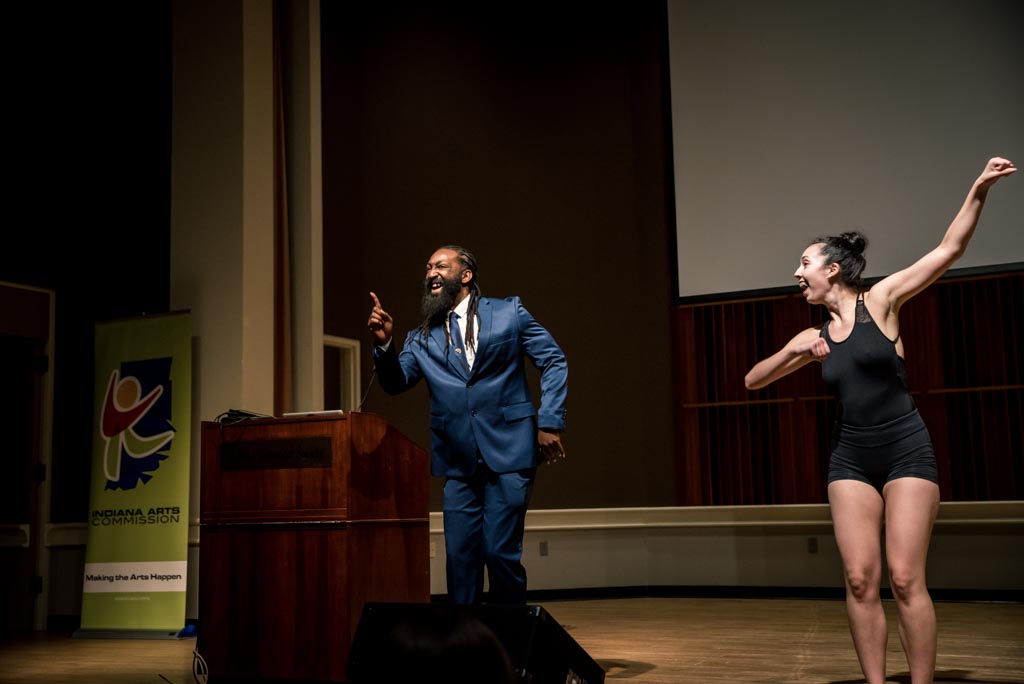
When we say access, we mean it. After all, we believe in the arts evereywhere, every day, for everyone in Indiana. So when it came to planning the 2019 Indiana Arts Homecoming, we made sure to consider how to make the experience the best it could possibly be for every attendee. That meant thinking in advance and asking the question to our attendees – do you need any accommodations? They did, and we helped them get the most out of their Homecoming experience.
Summary: What we did
We hired five American Sign Language (ASL) interpreters for the Indiana Arts Homecoming to provide services for nine people for a total 17 hours over two days. It cost $800 (average $50/hr plus mileage). We used CART captioning for two keynote sessions, five hours total, and it cost us $300 (average $55/hr plus mileage). In total, we spent $1,100 to make our two-day conference accessible. We used the company Luna Language to hire both of these services.
ASL interpresters: the details and process
Hiring the Urban Jazz Dance Company was one of the highlights of my work planning the Indiana Arts Homecoming conference last year. Antoine Hunter and his troupe of professional dancers were a perfect match for our theme of Inclusion, Diversity, Equity, and Access, and their artistry was phenomenal. I was elated to find out they were available for our conference dates. They presented our Keynote session and did some community outreach.
After Urban Jazz was confirmed, it was time to figure out the logistics. We would need interpreters – more then we’ve ever engaged before – to host a group of people who communicate through ASL as our keynote speakers. Even though the first thought was overwhelming, I can honestly say the process was fairly straightforward, and I learned so many things I will use for all of our public events from now on. I know a lot of people worry that hiring interpreters or making other accommodations is too expense, but if you plan ahead, every event, every performance, every public opening night, the expenses are a reasonable and expected part of the event.
There were two main days when we needed to hire an interpreter: the rehearsal night and the keynote session day. The rehearsal night, we needed to meet with the tech person and let the dancers become familiar with the stage. Our interpreter made sure the dancers could communicate all their needs to the tech person. They needed the stage cleared before their performance, and they needed the bass turned way up on the music so they could feel the vibrations on the stage.

On the main keynote day, we hired interpreters to be there from the moment the Urban Jazz group arrived in the building and settled into the green room, throughout their lunch, during the keynote presentation, and after the keynote for connecting with audience members who wanted to meet the Urban Jazz group. One thing I’m glad we did was schedule the interpreters with extra time before and after the actual events. We needed that extra time in case someone arrived early or someone wanted to chat extra long after a session.
Scheduling ASL interpreters did take some work for this big event. I wanted to make sure the interpreters had all the relevant information they needed, not just times and addresses, but also room numbers, what kind of dialogue to expect, and important proper nouns they may need to interpret.
In retrospect, I can think of one thing I think we could have done better. I wish we would have advertised that the keynote session was going to be ASL interpreted so that more people in the community would have felt welcomed and included. It’s so important to let people with disabilities know the services available on all your materials. We now know that moving forward!
Providing the interpreters was our legal responsibility, but it was also an added element that made the Homecoming experience richer for everyone.
And my hat is off to that great interpreter who had to interpret Robert Frost’s “The Road Less Traveled” on the fly as it was recited by our Poetry Out Loud state champion student. The beauty in the ASL language beautifully complemented the spoken word in that moment.
Simultaneously to all of the ASL interpretation planning described above, our conference focus on IDEA continued to develop, and we set up a meeting with our partner agency the Governor’s Council for People with Disability (GCPD). One of the GCPD’s recommendations to be inclusive and accessible during a big conference was to provide CART services for both of our keynote sessions. CART stands for Communication Access Realtime Translation. It’s the same as Closed Captioning that you can turn on on your TV, but when it’s being captioned and you don’t have the ability to turn it off, like our live event, it’s called Open Captioning. Captioning is something that benefits many people in the audience, not just those who identify as a person with a disability. We were sold on the benefits and ready to move forward, but the logistics were daunting.
Communication access real-time translation
I had seen Communications Access and Real-Time Translation (CART) in person one time at a national conference, but I had so many questions. How does it work? Did we need to provide a laptop? Do we need to download software? What cords did we need? Where do we project the text? Can we connect to a big TV? It took me several phone calls with our CART provider to find out all the answers: They bring their own laptop with special captioning software already installed, and we provided the cords and the screen we wanted the captions projected onto.
The CART services were very easy to schedule, and we got a great deal of positive feedback from attendees that they loved the captioning. It was such a benefit to our conference, it’s something I won’t hesitate to integrate into events again in the future
Do you have questions about accessibility accommodations at events? Contact me!
Stephanie Haines
Arts Education and Accessibility Manager
shaines@iac.in.gov
Published 8/10/2020
