Quarterly Report FY 2025, Quarter 4
July 1 – September 30, 2025
Prepared for
Mental Health Advisory Council (MHAC) Meeting on November 19, 2025
Indiana Protection and Advocacy Services (IPAS) Commission Meeting on November 21, 2025
IDR's Mission: To uphold, promote, and advance the rights of individuals with disabilities
through empowerment and advocacy to achieve a more equitable society.
Table of Contents
Executive Director's Note
IDR Opening Fewer Cases Due to Funding & Shutdown
With the government shutdown and delay of confirmation on federal fiscal year 2026 funds, IDR has had to make the difficult decision to limit the number of cases that we open in certain programs, including PADD and PAIMI. Our hope is that once the government reopens and we are able to determine our 2026 federal budget, we will be able to reassess our case capacity. (P&O 3.1)
Rebalancing Due to Staffing Challenges
In 2025, IDR lost 4 staff that we are unable to replace due to the uncertainty of our 2026 funding and loss of state funds. The entire IDR team has taken on additional work and has shown tremendous flexibility as we have had to shift some roles and responsibilities to prioritize our grant obligations. (P&O 3.1)
IDR is Monitoring Affected Federal Programs
We continue to monitor the funding situation for federal fiscal year 2026, not just for P&A programs but for many services and supports important to the disability community. The future of SAMHSA, as well as education services for students with disabilities overseen by the Department of Education are in jeopardy. P&A programs exist to help ensure these programs are available and accessible to those who need them. (P&O 3.2)
Safety Grant Awarded to IDR
IDR was awarded $5,000 to train our investigation and monitoring staff on how to monitor fire safety conditions at facilities. IDR’s investigation coordinator, Tina Frayer, was part of a group of P&A staff trained by NDRN on this important topic and the award of funds to support this training of our staff allows IDR to reserve additional funds for program use. (P&O 1.1)
IDR Meets with Governor Braun to Advocate for Small Agencies
I met with Governor Braun and other Health and Family Services agency heads to provide information about our programs, successes, challenges, and opportunities. I used this opportunity to connect with other agency heads new to the administration and to advocate for more flexibility for smaller agencies. (P&O 3.1)
Supporting Individuals in Appeals Process
IDR received 16 appeals in 2025. All requests stemmed from IDR’s inability to provide representation due to a lack of resources and/or no identified rights violations. IDR provided additional referrals and recommendations to each person requesting reconsideration. (P&O 3.1)
Staff Support Callers, Clients, and One Another
In September, IDR staff gathered together to share food, offer support, and hear successes from the past year.
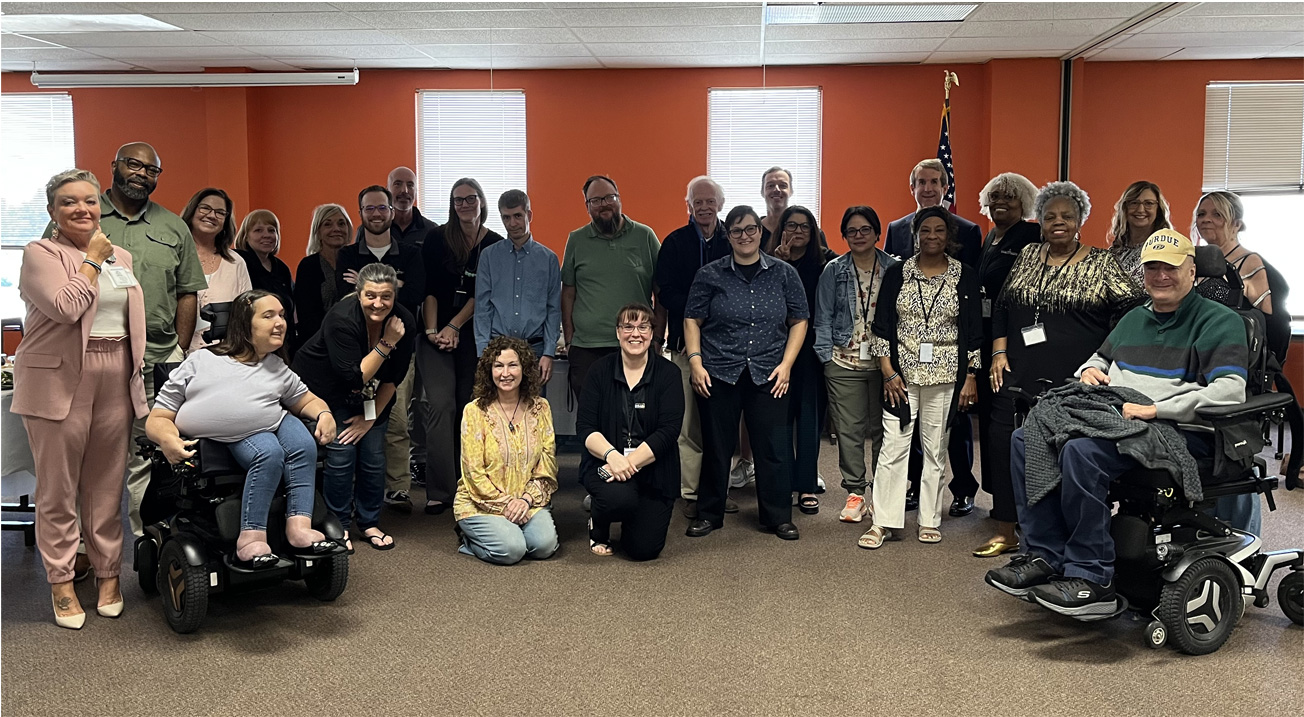
Staff of Indiana Disability Rights, September, 2025
Team Updates
Abuse, Neglect, & Discharge Team
Monitor and Investigate
Licensing Reports Filed
Six cases were opened this quarter to investigate allegations of abuse, neglect, and exploitation. Additionally, IDR filed eight licensing complaints with overseeing authorities—six with DCS, one with APS, and one with the Joint Commission. (P&O 1.1)
Investigation Finds Hospital Kept a Patient in Restraints for Twelve Days
A patient at a state hospital reported he had been placed in a restraint chair for 48 hours, followed by ankle and wrist restraints for ten days. Christian Ewoldt immediately investigated, and the hospital substantiated the patient’s allegations. A review of hospital records and policies found that staff acted within current policies. IDR’s investigation led to administrative and policy changes. Christian’s advocacy also resulted in the hospital addressing other safety concerns and possible rights violations. (P&O 1.1)
IDR Reviewed 377 Death Records and Opened Ten Investigations in FY2025
This quarter, staff reviewed 77 death reports, as part of the Mortality Review Committee. During the fiscal year, IDR reviewed a total of 377 death reports. Ten reports showed possible abuse and neglect, resulting in IDR conducting 10 investigations. This work directly fulfills IDR’s goal to prevent, find, and stop the abuse and neglect of people with disabilities by service providers. (P&O 1.1)
Advocate
A Patient's Right to Restoration of Personal Belongings
For patients, personal items may provide comfort, connection to the person’s history or family, and symbolize their identity. After over a year of advocating for the return of “David’s” personal items, which were being held at the county jail, Advocate Natasha Henry was successful in retrieving the items and returning them to David at the state hospital where he is now a patient. When the items arrived, a nurse attempted to throw out the items, without requesting David’s permission to do so. Natasha immediately reported the situation to hospital administrators, and the issue was addressed. As a result of IDR’s advocacy, state hospital staff were retrained to follow proper procedures before discarding patients’ belongings, ensuring other patients’ rights to access their belongings will be respected. (P&O 1.1, 2.1)
Educate
Highlighting the Rights of Youth in Placement
Natasha Henry and Christian Ewoldt spoke at Indiana Family to Family’s Heart to Heart Conference in September. Their training, based on IDR’s Know Your Rights Coloring Book, focused on the urgent need for young people to understand their rights when receiving treatment in a facility, to help prevent mistreatment, ensure they receive the least restrictive care, and empower them to participate in their care and to advocate for themselves. (P&O 2.5)
Success Story
Discharge Advocacy Allows Individuals to Move to Less Restrictive Environments
IDR staff continue to monitor discharges from state hospitals and CRMNFs to ensure individuals are given timely consideration for discharge. This quarter, IDR monitored the discharge of eight adults, who are now living in less restrictive settings. (P&O 2.1)
Monitoring Team
Monitor and Investigate
Staff Conducted 117 Monitoring Visits in FY2025
IDR staff conducted 26 monitoring visits at eight facilities this quarter. That brings the total for the year to 117 monitoring visits at 42 facilities. Advocates were able to identify and address risks such as inadequate staffing, unsafe environments, or lapses in care standards as they advocate on behalf of those receiving services. (P&O 1.1)
Success Story
Advocates Monitor State Psychiatric Hospitals to Address Patient Concerns
As the State Psychiatric Hospital (SPH) system continues to implement the current administration’s budgetary guidance, there have been numerous staff changes and eliminations, which can disrupt patients’ routine and stability. Monitoring visits allow IDR staff to stay abreast of these changes and provide consultation and advocacy to patients. (P&O 3.1)
Rep Payee Team
Monitor and Investigate
Reviews Protect Social Security Beneficiaries
IDR started 18 new cases, had 19 cases in progress, and finished 20 cases this quarter. In addition, IDR completed 116 appointments with payees, beneficiaries, guardians, and third parties. Rep Payee Reviewers initiated a total of 98 cases and finished a total of 93 cases this year. This work aligns with the Strengthening Protections for Social Security Beneficiaries Act. (P&O 1.1)
Rep Payee Team Completed 536 Appointments in FY2025
Rep Payee Reviewers completed 116 appointments this quarter. These included payee appointments, beneficiary appointments, legal guardian appointments and/or third-party appointments. That brings the total number of appointments completed by this team this fiscal year to 536. (P&O 1.1)
Success Story
Communication with SSA Restored Temporarily; Guidance Received
After several months with no communication from SSA, SSA’s new temporary Regional Officer (Chicago Office) resumed communication in August and September. IDR received approval for submitted corrective action plans and was able to close completed cases. At the same time, the P&A network requested and was provided with new case assignments for the upcoming quarter. As of October 1, the federal government shutdown has stopped the work at SSA that oversees the Rep Payee program, so no further communication will be received until the shutdown ends. Rep Payee reviewers will continue to submit case closures to NDRN and await SSA’s response in the coming quarter. (P&O 1.1)
Civil Rights Team
Advocate
Tenant Charged Fee for Handrail in Common Area
“Don” was charged a fee by his apartment complex for the installation of a handrail in a common area. With IDR's help, Don's landlord reversed the charge. (P&O 2.1)
Educate
ADA Essentials: Service Animals and Public Access Explained
In September, Sam Adams spoke to 150 public health officials at the Indiana Environmental Health Association Conference about the rights of individuals with service animals to access public spaces. This presentation informed officials of the rights of individuals with service animals and will help officials inform staff of the facilities they inspect about their responsibility to ensure public spaces are accessible for patrons with service animals. Check out IDR’s Service Animal Fact Sheet for more information. (P&O 2.1)
Success Stories
An Unreasonable Demand for a Reasonable Accommodation
“Dorene’s” landlord demanded medical documentation each time she requested a reasonable accommodation, even if they already possessed all the information necessary to review her request. Thanks to IDR’s advocacy, the landlord reversed course and removed the request for unnecessary medical documentation. (P&O 2.1)
Systemic Litigation
Seventh Circuit Continues to Allow Mothers to Provide Attendant Care Services for Their Medically Fragile Children
Indiana Protection and Advocacy Services Commission, et al. v. Indiana Family and Social Services Administration, et al. (1:24-cv-833-TWP-TAB; U.S. District Court, Southern District of Indiana)
The U.S. Seventh Circuit Court of Appeals has affirmed a district court’s preliminary injunction in favor of two medically fragile children against the application of changes to the Indiana Family and Social Services Administration’s (“FSSA”) Health and Wellness Medicaid Waiver Program (“H&W Waiver”) that prohibited parents from providing paid care to their medically complex children. The decision means that two Indiana mothers can continue to serve as paid providers of “attendant care” for their children. Further, the Court remanded the case to the district court for further proceedings. “This decision reinforces the understanding that children with complex medical needs are best served when they can remain at home with their families. The Court found that there are steps that FSSA can and must take to help ensure these children remain safely in their families’ homes,” said Senior Attorney Sam Adams. (P&O 2.4)
- Appeals court sides with mothers in attendant care case; Capital Chronicle
- US appeals court preserves paid attendant care for 2 Indiana moms; WISH TV
- MEDICAID—7th Cir.: Appeals court affirms preliminary injunction against Indiana LRI attendant care policy change; Vital Law
Individual Litigation
Settlement Reached in Fair Housing Case
Jason Grabarczyk and Annette Young v. Town of Edinburgh, Indiana (1:24-cv-847-JRS-TAB; U.S. District Court, Southern District of Indiana)
This lawsuit, filed on behalf of an Edinburgh resident with disabilities (and his caretaker/housemate) under the Fair Housing Act, challenged the town’s failure to allow the residents to keep chickens at home for therapeutic purposes. The case has been settled, with the town agreeing to allow the residents to keep their current chickens. (P&O 2.3)
Education Team
Advocate
When a 504 Plan Does Not Provide Adequate Support for a Student
The high school denied “Dakota” an IEP, saying his 504 Plan was sufficient. IDR argued Dakota needed specialized instruction, not just accommodations, and that Dakota’s academic performance was suffering due to lack of an IEP. IDR staff attended the case conference and were able to successfully advocate for an IEP and ensure Dakota would have access to previous assignments. Dakota finished the school year with passing grades in his classes. (P&O 2.1)
Educate
Explaining Rights and Possibilities to Students Approaching Adulthood
Staff provided four presentations to groups supporting students preparing to leave high school for employment, training, or post-secondary education. Michelle Wickham presented at several Family Employment Awareness Trainings, explaining the role and resources of IDR. Melissa Keyes presented to the Plainfield Schools Special Education Parent Advisory Council on supported decision-making and students’ rights when they reach adulthood. (P&O 2.2, 3.1)
Success Story
Student Denied Speech Therapy Receives Compensatory Services
“Dalton’s” IEP called for him to receive speech language therapy. He was not receiving it, his high school said, because they had no providers. IDR staff attended two case conferences and successfully advocated for prompt initiation of speech therapy services. The school also agreed to provide 450 minutes of compensatory services to make up for the time Dalton had missed. (P&O 2.1)
Employment Team
Advocate
Twenty Year Employee Fired After FMLA
“Deborah” called IDR after the company she worked at for twenty years fired her after she returned from taking leave under FMLA. IDR represented Deborah and was able to negotiate a pre-litigation settlement agreement between Deborah and her employer. (P&O 2.1, 2.2)
Educate
IDR Educates Job Coaches to Support VR Participants Seeking Reasonable Accommodations
IDR’s Employment team presented to 48 counselors, job coaches, and specialists from the Indianapolis and Muncie Vocational Rehabilitation offices this quarter. (P&O 2.2, 3.1)
Success Stories
Reasonable Accommodation is Required During Orientation and On the Job
“Deja” required a reasonable accommodation to complete new employee orientation at her new job, which her employer refused to provide. Deja reached out to IDR for help. IDR represented Deja through an Equal Employment Opportunity Commission investigation and helped her file a lawsuit for discrimination under Title I of the ADA. Thanks to IDR’s advocacy, the issues was resolved through settlement. (P&O 2.2)
Fired for Using a Wheelchair: IDR Helps "Daniella" Fight for Her Rights at Work
“Daniella” was fired from her job in healthcare after her first day of work. Daniella sometimes uses a wheelchair for support and disclosed this to her employer. She was suspended after her first shift and was required to see a medical provider selected by her employer before she could return to work. She was subsequently terminated because her employer felt she could not perform the essential functions of her job. Thanks to IDR’s legal representation, Daniella and her employer reached a settlement agreement. (P&O 2.2)
Health Care Team
Advocate
In-Home Nursing Appeal Needed for "Don"
IDR successfully represented “Don,” a Medicaid recipient, to appeal the partial approval of his request for in-home nursing hours. After the hearing, an administrative law judge increased Don’s daily in-home nursing hours from 10 to 14, allowing him to receive the care he needs and remain in his home. (P&O 1.1, 2.3)
Educate
IDR Helps the Department of Health Serve Individuals with Disabilities
The Indiana Department of Health asked IDR for its recommendations to form a work group to investigate the issue of smoking cessation and cancer screening in the disability community. The group convened for the first time this quarter. (P&O 2.1, 3.2)
Self-Determination Team
Monitor
Advisory Board Convenes for Court Monitoring Pilot Project
Melissa Keyes and Justin Schrock joined the newly formed State Advisory Board for the Court Monitoring Pilot Project (CMPP), set in Fountain County. Board members discussed project scope, procedures, data collection, and recruitment of volunteer court monitors. This highly anticipated project is expected to begin in the new fiscal year. (P&O 2.4)
Advocate
IDR Resource Helps You Choose Your Health Care Advocate
Daisy’s parents obtained plenary guardianship over Daisy when she turned 18, while living in Ohio. The family recently moved to Indiana and contacted IDR regarding the transfer of the guardianship. IDR staff discussed alternatives to guardianship with Daisy and her parents and assisted Daisy in filling out the paperwork necessary to appoint her mother as her Medicaid representative. Then Daisy used IDR’s Health Care Representative form to appoint her parents as her health care representatives. With this support, in addition to those already in place, the Ohio court agreed to terminate the prior guardianship, ensuring Daisy can make decisions for herself. Check out IDR’s Advanced Directives website for more information. (P&O 2.4)
Educate
IDR Featured on Ask the Arc
Justin Schrock joined Karly Sciortino-Poulter on the September edition of the Ask the Arc web series. The episode, called “Guardianship Rights, Responsibilities, and Limits” offered practical and actionable ways to promote self-advocacy and self-reliance. The session was viewed by 71 individuals live and has been replayed over 100 times on The Arc of Indiana’s YouTube channel. (P&O 2.4, 3.2)
Training Offers Case Managers Tools to Empower Those They Serve
This quarter, Justin Shrock educated 80 professionals at Inspire Case Management about the responsibilities of guardians and the need to empower individuals to greater autonomy, using tools like supported decision-making, healthcare representative agreements, and advanced directives. Because of funding issues, IDR has paused training programs for providers and will not offer them again until further notice. (P&O 2.4)
Technical Assistance
IDR Legal Expertise Requested by Community Leaders
Technical assistance on supported decision-making (SDM) and less-restrictive alternatives to guardianship to 33 organizations (9 in Q1, 12 in Q2, and 12 in Q3). IDR has offered technical assistance at least 115 times to stakeholders, many of whom regularly engage IDR for support. IDR's leadership in this area is needed now more than ever to continue the momentum toward self-determination. (P&O 2.4, 3.2)
Legislative Advocacy
Legislation Needed to Convene a Work Group to Review Proposed Revision to Indiana's Guardianship Code
Melissa Keyes worked with members of the Probate Trust and Real Property Section of the Indiana State Bar Association on proposed legislation to convene a workgroup in 2026 to review a proposed revision of Indiana’s guardianship code. This work group will be an important next step in modernizing Indiana’s laws to improve protections for people subject to guardianship, and to clarify the roles and responsibilities of guardians. (P&O 2.4)
Policy & Special Projects Team
Legislative Advocacy
IDR Submits Public Comments Regarding Proposed HCBS Waiver Amendments
On August 8, IDR submitted comments regarding the proposed changes in the HCBS Waiver. In FY2025, IDR submitted public comments 13 times. (P&O 2.3)
Monitor
IDR Urges DDARS to Include Data and Analysis to Demonstrate Effectiveness of Career Counseling Program
Melissa Keyes and Emily Munson and staff from the Center for Public Representation met twice this quarter with DDARS staff regarding its initiatives to increase competitive integrated employment opportunities. IDR reiterated the importance of data collection and analysis to determine program success and urged DDARS staff to begin collecting more robust data regarding participation in employment services. IDR also expressed concern about BRS’s plans for meeting federal requirements for delivering career counseling to sheltered workers at least annually, as its contract to deliver these services expired June 30. (P&O 3.3)
Advocate
Work on IDR's Websites Ensures Visitors Get the Information They Need
IDR is committed to ensuring our websites are accessible for visitors, and that they can locate the information they need. To this end, Michelle Wickham and Emily Munson began combing through IDR’s web files. Archiving unnecessary web files will make finding relevant information easier, and this process is the first step in the State’s process to comply with federal accessibility regulations set to take effect in April 2026. (P&O 3.1)
Educate
IDR Featured in Federal Court's Celebration of Disability Awareness
In September, Emily Munson spoke at the federal courthouse in Indianapolis, at the Southern District’s celebration of disability awareness. Emily presented to 150 judges, clerks, and court staff about the changing meaning of “disability” throughout U.S. history and touched on current topics in disability law. The organizer said attendees described Emily’s presentation as informative and enjoyable. Opportunities like this strengthen IDR’s relationship with the courts and legal community and enhance IDR’s credibility as experts in disability law. (P&O 3.1, 3.2)
Success Story
IDR Feedback Leads to Change to DMHA Proposed Rule
DMHA made changes to a proposed rule about mental health referral programs, based on IDR’s public comments. Specifically, IDR recommended DMHA require the programs to post their guidelines online. DMHA acknowledged that this may be burdensome for some smaller programs but agreed that it is appropriate and will require programs to do so. IDR also recommended that DMHA require programs to post complaint and grievance procedures. DMHA is now requiring the guidelines (referenced above) to include a complaint and grievance procedure. (P&O 3.2)
Voting
Educate
Staff Offer Voting Support to Self-Advocates
Nine staff members interacted with 480 people at the annual Self-Advocates of Indiana (SAI) Picnic in September. IDR offered 279 resources at the event. With staff support, five attendees updated their voter registration, one attendee registered to vote for the first time, and one attendee created their own Health Care Representative form as part of an Advanced Directive. In addition, attendees decorated 225 “Why I Vote” buttons and paper fans. (P&O 2.6, 3.2)
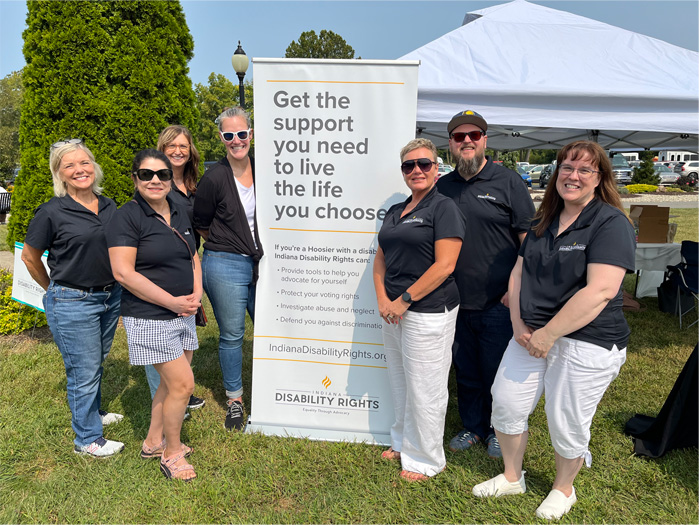 IDR staff at the 2025 Self-Advocates of Indiana picnic | 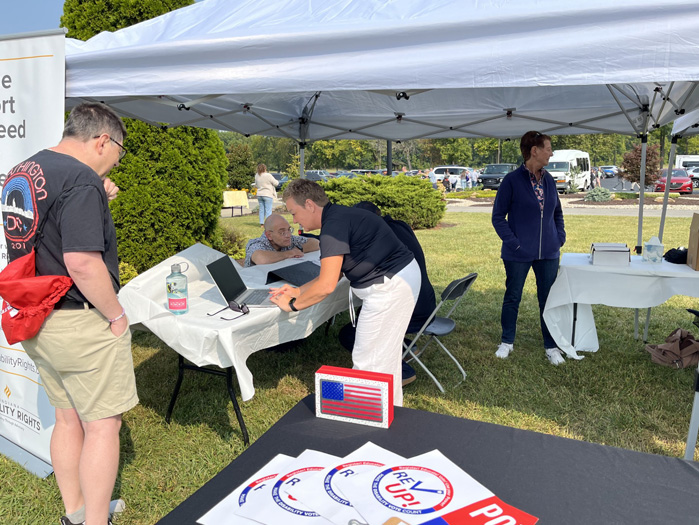 Staff assist self-advocates to check their voter registration. |
|---|
Education & Outreach
Educate
IDR Nearly Doubles Presentations to Support Self-Advocacy
This quarter, IDR staff reached 912 attendees through 18 presentations that focused on IDR’s Priorities and Objectives. In FY2025, staff have provided a total of 47 presentations versus 2024’s 25 presentations. This fiscal year, IDR’s presentations reached 2,044 attendees versus 2024’s 1,179 attendees. (P&O 3.1, 3.2)
IDR Offers Resources in Spanish, English, and Braille at Vision Expo
 Logan McCullough and Carmen Ledezma represented IDR at the Indiana Vision Expo at the Indiana State Library in September. They spoke with attendees interested in employment services in Spanish and English, and offer print resources in Spanish, English, and Braille. Accessible materials are crucial for Hoosiers to be able to learn about their rights in their own language. (P&O 2.2, 3.1)
Federal Budget Constraints Impact Important Programming
Due to federal budget constraints, beginning this quarter, IDR has made the difficult decision to decline presentation requests, invitations to table events, and other outreach opportunities until further notice. IDR hopes to reengage in educational presentations for self-advocates in early 2026.
Press
Media Interactions Showcase IDR's Priorities
This quarter, IDR interacted with the media 13 times and were featured in twelve television, radio, and online news stories. In FY2025, IDR has been featured in 30 news stories. (P&O 3.1)
Proposed Cuts to Programs Garner Media Attention
IDR has a proven track record of investigating the abuse, neglect, and exploitation of individuals with disabilities. Proposed federal budget cuts threaten this important work. The proposed drop in funding for just one critical program, the Protection and Advocacy for Individuals with Mental Illness (PAIMI) program, would cut funding from $644,339 to $230,610 and drastically reduce IDR's ability to investigate and advocate for people with mental health concerns. Read the article from WFYI/Side Effects Public Media. (P&O 3.1)
Success Story
Data Shows More Self-Advocates Access IDR Websites and Social Media
- Websites - In FY2025, IDR webpages have been viewed a total of 379,649 times. This is 135,000 more views than in FY2024. This year, IDR websites had 227,773 visitors. This is 80,000 more visitors than in FY2024.
- Social media - In FY2025, IDR’s informational posts were viewed on social media platforms Facebook, X, and Instagram over 72,000 times, compared to FY24’s approximately 25,000 views.
Check out the IDR Data Dashboard for more information. (P&O 3.1)
Supplemental Information
IDR Staff
Current Grant Programs
- CAP – Client Assistance Program
- PAAT – Protection & Advocacy for Obtaining Assistive Technology
- PABSS – Protection & Advocacy for Beneficiaries of Social Security
- PADD – Protection & Advocacy for Persons with Developmental Disabilities
- PAIMI – Protection & Advocacy for Individuals with Mental Illness
- PAIR - Protection & Advocacy for Individual Rights
- PATBI - Protection & Advocacy for Persons with Traumatic Brain Injury
- PAVA - Protection & Advocacy for Voting Access
State Hospitals
- EPCC – Evansville Psychiatric Children’s Center
- ESH – Evansville State Hospital
- LSH – Logansport State Hospital
- MSH – Madison State Hospital
- NDI – NeuroDiagnostic Institute
- RSH – Richmond State Hospital