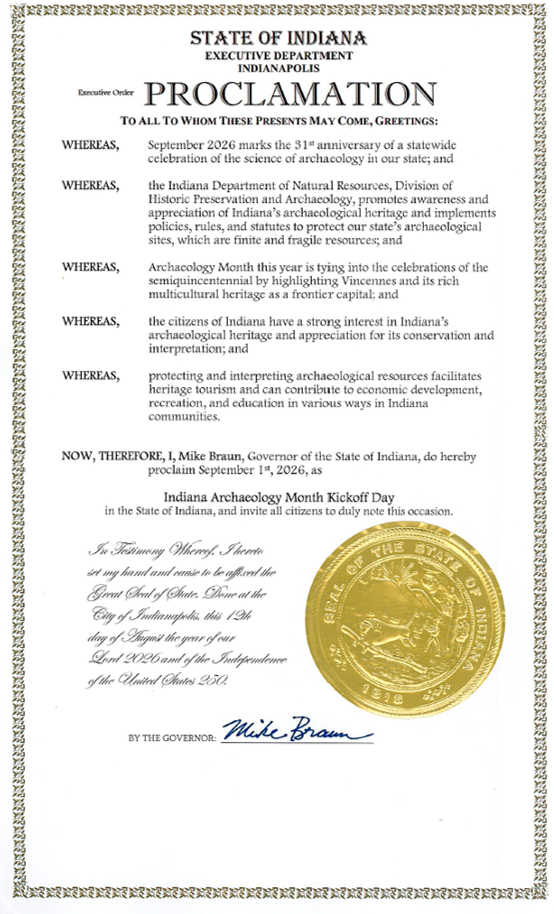
September is Indiana Archaeology Month. The Division of Historic Preservation & Archaeology (DHPA) coordinates the event to encourage learning about Indiana archaeology. Universities, museums, organizations, and individuals throughout the state host a variety of programs. These can include archaeological laboratory open houses, artifact identifications, lectures on archaeological topics, archaeological excavations, and more.
Archaeology Month helps Hoosiers learn more about the discipline of archaeology, Indiana archaeological sites, and laws protecting those sites. A goal of this month is to increase public awareness and to minimize myths and misconceptions commonly associated with the science.
Information for Event Hosts
The Division of Historic Preservation and Archaeology will produce and distribute a press release regarding Indiana Archaeology Month. Other avenues of publicity utilized by the DHPA include: e-mail, the DHPA and DNR Facebook pages, and the Preservation at the Crossroads e-newsletter.
The DHPA Calendar of Events webpage will post the complete calendar of events taking place around the state. Event hosts may refer the public to this page for information about the Month.
Event hosts are encouraged to cultivate as much local publicity for their events as possible. We suggest contacting local papers, radio stations, etc. for possible advertising options.
The DHPA has many educational materials available free of charge. If event hosts wish to have any of these items to help with publicity, or to hand out during the event, feel free to download as many as you like. Postage costs will be charged if physical copies are needed. Payment must be received prior to mailing any items.
If possible, we request that after Archaeology Month, event hosts provide the Division with summary information regarding their events. Information such as attendance numbers, comments regarding activities, suggestions for future events, etc. is very helpful for the Division staff to learn about and improve upon the continuing successes of Indiana Archaeology Month and public archaeology outreach.
Archaeology Month Poster
This year, the Indiana Archaeology Month poster is highlighting Vincennes and its rich multicultural heritage as a frontier capital. Vincennes, founded in 1732 in what was then French territory, is Indiana’s oldest continuously inhabited community founded by Europeans. The area had been home to Native American tribes for thousands of years before European arrival. Control of the region shifted from Native Americans to France to Great Britain and later to the United States, and Vincennes served as the capital of the Indiana Territory from 1800 to 1813.
2026 is the 31st anniversary of a statewide celebration of archaeology in our state, and we hope that you will be able to attend some of the archaeology related events which will be taking place in September!
Requests for folded posters (limit of 5 per person) to be mailed may be sent to dhpaconnect@dnr.IN.gov. Free posters (folded and unfolded) will also be available beginning September 1, 2026 for pick up in person at the DNR Central Office in the Indiana Government Center South complex in Indianapolis from 8:30 a.m. to 4 p.m., Monday through Friday. When attending Archaeology Month events, DHPA staff will also have posters to distribute.
For additional information on the poster imagery, see 2026 poster details below.

As the America 250-Indiana webpage explains, “In 2026 the United States commemorates 250 years since the signing of the Declaration of Independence. While the 1976 bicentennial focused on celebrating the nation’s founding, this semiquincentennial will look at the bigger picture of the American experience. This commemoration will explore Indiana's role in the nation’s history, from the actions leading to the revolutionary period until today.” This year, the Indiana Archaeology Month poster is joining that celebration by highlighting Vincennes and its rich multicultural heritage as a frontier capital.
Vincennes, founded in 1732 in what was then French territory, is Indiana’s oldest continuously inhabited community founded by Europeans. The area had been home to Native American tribes for thousands of years before European arrival. Control of the region shifted from Native Americans to France to Great Britain and later to the United States, and Vincennes served as the capital of the Indiana Territory from 1800 to 1813.
Information regarding the featured images:
- The photograph at the top of the poster shows the George Rogers Clark Memorial on the bank of the Wabash River. The structure is part of the George Rogers Clark National Historical Park and was a major feat of architectural engineering when it was constructed between 1931 and 1933. Colonel George Rogers Clark and his men capturing Fort Sackville from the British in 1779 was a victory that was crucial in securing the Northwest Territory for the United States. Past archaeological efforts in this area have occurred to attempt to locate remnants of Post Vincennes, Fort Sackville, and Fort Knox III; however, substantial development has impacted colonial period remains to some degree.
As stated by the Indiana Historical Bureau, history is not one-sided. “Clark lived in a turbulent time. America, seeking independence, was engaged in a bloody conflict with the British. And caught in the middle were tribes of Native Americans. It was a time when their way of life and surroundings were being reevaluated through a critical European eye. Years among the whites had taken a tragic toll.” - Fort Knox II site- The photograph shows an aerial view of the Fort Knox II archaeological site, which is part of the Vincennes State Historic Sites. This fort was used by the U.S. Army as a military installation from 1803-1813. It was the mustering location of the army that fought the Battle of Tippecanoe in 1811. Extensive past investigations by archaeologists with Indiana University, and later the Indiana State Museum and Historic Sites have helped to document the fort’s architectural configuration and assist us with understanding the lifestyles of the soldiers and their relations with the nearby town. The site is listed on the National Register of Historic Places.
- The Old French House, or the Michel Brouillet House, stands as the most intact early 19th century French Creole style house in Indiana. The structure was constructed in 1809 by fur-trader Brouillet (1774-1838) in the French colonial tradition called poteaux-sur-sole, or vertical “posts on sill.” The house is listed on the National Register of Historic Places, within the Vincennes State Historic District. Michele Greenan, Indiana State Museum Director of Archaeology, states in her Knox County piece in the DHPA archaeology Storymap that “not only do the house and property serve to tell the story of early Vincennes and Indiana, but also the story of how we got to where we are today.”
- Sugarloaf Mound is a natural loess hill overlooking the Wabash River at Vincennes. Once believed to be a human built mound, archaeological and geological studies show it formed naturally from wind deposited silt. Indigenous peoples used the hill for burials and likely ceremonial activities, giving it lasting cultural significance. Early accounts and 19th century excavations fueled myths about its origins, but later research—especially in the 1990s—confirmed its natural formation. Today, Sugarloaf is part of the Vincennes State Historic Sites, valued not for being man made but for its long Indigenous history and meaning.
- Artifacts recovered from “The Old French House,” home of Michel Brouillet, include the bowl rim fragment of a ceramic tobacco pipe and the ceramic tobacco stem and partial bowl, both found during 1979 archaeological investigations at the site.
The medallion featuring an 1812 era U.S. soldier with a flag and tents in the background was recovered at Grouseland, the mansion William Henry Harrison had built in Vincennes between 1802-1804. Harrison became Governor of the Indiana Territory beginning in 1801 and led the offensive force in the Battle of Tippecanoe between American forces and warriors of Shawnee Chief Tecumseh’s multi-tribal Native American confederation. Harrison was later the ninth president of the United States, and Grouseland is a National Historic Landmark.
The remaining featured artifacts were discovered during 2006 archaeological investigations by the Indiana State Museum at Fort Knox II. The pewter cockade eagle was likely pinned to a cockade (a decorative knot or rosette) on a military hat. Other examples of material culture found at the site include a ceramic pearlware cup and redware plate, both with hand painted designs. - Illustrations- A typical 18th century rural French colonial property is shown (bottom left) and demonstrates the similarities between the settlements of the period in Vincennes to those in France. Also shown is an early plan for a fort, likely Fort Knox III (built 1813), in Vincennes.
- In the background of the poster is a portion of an 1880 map (Lake & Co.) which includes some of the areas having the classic lines of colonial long-lot land divisions of French/French Canadian inhabitants in Vincennes. A long lot is a narrow, rectangular land parcel with a slim frontage on, for example, a river, that stretches back from that frontage.
Image credits: D.J. Lake & Co.; Indiana Department of Natural Resources, Brent Drinkut; Indiana Division of Historic Preservation and Archaeology (Artifact courtesy of Francis Vigo Chapter DAR and Grouseland Foundation, Inc.); Jean-François-Benjamin Dumont de Montigny, Internet Archive; Map Collection, Indiana Division, Indiana State Library; and from the collection of the Indiana State Museum and Historic Sites.
References
Lake, D.J. & Co.
1880 An Illustrated Historical Atlas of Knox County, Indiana. D.J. Lake & Co., Philadelphia.
This poster has been funded in part by a grant from the U.S. Department of the Interior, National Park Service’s Historic Preservation Fund administered by the Indiana Department of Natural Resources, Division of Historic Preservation and Archaeology. The project received federal financial assistance for identification and protection of historic properties. However, the contents and opinions contained in this document are those of the authors and do not necessarily reflect the views or policies of the U.S. Government or the U.S. Department of the Interior. Mention of trade names or commercial products does not constitute endorsement or recommendation by the U.S. Government or the U.S. Department of the Interior. Under Title VI of the Civil Rights Act of 1964, Section 504 of the Rehabilitation Act of 1973, and the Age Discrimination Act of 1975, as amended, the U.S. Department of the Interior prohibits discrimination on the basis of race, color, national origin, disability, or age in its federally assisted programs. If you believe you have been discriminated against in any program, activity, or facility as described above, or if you desire further information, please write to: Office of Equal Opportunity National Park Service 1849 C Street, N.W. MS-2740, Washington, D.C. 20240.