
Data Day 2026
From Data to Impact: Building Indiana's Intelligent Future
Data Day 2026 brought more than 750 data professionals to the Indiana Government Center on April 30 for the best-attended Data Day in the event's nine-year history. Hosted by the Indiana Management Performance Hub, this year's event brought together state employees, data practitioners and innovation leaders for a full day of learning, collaboration and inspiration.
In an era of rapid technological change, this year's theme — From Data to Impact: Building Indiana's Intelligent Future — challenged attendees to transform how state government uses data. As artificial intelligence and emerging technologies expand what's possible, the fundamentals matter more than ever: strong governance frameworks, robust privacy protections and the analytical skills to turn data into decisions.
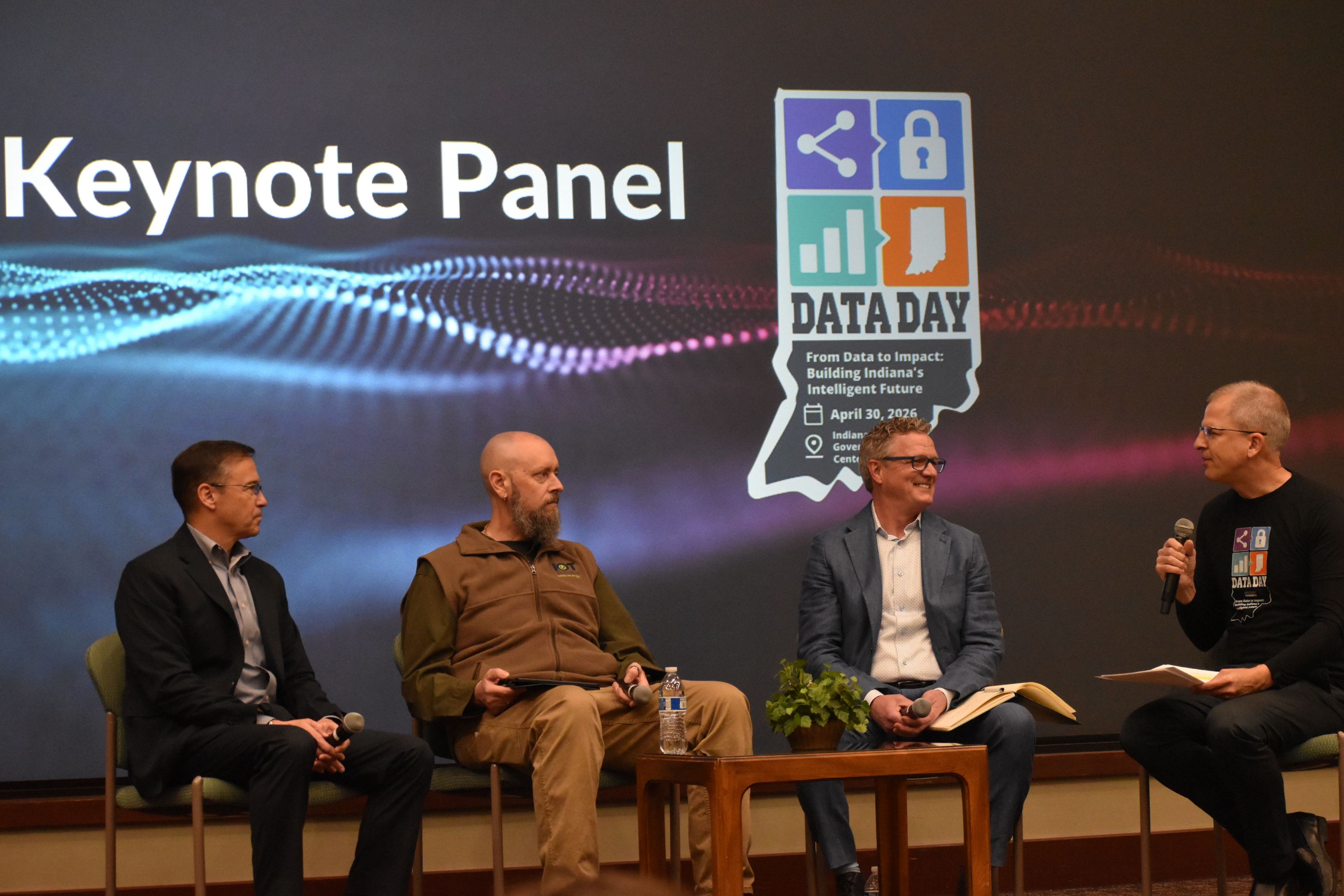
The day opened with a keynote panel on AI adoption in state government explored Indiana's rollout of Microsoft Copilot across state agencies, the data governance foundations required for responsible AI deployment, the evolving US regulatory landscape and practical strategies for embedding AI into government workflows.
Attendees chose from 16 breakout sessions at every experience level across four tracks — AI and Emerging Technology, Data Governance and Privacy, Visualization and Analytics and Data in Action — covering topics from air quality modeling and geospatial mapping to privacy law, health data linkage and AI tools built for state government.
Select a Data Day 2026 Session Track:
- Artificial Intelligence (AI) & Emerging Technology
- Data Governance & Privacy
- Visualization & Analytics
- Data in Action
 Data Day On Demand
Couldn't make it — or want to revisit a session? Data Day On Demand is a post-event content library featuring presentation slides from all sessions and recorded video from nine sessions including the keynote panel. Additional recordings are being added as they become available.
Keynote Panel—From Data to Impact: AI in Public Service
Indiana Chief Data Officer Pete Miller welcomed the statewide data community to Data Day 2026 with a panel to discuss how artificial intelligence is reshaping the work of public service.
The Data Day 2026 keynote panel brought together leaders from industry, government and the privacy and policy community for a moderated panel exploring the full lifecycle of enterprise AI adoption. From the tools entering the workplace to the rollout of Copilot happening right now across Indiana state government to the policy and regulatory guardrails shaping responsible use — this conversation covers where we are, what's working and what comes next.
AI & Emerging Technology
AI & Emerging Technology
No PhD Required: A Practical Guide to AI in the Workplace
Presenter: Dr. Zach Horton, Principal Data Scientist, Indiana Management Performance Hub
AI increasingly finds its way into organizational and policy discussions, but knowing what to do with it is a challenge many people share. This session showcases ways AI has impacted organizations both in and out of state government and offers practical guidance on finding opportunities to leverage this exciting technology. Whether you're just getting started or looking for new use cases, this session provides an accessible, real-world look at what's possible.
AI & Emerging Technology
Your Documents Have Been Holding Out on You: Introducing DocuSage
Presenter: Theodore Stumpf, Senior Data Scientist, Indiana Management Performance Hub
DocuSage is an in-house document intelligence tool enabling natural language querying, automated data extraction, and conversational document chat powered by large language models. This session demonstrates what DocuSage can do and where it fits into your workflow, then looks under the hood at Retrieval Augmented Generation, document chunking strategies, and agentic AI — along with an honest discussion of the limitations and trade-offs inherent to these approaches.
AI & Emerging Technology
Getting More from Copilot: Practical Prompting for State Agencies
Presenter: Colin Stauffer, Partner, BiG Impact Group
Most state employees have access to Microsoft Copilot but few are using it to its full potential. This hands-on session covers prompting best practices and live demonstrations showing how agencies can use Copilot to draft, summarize, research, and streamline everyday work.
AI & Emerging Technology
Transforming Meteorological Data Processing for Air Quality Modeling
Presenter: John Welch, Project Manager; Mike Mosier, Senior Environmental Manager; and Emma Faust, Environmental Manager, Indiana Department of Environmental Management
Air quality models need accurate weather data, but preparing it was a slow, manual process — up to eight hours per site. IDEM used automation to cut processing time by more than 90%, improving accuracy and simplifying quality checks. Learn why weather data matters for air quality predictions, how automation transformed a complex manual process, and how teamwork and technology combined to make it possible.
Data Governance & Privacy
Data Governance & Privacy
How You Can Help Shape AI at the State of Indiana
Presenters:John Stark, Director of Data Governance and Scott Maitland, Director of Enterprise Solutions, Indiana Management Performance Hub
Artificial Intelligence is transforming how the State of Indiana delivers services, solves problems and plans for the future—but the most powerful innovations start with you. In this session, MPH will walk through the practical ways you can engage with enterprise AI efforts. Learn how staff across your agency can take an active role in AI governance, participate in our growing AI communities of practice, and contribute directly to long term AI strategy by joining user groups that will help shape enterprise use case development. Whether you're an AI beginner or already exploring its potential, this session will show you where your voice fits and how you can help guide responsible, meaningful AI adoption across the State.
Data Governance & Privacy
Minimum Viable Governance: Balancing Control and Agility
Presenters: Matthew Stucky, Data Governance Lead, Indiana Department of Health and Chris Schilling, Data Governance Program Manager, Indiana Management Performance Hub
Too much governance slows projects; too little exposes organizations to risk. This session introduces Minimum Viable Governance — a practical, risk-based approach delivering just enough structure to manage risk without stifling agility. Learn the core principles, see practical examples from data and cloud governance, and hear how IDOH is applying MVG to streamline policies and enable faster delivery. Leave with actionable steps to implement MVG in your own organization.
Data Governance & Privacy
US Privacy in 2026
Presenter: Stan Crosley, Managing Partner, Crosley Law Offices and IAPP
An overview of the current U.S. privacy landscape and the importance of privacy standards for government and private sector personnel. Stan Crosley brings more than 25 years of privacy and data strategy experience, including serving as Chief Privacy Officer at Eli Lilly, co-Director of the IU Center for Law, Ethics and Applied Research, and leadership roles with the Future of Privacy Forum and Information Accountability Foundation. An accessible look at where U.S. privacy stands today and what to expect heading forward.
Visualization & Analytics
Visualization & Analytics
Monitoring Local Acute Respiratory Disease Trends Using an Interactive Data Dashboard and Custom Alert Thresholds in Marion County
Presenter: Alexandra Curtis, Epidemiologist, and Ariane Thomas, Epidemiologist
Marion County Public Health Department
State and regional respiratory disease trends frequently differ from local patterns in Marion County. This session presents county-level severity thresholds developed using emergency department data and the Moving Epidemic Method for RSV, influenza-like illness, COVID-like illness, and a broad acute respiratory indicator. Learn how an interactive Power BI dashboard was built to track these trends, how stakeholder input refined the approach, and how the alert system was incorporated into existing communication processes to support unified public health action during flu season.
Visualization & Analytics
The Mayor's Favorite Meeting: Scaling Performance-Management-as-a-Service in South Bend
Presenter: David Finley, Director of Data and Performance, City of South Bend
South Bend evolved traditional stat meetings into lean Data Huddles powered by a "Danger Zone" diagnostic framework. The City Service Tracker flags service requests falling below 90% on-time completion for three consecutive months, pivoting discussions from passive review to active intervention. Results include a 21% improvement in solid waste delivery times and pothole reporting accuracy jumping from 60.7% to 97.9%. Walk away with a blueprint for designing your own data-to-action pipeline.
Data in Action
Data in Action
UAV Mapping and Data Collection in Emergency Response
Presenter: Michael White, Hazmat Specialist and UAV Pilot, Indiana Department of Homeland Security
During the 2024 Winchester Tornado, IDHS provided emergency mapping, live aerial video feeds, and damage data collection within two hours of the event, delivering constant data for the first 48 hours. This session explores how UAV technology supports real-world emergency response — from rapid deployment and aerial assessment to providing actionable data for on-the-ground decision-making during critical incidents.
Slides Coming Soon!
Data in Action
Using the Indiana State Cancer Registry to Evaluate a Community Cancer Cluster Near an EPA Superfund Site
Presenter: Taylor Eisele, Cancer Epidemiologist, Indiana Department of Health
Following community concern about an EPA Superfund site in Martinsville, Indiana, IDOH conducted a 20-year retrospective analysis using the Indiana State Cancer Registry. This session walks through the methodology, findings, and challenges of cancer cluster investigations — including why they rarely establish causal links between environmental exposures and cancer outcomes, and why clear public communication about interpretation constraints is essential.
Data in Action
A Demonstration of the Potential of Health Workforce Data to Impact Health Workforce Policies and Initiatives in Indiana
Presenter: Brittany J. Daulton, PhD, MS, Assistant Clinical Professor and Associate Director, Bowen Center for Health Workforce Research and Policy
This presentation demonstrates the power of health workforce data through three Indiana case studies: linking CNA license data to nursing career pathways — leading Ivy Tech to create a new credit program; assessing the behavioral health training pipeline — informing two recently passed bills; and analyzing foreign-educated nurse data — contributing to legislation that increased the percentage of internationally educated Indiana RNs from 0.8% to 2.0%. Real data driving real policy outcomes.
Data in Action
School and Student Safety Dashboard: How Analyzing Behavioral Threat Data Saves Our Students
Presenter: Megan Barber, Data and Reporting Specialist, and Brad Ferris, Academic Achievement & Analytics Officer at Hamilton Southeastern Schools
In the past three years, Hamilton Southeastern Schools has built a robust behavioral threat assessment program — and with that new data came a need for analytics. This session walks through how the HSE Ed Tech team created a digital intake form feeding into a Power BI dashboard that aggregates behavioral threat assessments by gender, race, IEP status and other demographics. Leaders use the dashboard to identify disproportionalities, target solutions to inequity and flag students indicated as high risk. The work brings together data analysts, policy professionals, counselors and safety officers — and future development includes adding student outcomes to enable predictive and prescriptive analysis.
Data in Action
Linking Local Health and Homelessness Data to Inform Practice and Policy
Presenters: Chelsea Haring-Cozzi, PhD, CEO, Coalition for Homelessness Intervention and Prevention (CHIP) and Sarah Wiehe, MD, MPH, Jean and Jerry Bepko Scholar in Pediatrics, Indiana University
A collaborative study by the Coalition for Homelessness Intervention and Prevention and Indiana University links Homeless Management Information System data with Medicaid and Indiana Network for Patient Care data to examine healthcare utilization among individuals experiencing homelessness. This session explores the methodology, early findings, and parallel efforts to address legal, governance, and operational barriers to a real-time social health information exchange — advancing coordination across health and social service sectors for a highly vulnerable population.