
Impact - Community Services
The Community Services team and its programs are designed to promote community-wide commitment to the goal of ending homelessness, provide funding, promote access to mainstream resources, and provide the framework for optimizing self-sufficiency among individuals and families experiencing homelessness. Multiple federal grants and programs are utilized for funding the work towards this goal, including Emergency Solutions Grant, Continuum of Care, and Housing Opportunities for Persons with AIDS.
Success for Community Services programs is measured not just in the number of people helped but also their exit destination. The way to end homelessness involves both providing a safety net and the resources to prevent homelessness from happening again. As you read below, a positive housing situation is defined as voluntary, stable, permanent housing. These individuals and families may still receive rental assistance, supportive services, and other forms of aid after they are in a positive housing situation to ensure their long-term success. A homeless situation includes both unsheltered homelessness and sheltered homelessness, such living in a shelter, a hotel, with family or friends, and other situations where the individual or family is not in a permanent residence. It is possible for an individual or family to receive multiple forms of aid in succession.
Scroll down to Coordinated Entry to learn about the specific activities these programs fund and the overlap between the programs.
Emergency Solutions Grant
ESG provides funding for essential services, operations, rapid re-housing, and homelessness prevention to shelters, outreach, and housing programs across the state.
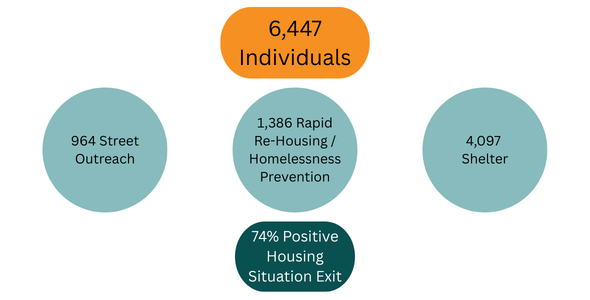
Of the clients that left the Rapid Re-Housing and Homelessness Prevention programs in 2025, 74% exited to positive housing situations with less than 4% exiting to a homeless situation.
Temporary Assistance for Needy Families
The Temporary Assistance for Needy Families (TANF) program provided funding for short-term rapid re-housing and homeless prevention efforts in Indiana. Eligible families with children who were either experiencing homelessness or were at imminent risk of homelessness were provided rental and utility assistance to stabilize housing.

The 929 families were comprised of 2,095 children, 1,578 adults, and 19 seniors. 82% of program participants exited to positive housing situations, with less than 1% exiting to a homeless situation. TANF was jointly administered by IHCDA and FSSA until 2025, at which point FSSA became the sole administrator.
Continuum of Care
CoC provides funding for permanent supportive housing and additional overlap funding with ESG for rapid re-housing.
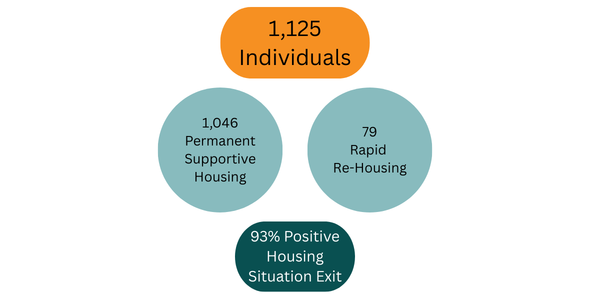
The 93% positive housing situation exits is a testament to the hard work and thoughtful, data-driven methodologies provided to those in the program. Learn more about Permanent Supportive Housing here.
In addition to providing funding, CoC also refers an organization with a board of directors dedicated to ending homelessness. IHCDA is part of the Indiana Balance of State CoC, which oversees all counties except Marion County, which has its own CoC.
Housing Opportunities for Persons with AIDS
The Housing Opportunities for Persons with AIDS (HOPWA) program is a formula grant administered by the U.S. Department of Housing and Urban Development (HUD) for low-income individuals and families who are living with HIV or AIDS. HOPWA funding can be used to provide long and short-term rent, mortgage assistance, utility assistance, facility- based assistance, housing information services, supportive services, and permanent housing placement services to Hoosiers living across Indiana.

Of the clients that left the program in 2025, 73% exited to positive housing situations with less than 1% exiting to a homeless situation.
Activity Definitions and Process
Community Services activities begin before a person is homeless and extends to stable, permanent housing. Coordinated Entry (CE) is the process by which people experiencing or at risk of homelessness can be connected to many housing programs. IHCDA serves as the Coordinated Entry lead for the Balance of State (BoS), which is 91 of Indiana’s 92 counties (excepting only Marion). CE prioritizes those with the greatest need and refers to the appropriate resources, covered below. In 2025, the CE Process across the BoS assessed approximately 8,700 households. Assessments took place across the state on 346 different days in 2025 including Christmas Eve, Christmas Day, New Year’s Eve, New Year’s Day, and Thanksgiving.
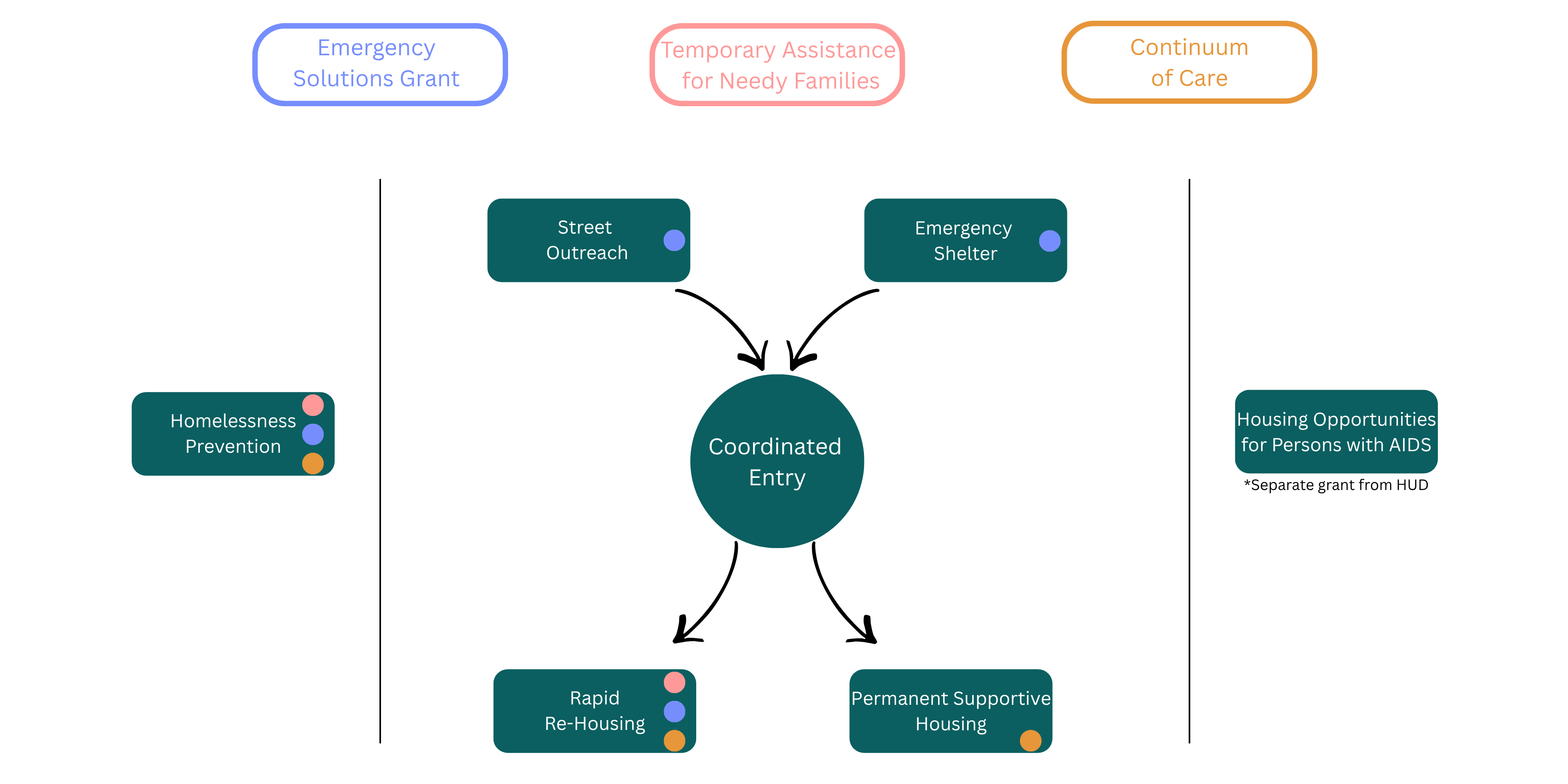
Street Outreach - meet the immediate needs of people experiencing homelessness in unsheltered locations by connecting them with emergency shelter, housing, or critical services, and providing them with urgent, non-facility-based care. Component services generally consist of engagement, case management, emergency health and mental health services, and transportation.
Emergency Shelter - increase the quantity and quality of temporary shelters provided to people experiencing homelessness through the renovation of existing shelters or conversion of buildings to shelters, paying for the operating costs of shelters, and providing essential services.
Rapid Re-Housing - provides short-term (up to three months) and medium-term (4-24 months) tenant-based rental assistance and supportive services to households experiencing homelessness. Many RRH programs across Indiana are focused on housing survivors of domestic violence, allowing these survivors to re-establish themselves in safe, stable housing away from their abuser.
Homelessness Prevention - prevent an individual or family from moving into an emergency shelter or living in a public or private place not meant for human habitation. Provides short-term (up to three months) and medium-term (4-24 months) tenant-based rental assistance.
Permanent Supportive Housing - supports individuals and families with a disability who are experiencing homelessness. PSH combines housing assistance with support services like case management, life skills, job training, mental health treatment, and more to address the needs of chronically homeless people.
Housing Opportunities for Persons with AIDS - address the specific needs of individuals and families who are living with HIV or AIDS. HOPWA funding can be used to provide long and short-term rent, mortgage assistance, utility assistance, facility- based assistance, housing information services, supportive services, and permanent housing placement services.