
Whether you are experiencing a disaster or looking for ways to help to prevent one, the resources below can help.
Do you have an immediate disaster that is impacting records? Let us know: State - rmd@iara.in.gov; County/Local - cty@iara.in.gov
In the case of reporting a public records disaster:
- Contact professional disaster recovery experts for advice as soon as possible after you discover the situation. If you need help finding an expert, you can use the Indiana Archives' list of potential commercial property-damage restoration vendors, please note that this list is not a recommendation.
- If a minor disaster emergency happens during non-business hours to a government office building, contact any commercial property-damage restoration vendor of your choice.
- If a major disaster emergency happens during non-business hours to an government office with historical records, contact the American Institute for Conservation’s National Heritage Responders 24 hour free hotline at 202-661-8068.
- Follow up by contacting IARA's Records & Information Management team if you need help with determining which records are salvageable, or properly disposing of records that are not salvageable.
- For County/Local government offices, contact cty@iara.in.gov.
- For State agencies, contact rmd@iara.in.gov.
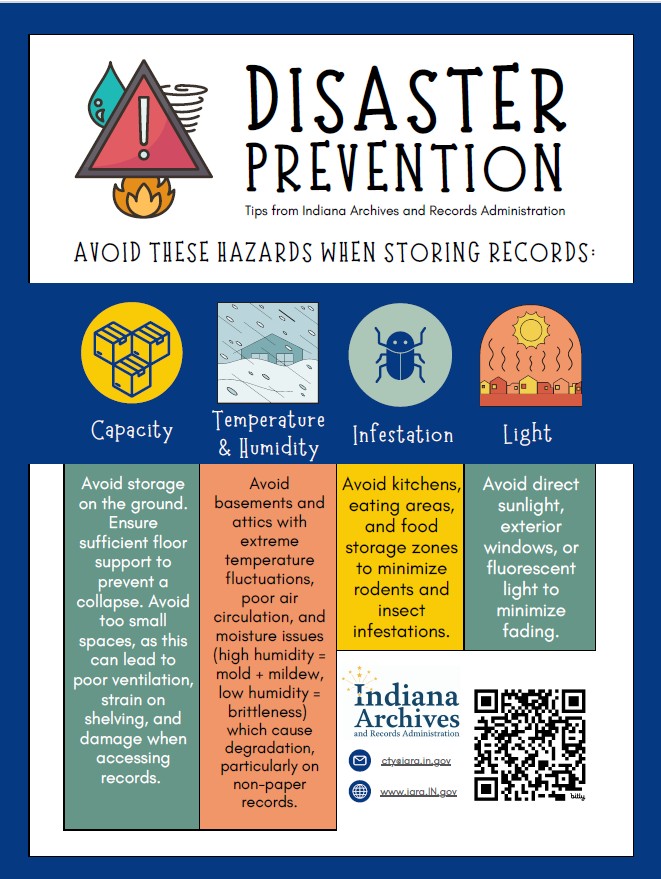
See our Disaster Prevention poster for a comprehensive list of tips.
- Never store records in a basement or attic.
- Never store records near water pipes or air conditioning.
- Never store records near a heat source-the ideal climate for records storage is between 65 and 70 degrees, 35-50 percent humidity.
- Store records away from light: sunlight and fluorescent light fades and damages records.
- Wash hands before handling records: natural oils from your skin contaminate records.
- Keep copies of critical records at a separate location.
- Do not tape, paper clip, staple, or fold records.
- Never use ballpoint or felt-tip pen to label records.
- Always use a soft, number-two pencil to label the backs of photographs.
- Always place plastic covers over computer equipment when not in use.
- Damage to computers, disks, and peripheral equipment requires professional restoration. Do not attempt to use your equipment after a disaster as any damage to equipment could cause further harm to records.
- Be sure to migrate electronic records when you install new software on your computer.
- Keep your desk clean and tidy, be sure to file important papers away and off of your desk.
- Never store records directly on the floor, keep them at least 2 inches off of the ground.
Salvaging Water-Damaged Items
In an effort to aid residents, businesses and governments across Indiana suffering from flood damage, the Indiana Archives is providing the following information to assist in preserving records and minimizing the damage.
Tips for flood damaged pictures, documents and books
If your items can be dealt with immediately, carefully rinse silt, mud, or debris off of item with clean water if possible. If this is not possible very gently brush sediment off items. It is crucial to completely dry or to freeze items as quickly as possible to avoid the growth of mold. Photographs should be removed from frames or frozen in frames. Books, papers and home made print-outs of digital photographs can be safely dried in a place where air is circulating (i.e. not in a tightly closed room). Place plain paper towels in between approximately every 15 pages or less and change out with dry paper towels as they become saturated. To dry photographs that have been professionally developed, place wax paper in between each photograph as they are drying, or lay the photographs out individually. Be aware that photographs may curl if dried in this manner, but can be flattened later. Smaller books can be stood on end on a flat surface with the pages fanned open to air dry. Only use this method if the book is strong enough to stand open in this manner. Books and magazines with glossy paper must be opened so that every page remains separated while drying to avoid the pages becoming stuck together.
If items cannot be dealt with immediately, wrap in plastic each book or stack of papers no more than an inch high and freeze. Professionally printed photographs should be isolated between layers of wax paper before freezing. Freezing inhibits the growth of mold. Items can be thawed at your convenience until the pages or photographs can be separated without tearing and then dried in the above manner.
Continue to dry items in your preferred method at least 24 hours beyond the point at which they are dry and no longer cool to the touch. If items are affected by mold, do not attempt to clean them yourself as the mold can be a health hazard; consult a conservation professional.
Tips for small amounts of moldy records or boxes with mold
Protect yourself first with disposable gloves and respiratory protection like an N95 mask.
Clean the records or boxes as quickly as possible and isolate them from the rest of your collection. To clean less than 3 square feet of dormant mold, take the box/records outside and brush off the mold. If indoors, vacuum with a HEPA filter attached.
Indiana Archives Conservation Lab
6440 E. 30th St.
Indianapolis, IN 46219
- Elizabeth Hague
Conservation Technician
ehague@iara.in.gov
317-522-9060
The Preservation Resources webpage offers information for Indiana government regarding the preservation of delicate records.

Indiana Archives and Records Administration