The Indiana Criminal Justice Institute (ICJI) supports child passenger safety (CPS) and the state’s over 1800 certified CPS technicians and instructors by offering training, continuing education, and support materials to educate caregivers on the proper use of car seats, booster seats and seat belts.
In Indiana and across the United States, 4 out of 5 car seats are installed incorrectly. Simple mistakes can have devastating consequences. Finding the right seat for your child depends on many factors, and the easiest way to ensure everyone is traveling safely is to have your car seat checked by a certified CPS Technician. Car seat inspection stations operate across Indiana. Search the map to find an active inspection station in your area or go to NHTSA.gov to learn more.
As a general rule, children travel in vehicles in these four steps:
Find the right car seat
- Learn about the four car seat types
- Follow NHTSA’s car seat recommendations based on your child’s age and size
- Find and compare car seats and ease-of-use-ratings using NHTSA’s Car Seat Finder
Install your car seat correctly
- Understand the parts and tips used for installation
- Follow our detailed car seat installation instructions and videos
- Get your car seat inspected at a station nearest you
Keep your child safe in a car seat
- Register your car seat and sign up for recall notices to receive safety updates
There are many car seat choices on the market. Use the information below to help you choose the type of car seat that best meets your child’s needs or print out NHTSA’s car seat recommendations for children.
- Select a car seat based on your child’s age and size, then choose a seat that fits in your vehicle, and use it every time.
- Always refer to your specific car seat manufacturer’s instructions (check height and weight limits) and read the vehicle owner’s manual on how to install the car seat using the seat belt or lower anchors and a tether, if available.
- To maximize safety, keep your child in the car seat for as long as possible, as long as the child fits within the manufacturer’s height and weight requirements.
- Keep your child in the back seat at least through age 13.
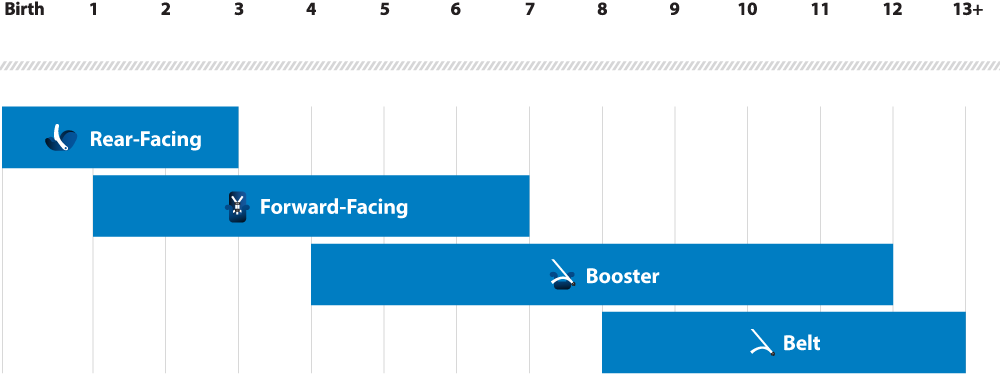
Choosing the Right Seat
Rear Facing Car Seat
For the best possible protection, keep infants in the back seat, in rear-facing child safety seats until age 2.

Rear Facing Car Seat
Forward Facing Car Seat
When children outgrow their rear-facing seats at 2 years of age, they should ride in forward-facing child safety seats, in the back seat.

Forward Facing Car Seat
Booster Seat
Once children outgrow their forward-facing car seats (usually around age 4 and 40 pounds), they should ride in booster seats, in the back seat, until the vehicle seat belts fit properly.

Booster Seat
Seat Belt
When children outgrow their booster seats (usually at age 8 or at 4’9” tall), an adult seat belt in the back seat can be used if it fits properly.

Seat Belt
Child Passenger Safety Specialists
The Child Passenger Safety Specialist (CPSS) Program mission is to serve as the primary point of contact for all child passenger safety (CPS) efforts in each region; by serving as mentors to technicians, supporting permanent fitting stations (PFS), provide assistance accessing CEU's and completing required elements for recertification, including seat checks and community events.
Each CPSS is expected to possess the knowledge and professionalism to accomplish this mission in their assigned region.

Kathleen Vasilopulos
Region 1 Specialist
(317) 499-2372
kvasilopulos@cji.in.gov

Kennedy Labra
Region 3 Specialist
(317) 503-5858
klabra@cji.in.gov
Keisha Nickolson
Region 4 Specialist
(317) 504-3238
knickolson@cji.in.gov
Find your Specialist
Click on your county to be connected to your Child Passenger Safety Specialist.


County Map Legend
Helpful Links
