IDEM and other agencies monitor blue-green algae to track their presence in Indiana’s lakes and reservoirs, especially in areas where people and animals are most likely to come into contact with the water. Visit the Blue-Green Algae Dashboard for more information on current and historical swimming beach advisories.
Latest Testing Results
Indiana Reservoir and Lake Sampling and Test Results
IDEM, along with the Indiana Department of Natural Resources (DNR), the Indiana Department of Health (IDOH), and the Board of Animal Health (BOAH) are working together to provide information about blue-green algae in our lakes. IDEM samples selected swimming areas at some state parks and state recreation areas for blue-green algae and toxins between Memorial Day and Labor Day. The weekly results can be found within the Indiana Reservoir and Lake Sampling Update or Blue-Green Algae dashboard.
Blue-green algae, also known as cyanobacteria, are a group of photosynthetic bacteria that have been around for billions of years and occur naturally in a wide range of waterbodies throughout Indiana, the United States, and the world. Not all blue-green algae (cyanobacteria) species produce toxins and the ones that can are not producing toxins all the time. The most common routes of exposure to cyanobacteria and their toxins occur either through ingestion or skin exposure. Humans can be exposed through accidental ingestion of water while recreating. Direct contact with cyanobacterial cells can also irritate the skin for sensitive people. This includes buildup of cyanobacterial cells and their toxins in bathing suits. Cyanotoxins can also kill livestock and pets that drink affected water. Additional exposure for animals includes eating algal mats or licking cyanobacteria or toxins off their fur. Exposure through inhalation is not as common in Indiana and this occurs when water containing cyanobacteria cells release toxins into the air.
IDEM scientists take water samples, identify and count blue-green algae, and analyze for four algal toxins:
Four Algal Toxins
Anatoxin-a
Anatoxin-a is a neurotoxin produced by multiple genera of freshwater cyanobacteria including Anabaena, Aphanizomenon, Microcystis, Planktothrix, Raphidiopsis, Arthrospira, Cylindrospermum, Phormidium, Nostoc, and Oscillatoria that are found in water bodies globally including lakes in Indiana.
Cylindrospermopsin
Cylindrospermopsin is a toxin produced by cyanobacteria including Aphanizomenon, Lyngbya and Raphidiopsis. It has been found in freshwater throughout the world including some lakes in Indiana. Testing for cylindrospermopsin begins in July because species that produce it generally appear later in the summer. Most of the cyanobacterial cells that produce it are regarded as subtropical/tropical species. Cylindrospermopsin is a hepatotoxin that primarily affects liver and kidney function.
Microcystin
Microcystins are commonly found in freshwater throughout the world including lakes in Indiana. They are produced by many types of cyanobacteria including Microcystis, Dolichospermum, and Planktothrix which are commonly found in Indiana. Microcystin is a hepatotoxin so they primarily affect liver function but can also affect the kidney and reproductive system.
Saxitoxin
Saxitoxin is known as one of the paralytic shellfish poisoning (PSP) toxins in marine environments. It is unique among neurotoxins in that it is found in both marine and freshwater environments. The vast majority of PSP cases are from consuming contaminated shellfish from marine environments. Cyanobacteria that can produce saxitoxin in Indiana include Aphanizomenon, Dolichospermum, Lyngbya, and Planktothrix.
Kosciusko County Lakes
The Lilly Center for Lakes & Streams at Grace College collects water samples from open water on Kosciusko County’s twelve all-sport lakes and Center and Pike lakes, along with the public swimming beaches at Center, Pike, Syracuse, Waubee, Webster and Winona lakes. Samples are processed and analyzed for microcystin; a blue-green algae toxin relevant in the county. Toxin results will be updated on their microcystin page every week.
Indiana DNR Beach Advisories and Closings
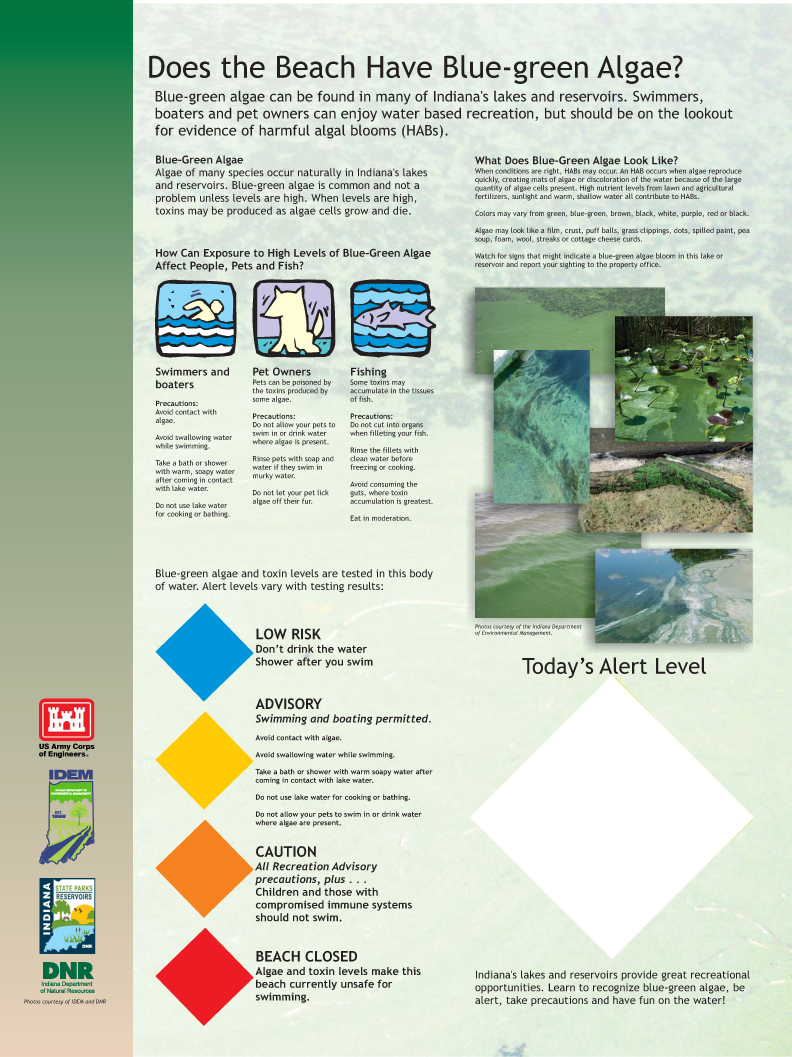
The Indiana DNR advises the public of the blue-green algae threat through signs at the swimming areas and on the DNR website for the properties being sampled. The Indiana State Parks Alerts page has the full list of these facilities.
Since the presence of harmful algae isn't always obvious and the effect of coming in contact with it is different for everyone, it is best to pay close attention to these signs. Just like everyone has different sensitivity to poison ivy, your response to blue-green algae is not predictable.
If you are recreating in a lake or other waterbody, don’t ingest the water, avoid contact with visible algae or algal scums, and shower or bathe with warm, soapy water when you are finished. If you think you are ill from contact, you need to contact your doctor for assistance and to report a human illness.
Hazards to Pets and Livestock
Veterinarians recommend not allowing pets and livestock to drink or swim in waters affected by algae. If in doubt, keep your animals out. Dogs are particularly susceptible to blue-green algae poisoning. If you think your animal is ill from contact, this is an emergency so call your veterinarian immediately. Details on what symptoms to track are provided on the Indiana State Board of Animal Health (BOAH) Blue-Green Algae site.
Ways to Help Reduce Blue-Green Algae
Many ways exist to reduce or stop nutrient inputs into our waterways. Here are some simple things we can do right in our own backyards:
- Most established lawns do not need phosphorus to be healthy. If applying fertilizer, use a phosphorus-free lawn fertilizer. This is critical if you live on a lake. Lawn-fertilizer packaging is labeled with three (3) numbers for nutrient content:
- The first number indicates the percentage amount of nitrogen.
- The second number indicates the amount of phosphorous. A zero (0) indicates a phosphorus-free fertilizer.
- The third number indicates the amount of potassium.
- Do not over fertilize your garden. Check soil nutrient levels prior to applying garden fertilizer to ensure correct application. Soil test kits can be purchased from some local hardware stores and through online distributors.
- Do not fertilize up to the edge of a waterway. Check with your local government for any specific setback requirements.
- Do not dispose of grass clippings or leaves in or near a waterway.
- To prevent inputs from human waste, have your septic system inspected and the tank pumped out at least every two years.
- If conducting land disturbing activity, prevent soil and organic matter from washing into waterways, as soil can carry nutrients into the waterway.
Additional Resources
For more on Blue-Green Algae, there are resources available to explore from IDEM partners:
- Indiana Department of Health
- Indiana State Board of Animal Health
- Indiana Department of Natural Resources
and through the IDEM factsheet entitled Blue-Green Algae (available on the IDEM Fact Sheets page under Watersheds and Nonpoint Source Water Pollution).