Table of Contents
- Questions Related to the Application Process
- Questions Related to General Grant Guidance
- Questions Related the Financial Aspects of the Project
- Questions Related to Priority Areas
- Appendix 1A - Chronic Disease Asthma Guidance
- Appendix 1B - Chronic Disease Cancer Guidance
- Appendix 1C - Chronic Disease Cardiovascular Health Guidance
- Appendix 1D - Chronic Disease Diabetes Guidance
- Appendix 2 - Hepatitis C Guidance
- Appendix 4 - Food Insecurity - Obesity Guidance
- Appendix 5 - Elevated Blood Lead Level Reduction Guidance
- Appendix 6A - Community Health Workers Guidance
- Appendix 6B - Community Paramedicine Guidance
Questions Related to the Application Process
When the application is submitted or if you need to pause and continue later, you will receive a code that will allow you access to application. If you’re having trouble accessing the application, please send your request, including the name of the organization and the individual who submitted the application, to the healthissuesandchallenges@health.in.gov mailbox.
The online application form should be completed all at one time. It is suggested that applicants draft the components of the application in another format and then paste the text into the form. The form fields do not have character or word limits; however, the Health Equity goals questions have a 250-word limit.
If you get booted out the system, please use the code you were provided and if you lose your code and you cannot access the application, please send your request for access to the Health Issues & Challenges mailbox for your code or assistance.
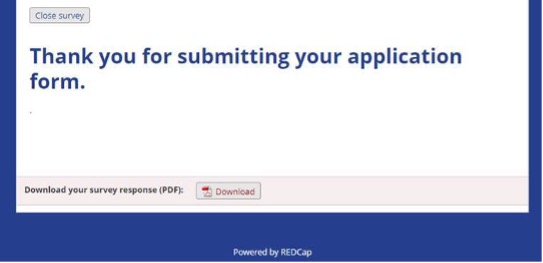
When the application is submitted, you receive a confirmation email. The confirmation email will be sent to email address you put on the application. Also, a confirmation message with an option to download the survey response in PDF is given, as shown below.
Tip: Remember to complete each field in the application survey. If you have submitted an incomplete application, a courtesy email will be sent to the email address provided to allow an opportunity to complete the application and resubmit. As a reminder, incomplete applications will not be accepted or reviewed.
General Project Questions
This grant opportunity is open to both nonprofit and for-profit entities. Organizations that are eligible include individual, employer, employer association, nonprofit organization, for-profit organization, municipality, local health department, school corporation, charter school, accredited non-public school, research institution, health insurance plans, health insurance ministry, or combination herein.
Your project can be structured for the span of time as best suits what outcomes you intend to achieve based on a 2-, 3- or 4- year period beginning July 1, 2023, and ending Dec. 31, 2026; however, all grant agreements must be fully executed by Dec. 31, 2024, and all funding spent by Dec. 31, 2026. Projects with less than a 24-month project period will not be considered.
The grant guidance does not indicate such requirement. However, if you think that would help your application, then feel free to include it.
The data will be reported in REDCap Survey. The questions are written to ask for an aggregate number to be input into a blank field. The exact requirements are listed in the grant guidance.
Yes, we have allowed fiscal agencies to be the lead applicant. The MOU or subrecipient contract with the organization implementing the grant will be between the lead agency and subrecipient.
One agency will be the parent agency and the other will be a subrecipient. The agency may submit one application, but they will need to clarify who the parent agency will be.
No, current grantees may not apply for the priority area in which they are currently funded, that includes their entire system/service lines.
Priority Areas/Populations
While proposal evaluation will not target that metric, consideration of that level will be made in the overall evaluation. Communities that have an SVI of 0.5 or higher will receive priority depending on the number of applications we receive; however, we will not discount a project based on SVI alone.
No, there is no limit. If you feel well-suited to apply for more than one priority area, then please apply for any relevant priority areas. Current grantees may not apply for the priority area in which they are currently funded but may apply in priority areas in which they did not receive an award.
There is no limit to the total amount of funding for which an organization can apply. The total funding available in the grant opportunity is $50 million, and it will be allocated among all priority areas (and awardees) plus fund the dashboard created by the Indiana Management Performance Hub. Applicants should consider these factors when applying.
Current grantees may not apply for the priority area in which they are currently funded.
Current grantees may apply in priority areas in which they did not receive any funding. Current grantees are only eligible for funding in program areas where they were not awarded funding for Round 1. Grantees that fall under the same organizational umbrella may not reapply in program areas where they have already received funding.
Yes, serving persons with disabilities would fit under the health equity expectation. However, please also reference the Social Vulnerability Index link in the grant guidance to confirm if the county you are serving falls within the following guidelines: To further prioritize health equity, organizations that reside in, or serve communities that rank high (.5 and above) on the CDC’s Social Vulnerability Index, will be prioritized for funding.
Award Cap
Some project areas do list funding limits, but to capture as many quality and diverse proposals as possible, funding will be awarded on the type of program, merit and in some cases, geography; therefore, IDOH will not impose a ceiling on award amounts. An average award amount, therefore, has not been determined.
No, if an award cap has been established for a program area, budgets that exceed the specified amount will not be considered.
Budget Questions
Yes, the encumbrance clause from the grant guidance states all funds must be encumbered by December 21, 2024 and must be spent by December 31, 2026.
Yes, applicants will submit a separate application and budget for each priority area.
Invoicing
Grant funds will be made available through a reimbursement and deliverables-based contract based on the approved grant application. Awardees invoice on a monthly basis.
Sub-Awards to Community Partners
We have an outreach team that addresses the issues of our clients and refers them for services available. Is there a specific priority that you would consider that we should apply for, or are all these an option since we have the resources to do them all?
Priorities are reflected in the guidance appendices. Your proposal can provide for collaboration with other entities for the span of time as best suits what outcomes you intend to achieve based on a 2-, 3- or 4-year (or combination thereof) period beginning July 1, 2022, and ending Dec. 31, 2026; however, all grant agreements must be fully executed by Dec. 31, 2024, and all funding spent by Dec. 31, 2026.
All staff or team members working on programs funded through Health Issues and Challenges grant program need to complete health equity training. The Health Innovation Partnerships and Programs division will offer free health equity training for grantees awarded.
Appendix 1A - Chronic Disease Asthma Guidance
No, reducing the prevalence of chronic disease must be more directly related to individuals’ health outcomes that can be immediately measured and reflected within a 2 to 4-year period.
Appendix 1B - Chronic Disease Cancer Guidance
Under the “Description of Proposal” it states that the applicant should “… choose one or more programs from the following evidence-based programs and describe how they will be implemented by your organization.” Is it a requirement that the proposed program be one of the evidence-based programs described on the NCI website?
We prefer the listed evidence-based programs on the NCI or Community Guide website be used; however, if you have a different evidence-based program you would like to use, please indicate its reference. Programming must be evidence-based.
For example, with the cancer screening grant, it says the awards are $150,000. Is that $150,000 for 1 12-month period, or is it $150,000 for each 12-month period through the end of December 31, 2024, or 2026? Or is it $150,000 for as long as we spread out the funds through the end of 2026?
If the award is $150,000, your organization may determine the project period * Project periods must be at least two years but no longer than four. Grantees have until December 31, 2026, to spend funds as they have described in their awarded proposal, whether that is through subgrants or direct expenditures.
Appendix 1C - Chronic Disease Cardiovascular Health Guidance
Yes, this is an allowable expense.
Appendix 1D - Chronic Disease Diabetes Guidance
The grant is open to organizations that are seeking to start a National Diabetes Prevention Program (DPP) or those that currently have a CDC National DPP and are seeking to expand services (including a virtual expansion).
We are assuming this will be a purchase of a cellular app for patients to use while they are attending the diabetes prevention program that you will implementing. Yes, this would be an allowable expense.
The Dashboard link will be used to report grantees’ aggregate data within a category. The data required to be reported for the Diabetes Prevention Program Grant will be that which is already collected by the Centers for Disease Control and Prevention’s Diabetes Prevention Recognition Program (DPRP). Data Reporting for the Lifestyle Change Program (cdc.gov). The IDOH template for reporting the required grant data will be provided to grantees once the grants are awarded.
Appendix 2 - Hepatitis C Guidance
(Not Applicable for grant cycles after August 1, 2022)
No. This funding was intended to create navigation for clients throughout the state, through establishing care coordinators. The application is open-ended and leaves room for justification of your proposed plan.
There are many tangible ways that hepatitis C linkage to care can be enhanced through these efforts within your community. Please think of and report on ways that can be sustained with and without continued funding. IDOH will continue to seek additional funds to support this programming beyond the initial period of performance.
Documents that can demonstrate the lead entity’s existing scope of work across the state (collaborations and partnerships). Documentation of the lead entity’s ability to manage/contract for the 20 required positions for this funding opportunity.
The performance measures are not meant to be punitive but rather goals to achieve, knowing that this will be a new program in much of the state. The measurement of these goals will be overseen by the lead entity but will be closely monitored by IDOH staff with ongoing communications and collaborations on ways to enhance and improve the program as necessary.
Yes, that number is the estimated, anticipated impact of the total program. Again, this number is not meant to be punitive but rather a goal for the program to achieve.
Please submit a two-to-four-year budget.
No, this funding was intended to create navigation for clients throughout the state, through establishing care coordinators. Care coordinators could promote education and conduct outreach to providers while aligning clients with a payer for medical services (i.e., Medicaid or marketplace insurance programs).
Please get involved with your local ZIP Coalition if you are not already. The lead entity will be tasked with working collaboratively with each ZIP Coalition to determine partner organizations at the local level, for engagement in this funding opportunity. Please let the ZIP Coalition know of your desire to participate in this funding opportunity and project. You can sign up to be a member of your local ZIP Coalition by going to www.ZIPindiana.org.
Utilization of Luther Evaluation Web’s APHIRM or a similar database is necessary to report data on health outcomes.
This will be determined on a case-by-case basis in partnership with the lead entity and each identified agency. Both approaches are acceptable. ZIP Coalition feedback has advised IDOH that a contractual relationship with local organizations is preferred over the lead entity hiring all 20 staff positions and placing them at satellite locations.
There is no funding ceiling for this section. Applicants are encouraged to present their proposals and matching budgets with clear justification of the need for the proposed funding being requested.
As currently stated in the RFP, funds must be encumbered (obligated) by Dec. 31, 2024. Funds must be spent by Dec. 31, 2026. This means that funds awarded to a grantee must be executed in a contract with IDOH and the purchase order finalized by Dec. 31, 2024. Grantees have until Dec. 31, 2026, to spend funds as they have described in their awarded proposal, whether that is through subgrants or direct expenditures.
Please plan as though these funds will not be renewed. We are uncertain as to the future availability of funding.
Appendix 4 - Food Insecurity - Obesity Guidance
There is not a cap on how much funding you can apply for related to food insecurity/obesity. All activities would require various funding levels, so it was decided not to include a range or a cap. Please request a level of funding appropriate to your grant activity/project proposal.
The direct purchase of food is an allowable expense. Please include in your proposal how this will be sustainable after this funding expires.
Could we apply for this grant to provide updated equipment (such as exercise bands, weights, mats, jump ropes, music equipment, etc.) and programming (class instructions, music, etc.) for their exercise classes, as well as new CPR mannequins for their courses?
Yes, you may apply for these activities; however, please know that we are most interested in activities/projects that focus on policy, system, and environmental change strategies and also activities/projects that will be sustainable after funding is spent.
The general grant guidance has examples that seem to span whole school districts, government initiatives or several hundred employers. Could a smaller project aimed at expanding food access to the extremely rural members of our county and increasing fresh food options from within our pantry fit within the parameters of the RFA? Our goal is to utilize funding for the purchase of additional food, transportation costs and employee time.
While we do want some initiatives/funding proposals to span larger initiatives with a larger reach, we also expect to receive applications (and award them) to smaller organizations/projects. Your idea fits the parameters of the RFA, but we do not yet know the answer to the question about direct food costs. We have had some challenges with our funders allowing that in the past, so we are looking into whether food will be an allowable cost and in what way.
We have an established relationship with the Purdue University to offer onsite dietician classes through our food pantry and shelters to promote healthy eating, but we are also hoping to help integrate physical activity through the creation of a shared gym and outdoor playground at the physical location of our shelter and food pantry. Would such an activity fit within the parameters of the RFA for physical activity?
Yes, this type of activity would fit in the parameters for the RFA. Having a combined approach (nutrition and physical activity) would likely help your application score higher vs. if you only focused on one or the other. Evidence shows that the more risk factors a community organization can focus on at one time, the better the health outcomes.
You may use funding for physical improvements such as those you mentioned. Please make sure to include how it will increase physical activity or nutrition or decrease food insecurity.
Yes, this is an allowable expense.
It looks like our organization’s work would only apply under two categories. The guidance document suggests that funding will go to organizations that will implement activities in most or all of the categories. Since we don't work on physical activity or direct distribution of food, are we not the right fit for this opportunity?
The hope is to have some applicants who plan to work in all or most of the categories; however, projects in just one or two categories will also likely be funded. Language from the RFP: Ideally, funding will go to a community-wide applicant who plans to implement activities in most or all the categories. That applicant will be given a higher funding level. However, smaller projects that are only in 1-2 categories will still be considered given the demographics and need/impact of the project. You are still encouraged to apply.
Appendix 5 - Elevated Blood Lead Level Reduction Guidance
No, IDOH is planning to purchase these in bulk and lend them out to local health departments who may need one. Please email Paul Krievins at pkrievins@isdh.in.gov if you require one or more XRF units.
Yes, any loaned equipment will be required to be maintained and resourced by the local health department. Equipment must be returned if there is no one on staff qualified to use the equipment.
To be licensed as a risk assessor, an individual first needs to meet the following qualifications:
- Successfully complete an approved lead-based paint course in the appropriate discipline and receive a certificate of training from an approved course provider.
- Have attended an Indiana approved lead-based paint two (2) hour rules awareness course within twelve (12) months prior to making license application, if the approved lead-based paint course in subdivision (1) is not an Indiana-approved course.
- Meet or exceed the experience and education requirements for each desired discipline as listed in subsection (b).
- For inspector, risk assessor, project designers, and supervisor applicants, pass the third-party examination in the appropriate discipline.
Risk assessor applicants shall take and pass the inspector and risk assessor courses and pass all required examinations, including third-party examinations. Applicants must meet any one
(1) of the following combinations of education and experience:
- Bachelor’s degree and one (1) year of experience.
- Associate degree and two (2) years of experience.
- A high school diploma or GED and three (3) years of experience.
Required experience must be in a related field, including lead, asbestos, environmental remediation work, or construction.
Info on training providers who offer risk assessor courses can be found at https://www.in.gov/health/files/2020-2021-lead-abatement-training-course-providers-contact-info.pdf.
IDOH does have some scholarship funds to cover the cost of the course, but the LHD would be responsible for travel, per diem, hotel, and wages for that individual for the week of training. Scholarship funds are available on a first come-first serve basis, and Katie Etter tracks whether we have funding available or not. The cost for the license can be waived for LHD personnel.
Yes.
Yes, staff supporting a risk assessor with either clerical or in-field work are allowed. Please note that any risk assessment entered into I-LEAD must be entered using the credentials of the licensed individual, and any in-field samples taken must be taken by the licensed individual.
Yes, the requirements for case management currently in place for children with a confirmed blood lead level at 10 will be the requirements for children with a confirmed level at or above 5.
Yes, they will mirror the current requirements for children between 5.0 and 9.9 and are as follows:
- Notifying the child’s primary medical provider, within 10 working days
- Providing education material to the parents
- Any other actions the local health officer deems appropriate.
Yes.
Agencies will submit monthly claims for cases and homes that are complete. For case management funding, "complete” means the home visit, nutritional assessment and developmental assessment are complete and the case is fully documented in NBS. For environmental investigations, “complete” means the initial risk assessment is complete and fully documented in I-LEAD. IDOH will reimburse LHDs up to the number of cases identified in the table labeled “Projected 2-year 5-9.9 Cases for LHDs”. To get a per-case amount, divide the allocation by the projected number of cases.
Appendix 6A - Community Health Workers Guidance
Yes, adding community health workers to an existing program is appropriate if adding the positions would allow geographic expansion or additional partner relationships, provide for more people to be assisted or result in other concrete ways to expand the scope of your existing program.
Appendix 6B - Community Paramedicine Guidance
The paramedicine activity was designed for entities providing direct service; however, associations collaborating administratively with an eligible applicant(s) like a hospital, a fire department, a community health center or an emergency medical services provider is allowable.
Yes, this is an allowable expense.
Yes, schools are eligible applicants.