In the United States in 2022, 1 in 6 deaths (17.5%) from cardiovascular disease was due to stroke. Stroke is the leading cause of chronic disability and a leading cause of death in Indiana. On average, one person in the U.S. has a stroke every 40 seconds and someone dies from stroke every 3½ minutes. Unlike heart disease, which is more common in men, it is estimated that about 55,000 more women than men have strokes in the U.S. each year.
A stroke occurs when something blocks blood supply to part of the brain or when a blood vessel in the brain bursts. A stroke is when there is a stoppage of blood flow to the brain, while a heart attack is when there is a stoppage of blood flow to the heart.
An ischemic stroke occurs if an artery that supplies oxygen-rich blood to the brain becomes blocked. Blood clots often cause the blockages that lead to ischemic strokes.
A hemorrhagic stroke occurs if an artery in the brain leaks blood or ruptures (breaks open). The pressure from the leaked blood damages brain cells. High blood pressure and aneurysms are examples of conditions that can cause hemorrhagic strokes. Aneurysms are balloon-like bulges in an artery that can stretch and burst.
Another condition that’s similar to a stroke is a transient ischemic attack, also called a TIA or “mini-stroke.” A TIA occurs if blood flow to a portion of the brain is blocked only for a short time. Thus, damage to the brain cells isn’t permanent (lasting). Like ischemic strokes, TIAs often are caused by blood clots. Although TIAs are not full-blown strokes, they greatly increase the risk of having a stroke. If you have a TIA, it’s important for your doctor to find the cause so you can take steps to prevent a stroke. Both strokes and TIAs require emergency care.
How you are affected by a stroke depends primarily on the location and the extent of damage to the brain tissue. Brain injury can cause changes in certain sensory, motor, or cognitive functions.” You can have a stroke in the right side of the brain, left side of the brain, or in the brain stem. At the hospital they will do brain scans to determine if and what kind of stroke occurred. If you had an Ischemic Stroke, and arrived at the hospital within 3 hours, you may get a type of medicine called a thrombolytic (a "clot-busting" drug) to break up blood clots.” Studies show that patients with ischemic strokes who receive this medication are more likely to recover fully or have less disability than patients who do not receive the drug.” If you had a Hemorrhagic Stroke other medicines, surgery, or procedures may be needed to stop the bleeding from hemorrhagic stroke and save brain tissue. For example, you may receive Endovascular procedures or surgical treatment.
Your lifestyle choices can increase your risk for stroke. The good news is that healthy behaviors can lower your risk for stroke. Talk with your health care team about making changes to your lifestyle.
- Eating a diet high in saturated fats, trans fat, and cholesterol has been linked to stroke and related conditions, such as heart disease. Also, getting too much salt (sodium) in the diet can raise blood pressure levels
- Not getting enough physical activity can lead to other health conditions that can raise the risk for stroke. These health conditions include obesity, high blood pressure, high cholesterol, and diabetes. Regular physical activity can lower your chances for stroke
- Drinking too much alcohol can raise blood pressure levels and the risk for stroke. It also increases levels of triglycerides, a form of fat in your blood that can harden your arteries
- Women should have no more than one drink a day
- Men should have no more than two drinks a day
- Tobacco use increases the risk for stroke
- Cigarette smoking can damage the heart and blood vessels, increasing your risk for stroke
- Nicotine raises blood pressure
- Carbon monoxide from cigarette smoke reduces the amount of oxygen that your blood can carry
- Exposure to secondhand smoke can make you more likely to have a stroke
Stroke is more common in women than in men, and women of all ages are more likely than men are to die from stroke.Pregnancy and use of birth control pills pose special stroke risks for women. People who are non-Hispanic Black or Pacific Islander may be more likely to die from a stroke than people who are non-Hispanic White, Hispanic, American Indian or Alaska Native, or Asian. The risk of having a first stroke is nearly twice as high for Black people as for White people. Black people are also more likely than White people to die from stroke.
You can help prevent stroke by making healthy choices and managing any medical conditions you might have. Live a Healthy Lifestyle…
- Eat a healthy diet
- Choosing healthful meal and snack options can help you avoid stroke and its complications. Be sure to eat plenty of fresh fruits and vegetables
- Eating foods low in saturated fat and cholesterol and high in fiber can help prevent high blood cholesterol. Limiting salt or sodium in your diet can also lower your blood pressure
- For more information on healthy diet and nutrition, visit the CDC’s Nutrition website
- Maintain a healthy weight
- Being overweight or obese can increase your risk for stroke. To determine whether your weight is in a healthy range, doctors often calculate a number called the body mass index (BMI). Doctors sometimes also use waist and hip measurements to measure a person’s excess body fat. '
- If you know your weight and height, you can calculate your BMI at CDC’s Assessing Your Weight website
- Be active
- Physical activity can help you maintain a healthy weight and lower cholesterol and blood pressure. The Surgeon General recommends that adults should engage in moderate-intensity exercise for at least 30 minutes on most days of the week
- For more information, visit the CDC’s Physical Activity website
- Don't smoke
- Cigarette smoking greatly increases your risk for stroke. So, if you don’t smoke, don’t start. If you do smoke, quitting will lower your risk. Your doctor can suggest ways to help you quit
- For more information about tobacco use and quitting, visit the CDC’s Smoking and Tobacco Use website
- Limit alcohol use
- Avoid drinking too much alcohol, which causes high blood pressure. For more information, visit CDC’s Alcohol and Public Health website
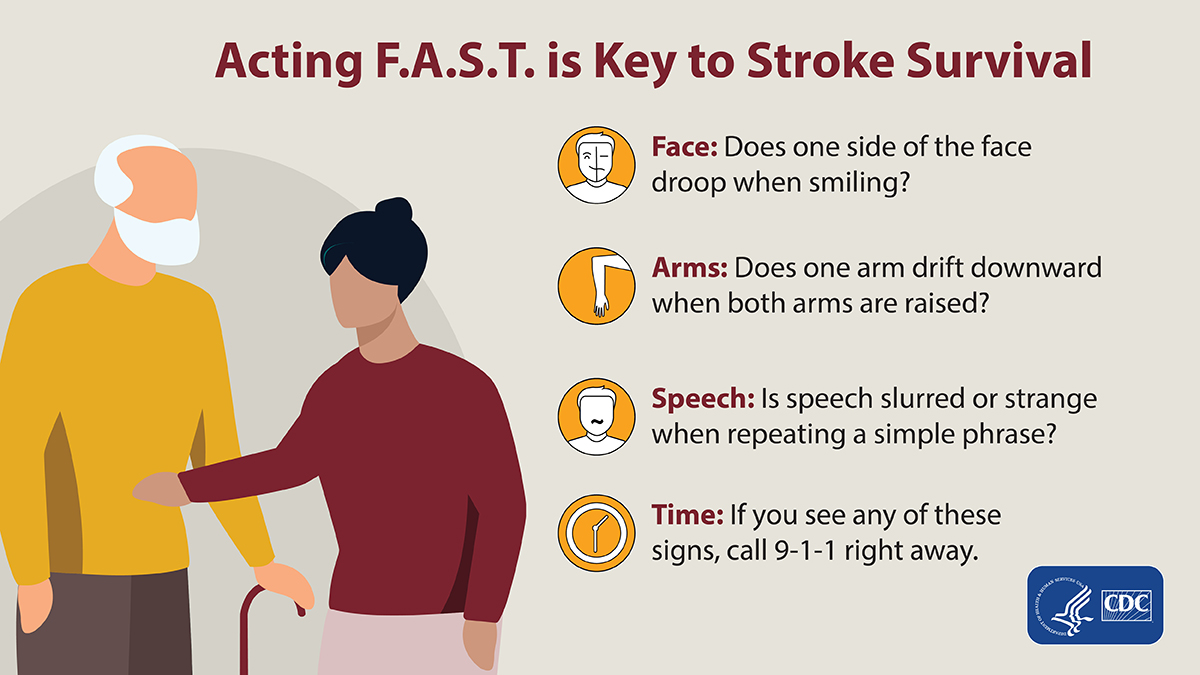
If you think someone may be having a stroke, act F.A.S.T.
During a stroke, every minute counts.” With a stroke- damage can be minimized if you get to the hospital quick enough. The stroke treatments that work best are available only if the stroke is recognized and diagnosed within 3 hours of the first symptoms.
What are the warning signs of a stroke? “You may have some or all of these signs. Note the time when symptoms start and call 911 or the emergency response number in your area immediately. Stroke is a medical emergency!” “Don’t ignore these warning signs, even if they go away.
Stroke Warning Signs:
- Sudden numbness or weakness of the face, arm or leg, especially on one side of the body
- Sudden confusion, trouble speaking or understanding
- Sudden trouble seeing in one or both eyes
- Sudden trouble walking, dizziness, loss of balance or coordination
- Sudden severe headache with no known cause
- There is a Spanish version instead of FAST: RAPIDO Conociendo sobre los accidentes cerebrovasculares identificar los signos y actuar R.Á.P.I.D.O.
Percentage of Hospitalizations due to Stroke, 2023
In 2023, 2.98% of hospitalizations in Indiana were due to Stroke.
Hover a county for info
Source: IDOH Hospital Discharge Data