The Watershed Development Commissions article (IC 14-30.5) allows a watershed development commission to be established as a legal entity and provide a mechanism by which one or more counties can collect an annual special assessment to locally address specific watershed-wide issues related to water resources management.
Watershed development commissions are regional entities established to oversee the development and management of watersheds at the local level. They can create strategies and implement projects that improve water quantity and quality in the watershed.
Watershed development commissions can perform activities related to the following general purposes that are outlined in IC 14-30.5-3-1: Flood damage reduction, drainage, stormwater management, recreation, water infrastructure, and improve water quality.
How DNR interacts with watershed development commissions
Besides serving as board members or technical advisors for watershed development commissions, the DNR Watershed Stewardship Section reviews petitions for the establishment of watershed development commissions.
The DNR Watershed Stewardship Section also reviews and approves the following activities for watershed development commissions:
- proposed public works
- water quality improvement plans
- flood damage reduction activities
- agreements with state agencies in other states
Featured News
- None at this time.
Frequently Asked Questions on Watershed Development Commissions
A watershed development commission is a legal entity that provides a mechanism by which one or more counties can collect an annual special assessment to solve specific issues related to water resources management at the local level. A commission's boundaries are organized on the HUC-8 watershed scale with the ability to undertake certain activities for the benefit of the watershed.
No, existing river basin commissions and watershed development commissions cannot overlap with each other or new ones.
- Flood damage reduction
- Drainage
- Stormwater management
- Recreation
- Water infrastructure purposes (not drinking water or wastewater)
- Water quality improvement (cannot be only addressed issue)
One or more counties pass an ordinance in their county and then get approval from Natural Resources Commission. Those interested in forming a watershed development commission should review DNR's Guidelines for Forming a Watershed Development Commission.
Petitions can be submitted to the following address.
Natural Resources Commission
C/O Department of Natural Resources, Legal Division
Indiana Government Center South
402 West Washington Street, Room W261
Indianapolis, Indiana 46204
317-232-4200
The board consists of the following individuals (IC 14-30.5-4-1):
- The county surveyor of each county that is a member of the commission and is entitled to membership on the board
- A second county representative appointed by the county executive
- An individual appointed to represent each second-class city (34,000+ population) within each county. If there are no second-class cities within the county, an individual representing the municipality with the highest population within each member county
- Director of the Department of Natural Resources or the director’s designee
An existing river basin commission that transforms into a watershed development commission may have different board member requirements.
A watershed development commission may impose an annual special assessment up to a certain amount, codified in statue, on each taxable parcel of real property. The amount of money depends on the type of property and is capped at the amount specified by the legislation.
A watershed development commission can use other funding mechanisms such as grants or receiving direct support from a member county. The direct support must equal at least 90% of the amount that the WDC would otherwise receive from annual special assessments.
- Can provide a steady source of funding
- Can tackle water quantity and quality issues
- Can address the whole watershed
- Can work across state lines with agencies on the other side of the border within the same watershed
- Provides opportunities for water technicians and soil and water conservation districts (SWCDs) to provide expert input on issues facing the watershed
Yes, any county that has land in the boundaries can petition to join an existing watershed development commission.
Resources for Watershed Development Commissions
- Watershed Development Commission Statute IC 14-30.5
- DNR Guidance for Forming a Watershed Development Commission
Existing Watershed Development Commissions
The following is a list of established watershed development commissions under IC 14-30.5.
Pigeon Creek Watershed Development Commission was established in 2024 and has territory in Gibson, Pike, Warrick, and Vanderburgh counties. County members include Vanderburgh.
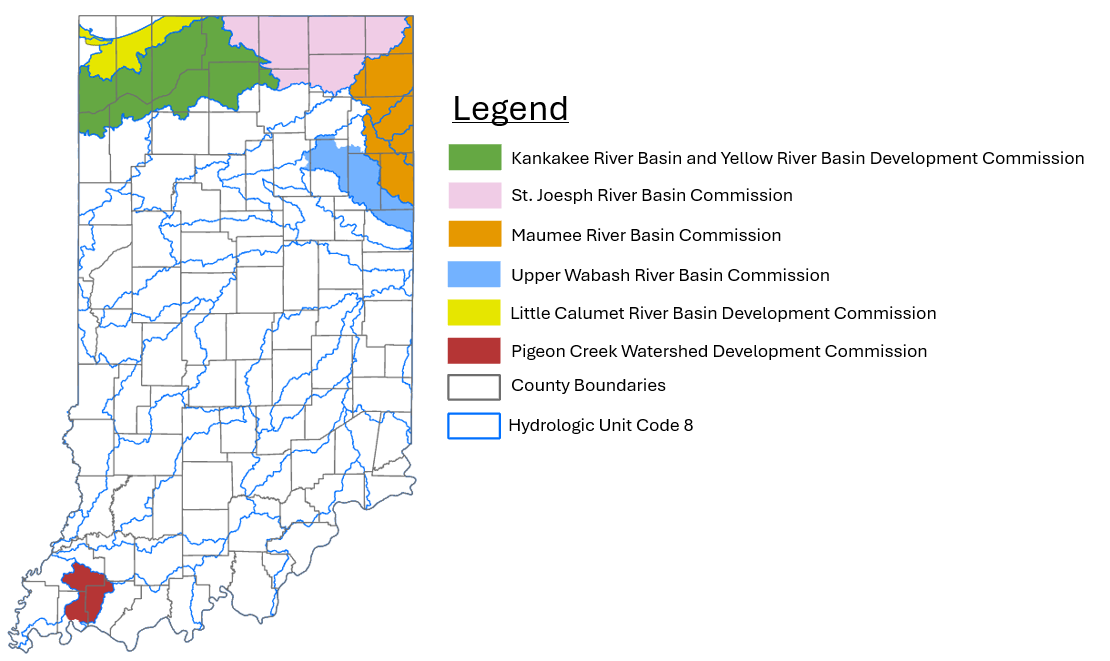
Map of existing river basins and watershed development commissions in Indiana. New watershed development commissions cannot overlap with an existing river basin or watershed development commission.