Covered Expenses
A maximum award of $15,000 may be available to help cover expenses resulting from any one injury or death. Medical expenses must be incurred within two years of the crime. On top of that, an additional $5,000 can be used to recoup funeral and burial costs.
By law, the program is a payer of last resort, which means applicants are compensated for covered expenses that have not been and will not be compensated from any other source. You are still legally responsible for the payment of your bills associated with the crime. Filing an application does not prevent service providers from taking collection steps against you. If you application is approved, you will be reimbursed for eligible out-of-pocket expenses.

Examples of reimbursable expenses include:
- Medical bills.
- Out-patient services including but not limited to: medical, hospital, surgical, lab, x-ray, pharmacy, physical therapy, dental, optometry, and ambulance expenses.
- Mental health counseling (up to $3,000).
- Funeral and burial or cremation expenses (up to $5,000).
- Lost wages.
- Loss of support for legal dependents of a crime victim who was killed. (Note: This requires verification of legal dependent status, marriage and support, or paternity and support).
- Reasonable child care services.
- Limited attorney fees related to a successful appeal.
- Recent change Crime scene clean-up and the replacement of windows or door locks are eligible expenses for crimes that occurred after July 1, 2022.

Examples of non-reimbursable expenses include:
- Property damage (other than the replacement of windows or door locks) and replacement of property or cash.
- Moving, relocation or daily living expenses.
- Rent, utilities, food, travel, or lodging.
- Burial clothing, funeral flowers, or food.
- Pain and suffering.
- Out of pocket expenses without proof of payment.
- Attorney fees (other than fees charged to represent the victim at an administrative hearing before the division).
- Medical expenses incurred for treatment of injuries that are not a direct result of the crime.
- Expenses that cannot be verified via an itemized bill.
Notice
 We are currently experiencing issues with our online application portal. We are working to fix the issue as soon as possible. In the meantime, please submit a written application. We are sorry for the inconvenience.
Apply for Violent Crime Compensation
You can file a claim either online or by submitting a paper application. The paper application must be mailed or hand-delivered. It is unnecessary to submit medical bills or police reports at the time you file your application, as additional information will be requested throughout the investigation process.
Applications must be filed no later than two years after the crime occurred.
File a PDF claim: If applying online isn't an option, PDF applications can be mailed or hand delivered to the Indiana Criminal Justice Institute at: Indiana Government Center South, 402 W. Washington Street, Room W469, Indianapolis, IN 46204. They can also be faxed to: 317-232-7103.
Download a PDF application or Descargar aplicación en español

Apply for Sexual Assault Compensation
Hospitals can file a claim by submitting a paper application.
Applications must be filed no later than 180 days after the crime occurred.
VOCA Victim Compensation
Data Dashboard
For detailed information on Indiana’s Victim’s Compensation Program—including application trends, demographic data, payment statistics, and expense categories—please visit the VOCA Victim Compensation Data Dashboard, developed by the Office for Victims of Crime (OVC).
This dashboard provides both national and state-level data. To view Indiana information, select "IN" from the “State” drop-down menu.
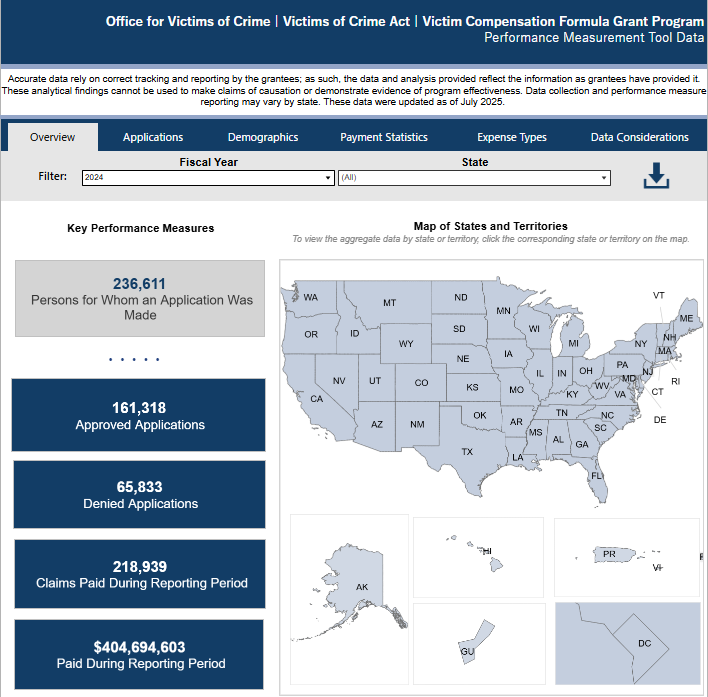
VOCA Victim Compensation Data Dashboard
Still have questions?
If you have questions about completing the application or if you are an organization that would like to request application forms, please contact the Violent Crime Victim Compensation division at: