
Search for Keywords
- A
Annual Financial Report Updates 2025
Appropriation of Insurance Claim Proceeds
Appropriations of Federal and State Funds
Assignment of Wages - Wage Deductions
IC 5-3-1-3 provides that each library fiscal officer shall have published an annual report of the receipts and expenditures of such library within 60 days after the close of each calendar year. (link: https://iga.in.gov/laws/2024/ic/titles/5#5-3-1-3 )
IC 5-11-1-4 requires such reports to be filed with the State Examiner, as set forth in the Uniform Compliance Guidelines, which states no later than sixty (60) days after the close of the year. (link: https://iga.in.gov/laws/2024/ic/titles/5#5-11-1-4 )
If the library has a budget of at least $300,000, the “Cash and Investments Combined Statement” of the annual report is to be published one time in two newspapers unless there is only one newspaper in the library territorial limits, in which case publication in the one newspaper is sufficient. If no newspaper is published in the library territorial limits, then publication is to be made in a newspaper published in the county in which the library is located, and that circulates within the library territorial limits.
The “Cash and Investments Combined Statement” to be advertised is located in the Annual Report Outputs section under “Advertising Outputs”.
The Department of Local Government Finance may not approve the budget or a supplemental appropriation of a library until the library files an annual report for the preceding calendar year.
ANNUAL FINANCIAL REPORT UPDATES 2025
As we begin year-end duties and prepare for completion of the 2025 Annual Financial Report (AFR), we want to highlight a few important updates you will notice throughout the report. In the Unit Questions section, questions 12–20 will be automatically prefilled with “Not Applicable.” These items have been inactivated for this year’s reporting, which means the Transfer Schedule, Interfund Loan Schedule, and Tax Abatement Schedule will not be required for the 2025 AFR.
If you encounter any issues or have additional questions regarding the AFR, please contact the Directors for assistance.
APPROPRIATION OF INSURANCE CLAIM PROCEEDS
Insurance proceeds should be receipted back into the fund which originally paid for the asset. These funds would not need to be appropriated if they are being spent within the year of receipt. However, if the repair to the asset exceeds the proceeds from insurance, then you would need to appropriate for the overage. IC 6-1.1-18-7 discusses this topic (link: https://iga.in.gov/laws/2024/ic/titles/6#6-1.1-18-7 )
Pursuant to IC 6-1-1-18-6, the library board may transfer money from one major budget classification to another within a department or office if:
- They determine that the transfer is necessary;
- The transfer does not require the expenditure of more money than the total amount set out in the budget as finally determined under IC 6-1.1; and
- The transfer is made at a regular public meeting and by proper resolution.
A transfer may be made under this section without notice and without the approval of the Department of Local Government Finance.
Unanticipated LIRF expenditures and appropriation of unanticipated revenue require a board resolution, publication of the additional appropriation request, public hearing, and approval by the Department of Local Government Finance.
APPROPRIATIONS OF FEDERAL AND STATE FUNDS
When funds are provided by the federal government either directly to or through a state agency for any program or project, the following procedures should be followed:
Advance Grants. Advance grants should be handled as follows:
- Where funds are “advanced” directly by the federal government for a specific purpose prior to making any disbursements, the money should be placed in a separate project fund and disbursements subsequently made from that fund. No appropriation of the federal funds is required.
- Where federal funds are “advanced” through a state agency or department with no state funds added thereto prior to making any distributions, the money should be placed in a separate project fund and subsequent disbursements made from that fund. No appropriation of the federal funds is required.
- Where federal funds are “advanced” by a state agency or department and state funds are included along with the federal funds in one check or voucher and the funds are for a specific purpose, the money should be placed in a separate project fund and disbursements made from that fund. Appropriation(s) must be obtained for the combined total (i.e., federal and state) prior to any disbursement being made from that project fund.
Reimbursement Grants. Reimbursement grants should be handled as follows:
Where a federal or state grant provides for payments to be made directly on a “reimbursement” basis after payment of expenses, the entire amount of the federal or state reimbursement may be appropriated by the library board without using the additional appropriation procedures under IC 6-1.1-18-5, if the funds are provided or designated by the state or the federal government as a reimbursement of expenditures. [IC 6-1-1.1-18-7.5].
No separate fund for the project or program is required unless the terms of the grant require one.
Matching Grants. Matching Grants should be handled as follows:
When a federal grant or program requires expenditures or “matching” funds to be provided from library funds, an appropriation must be obtained for the amount of such expenditures or local matching funds. Individual program requirements will dictate whether the appropriation should be obtained within the applicable library fund for expenditures there from or whether an appropriation should be obtained within the applicable library fund for a transfer to a required separate fund. This matter should be set out in the terms and conditions entered into between the library officials of the federal agency.
Summary. To summarize, no appropriations of federal funds are necessary:
- when advanced directly from the federal government for a specific purpose prior to making disbursements, and the money is placed in a separate project fund with disbursements made from that fund; or
- when federal funds are received in advance through a state agency for a specific purpose prior to making disbursements and the money is placed in a separate project fund with disbursements made from that fund and there is no state match.
Please keep in mind, if a library wishes to obtain an appropriation for all funds to be spent (i.e., federal, state, and local), there is certainly no prohibition in state statutes.
Depositories used by libraries must be approved as depositories for State funds. The Indiana Board for Depositories' website contains the most recent listing of approved depositories. The list can be accessed at www.in.gov/tos/deposit/.
ASSIGNMENT OF WAGES - WAGE DEDUCTION
IC 22-2-6-1 provides any direction given by an employee to his employer to make a deduction from
wages, shall constitute an assignment such wages subject to the provisions of the act. The term “employer” includes the State of Indiana and any political subdivision thereof. IC 22-2-6-2 outlines the procedures which must be followed and purposes for which deductible assignments may be made.
RECORDING OF AUDIT COSTS
Inquiries have questioned the correct procedure for accounting for city and town audit costs (this does not apply to costs associated with the utility audit).
Indiana Code 5-11-4-3(b) guides this process and states, in part:
“… Immediately upon receipt of the certified statement, the county auditor shall issue a warrant on the county treasurer payable to the treasurer of state out of the general fund of the county for the amount stated in the certificate. The county auditor shall reimburse the county general fund, except for the expense of examination and investigation of county office, out of the money due the taxing units at the next semiannual settlement of the collection of taxes.”
Therefore, counties shall continue to forward Examination of Records (audit costs) payments to the Treasurer of State for city and town audits when billed by the State Board of Accounts. The county general fund shall then be reimbursed from property tax collections of the city or town at the next semiannual settlement.
To properly account for the library’s audit costs the full amount of property and excise taxes (before audit costs) are to be receipted to the appropriate library funds. A disbursement for the Examination of Records is to be posted to library funds.
The Statement of Engagement Costs should be compared to the amount withheld for the Examination of Records to ensure the amounts agree. IC 5-11-4-4 provides that all disbursing offices are authorized to make payments required under this chapter without appropriation. Therefore, the examination of records costs would be considered an unappropriated disbursement.
- B
Budgets
IC 5-1-15 authorizes cities and towns to issue “bonds, notes, evidences of indebtedness, or other written obligations” in fully registered or book entry form.
A question frequently comes up as to whether a depository issuing debt needs to be an approved depository. IC 5-1-15 authorizes political subdivisions to issues “bonds, notes, evidence of indebtedness, or other written obligations” in fully registered or book entry form. Then IC 5-1-15-4 states “The entity may employ any bank or trust company as paying agent or registrar, co-registrar, or depository institution. The bank or trust company need not be a depository bank under IC 5-13, and need not be located within the state of Indiana.
Regardless of any other legal provisions, registrars, registration books, and transfer records related to bonds, notes, debt instruments, or other written financial obligations of any entity are not considered public records. These documents are intended solely for use by the entity itself, as well as any trustee, fiduciary, paying agent, registrar, co-registrar, or transfer agent involved. If a bank’s trust department holds such records, it must not disclose them to the bank’s bond or commercial departments, nor to any of its subsidiaries or those of its parent corporation. (IC 5-1-15-5)
In an effort to facilitate accounting procedures, the State Board of Accounts has issued the following instructions:
- If a bank, trust company, or other financial institution has been employed as a paying agent or registrar, a properly certified listing of bondholders from the paying agent or registrar shall serve as a mailing list for the fiscal officer. There is no requirement for each individual bondholder to file a claim.
- The mailing of the funds for bonds and coupons coming due must be mailed in such a manner to ensure receipt by the bondholder by the due date specific. Personnel of financial institutions state they usually make such mailing by first class mail one to three business days in advance of 4 the due date. They do not mail by certified or registered mail due to costs involved. We suggest you review this with your city or town attorney.
- Since the paying agency or the registrar shall keep a register of ownership of bonds and all bonds and coupons shall be paid when becoming due, we see no reason for the municipality to duplicate those same records maintained by the paying agent or registrar by keeping a bond register. There should be no unpaid outstanding matured bonds or coupons.
- In all instances when employing a bank, trust company, or other financial institutions, be sure to protect the municipality from any liability arising due to any possible errors relating to names and addresses of current bondholders. This protection may be obtained by the financial institution furnishing a bond or insurance in favor of the municipality.
As stated previously, please consult your city or town attorney with questions regarding procedures for registered bonds.
If any reduction is made by the Department of Local Government Finance in the library’s budget and tax levy, the appropriating body should comply with the section of the budget law found in IC 6- 1.1-18-4 which is quoted below:
“Appropriations not to exceed budget – Except as otherwise provided in this chapter, the proper officers of a political subdivision shall appropriate funds in such a manner that the expenditures for a year do not exceed its budget for that year as finally determined under this article.”
- C
Capital Assets
Establishing the Estimated Cost of Capital Assets
Certified Checks for Bonds on Public Contracts
Certified Report of Names, Addresses, Duties, and Compensation of Public Employees
Claims for Payments to State and Federal Agencies
Computing Salaries for Partial Periods
Conflict of Interest Disclosures
Cybersecurity Incidents - Reporting
CAPITAL ASSETS
ESTABLISHING THE ESTIMATED COST OF CAPITAL ASSETS
When it is not possible to determine the historical cost of capital assets owned by a governmental unit, the following procedure should be followed.
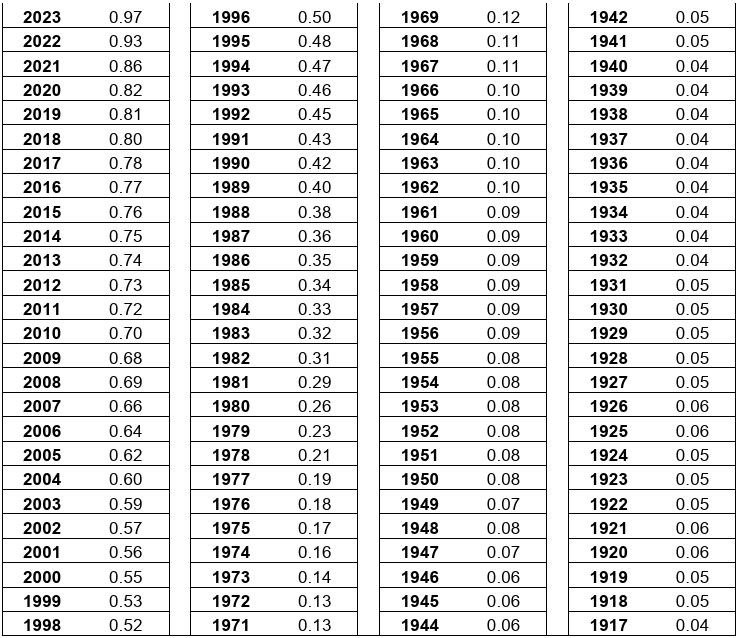
Develop an inventory of all capital assets which are significant for which records of the historical costs are not available. Obtain an estimate of the replacement costs of these assets. Through inquiry determine the year or approximate year of acquisition. Then multiply the estimated replacement cost by the factor for the year of acquisition from the Table of Cost Indexes. The resulting amount will be the estimated cost of the asset.
In some cases estimated replacement cost can be obtained from insurance policies; however, if estimated replacement costs are not available from insurance policies, you should obtain or make an estimate of the replacement costs.
If the replacement cost is estimated to be $76,000.00 and the asset was constructed about 1930, then the estimated cost of the asset should be reported as $5,320.00.


Every library should have a complete inventory of all capital assets owned which reflects their acquisition value. Such inventory should be recorded in the Capital Assets Ledger, General Form 369. A complete inventory should be taken at least once a year for good internal control and for verifying account balances carried in the accounting records.
Capitalization Policy
The governing body should establish a capitalization policy that sets a dollar amount as a threshold to be used in determining which items will be recorded.
Land
The records of each library should reflect land owned, its location, its acquisition date and cost (purchase price). Infrastructure A capital asset account for the cost of infrastructure should reflect the location of each road, bridge, tunnel, drainage system, water, wastewater or stormwater system, dam, or lighting system.
Buildings
A capital asset account for buildings should reflect the location of each building and the cost value (being the purchase or construction cost) and, if improvements are made to the building, the cost of such improvements would be included. If a building is acquired by gift, the account would reflect its appraised value at the time of acquisition.
Improvement Other Than Buildings
A capital asset account should reflect the acquisition value of permanent improvements, other than buildings, which have been added to land. Examples of such improvements are fences, retaining walls, parking lots, and most landscaping. The improvements would be valued at the purchase or construction cost.
Equipment
Tangible property of a permanent nature, other than land, buildings and improvements, should be inventoried. Examples include machinery, trucks, cars, furniture, desks, safes, cabinets, etc. The value of such items should be carried in the inventory at the purchase cost.
Construction Work In Progress
Where construction work has not been completed in the current calendar year, the cost of the project should be carried as “construction work in progress.” When the project is completed, it will be placed on the inventory applicable to the assigned asset accounts.
CERTIFIED CHECKS FOR BONDS ON PUBLIC CONTRACTS
Per IC 1-1-7.5-1, whenever state law requires a certified check to accompany bids for public contracts, bidders may instead provide a draft, cashier’s check, or money order, as long as it is issued by a financial institution covered by federal insurance. (link: https://iga.in.gov/laws/2025/ic/titles/1#1-1-7.5-1)
CERTIFIED REPORT OF NAMES, ADDRESSES, DUTIES, AND COMPENSATION OF PUBLIC EMPLOYEES
All libraries must file with the State Examiner on or before January 31, Form 100-R, a Certified Report of Names, Addresses, Duties and Compensation of Public Employees. This report is required by IC 5-11-13 (link: https://iga.in.gov/laws/2024/ic/titles/5#5-11-13 ). Only the business address of each officer or employee listed is to be included on the form.
Such report must indicate whether the library offers a health plan, a pension, and other benefits to full-time and part-time employees.
A change in statute added IC 36-1-30 in 2022 which requires the reporting of donated money used to fund salaries by January 31 each year to the State Examiner. This reporting will be included as part of the 100R reporting. A drop-down box has been added to the right of each individual reported to either select “yes” for donated monies were used or “no” donated monies were not used.
The report is to be filed electronically on the Gateway portal with the State Board of Accounts.
IC 20-33-3 places certain restrictions on work hours for children under 18 years old. For questions regarding child labor laws, please contact the Indiana Department of Labor. The Bureau of Child Labor home page is located at https://www.in.gov/dol/childlabor.htm. The preferred contact information is childlabor@dol.in.gov.
IC 20-33-3-39 through IC 20-33-3-41 list the penalties for violations of the child employment laws which can be as high as $400 per violation.
CLAIMS FOR PAYMENTS TO STATE AND FEDERAL AGENCIES
The State Board of Accounts’ audit position is that when statutory payments are due to state or federal agencies, there is no requirement for the state or federal agency to file an invoice or claim for such payments. This audit position would include payments for social security obligations, public employees’ retirement fund contributions, federal, state, or county taxes withheld, sales tax, and other such amounts due state or federal agencies. The disbursing officer should prepare an accounts payable voucher and attach any copies of payroll deduction reports, federal or state invoices, communications, etc., to document the payment. The accounts payable voucher will provide a posting media indicating to whom paid, fund on which drawn, accounts to be charged, and the approval by the proper boards.
FILING AND DOCKETING CLAIMS
Indiana Code 5-11-10-2 states in part:
“(a) Claims against a political subdivision of the state must be approved by the officer or person receiving the goods or services, be audited for correctness and approved by the disbursing officer of the political subdivision, and, where applicable, be allowed by the governing body having jurisdiction over allowance of such claims before they are paid. If the claim is against a governmental entity as defined in section 1.6 [IC 5-11-10-1.6] of this chapter, the claim must be certified by the fiscal officer.
(b) The state board of accounts shall prescribe a form which will permit claims from two (2) or more claimants to be listed on a single document and, when such list is signed by members of the governing body showing the claims and amounts allowed each claimant and the total claimed and allowed as listed on such document, it shall not be necessary for the members to sign each claim.
(c) Applies to solid waste management districts.
(d) The form prescribed under this section shall be prepared by or filed with the disbursing officer of the political subdivision together with… the supporting invoices or bills...
(e) Where under any law it is provided that each claim be allowed over the signatures of members of a governing body, or a claim docket or accounts payable voucher register be prepared listing claims to be considered for allowance, the form and procedure prescribed in this section shall be in lieu of the provisions of the other law.”
The State Board of Accounts has prescribed General Form No. 364, Accounts Payable Voucher Register, which shall be prepared by, or filed with, the disbursing officer of the library, together with the supporting accounts payable voucher, and all such documents shall be carefully preserved by the disbursing officer as a part of the official records of the office.
If members of the governing body would rather approve and sign each individual accounts payable voucher in lieu of signing the Allowance of Vouchers section of General Form 364, this procedure is acceptable.Indiana Code 5-11-10-1.6 states, in part:
“(c) The fiscal officer of a governmental entity may not draw a warrant or check for payment of a claim unless:
(1) there is a fully itemized invoice or bill for the claim;
(2) the invoice or bill is approved by the officer or person receiving the goods and services;
(3) the invoice or bill is filed with the governmental entity's fiscal officer;
(4) the fiscal officer audits and certifies before payment that the invoice or bill is true and correct; and
(5) payment of the claim is allowed by the governmental entity's legislative body or the board or official having jurisdiction over allowance of payment of the claim…(d) The fiscal officer of a governmental entity shall issue checks or warrants for claims by the governmental entity that meet all of the requirements of this section. The fiscal officer does not incur personal liability for disbursements:
(1) processed in accordance with this section; and
(2) for which funds are appropriated and available.(e) The certification provided for in subsection (c)(4) must be on a form prescribed by the state board of accounts.”
The library fiscal officer has the option of certifying either on each Accounts Payable Voucher or by signing the certification section of the Accounts Payable Voucher Register.
COMPUTING SALARIES FOR PARTIAL PAY PERIODS
A city or town employee on a monthly salary, whose employment with such city or town begins or terminates in the middle of a month, should be paid only for that part of such month that he has worked. If such employee’s work was terminated at the end of the day on January 15, 2015, for example, we believe that he should receive 15/31 of his regular monthly salary for the month of January.
The same procedure should be used for a semimonthly, biweekly, and weekly salaries.
CONFLICT OF INTEREST DISCLOSURES
Indiana Code 35-44.1-1-4 prohibits public servants, their spouses, their minor dependents, and any person who receives more than half of their financial support from a public servant from having a pecuniary interest in contracts or purchases of the government entity for which the public servant works. However, subsection (d) of the statute creates a safe harbor through a conflict-of-interest disclosure. A public servant who completes a disclosure form is protected. The disclosure must be properly filled out, approved in a public meeting, and filed with the State Board of Accounts. There is a link on the Indiana Gateway for Government Units (Gateway) website to upload disclosures (link: https://gateway.ifionline.org/sboa_coi/ ). In order to protect the public servant, the disclosure should be accepted in a public meeting before final action on the contract or purchase and should be uploaded within fifteen days after final action.
We receive a lot of questions asking if certain situations require a conflict-of-interest disclosure. Each situation varies; however, it never hurts to file the disclosure. So, when in doubt, fill it out!
Periodically, we receive questions from units of government wanting to utilize the out-of-state Purchasing Cooperative Sourcewell to make large purchases such as assets without having to advertise for bids. A municipality may only avoid standard procurement procedures and rely on another entity’s purchase price if the original entity’s procurement was fully compliant with the requirements of Indiana Code, in this case Indiana Code 5-22. In general, any cooperative used by an Indiana city or town must comply with Indiana purchasing statutes or public works laws, and we always recommend the local units obtain the written opinion of their city or town attorney. Sourcewell (formerly NJPA) was established under the laws of the State of Minnesota and the SBOA is not aware of any provisions in Minnesota law for a cooperative taking bids for equipment and supplies. Sourcewell’s website notes that their members are able to utilize the cooperative purchasing laws “in their respective jurisdiction.” [ https://www.sourcewellmn.gov/compliance-legal]
Therefore, SBOA would recommend a local unit of Indiana government obtain the written legal opinion of an attorney stating that using a cooperative such as Sourcewell would be in compliance with all Indiana laws. If purchases and/or lease agreements through Sourcewell were identified during an audit of a local governmental unit, we would take an attorney’s written legal opinion into consideration. If items were purchased from an out-of-state cooperative without the support of a written legal opinion, SBOA may take audit exception in the form of a written comment/finding in our Audit Report.
Some of the statutes cited by Sourcewell to support Indiana cities and towns purchases are IC 5- 22-10-5, IC 5-22-10-12, and IC 5-22-10-14, special purchasing laws. If justifying a purchase from Sourcewell or other cooperative as a special purchase, cities and towns should ensure they comply with Indiana Code, including (but not limited to) retaining documentation supporting the special purchase. IC 5-22-10 et seq. For instance, Sourcewell cites IC 5-22-10-5 as providing a special purchase can be made “when there exists a unique opportunity to obtain supplies or services at a substantial savings”. Because some of the terms in this statute, namely “unique opportunity” and “substantial”, are not defined, our position is when an Indiana governmental unit is obtaining supplies using IC 5-22-10-5 as the authority, they should obtain a written legal opinion from their attorney that the purchase complies with this statute. SBOA would take the opinion into consideration during an audit.
Regarding IC 5-22-10-12, this statute provides when the market structure is based on price, a local unit of government can make a purchase when they are able to receive a dollar or percentage discount “of the established price”. In the case of a bid and price offered by Sourcewell, we are unclear as to what the discount of the “established price” would be. Is the bid price the “established price”? Is there a discount off of the bid price? Is the bid price considered the discount – if so, what would the established price be? Our audit position is when an Indiana governmental unit is obtaining supplies using IC 5-22-10- 12 as the authority, they should obtain a written legal opinion from their attorney that the purchase complies with this statute. SBOA would take a written legal opinion into consideration during an audit.
Regarding IC 5-22-10-14, this statute provides the purchasing agent may make a purchase when they determine, in writing, that the supplies can be purchased at prices equal to or less than prices stipulated in current federal supply service schedules established by the federal General Services Admin and it’s advantageous to the government body’s interest in efficiency and economy. Because the purchasing agent at the local government has to make a written determination the prices are equal to or less than federal supply service schedules and that it’s to their advantage because of “efficiency and economy”, we would take the written legal opinion of any attorney that making a purchase under this statute would comply with Indiana’s laws.
The library board shall establish a fee schedule by ordinance for the certification and copying of documents. For questions on fees please see IC 5-14-3-8 (d)
(link: https://iga.in.gov/laws/2025/ic/titles/5#5-14-3-8)
The State Board of Accounts will not take exception to the use of credit cards by a governmental unit provided the following criteria are observed:
- The governing board must authorize credit card use through an ordinance or resolution, which has been approved in the minutes.
- Issuance and use should be handled by an official or employee designated by the board.
- The purposes for which the credit card may be used must be specifically stated in the ordinance or resolution.
- When the purpose for which the credit card has been issued has been accomplished, the card should be returned to the custody of the responsible person.
- The designated responsible official or employee should maintain an accounting system or log which would include the names of individuals requesting usage of the cards, their position, estimated amounts to be charged, fund and account numbers to be charged, date the card is issued and returned, etc.
- Credit cards should not be used to bypass the accounting system. One reason that purchase orders are issued is to provide the fiscal officer with the means to encumber and track appropriations to provide the governing board and other officials with timely and accurate accounting information and monitoring of the accounting system.
- Payment should not be made on the basis of the statement or a credit card slip only. Procedures for payments should be no different than for any other claim. Supporting documents such as paid bills and receipts must be available. Additionally, any interest or penalty incurred due to the late filing or furnishing of documentation by an officer or employee should be the responsibility of that officer or employee.
- If properly authorized, an annual fee may be paid.
- If a vendor charges a convenience fee for use of the card, such fee may be paid to the vendor.
If properly authorized, an annual fee may be paid.
Recent legislative changes allow a taxing unit to deposit distributions of Financial Institutions Tax (FIT) and Commercial Vehicle Excise Tax (CVET) in “any fund maintained by the taxing unit,” and the distributions may be used for any purpose allowed by law. [IC 6-5.5-8-2(c); IC 6-6-5.5-20(h)]. While this broad language benefits taxing units by allowing them to receipt the funds where they will be most effectual, if a unit does not take steps to ensure the distribution is adequately tracked, critical audit findings may result.
During audit, it is imperative that SBOA be able to identify into which fund the distributions are receipted. Therefore, if a unit receipts FIT and CVET distributions into any fund other than the General Fund, the legislative body of the unit must identify into which fund the distributions will be receipted. The fund identification must be made prior to the distribution and may be done through ordinance, resolution, or vote (memorialized in meeting minutes). If the distributions are receipted into the General Fund, the unit need not adopt an ordinance, resolution, or vote.
REPORTING CYBERSECURITY INCIDENTS
House Enrolled Act 1169 (2021) added IC 4-13.1-2-9 as a new section to the Indiana Code which requires political subdivisions, as defined in IC 36-1-2-13, to report any cybersecurity incident using their best professional judgement to the Indiana Office of Technology (IOT) without unreasonable delay and not later than two business days after discovery of the cybersecurity incident. A cybersecurity incident may consist of one or more of the following categories of attack vectors: (1) Ransomware, (2) Business email compromise, (3) Vulnerability Exploitation, (4) Zero-day exploitation, (5) Distributed denial of service, (6) Web site defacement, (7) Other sophisticated attacks as defined by the chief of information officer and that are posted on the officer’s Internet web site. (IC 4-13.1-1-1.5)
Cybersecurity incidents can be reported on IOT’s web site at the following webpage. https://www.in.gov/cybersecurity/report-a-cyber-crime/
- D
Dedicated Fund Transfers To Rainy Day Fund
Deferred Compensation Plans - PERF
DEDICATED FUND TRANSFERS TO RAINY DAY FUND
The term “dedicated fund” has been used throughout the state, and the officials have asked for a meaning of that term as it relates to Rainy Day transfers. Our audit position is as follows:
Dedicated funds are a generic term not defined in statute but is generally construed to mean a fund set aside for a specific purpose. For purposes of transferring to the Rainy Day fund, we are limiting our position to those dedicated funds that result from statutory authority but do not include home rule funds or clearing accounts. Debt service funds are already specifically prohibited from transfer in the Rainy Day statute and so are not considered here either.
In order to determine whether or not monies in a fund may be transferred to the Rainy Day fund, an analysis would need to be made of the authority creating the fund in light of IC 36-1-8-5.1. It would be up to the political subdivision to show SBOA how money transferred to the Rainy Day fund met the criteria for transfer. However, we can provide general guidance based on our position.
Tax levy and LOIT funds have different criteria than other statutorily created funds in regard to transferring to the Rainy Day fund. The key words to tax levy and LOIT funds are whenever the purposes of a tax levy have been fulfilled and unencumbered balance remains in the fund and unless a statute provides that it be transferred otherwise. In general, it will be up to the unit of government to define when the purposes have been fulfilled. There are certain funds that are raised by levy that have very specific language that the balance may not be transferred, such as the assessment fund. For those funds, we would take exception if there were a transfer to Rainy Day fund. Also, for some cumulative funds such as those found under IC 6-1.1-41-1, balances in these funds may only be transferred to the General fund per IC 6-1.1-41-15 and again we would take exception if they were transferred to the Rainy Day fund.
For other funds, the statute allows for the transfer to Rainy Day fund if the funding source is specified in the ordinance or resolution and the transfer is not otherwise prohibited by law. It is our general position that if the statute provides definitive restrictive language on the use of the funds or that the balance is not to be transferred, whether Rainy Day fund is specifically included or not, that the monies are not to be transferred to Rainy Day fund. For example, MVH funds [IC 8-14-1-3(1)] provide that for cities or towns, no part of such sum shall be used for any other purpose than for the purposes defined in this chapter. IC 8-14-1-4 provides similar restrictions for counties. For LRS funds, IC 8-14- 2-5 defines the exclusive uses of the funds, and IC 8-14-2-7 further restricts transfers of certain towns’ LRS to General fund after these monies have not been spent for 24 months. Transfers from MVH and LRS (or any other fund with similar statutory restrictions) to Rainy Day would be prohibited and we would take exception if monies were so transferred. Where there is not such restrictive language or prohibition of transfer, we will consider the unit attorney’s written opinion as to why the other fund would not fall under the category of prohibited and so be transferred.
DEFERRED COMPENSATION PLANS - PUBLIC EMPLOYEES RETIREMENT FUND
IC 5-10-1.1-1 allows cities and towns to contribute amounts before January 1, 1995 and continue or begin to contribute amounts after January 1, 1995, to a nonqualified deferred compensation plan on behalf of eligible employees, subject to any limits and provisions under section 457 of the Internal Revenue Code. IC 5-10-1.1-7 allows cities and towns to offer to their employees both the state deferred compensation plan and another deferred compensation plan that uses private vendors.
IC 5-10.2-2-1 further provides that it does not prohibit a city or town from establishing and providing before January 1, 1995 and continuing to provide after January 1, 1995, retirement, disability, and survivor benefits to the employees of the city or town if the city or town took action before January 1, 1995, and was not a member of the Public Employees’ Retirement Fund (PERF) on January 1, 1995.
A city or town has no authority to establish a local pension plan by ordinance, resolution, or contract after January 1, 1995, without specific statutory authority. PERF, deferred compensation plans, police and fire pension plans, and utility employee pension plans are all authorized by statute.
CONTRIBUTIONS, DONATIONS, GIFTS
Library Gift Funds
Pursuant to IC 36-12-3-11(a)(5), money or securities accepted and secured by the library board as a grant, gift, donation, endowment, bequest or trust may be set aside in a separate fund or funds, and shall be expended, without appropriation, in accordance with the conditions and purposes specified by the donor.
Definitions
The following definitions apply to the gift fund."Restricted" gifts are those to which the donor has attached terms, conditions and purposes. These may be quite specific or very general, such as "books", etc.
"Unrestricted" gifts are those to which the donor has not attached terms, conditions or purposes.
Sources
Grants, gifts, donations, endowments, and bequests (hereinafter required to collectively as "gift"). It is the prerogative of the Board to accept or reject any gift.Income in the form of tax receipts, fees, sale of library property, rental, etc. may not be receipted into the library gift fund.
Accounting
Gifts may be handled in any of the following ways:Operating Fund. If the gift is unrestricted, the library may receipt the gift into the library operating fund.
A. If deposited into the library operating fund, the gift money must be budgeted, appropriated (in the regular budget or by additional appropriation) in the manner prescribed, including advertising and approval by the Department of Local Government Finance. Any gift receipted to the Library Operating Fund must be posted to Columns A-1 and B-1 of the Library Financial and Appropriation Record. Disbursements are to be posted to Columns A-2 and B-2 and also in the applicable appropriation columns.
B. Gift money placed into the library operating fund may be spent as determined by the library board within the scope of its statutory authority. It is to be expended as other funds of the library.
C. Gift money placed in the library operating fund does not accumulate and must be spent or encumbered within the fiscal year or it will revert to the library operating fund balance and must be re-appropriated before the disbursement.
Separate Fund or Funds. A separate fund may be established for each gift; gifts for like purposes may be receipted into separate funds for each purpose; or all gifts may be placed into one "Gift Fund".
Use of Gift Funds
If the library board chooses to receipt any gift (restricted or unrestricted) to a separate fund or funds, the following will apply.1. Gift money may be spent without budgeting or appropriation.
2. If restricted, it must be spent according to the donor's restrictions.
3. If unrestricted, it may be spent as determined by the library board within the scope of its statutory authority.
4. The fund or funds may be accumulated and may be spent at any time the library board determines, unless otherwise required by the terms of the donor.Accounting
If all gifts are placed into a "Gift Fund", the following accounting will be necessary:1. A subsidiary record to keep track of the disbursements relating to each gift must be maintained.
2. The subsidiary record may be kept on any appropriate commercial form or columnar worksheet, such as a cash journal.
3. A separate sheet should be opened in this subsidiary record for each restricted gift. Entries to this separate sheet would include the receipt of the restricted gift and disbursements chargeable to each gift including the date, amount and explanation of each.
4. Income from the interest on gifts may be receipted into the same fund in which the principal of such gift has been receipted provided it is to be used for the same purpose as the principal. However, if, under the terms of the trust, the principal must be held in trust in perpetuity and only the income used by the governmental unit, there should be two accounts established, one designated as "Trust Principal" and the other designated "Trust Income."
5. Unrestricted gift fund monies may be invested as part of the "total monies on deposit," and the interest thereon receipted to the library operating fund.
6. All funds, regardless of source, are deposited by the treasurer in only one bank account in each designated depository.
7. Receipts to and disbursements from a separate gift fund or funds may be posted in columns D-1, D-2, E-1, E-2, and E-3 or F-1, F-2 , and F-3 on the Library Financial and Appropriation Record if such columns are not being used. If space for additional funds is needed, the optional flyleaf sheet (Library Form No. 1C) should be used. This form contains columns for four additional funds.Community Foundation Transfers
Gifts to the library may be set aside in an account with a nonprofit corporation established for the sole purpose of building permanent endowments within a community (referred to as a "community foundation"). The earnings on the funds in the account, either deposited by the library or accepted by the community foundation on behalf of the library, may be distributed back to the library for disbursement, without appropriation, in accordance with the conditions and purposes specified by the donor. A community foundation that distributes earnings under this clause is not required to make more than one (1) distribution of earnings in a calendar year. [IC 36-12-3-11(a)(5)(B)]This action must be authorized by the library board by resolution. Note that the statute does not provide for a return of principal to the library.
- E
Emergency Repairs - Public Works
Establishing the Estimated Cost of Capital Assets
Examination of Records and Statement of Engagement Cost
Indiana Code 36-12-3-16.5 covers the payment of claims via electronic transfer. Note that subdivision (c) requires a unit to utilize the normal claims process, even for electronic funds transactions. Among other limitations, this means that it is impermissible for a third party to “pull” money out of a unit’s bank account. Instead, the fiscal agent must initiate or direct the unit’s financial institution to disburse the funds.
EMERGENCY REPAIRS - PUBLIC WORKS
The Indiana Code includes special purchasing provisions in emergency public work situations. IC 36-1-12-2 provides a definition of public works and IC 36-1-2-4.5 provides a definition of an emergency.
Whether or not the political subdivision can declare a situation an emergency in order to bypass the bidding requirements of the public works statutes is fact specific. IC 36-1-12-9 provides for the governing body to contract for public works without advertising bids or quotes. We would recommend working with an attorney in order to maintain compliance with these statutes.
During an audit we would be looking for the formal declaration of emergency noted within the official board minutes and the names of the persons invited to bid or provide quotes. Documentation should be maintained including the original bids or quotes and the board’s determination of the project award. Any insurance proceeds received should be receipted into the fund the originally paid the cost and per IC 6-1.1-18-7 would be considered appropriated for 12 months after received for the sole purpose of repairing or replacing the property that was insured. Any additional funds above the insurance proceeds would need to follow normal additional appropriation procedures.
As economic conditions fluctuate and budgets tighten, political subdivisions face growing pressure to manage costs with precision and plan audits more strategically. This article takes a closer look at how the Statement of Engagement Costs can serve as a vital tool for forecasting expenses for future audit costs.
Rates
If necessary, our rates are amended annually and submitted to the audit committee for review to ensure the cost of performing an audit does not exceed an amount equal to eighty percent (80%) of the market rate cost. Our rates are not changing for the upcoming fiscal year and can be found on our website: https://www.in.gov/sboa/about-us/our-rates/.
Statement of Engagement Costs
At the end of an audit engagement, the State Board of Accounts sends a Statement of Engagement Costs to each political subdivision, including the County. This statement details a summary of the engagement, including the number of days spent on the audit, the daily/hourly rate, and any report processing fees. This statement is not an invoice that is to be paid by the entities.
The process for the county to pay the examination fees is outlined in statute:
“The state examiner shall certify to the auditor of each county the amount chargeable to each taxing unit within the county for the expense of its examinations as provided in this chapter. Immediately upon receipt of the certified statement, the county auditor shall issue a warrant on the county treasurer payable to the treasurer of state out of the general fund of the county for the amount stated in the certificate. The county auditor shall reimburse the county general fund, except for the expense of examination and investigation of county offices, out of the money due the taxing units at the next semiannual settlement of the collection of taxes.”
[IC 5-11-4-3(b)].
The statute does not specifically restrict the use of any of the funds taken from settlement and a distribution is not viewed the same as a disbursement from the fund so we will not take exception to taking a distribution from a fund other than general. We do however recommend avoiding taking from the debt funds without discussing with the unit first as these funds are levied for the exact amount needed to cover a political subdivisions debt.
If the county knows or reasonably believes that it does not have on hand or will not have collected enough taxes by the next distribution date for a taxing unit included on the examination of records billing, the county auditor will send the certified statement to the taxing unit for payment of costs. The taxing unit should contact the State Board of Accounts to arrange for payment of examination costs directly to the State Board of Accounts. The cost must be paid prior to the next audit. If the audit costs due to the State Board of Accounts are not paid prior to the next audit, the independence of the State Board of Accounts is impaired and future audits are delayed.
When the taxing unit is required to pay audit costs directly, these costs may be allowed to be paid from funds other than General fund. For example, Rainy Day funds could be used if your Rainy Day Ordinance allows for the payment of audit costs. Payment of audit costs does not require an appropriation per IC 5-11-4-4, which states:
“All disbursing officers be and they are hereby authorized to make all disbursements or payments required to be made under the provisions of this chapter without any appropriation being made therefor.”
Planning for Future Audits
For political subdivisions, planning for audit costs is a strategic exercise that ensures transparency, compliance, and fiscal responsibility. Whether preparing for a routine financial audit or a more complex single audit of federal programs, understanding the drivers of audit costs can help entities plan effectively and avoid surprises.
There are a number of key factors to consider when planning for audit costs:
- Amount of federal assistance disbursed during the audit period - If you have expended $1,000,000 or more of federal awards (whether the award is direct or passed through another entity) in a year, the taxing unit is required to have a single audit conducted in accordance with the Federal Office of Management and Budget’s Uniform Guidance. Single audits require an annual audit. If your unit does not need a Single Audit, there may be a longer time between your examinations.
- Tip – Review your Schedule of Expenditures of Federal Awards (SEFA) to identify the amount of federal assistance disbursed over the threshold.
- Tip – If you will not need a single audit, the anticipated audit costs will be less than audit costs for a year that needs a single audit.
- Tip – Review the grant agreement for any large federal grant to determine whether grant funds may be used to pay a portion of the audit costs.
- Number of years in the audit period - Multi-year audits or audits covering extended periods require an increased number of audit days and staff hours needed for the engagement.
- Tip – During the entrance conference, confirm the number of years the audit period covers.
- Prior period audit costs – Past audit costs offer a benchmark for estimating future costs. The prior Statements of Engagement Costs outline the number of years included in the audit, hourly rates, number of days, and fees, which calculate the total cost.
- Tip - Review prior statements of engagement costs to form a baseline for future engagement costs. Current rates and fees are included on our website: https://www.in.gov/sboa/aboutus/our-rates/.
- Entrance and exit conference documentation – Field examiners are required to provide estimates of audit costs at the entrance and exit conference of each engagement. These forms give insight into the estimated time spent on the audit.
- Tip - Use entrance and exit forms to calculate an estimated total cost of the audit. Multiply the number of hours spent by the current daily rate to estimate future costs, plus fees for processing and technology costs. If a federal audit is performed, you will also have to add the number of federal programs audited: multiply the number of hours for each federal program by the full direct cost rate.
- Complexity and Readiness of Financial Records – Well-organized records reduce audit time; disorganized or incomplete records increase it. The more issues and difficulty encountered during the audit increase the length of the engagement.
- Tip - Invest in pre-audit preparation. Clean books and reconciled accounts can reduce audit hours and overall cost.
- Prior period comments and follow-up - Prior period audit comments can significantly impact future audit costs, especially if issues remain unresolved. These comments often lead to followup, the possibility of expanded testing, and increased documentation requirements, all of which increase audit time and costs. Addressing them proactively not only demonstrates a commitment to financial integrity but also reduces the risk profile of the engagement.
- Tip – Prior period comments should be reviewed prior to the next audit and corrected. Clear documentation of corrective actions can streamline the audit process and help control costs.
Planning for audit costs isn’t just about numbers—it’s about understanding your entity’s financial landscape and anticipating changes. By analyzing federal assistance, audit history, and examiner documentation, a political subdivision can plan ahead for realistic audit costs. Please reach out to the Directors if you want additional guidance on planning for audit costs.
ESTABLISHING THE ESTIMATED COST OF CAPITAL ASSETS
When it is not possible to determine the historical cost of capital assets owned by a governmental unit, the following procedure should be followed. Obtain an estimate of the replacement costs of these assets. Through inquiry determine the year or approximate year of acquisition. Then multiply the estimate replacement cost by the factor for the year of acquisition from the Table of Cost Indexes. The resulting amount will be the estimated cost of the asset. In some cases, estimated replacement cost can be obtained from insurance policies; however, if estimated replacement costs are not available from insurance policies, you should obtain or make an estimate of the replacement costs.
If the replacement cost is estimated to be $76,000.00 and the asset was constructed about 1930, then the estimated cost of the asset should be reported as $3,800.00 ($76000 x .05).

EXAMINATION OF RECORDS AND STATEMENT OF ENGAGEMENT COST
At the end of an audit engagement the State Board of Accounts sends a notice of Statement of Engagement Cost to each political subdivision, including the County. This statement details a summary of the engagement including the number of days spent on the audit, the daily/hourly rate, and any report processing fees. We would like to point out that this statement is not an invoice that is to be paid by the entities.
A separate invoice for payment of these audit costs will be sent to the County for payment in accordance with IC 5-11-4. Immediately upon receipt of the certified statement, the county auditor shall issue a warrant on the county treasurer payable to the treasurer of state out of the general fund of the county for the amount stated in the certificate. The county auditor shall reimburse the county general fund, except for the expense of examination and investigation of county offices, out of the money due the taxing units at the next semiannual settlement of the collection of taxes.
If the county reasonably believes or knows that it does not have on hand or will not have collected enough taxes by the next distribution date for a taxing unit included on the examination of records billing, then the county auditor will send the certified statement to the taxing unit. The taxing unit should then contact the State Board of Accounts for directions on paying for the cost of the examination directly to the State Board of Accounts instead of using settlement. It is important that the cost be paid off prior to the next audit. If the audit costs, due the State Board of Accounts, are not paid prior to the subsequent audit, it impairs the independence of the State Board of Accounts. This will delay future audits.
As the amount of federal funding to local governments has increased, so has the need for single audits and more frequent audits, which has helped drive up audit costs. We are now beginning to see this result in semiannual tax distributions that are not sufficient to pay the audit costs. It is important to plan and budget accordingly for these costs. It might be beneficial once an examination of records has been completed for the taxing unit to go directly to the county auditor if sufficient taxes will not be collected to pay the estimated costs of the examination of records. Having this conversation before receiving the certified statement from the county auditor can prepare the taxing unit for the payment of these costs. You can discuss with your field examiner during the exit how you may best meet the costs. This may involve the use of other funds, such as Rainy Day, or if there are ARPA funds remaining under the revenue loss category, those can also be used to pay audit costs. If you have questions after the exit, please feel free to reach out to your State Board of Accounts Director for further assistance in looking for funds that can pay the audit costs.
When determining how these costs will be paid, it is also important to plan for the next year. During this determination, take into consideration the amount of federal assistance that you have disbursed during the year. If you have expended $750,000 or more of federal awards (whether the award is direct or passed-through another entity) in a year the taxing unit is required to have a single audit conducted in accordance with the Federal Office of Management and Budget’s Uniform Guidance. Single audits require an annual audit. If your unit does not need a Single Audit, there may be a longer time between your examinations. Since these costs could become an annual expense for the taxing unit, future budgets would need to be adjusted for those costs.
IC 5-11 4-3(b) is the statute that explains the process of the county paying for exam fees, which states: “The state examiner shall certify to the auditor of each county the amount chargeable to each taxing unit within the county for the expense of its examinations as provided in this chapter. Immediately upon receipt of the certified statement, the county auditor shall issue a warrant on the county treasurer payable to the treasurer of state out of the general fund of the county for the amount stated in the certificate. The county auditor shall reimburse the county general fund, except for the expense of examination and investigation of county offices, out of the money due the taxing units at the next semiannual settlement of the collection of taxes.”
The statute does not specifically restrict the use of any of the funds taken from settlement and a distribution is not viewed the same as a disbursement from the fund so we will not take exception to taking a distribution from a fund other than general. We do, however, recommend avoiding taking from the debt funds without discussing with the unit first, as these funds are levied for the exact amount needed to cover a political subdivisions debt.
As always, we encourage the counties to work with their political subdivisions to keep everyone operating effectively and efficiently
- Amount of federal assistance disbursed during the audit period - If you have expended $1,000,000 or more of federal awards (whether the award is direct or passed through another entity) in a year, the taxing unit is required to have a single audit conducted in accordance with the Federal Office of Management and Budget’s Uniform Guidance. Single audits require an annual audit. If your unit does not need a Single Audit, there may be a longer time between your examinations.
- F
- G
The SBOA GAAP Efficiency Team (GET) serves cities, towns, and special districts that prepare financial statements following generally accepted accounting principles. GET serves as a liaison between local officials and their audit teams to resolve questions and concerns regarding the audit process and GASB and SBOA guidance. Per I.C. 5-1-11.5, municipalities with populations of more than 75,000 are required to file annual financial reports in accordance with GAAP to issue new bonds. This statute currently applies to eight Indiana cities. Five other Indiana cities currently report on the GAAP basis voluntarily.
Local units are reminded that per 2 CFR 200.512, the federal deadline for units to submit audited reports to the Federal Audit Clearinghouse is the earlier of 30 days after receipt of the report or nine months after the end of the audit period. GET anticipates that 11 Indiana cities reporting on the GAAP basis will meet the September 30, 2024, deadline.
Cities required to report in accordance with GAAP: Bloomington, Carmel, Evansville, Fishers, Fort Wayne, Hammond, Indianapolis, South Bend
Cities reporting on GAAP voluntarily: Greenwood, Jeffersonville, Lafayette, Mishawaka, Noblesville
The following cities have already submitted their reports to FAC for 2023: Carmel, Fishers, Fort Wayne, Greenwood, Indianapolis, Noblesville
Anticipated on time: Evansville, Hammond, South Bend, Jeffersonville, Mishawaka
Late: Bloomington, Lafayette
Information Related to Previous LIT Guidance from SBOA Memorandum dated July 12, 2023
We are issuing a change in guidance for preparation of your next GAAP financial statements. Complete SBOA guidance is below. Almost all of the July 12, 2023 Memorandum is unchanged by the information below. The only changes are contained within the text boxes. Therefore, if you are familiar with the Memorandum from last year regarding LIT reporting you will want to concentrate on the areas within the text boxes for the changes. These changes are minor and pertain to reporting LIT Receivable within the fund financial statements. Other reporting recommendations have not changed.
GAAP Reporting of Local Income Tax
Unified Local Income Taxes (LIT) are derived tax revenues. Therefore, a receivable should be recognized in the period when the exchange transaction on which the tax is imposed occurs or when resources are received, whichever occurs first. Revenue net of estimated refunds and estimated uncollectible amounts, is recognized in the same period the receivable is recognized in accrual based financial statements (GASB Cod. N50.113). For modified accrual (governmental fund statements) revenue will be recognized when they become available and measurable. This means the Unified Local Income Taxes recognized as an asset and revenues in the current year are based on wages/income to the taxpayer from the current year.
The way the LIT statute is written and the GAAP standards that must be applied for asset and revenue recognition are difficult to align for this tax as the actual tax amount net of refunds and uncollectible amounts are not known at the time financial statements are prepared. As time passes, additional information about actual taxes imposed and collected continues to become available and can be used to adjust estimates. Therefore, it is important to determine what we know about the timing of state distributions to local governments for LIT as well as the estimated amounts of LIT.
One might think state distributions would be delayed until the tax imposed is collected and returns are processed by the State. However, that is not what is prescribed by Indiana Code. IC 63.6-3 requires the adopting body for LIT to adopt, increase, decrease, or rescind a tax or tax rate by ordinance. The timing of the ordinance passage determines the date of the imposition of the income tax and therefore, the date the asset and revenue should be included in the financial statements of the local government.
Based on IC 6-3.6-9-8, the State is distributing estimated LIT collections either current with the taxable transactions, when the effective date is January 1 of the following year, or within three months, when the effective date of the tax is October 1 of the current year. Per IC 6-3.6-9-16, the county shall allocate and distribute LIT to the appropriate entities upon receipt of each monthly distribution from the State. Therefore, other local governments are also receiving LIT current or within three months of imposition.
Each local government must use the information available to also determine the amount of assets and revenues appropriate to report as financial statements are prepared each year. The State provides much of the information you will find useful for calculating amounts for LIT journal entries and financial statement preparation.
We recommend the modified accrual statements recognize LIT revenue in the amount received during the year in monthly and supplemental distributions. Because of the language in GASB Cod. § N50.108, we believe the Asset recognition in the modified accrual statements would be the same as in the full accrual statement. Our recommendation for the calculation of the LIT Receivable amount is in the following paragraph and is the same for both the modified accrual and full accrual financial statements. Although the underlying derived tax transaction has occurred, revenue recognition in the modified accrual statements for the related LIT Receivable would only occur in these statements if the resources were also available, which we do not believe is the case with LIT. Therefore, the receivable would be posted as an asset with a corresponding deferred inflow of resources-unavailable revenue.
Our recommendation for the full accrual statements is for management to consider the supplemental distribution of LIT for the ensuing year. Because the supplemental distribution equals the amount of the unencumbered balance from two years prior that is determined to be in excess of 15% of the certified distribution minus any supplemental or special distributions that have not yet been accounted for in the last known balance of the county’s trust account, you should also consider the amount that equals 15% of certified distributions in your estimations for booking the appropriate LIT receivable and additional revenue.
If you choose another methodology to estimate and book the LIT receivable, deferred inflows, and revenue in your financial statements, that methodology must have a reasonable basis and be supported by documentation that can be audited.
- H
HEALTH SAVING ACCOUNT PAYMENTS
It has come to our attention that some units are not using payroll withholding funds to account for the employee directed Health Savings Account payments. Instead, the units make direct deposits to the Health Savings Accounts in a similar manner to the process of making net pay direct deposits to the employee’s bank account. Historically, our audit position has been to take exception to this accounting practice because all payroll transactions were not being recorded in the financial records. The State Board of Accounts has revised the audit position on this process and we will not take audit exception to amounts approved by employees being deposited directly into Health Savings Accounts without the use of a payroll withholding fund, provided the following criteria are observed:
- Unit is following state and federal guidelines of Health Savings Accounts;
- Reports of amounts deposited into Health Savings Accounts are produced in detail by employee for each individual payroll period and maintained for audit; and
- Amounts deposited into Health Savings Accounts (employee and employer share) are approved by the governing board.
- I
Interest on Delinquent Accounts
Internal Control Training Materials
During this last quarter, we received an increase in questions relating to insurance proceeds. Insurance proceeds would need to be receipted into the fund which originally paid for the asset. Additionally, these funds would not need to be appropriated if being spent within the year of receipt. However, if the cost to demolish, rebuild, or purchase the new asset exceeds the insurance amount, then you would need to appropriate those funds in excess of the insurance proceeds. Indiana Code 6-1.1-18-7 discusses insurance proceeds.
INTEREST ON DELINQUENT ACCOUNTS
Since existing statutes (and past court decisions) require that funds and appropriations must be available prior to entering into a contract, there is no reason why contractual payments should not be made in a timely fashion unless there is a dispute regarding the services rendered or materials delivered.
Please review your city or town’s purchasing and subsequent claim payment procedures to ensure you are not going to be in a position where you may incur late payment charges.
From the Department of Revenue, Departmental Notice #3 issued in October 2025 effective January 1, 2026:“Pursuant to IC 6-8.1-10-1, the rate of interest for an underpayment of tax and an excess tax payment is the percentage rounded to the nearest whole number that equals two percentage points above the average investment yield on state general fund money for the state’s fiscal year ending June 30, 2025, excluding pension fund investments, as provided by the State Treasurer’s office. The rate of interest for an underpayment of tax and an excess tax payment for calendar year 2026 will be 7%.”
In addition, we have included a historical list of calculated percentages for the last 10 years. This information can be found on the Department of Revenue website (www.in.gov/dor).
Historical Interest Rate List
Year Overpayments Delinquent Payments 2017
2018
2019
2020
2021
2022
2023
2024
2025
20263%
3%
3%
4%
4%
3%
2%
4%
6%
7%3%
3%
3%
4%
4%
3%
2%
4%
6%
7%INTERNAL CONTROL TRAINING MATERIALS
Internal control training materials
Indiana Code § 5-11-1-27(f) states:
Not later than November 1, 2015, the state board of accounts shall develop or designate approved personnel training materials as approved by the audit committee, to implement this section.
The State Board of Accounts has developed the following training materials on internal controls:
1. Uniform Internal Control Standards for Indiana Political Subdivisions manual by the State Board of Accounts.
2. Numerous webinars containing the phrase “internal control” posted on the SBOA’s website.
3. Live presentations by the SBOA at annual called meetings and conferences around the state.
The State Board of Accounts has designated the following training materials on internal controls:
4. Internal Control – Integrated Framework (2013) by the Committee of Sponsoring Organizations of the Treadway Commission (COSO).
5. Guidance papers, principles, or frameworks on Governance and Operational Performance, Internal Controls, Enterprise Risk Management, or Fraud Deterrence by COSO.
6. Standards for Internal Control in the Federal Government (the “Green Book”) by the Comptroller General of the United States.
- J
- K
- L
Library Improvement Reserve Fund (LIRF)
Each year the Department of Local government Finance will certify to each library figures which show one hundred two percent (100%) of the tax levy for each fund. If the property taxes received exceed one hundred two percent (100%) of the levy, the excess shall be receipted to a levy excess fund. However, if the amount is less than one hundred dollar ($100), no transfer is required. Please see IC 6-1.1-18.5-17 for more information.
LIBRARY IMPROVEMENT RESERVE FUND (LIRF)
Recently we had inquiries from multiple libraries wanting to close out their LIRF fund. The LIRF fund is a statutory fund, so libraries would have to keep these funds. However, libraries could spend the fund down to zero and then not utilize the LIRF fund.
Another question posed was whether libraries could transfer these funds to their Rainy-Day Fund. Libraries are required to use the money in the LIRF for future capital expenses as described in IC 36-12-3-11 (a) (4). Therefore, these funds cannot be transferred to the Rainy-Day fund, since the ordinance establishing the Rainy-Day fund could have a broad list of allowable expenditures and not as narrow as the LIRF requirements.
- M
The following are excerpts from the Amended State Examiner Directive 2015-6 regarding a Materiality Threshold for reporting irregular material variances, losses, shortages, and thefts under IC 5-11-1-27(j). Note that this materiality threshold does not apply to a Report of Misappropriation under IC 5-11-1-27(l) as discussed in the previous article.
Indiana Code § 5-11-1-27(j) states: “All erroneous or irregular material variances, losses, shortages, or thefts of political subdivision funds or property shall be reported immediately to the state board of accounts…“.
In general, each political subdivision must develop their own policy on materiality because the causes of irregular variances, losses, shortages, and thefts are as broad and varied as the political subdivisions in which the incidents occur. For example, a $500 variance in Fort Wayne is not necessarily as concerning as a $500 variance in Pershing Township, Jackson County. On the other hand, a $100 variance in Fort Wayne that occurs every Friday may be material. Moreover, each political subdivision is the best determiner of the qualitative and quantitative factors unique to the unit in arriving at materiality.
Political subdivisions must recognize that variances, losses, shortages, and thefts may occur. If an incident occurs, it is imperative that the political subdivision have a policy in place that outlines the steps to be taken. Such a policy must include a materiality threshold at which point the political subdivision reports incidents to the State Board of Accounts.
The policy must be detailed, and it is essential that materiality thresholds distinguish between incidents involving cash and other types of assets. The policy needs to address maintenance of documentation and resolution of incidents that do not meet the materiality threshold…
If a political subdivision does not develop a policy on materiality, then the threshold is $0.00 and the political subdivision is required to report all irregular variances, losses, shortages, and thefts to the State Board of Accounts…
When an irregular variance, loss, shortage, or theft is determined material pursuant to a political subdivision’s policy on materiality (or, if no policy on materiality is developed, whenever there is any incident of irregular variance, loss, shortage, or theft), the subdivision must report the incident to the State Board of Accounts. On the State Board of Accounts’ website there is a notification link, which allows public officials to report via e-mail material irregular variances, losses, shortages, or thefts. Telephone and in-person reporting is also acceptable. Reports will be followed up with a return e-mail or call to gather additional information as necessary…”
Please review the entire contents of the Amended State Examiner Directive 2015-6.
FEDERAL AND STATE MILEAGE RATES
The Federal business mileage rate is available at www.irs.gov. The State mileage rate can be found on the Indiana Department of Administration’s website.
IC 5-13-6-1(e) states that all local investment officers shall reconcile at least monthly the balance of public funds, as disclosed by the records of local officers, with the balance statements provided by the respective depositories.
In addition to compliance with statute, monthly bank reconcilements provide internal controls to achieve the safeguarding of public assets. We have received numerous reports that bank routing and account information is being used to create false checks that are clearing bank accounts and stealing public funds. If the unauthorized payments from the account are brought to the attention of the bank in a timely manner, the bank will replace the amount that was stolen. However, if you are not reconciling monthly, you would not be aware of these fraudulent transactions and the delay in reporting these fraudulent transaction to the bank may make it more difficult to get the bank to restore the funds to the bank account. Review the bank statement monthly and verify that all of your recorded deposits are credited to your account and all withdrawals from the account are transactions that trace to checks prepared by your office or electronic funds transfers that you have authorized. By doing this, you would catch any bank errors in a timely manner. In addition you would be able to identify any fraudulent activity as early as possible.
- N
Please see June 2025 Libraries Bulletin Page 1-9
- O
OVERDRAWN FUNDS AND APPROPRIATIONS
The overdraft of a fund or appropriation is prohibited by law. Expenditures are limited to the balance in the particular fund and, in the case of budgeted funds, to the balance of the appropriation therefore. Please see IC 6-1.1-18-4. The following Uniform Compliance Guideline is in the Accounting and Uniform Compliance Guidelines for Libraries, Chapter 1:
“The cash balance of any fund may not be reduced below zero. Routinely overdrawn funds could be an indicator of serious financial problems which should be investigated by the unit. In an instance in which a unit receives a reimbursement grant, the unit must be claiming reimbursement in a timely manner. In this case, it would be possible for a fund to be overdrawn for a short period of time.”
- P
Public Work Projects Costing Less than $150,000
The Public Employees’ Retirement System (PERF) Hybrid plan has two components, the defined benefit plan and the member’s annuity savings account. The member’s annuity savings component has been redefined as a “defined contribution” plan effective January 1, 2018. This change in definition will require a change in the disclosure in the notes to the financial statements for pensions. The defined contribution plan must be disclosed in a separate paragraph from the defined benefit plan component. In the past, these plans were presented together.
For the Enhanced Regulatory financial statements for 2019, this information will be shown in the pension note disclosure, however, in reviewing and approving the financial statements and notes to the financial statements, you will need to review that the defined benefit component has been separately identified. On the SBOA website at www.in.gov/sboa under 2019 Gateway-Annual Financial Report (AFR) Changes there are example reports. These reports provide an example of how the note disclosure for the defined benefit component should be reported. If any of your employees are enrolled in the My Choice plan rather than the PERF Hybrid plan, this will also need be disclosed as a defined contribution plan.
Whenever the cost of a public work project is estimated to be:
1. Less than $50,000 then IC 36-1-12-5 applies (link: https://iga.in.gov/laws/2025/ic/titles/36#36-1-12-5)
2. At least $50,000 and less than $300,000 then IC 36-1-12-4.7 applies (link: https://iga.in.gov/laws/2025/ic/titles/36#36-1-12-4.7)
3. At least $300,000 then IC 36-1-12-4 applies (link: https://iga.in.gov/laws/2025/ic/titles/36#36-1-12-4).
A bond or certified check shall be filed with each bid by a bidder in amount determined and specified by the board if the cost of the public work is estimated to be more than $200,000. A bond or certified check may be filed with each bid by a bidder in an amount determined and specified by the board if the cost of the public work is not more than $200,000.
The amount may not be more than 10% of the contract price. The bond or certified check shall be made payable to the political subdivision. All checks of unsuccessful bidders shall be returned to them by the board upon selection of successful bidders. Checks of successful bidders shall be held until delivery of the performance bond. (IC 36-1-12-4.5 https://iga.in.gov/laws/2025/ic/titles/36#36-1-12-4.5)
In all projects which are under the threshold mentioned in 1. And 2. above, the board shall invite quotes from at least three persons known to deal in the class of work proposed to be done by mailing a notice that plans are specifications are on file in a specified office. The notice must be mailed not less than seven days before the time fixed for receiving quotes. (IC 36-1-12-4.7 (b)(1)- https://iga.in.gov/laws/2025/ic/titles/36#36-1-12-4.7 and IC 36-1-12-5 (b)(1) - https://iga.in.gov/laws/2025/ic/titles/36#36-1-12-5)
For all statutory provisions related to Public Works, please see IC 36-1-12 (link: https://iga.in.gov/laws/2025/ic/titles/36#36-1-12).
PUBLIC WORKS PROJECTS COSTING LESS THAN $150,000
IC 36-1-12-4.9 states:
- This section applies to a public work for the routine operation, routine repair, or routine maintenance of existing structures, buildings, or real property if the cost of the public work is estimated to be less than one hundred fifty thousand dollars ($150,000).
- The board may award a contract for public work described in subsection (a) in the manner provided in IC 5-22
We will not take audit exception to expenditures for projects under $150,000 that maintain the existing condition of the asset or restore the asset to normal operating efficiency and which might qualify as routine operation, routine repair, or routine maintenance of existing structures, buildings, or real property under IC 36-1-12-4.9. Included in our audit position could be expenditures for the replacement and repair of elevators, flooring, ceiling, tile, bathroom fixtures, windows, sidewalks parking lots and roofs which would not be part of another public works project. Additionally, the costs associated with reconfiguring the interior of offices (additions/deletions of wiring for electrical outlets, lighting, data lines, and telephones, cubicle walls, etc.) and reconfiguring offices with movable walls which would not be part of another public works project, could be considered. Not included would be additions to the structure, reconfiguring offices with permanent walls, change of purpose of an area that involves substantial addition or removal of plumbing or gas lines (adding a kitchen area or bathroom), addition of elevator shafts, parking lots and other like changes to the interior or exterior that involve changes to the structural integrity of the building or improvements to real property, etc. or expenditures for which a determination has been made of the applicability of other provisions of the Public Works Law, IC 36-1-12-1 et seq. Our audit position is with the assumption a determination has been made by the governmental unit in a public meeting of the applicability of IC 36-1-12-4.9 to the proposed public works project.
- Q
- R
Ransomware is a type of malicious software designed to block access to a computer system until a sum of money is paid. The principle of ransomware is that the malware encrypts files on a system’s hard drive using an unbreakable key, and this is decrypted by the attacker once a ransom is paid.
There have been increased instances of ransomware recently, both locally and nationally. Beware of unexpected or suspicious emails, especially those containing a link or requesting a reply. Most ransomware is delivered via email and the typical overall themes are shipping notices from delivery companies. Also, many attacks are delivered by mass random emails because the intention is to infect as many as possible to maximize the chances of getting a result.
Consider your library’s policies related to the protection of computer information. The most common advice to recover from an attack by ransomware relies largely on whether a good backup policy is employed. Backup expectations are discussed in the Accounting and Uniform Compliance Guidelines for Indiana Political Subdivisions – Information Technology. Governmental entities also should keep their anti-virus software up-to-date and apply security patches in a timely manner.
If you become a victim of ransomware or any cybersecurity incidents, effective July 1, 2021, IC 4- 13.1-2-9 will require you to report cybersecurity incidents to the Indiana Office of Technology (IOT) within 2 business days after discovery. The IOT will be developing a format by which such notifications will be made. We would also recommend contacting local law enforcement agencies, your software vendor, and the State Board of Accounts.
The following rates, effective January 1, 2026, were computed based upon the statutorily authorized 2.75% increase allowed by IC 5-3-1-1(b)(4). Any percentage increase other than the 2.75% will require a separate computation by the State Board of Accounts. A newspaper, locality newspaper, or qualified publication may, effective January 1 of any year increase the basic charges by not more than 2.75% more than the basic charges that were in effect during the previous year.
(Please see Libraries Bulletin December 2025, pages 10-20)
An employee who works for more than one (1) governmental unit should not be paid by more than one (1) governmental unit for the same period of time worked. Such employee should use his/her accumulated leave time from one (1) governmental unit while serving the other governmental unit when there is an overlap in a work schedule. For example, a library director, who is also a member of a school board, attends a school board meeting during his/her normal library work shift. The director would be expected to use his/her leave time accumulated at the library while attending such meeting. IC 5-11-9-4 requires such officers and employees to maintain records showing which hours were worked each day.
In libraries where timecards are not used, this requirement can be met by preparing an endorsement on the payroll claim form showing the general work schedule and listing the specific affected employees who worked hours different from that general work schedule. The employee’s supervisor/department head would be responsible for preparing such endorsement on the payroll claim for their department or area.
At libraries where timecards are used, each supervisor/department head should be approving the timecards of each of the employees that they are responsible for.
RECORD RETENTION
IC 5-15-6-3 states:
“No financial records or records relating to financial records shall be destroyed until the earlier of the following actions:
- The audit of the records by the state board of accounts has been completed, report filed, and any exceptions set out in the report satisfied.
- The financial record or records have been copied or reproduced in accordance with a retention schedule or with the written consent of the administration.”
IC 26-2-8-111 states in part:
“(a) If a law requires that certain records be retained, that requirement is met by retaining an electronic record of the information in the record that:
- Accurately reflects the information set forth in the record after it was first generated in its final form as an electronic record or otherwise; and
- Remains accessible for later reference…
(e) If a law requires retention of a check, that requirement is satisfied by retention of an electronic record of the information on the front and back of the check in accordance with subsection (a).”
More information on record retention is available on the Indiana Archives and Records Administration website at www.in.gov/iara, including retention schedules and electronic records management.
Indiana Code 5-11-1-27(l) requires a public officer who has actual knowledge or reasonable cause to believe that there has been a misappropriation of public funds or assets to immediately send a written notice to the State Board of Accounts and the prosecuting attorney.
Indiana Code 5-11-1-27(l) states:
(l) A public officer who has actual knowledge of or reasonable cause to believe that there has been a misappropriation of public funds or assets of the public office, including:
- information obtained as a result of a police report;
- an internal audit finding; or
- another source indicating that a misappropriation has occurred;
shall immediately send written notice of the misappropriation to the state board of accounts and the prosecuting attorney serving in the area governed by the political subdivision.
The State Examiner Directive 2015-6 also addresses this statute.
The policy must also consider Ind. Code § 5-11-1-27(l), which requires public officials who have actual knowledge of or reasonable cause to believe that there has been a misappropriation of public funds to immediately send written notice of the misappropriation to the State Board of Accounts and the prosecuting attorney. There is no materiality threshold applicable to Ind. Code § 5-11-1-27(l). Thus, whenever a political subdivision has actual knowledge or is reasonably certain that a misappropriation of public funds has occurred (regardless of the dollar amount), the political subdivision must send written notice of the misappropriation to the State Board of Accounts and the local prosecuting attorney. Misappropriation occurs when an employee or in-house contractor of the political subdivision wrongly takes or embezzles public funds. When there is a known misappropriation or embezzlement of public funds by an internal actor, materiality is irrelevant. Indiana law requires the political subdivision to report the activity to the State Board of Accounts and the local prosecutor. Ind. Code § 5-11-1-27(l).
We are finding that the requirements of this statute are not being followed consistently. If a public official fails to report the misappropriation of funds or assets in a timely manner, this will result in a finding in the audit report. This may also result in additional audit costs. Also, be aware that reporting the misappropriation to a law enforcement agency does not fulfill the requirements of the statute. Even when you have notified law enforcement officials, you must still notify the State Board of Accounts and the prosecutor. If there are any concerns on the response the board of accounts will take after a report is received or how they will liaison with the law enforcement investigation, you can contact our Director of Special Investigations at (317) 232-2513.
- S
Social Security Tax Base Changes January 1
SOCIAL SECURITY TAX BASE CHANGES JANUARY 1
The 2026 contribution rate will remain at a total of 15.3 percent. The tax rate for both employees' and employers' shares for 2026 will be 7.65 percent (6.2% of Social Security and 1.45% Medicare).
The maximum amount of earnings that will be subject to Social Security contribution will increase to $184,500.
Please contact the Internal Revenue Service at 1-800-829-1040 if you have any questions.
The Social Security Administration provides an online verification of social security numbers of current and former employees at this link: https://www.ssa.gov/employer/ssnv.htm.
This service is useful to ensure that your current employees’ social security numbers match those on file with the Social Security Administration and can provide some assurance that retirees of single-employer pension plans are not deceased. This verification could be a necessary audit procedure if the library offers a single-employer pension plan. Our Field \ Examiners may request that you provide documentation that you have verified retirees receiving benefits from these plans are not, if fact, deceased. Consider enrolling for this service if you have not already done so and performing this verification prior to the start of the audit to avoid any delays in completion of the audit timely.
The State mileage rate is 49 cents per mile as of the date of this publication.
- T
Temporary Transfers to Depleted Funds
Timely Filing of Required Reports
TEMPORARY TRANSFERS TO DEPLETED FUNDS
Indiana Code 36-1-8-4 states:
“(a) The fiscal body of a political subdivision may, by ordinance or resolution, permit the transfer of a prescribed amount, for a prescribed period, to a fund in need of money for cash flow purposes from another fund of the political subdivision if all these conditions are met:
- It must be necessary to borrow money to enhance the fund that is in need of money for cash flow purposes.
- There must be sufficient money on deposit to the credit of the other fund that can be temporarily transferred.
- Except as provided in subsection (b), the prescribed period must end during the budget year of the year in which the transfer occurs.
- The amount transferred must be returned to the other fund at the end of the prescribed period.
- Only revenues derived from the levying and collection of property taxes or special taxes or from operation of the political subdivision may be included in the amount transferred.
(b) If the fiscal body of a political subdivision determines that an emergency exists that requires an extension of the prescribed period of a transfer under this section, the prescribed period may be extended for not more than six (6) months beyond the budget year of the year in which the transfer occurs if the fiscal body does the following:
(1) Passes an ordinance or a resolution that contains the following:
- A statement that the fiscal body has determined that an emergency exists.
- A brief description of the grounds for the emergency.
- The date the loan will be repaid that is not more than six (6) months beyond the budget year in which the transfer occurs.
(2) Immediately forwards the ordinance or resolution to the state board of accounts and the department of local government finance.”
Funds advanced shall be derived from taxes on property, special taxes, or any other revenue received from any operation of the municipal corporation.
Such temporary transfers should be affected by issuing a warrant and receipt for the amount of the transfer. The warrant should be endorsed and deposited in the depository account designated for the depleted fund. No appropriation is required either for the transfer or the repayment. Also, no interest should be charged on any such temporary transfer.
TIMELY FILING OF REQUIRED REPORTS
The Certified Report of Names, Addresses, Duties and Compensation of Public Employees (Form 100-R) and Annual Financial Report (AFR)
As previously discussed and pursuant to IC 5-11-13-1, all governmental units in the state must file the certified personnel report (Form 100-R) in January of each year with the SBOA. Also, pursuant to IC 5-11-1-4, all local governmental units in the state must file an Annual Financial Report (AFR) not later than 60 days after the close of each fiscal year. The Indiana Gateway for Government Units (Gateway) system was created to collect both of these reports.
Due to the importance of these reports, the State Examiner has established the following procedures for reports not filed timely:
If either the 100R or the AFR are not filed by the statutory due date, the State Board of Accounts will subpoena the fiscal officer to appear in our Indianapolis office with the information necessary to complete the 100R or AFR, as applicable. This subpoena will be served either by certified mail or through personal service by a representative of the Office of the Attorney General (OAG).
If the fiscal officer does not appear or does not submit the 100R or AFR in response to the subpoena, the State Examiner will send a notification to the OAG requesting the OAG to compel the fiscal officer to appear in court to answer as to his or her failure to file the report. The State Examiner may also send notification of the officer’s failure to comply with the law to the local prosecuting attorney.
Indiana Code 5-11-1-10 addresses the penalty for not filing a required report and not following the directions of the State Examiner:
A public officer who:
- fails to make, verify, and file with the state examiner any report required by this chapter;
- fails to follow the directions of the state examiner in keeping the accounts of the officer's office;
- refuses the state examiner, deputy examiner, field examiner, or private examiner access to the books, accounts, papers, documents, cash drawer, or cash of the officer's office; or
- interferes with an examiner in the discharge of the examiner's official duties; commits a Class B infraction and forfeits office.
If you need submission rights or have any questions regarding the use of Gateway, please contact our help desk at gateway@sboa.in.gov. Also, please feel free to contact our Directors of Audit Services if you are having difficulty completing your Form 100-R or AFR. Contact information is available on our website at www.in.gov/sboa.
On April 4, 2022, the Data Universal Numbering System (DUNS number) changed to the Unique Entity ID (UEI) which is generated by SAM.gov and is used across the federal government. The UEI is a 12 character alphanumeric ID, assigned by SAM.gov. The DUNS number will no longer be used for entity registration, searching, or data entry in SAM.gov, you will have to use the UEI. If you do not have a UEI, then you will need to register your entity. If you are registered in SAM.gov (active or not), you already have a UEI. For more information regarding the transition from DUNS to UEI, you can visit https://sam.gov/content/duns-uei for information and FAQ’s.
The following sets forth the audit position of the State Board of Accounts with regard to reimbursements made by local governmental units to their officers and employees for travel and meal expenses.
A local unit may reimburse such persons for actual miles traveled in their own motor vehicles on official business of the local unit at a reasonable rate per mile as fixed by an ordinance or resolution of the unit’s legislative body. The mileage rate should be fixed by the board or commission having authority to approve claims for travel expenses. No particular mileage rate has been set by the State of Indiana for local units of government and, consequently, the mileage rate lies within the discretion of legislative body, board or commission, unless otherwise provided by statute. The body setting the mileage rate should also determine whether parking fees and toll charges are included in the rate or, on the other hand, whether such expenses are to be reimbursed separately based on the submission of receipts.
Reimbursed mileage should not include travel to and from the officer’s or employee’s home and regular place of employment. If more than one person rides in the same vehicle, only one mileage reimbursement is allowable. General Form 101 (or an approved substitute) should be used for claiming mileage. The odometer reading columns on this form are to be used only when the distance between points cannot be determined by fixed mileage or official highway maps.
When traveling outside the local unit’s boundaries on official business, officers and employees may also be reimbursed for meals, lodging, and incidental expenses as defined in the travel policy. The claim for reimbursement should be supported by itemized receipts from hotels, restaurants, and taxi cabs used by the officer or employee while traveling on official business.
It is permissible for the legislative body of the local unit or the board or commission having the authority to approve claims to adopt an ordinance or resolution establishing a reasonable per diem rate intended to cover travel expenses other than hotel and mileage costs and the officer or employee may be reimbursed on the basis of such a per diem rate in lieu of submitting receipts. If a fixed per diem rate is established by policy, the policy should clearly indicate which type of expenses, in addition to meals, are included in the rate and which related expenses are to be reimbursed on the basis of actual receipts being submitted by the officer or employee. The policy should also define the local unit’s boundaries for purposes of reimbursing travel; i.e. outside a 50-mile radius of the office, outside of the county, etc. The policy should cover a proportionate reduction in the per diem rate when meals are provided by an outside party.
When state statutes govern the amounts of allowable travel reimbursements, those statutes supersede local policy. Also, when determining the reasonableness of a mileage rate or per diem rate, consideration should be given to rates established by the State of Indiana and the Federal government. The local unit should, however, consider the income tax implications of setting its rates higher than the current Federal rates.
In all cases, an officer or employee requesting reimbursement for overnight travel is required to submit a receipt from the hotel or other meeting place where such accommodations were provided.
- U
- V
- W
The look of our website has changed a little, however all the same information is still available. The most recent change is when looking for information related to your unit type, you will want to click the drop-down arrow by the words “Entities we Examine”. Here you can select your unit type and then navigate to information related to your local governmental unit. Some items you will find are State Examiner Directives, Uniform Compliance Guidelines Manuals (UCG Manuals), quarterly bulletins, and previous presentations and training materials.
- X
- Y
The following is a listing of duties and reports that occur each year end. These articles have been included in this issue in the same order noted below:
- Monthly and Annual Engagement Uploads
- Audit Preparation
- Cancellation of Warrants – Old Outstanding Checks
- Certification of Names and Addresses to County Treasurer
- Encumbered Appropriations – Balance Available
- Dormant Fund Balances – Transfers Authorized
- Internal Control Considerations
MONTHLY AND ANNUAL ENGAGEMENT UPLOADS
Monthly Uploads
State Examiner Directive 2018-1, as amended, requires the following files and governmental unit information to be uploaded monthly.
- Bank Reconcilements, Bank Statements, and Outstanding Check Lists
- Approved Board Minutes
- Funds Ledger, summarizing total receipts, disbursements, and beginning and ending balances by fund
Annual Uploads
State Examiner Directive 2018-1, as amended, requires the following files and governmental unit information to be uploaded annually by March 1:
- Year-end Investment Statements and Register of Investments, General Form 350
- Excel Data Capture/Data dump (no longer optional)
- Detail of Receipts by fund and account (if Data Capture not available)
- Detail of Disbursements by fund and account (if Data Capture not available)
- Current year Salary Ordinance (or Schedule) and Amendments
- Annual Vendor History Report
- Annual Payroll History Report, without social security numbers
- Annual Funds Ledger summarizing year-to-date total receipts, year-to-date disbursements, and beginning and ending balances by fund
- Accounts Payable/Accounts Receivable Schedule support
- Direct Federal Grant Agreements/Award Letters and Amendments initiated during the year
- Agreements for Subawards made to Subrecipients for all Federal Grants initiated during the year
- Personnel Policy (to be uploaded in 2023 and in future years if updated)
Annual files are due to be uploaded on Gateway no later than March 1, 2026.
Exceptions to certain requirements set forth in this Directive, such as for manual records, Opt-Out units, and other exceptions, are discussed in the Gateway User Guide https://gateway.ifionline.org/userguides/engagementguide. Contact information for questions and other help, including a "Frequently Asked Questions" section, is also available in the User Guide.
If, after consulting the User Guide, you still have questions, please contact the helpdesk at AnnualReports@sboa.in.gov.
More information is available on the SBOA website by clicking the Entities We Examine link on the lefthand menu and then by selecting the appropriate unit type. Scroll down and select the Gateway section and the Gateway Upload Application link.
AUDIT PREPARATION
When we arrive to conduct an audit, oftentimes officials have to spend time gathering information, records, and other documentation per our requests. Year-end is a good time to consider preparing some of those items in advance of our arrival so they can easily be produced when we arrive – saving time for you and the examiners.
Here are some items you can get ready at year-end that should help your engagement get off to a good start:
- Minutes of Council and other Board meetings – these should be uploaded to Gateway monthly. However, it is good to have them ready for audit in case additional information is needed.
- Bank reconcilements complete and bank information (statements, etc.) – these should be uploaded to Gateway monthly. However, you will want these ready for you audit in case the Field Examiner needs to look at the actual copies from the bank.
- Claims in order with supporting documentation available
- Copies of new ordinances, resolutions, or significant contracts from the year
- Written policies and procedures (internal controls, accrued leave, travel, etc.)
- Financial reports filed with other state or federal agencies
- Grant awards and agreements (federal and state)
CANCELLATION OF WARRANTS – OLD OUTSTANDING CHECKS
Pursuant to IC 5-11-10.5, all checks outstanding and unpaid for a period of two years as of December 31 of each year are void.
Not later than March 1 of each year, the fiscal officer shall prepare, or cause to be prepared, a list in duplicate of all checks outstanding for two or more years as of December 31 last preceding. The original copy shall be filed with the library board and the duplicate copy maintained by the fiscal officer of the library. The fiscal officer shall enter the amounts so listed as a receipt to the fund or funds upon which they were originally drawn and remove the checks from the list of outstanding checks. If the fund from which the check was originally drawn is not in existence or cannot be ascertained, the amount of the outstanding check shall be receipted into the operating fund of the library.
The list prepared must include:
- the date of issue of each warrant or check;
- the fund upon which the warrant or check was originally drawn;
- the name of the payee;
- the amount of each warrant or check issued, and
- the total amount represented by the warrants or checks listed for each fund
CERTIFICATION OF NAMES AND ADDRESSES TO COUNTY TREASURER
IC 6-1.1-22-14 states that on or before June 1 and December 1 of each year, the disbursing officer of each political subdivision shall certify the name and address of each person who has money due the person from the political subdivision to the county treasurer of each county in which the political subdivision is located. Upon the receipt of this information, the county treasurer shall search the records to ascertain if any person so certified is delinquent in the payment of property taxes. (link: https://iga.in.gov/laws/2025/ic/titles/6#6-1.1-22-14)
IC 6-1.1-22-15 states that if the county treasurer finds that a person whose name is certified to him under IC 6-1.1-22-14 is delinquent in the payment of property taxes, he shall certify the name of that person and the amount of delinquency to the official of the political subdivision who is to make payment to the person. The disbursing officer shall periodically make deductions from money due the person and shall pay the amount of these deductions to the county treasurer. (link: https://iga.in.gov/laws/2025/ic/titles/6#6-1.1-22-15)
ENCUMBERED APPROPRIATIONS – BALANCE AVAILABLE
With the opening of a new budget year and a new set of ledgers, it is advantageous to review the unpaid purchase orders and contracts which remain on the ledgers as “encumbered.”
Unpaid purchase orders and those items under contract are to be added for each appropriation account and the total carried to the new 2026 corresponding account. The actual unpaid amount of the purchase orders or contracts should be totaled and shown as a separate amount on the appropriation ledger sheet for 2026, with proper explanation, and added to the 2026 appropriation for the same purpose. By properly carrying out this procedure, the 2026 budget will not be expected to stand any expense not anticipated in making the budget.
We suggest the proper officials of the library make a listing of these encumbered items and make it part of the minutes in the last business meeting of the year. The Department of Local Government Finance will request this information from each unit. The information will be used to validate the current year’s financial worksheet during the following year’s budget cycle.
Keep in mind the appropriations encumbered and carried forward can be used for no other purpose other than the purchase order or the contract for which they were appropriated.
DORMANT FUND BALANCES - TRANSFERS AUTHORIZED
IC 36-1-8-5 gives the library board the authority to order the transfer to the general fund or rainy day fund any unused and unencumbered balance in any fund raised by a general or special tax levy, the purposes of which have been fulfilled. This action may be taken by a library board at any public meeting. (link: https://iga.in.gov/laws/2024/ic/titles/36#36-1-8-5)
Please see IC 36-1-8-5.1 (link: https://iga.in.gov/laws/2024/ic/titles/36#36-1-8-5.1) for more information about transfers to the Rainy Day fund.
INTERNAL CONTROL CONSIDERATIONS
At the end of the year, it is a good idea to evaluate the effectiveness of the internal controls of your library and determine whether changes are necessary to provide reasonable assurance that the objectives of your library are met. We also recommend documenting internal control procedures and reviewing for evidence of procedures being performed as intended.
Please note that IC 5-11-1-27 requires all “personnel,” as defined in the statute, to be trained on internal controls (link: https://iga.in.gov/laws/2024/ic/titles/5#5-11-1-27). Please make sure that all “personnel,” including newly hired employees, have viewed the SBOA approved training video. (link to training video: https://youtu.be/KY8TUe6jX88) The SBOA approved training is required only one time, but we always recommend additional training on internal controls as determined by your library.
- Z