Current Initiatives
Next Level Indiana
Through the Next Level Indiana program, our state is making record investments to improve bridge and road conditions, with plans to invest over $30 billion in preservation and construction projects through year 2037. In Fiscal Years 2019-22 alone, INDOT plans to invest $3.6 billion in pavement and bridge preservation and an additional $1 billion for local road and bridge maintenance preservation and repair projects. For more details, please refer to the Next Level Indiana and Next Level Preservation pages.
Asset Management Program
In 2018, INDOT elected to undergo an assessment of the organization’s asset management capabilities to measure how INDOT compared to industry practice. The assessment evaluated INDOT’s level of maturity related to asset management and identified key areas to focus on that would help improve INDOT’s capabilities.
As a result, INDOT is implementing a number of initiatives to enhance its asset management program. INDOT’s Asset Management Policy sets for the principles that guide INDOT’s asset management practices.
INDOT’s Strategic Asset Management Plan establishes INDOT’s asset-level goals and objectives, how they relate to INDOT’s Strategic Plan, and the activities and resources necessary to achieve objectives. INDOT’s asset lifecycle strategies document the decision-making processes and considerations used to prepare treatment strategies for bridges and pavement over the course of the assets’ lifecycles. INDOT is also enhancing the asset management program by documenting asset management roles and responsibilities, business processes, and by instituting a data governance framework for asset management data.
Corridors & Bundling Program
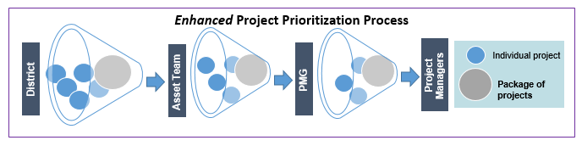
In 2016 INDOT adopted enhancements to its Call for Projects (CFP) framework to include three additional efficiency criteria:
- Portfolio Efficiency: bundling projects by asset type can generate cost efficiencies in terms of design, construction, financing and/or operating & maintenance (O&M);
- Corridor Continuity Efficiency: bundling projects in the same corridor (same or different asset types) reduces impacts to users and can generate cost efficiencies in design, construction and/or O&M; and
- Delivery Model Efficiency: use of an innovative project delivery approach (such as Design, Build, Finance, Operate, and Maintain) to generate savings in design, construction, and O&M.
These criteria are intended to enhance prioritization in the Call for Projects process. Actual value realized through portfolio, corridor continuity or delivery model efficiencies for a given project will vary and may require further analysis prior to implementation.