Summary
Fort Wayne City Utilities received a 205(j) grant in 2022 from the Indiana Department of Environmental Management (IDEM) to rewrite a Watershed Management Plan (WMP) for the Cedar Creek Watershed. The WMP is a strategy for achieving water quality goals by characterizing the watershed, setting goals and actions steps, and developing an implementation plan to address documented problems.
A WMP was developed and approved for Cedar Creek in 2005; however, the goals outlined in the WMP had not yet been met. For this reason, City of Fort Wayne Utilities Division (FWCU), the St. Joseph River Watershed Initiative Partnership (SJRWI) and other stakeholders partnered to develop a new comprehensive WMP so that updated water quality issues and land uses can be addressed to improve the Cedar Creek watershed.
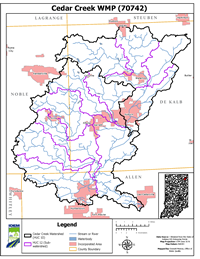
The Cedar Creek Watershed drains 174,773 acres of land in Allen, DeKalb and Noble counties. Cedar Creek is the largest contributing waterway to the St. Joseph River (OH), which is the drinking water source for over 300,000 individuals. The Cedar Creek Watershed is comprised of two ten-digit hydrologic unit codes (HUC); 0410000306 (Matson Ditch – Cedar Creek) and 0410000307(Cedar Creek).
A Steering Committee was formed and held several meetings in order to generate input in the development of a watershed management plan for the Cedar Creek Watershed. Based on water quality data and the watershed inventories conducted during the project, nutrients, sediment and E. coli were identified as water quality problems in the watershed. The stormwater carrying these pollutants can alter the temperature and pH of the stream, damage aquatic habitat, and add sediment to the stream flow by scouring the channel and eroding streambanks. Critical areas for nutrients, Dissolved Reactive Phosphorous (DRP), sediment, urban sources, and septic systems were identified. Critical areas prioritized for implementation were outlined to address non-point source pollution runoff from agricultural lands.
The Cedar Creek WMP meets the requirements of IDEM’s 2024 Watershed Management Plan Checklist and was approved by both IDEM and U.S. Environmental Protection Agency (EPA) in December of 2025. Meeting IDEM standards allows stakeholders to apply for State grant money to improve the watershed. The creation of this plan is not government mandated and participation is voluntary.