Cases on the Rise
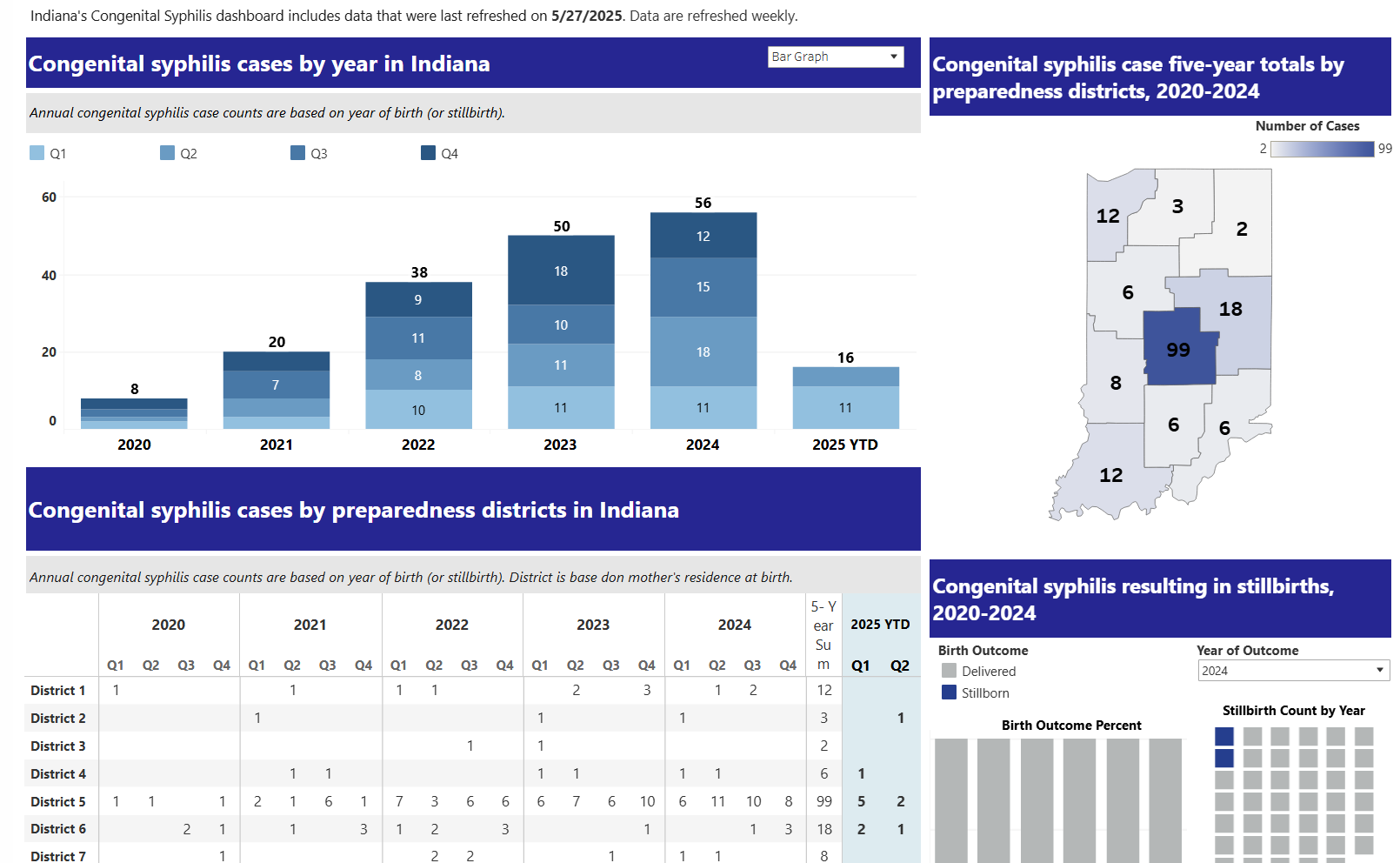
The number of congenital syphilis cases in Indiana increased by 2,650% from 2018 to 2024. Nationally, there has been a 740% increase in congenital syphilis cases between 2014 and 2023. The Centers for Disease Control and Prevention's recent analysis shows that almost nine in 10 cases of newborn syphilis in 2023 might have been prevented with timely testing and treatment during pregnancy. Over 42 percent of cases were among mothers who did not receive timely testing, and more than 40 percent of cases were among mothers who tested positive for syphilis during pregnancy but did not receive adequate or timely treatment.
This toolkit has several different resources to help expand testing and treatment in Indiana. For help obtaining resources, including rapid tests or Bicillin, please contact your local health department.
ALERT: Please review the following guidance regarding the Bicillin L-A Recall.
- Overview and Guidance
Overview:
- On July 10, King Pharmaceuticals LLC. (a subsidy of Pfizer), voluntarily recalled lots of Bicillin L-A (Penicillin G Benzathine Injectable Suspension), due to particulates identified during visual inspection. The impacted timeframe in which affected product lots were distributed was from Dec. 11, 2023, through June 24, 2025. To date, Pfizer has not received reports of any adverse events associated with this issue. Please refer to the above link for lot numbers, as well as product photos and labels for ease of identifying the impacted product.
- Pfizer issued a statement that same day regarding planning for patient care. Pfizer is anticipating a near-term stockout for Bicillin L-A due to this voluntary recall.
- The American Society of Health-System Pharmacists (ASHP) has updated its website with information regarding the products affected, reasons for the shortage, available products, estimated resupply dates, implications for patient care, and alternative agents and management.
The Indiana Department of Health (IDOH) is returning inventory that may be impacted by this voluntary recall. Please email Special Projects Manager Jeremy Roseberry if you have questions about this voluntary recall and anticipated near-term stockout.
What can you do?- Pfizer has provided guidance on how to check your current stock. If you have affected product lots, please discontinue use, stop distribution and quarantine the product immediately. Promptly return the product to Sedgwick; 2670 Executive Drive, Suite A; Indianapolis, IN 46241; Attn: Event 8637, or call Sedgwick at 800-805-3093. Affected product lots.
- Pfizer has implemented its Medical Request Process, effective immediately. The purpose of this process is to ensure that available inventory is distributed equitably to hospitals and clinics treating patients with the highest medical necessity, which, based on prior CDC guidance during Bicillin L-A shortages, is to prioritize product only for patients with confirmed congenital syphilis and risk of congenital syphilis. Please share this guidance with your provider networks.
- FOR IDOH PREVENTION PROGRAM GRANTEES ONLY: Please email Courtney Schaber, Jeremy Roseberry and Silva Tunio if you are running low on medication, and we will do our best to accommodate your needs. Please let us know how much medication you have on hand and your anticipated need, for consideration. Orders may be limited at this time.
Finally, the IDOH Prevention Program asks that providers do the following:
- Continue to follow the Centers for Disease Control and Prevention’s treatment recommendations for sexually-transmitted infections
- Prescribe Bicillin L-A as the only recommended treatment for pregnant women infected with or exposed to syphilis
- Consider prioritizing using Bicillin L-A to treat pregnant women and babies with congenital syphilis, if applicable. All other cases can be treated with doxycycline 100mg PO BID for two weeks (for early syphilis) or four weeks (for latent or syphilis of unknown duration)
Thank you for your continued partnership and dedication to the communities you serve. This page will be updated as we learn new information.
Role of Healthcare Providers
All healthcare providers play a critical role in screening reproductive age individuals. Here are some of our recommendations:
- Perform syphilis testing on all patients upon finding a positive pregnancy test.
- Test all pregnant women three times during pregnancy (at initial prenatal visit, again at 28-32 weeks of gestation, and then at delivery).
- Meet people where they are with syphilis testing and treatment outside of settings in which pregnant patients are typically encountered. This could include emergency departments, urgent cares, primary care visits, jail/prison intake, local health departments, community programs, and addiction services.
- Perform screening and treatment of all sexually active women and their partners for syphilis.
- Perform screening and appropriate treatment for those with other risk factors for syphilis (have unprotected sex and do not use condoms or do not use them correctly, have multiple sex partners, have a sex partner who has syphilis and have sex with a partner who has multiple sex partners).
- Treat all pregnant women who are infected with syphilis immediately upon diagnosis, according to their clinical stage of infection. Treatment must be with penicillin G benzathine (Bicillin LA).