River basin commissions are established by the legislature to address basin-wide water resource issues. A river basin commission typically involves multiple counties to focus on how to manage water on a large scale and is based on watershed boundaries, while a conservancy district is of a smaller scale for solving specific local issues and is based on parcel boundaries rather than the watershed. River basin commissions are led by locals living in the watershed and focus on water management needs specific to their watershed. A river basin commission requires General Assembly approval for basin-wide coordination and operates under its own specific Indiana Code, while a watershed development commission operates under IC 14-30.5.
River basin commissions were created to:
- Promote flood control
- Encourage soil and water conservation
- Improve water quality
- Increase cooperative planning and coordinated management of a basin's water and related land resources
- Support coordinated and cooperative action in the planning, development, and management of water resources
The Division of Water's Watershed Stewardship Section provides technical guidance and serves as a liaison between the DNR and the river basin commissions.
There are five legislatively established river basin commissions in Indiana:
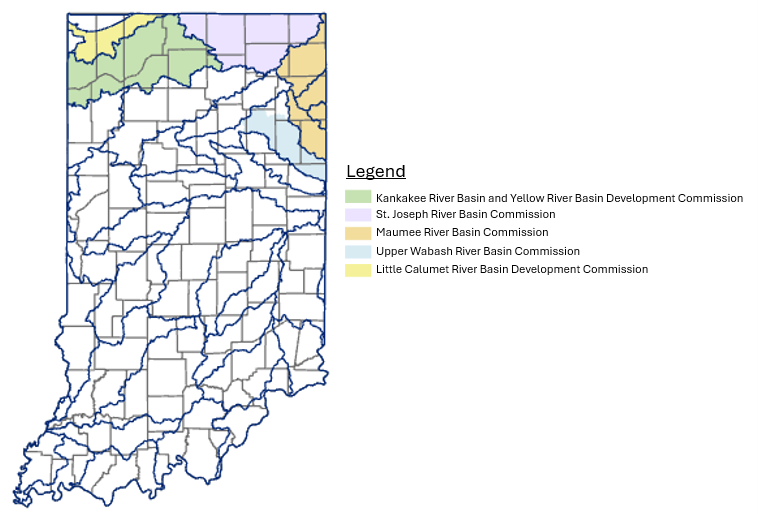
Map of existing river basin commissions in Indiana
The Kankakee River Basin and Yellow River Basin Development Commission was established in 2019 and directly serves the water resource planning and development of Jasper, Lake, LaPorte, Marshall, Newton, Porter, St. Joseph, and Starke counties in Indiana.
DNR completed a Kankakee Basin report in 1990.
The Little Calumet River Basin Development Commission was established in 1980 to originally serve as the local sponsor for the Little Calumet River, Indiana Flood Control and Recreation Project. It has territory in Lake, LaPorte, Porter, and St. Jospeh counties.
DNR completed the Lake Michigan Region report, which covers the Little Calumet watershed, in 1994.
The mission of the Maumee River Basin Commission is to provide regional leadership and promotion of flood mitigation, soil and water conservation and related resource management through a coordinated and comprehensive planning and implementing approach. It was established in 1986 and has territory in Adams, Allen, DeKalb, Noble, Steuben, and Wells counties.
DNR completed a Maumee River basin report in 1996.
The St. Joseph River Basin Commission was established in 1988 to improve water quality, encourage conservation, and increase coordinated management of the water and related land resources within the St. Joseph River basin. The governance and funding come entirely from the Indiana portion of the basin, but the SJRBC is authorized to work with Michigan to improve water management throughout the watershed. Its territory in Indiana includes areas in Elkhart, LaGrange, Noble, Steuben, and St. Joseph counties.
DNR completed a St. Joseph River basin report in 1987.
The Upper Wabash River Basin Commission was established in 2001 and serves areas in Adams, Huntington, Jay, and Adams counties. The Upper Wabash River Basin Commission supports restoring and sustaining the upper Wabash River and watershed by providing regional leadership and promoting flood damage reduction, healthy soil and clean water, and trails.