
Feeding
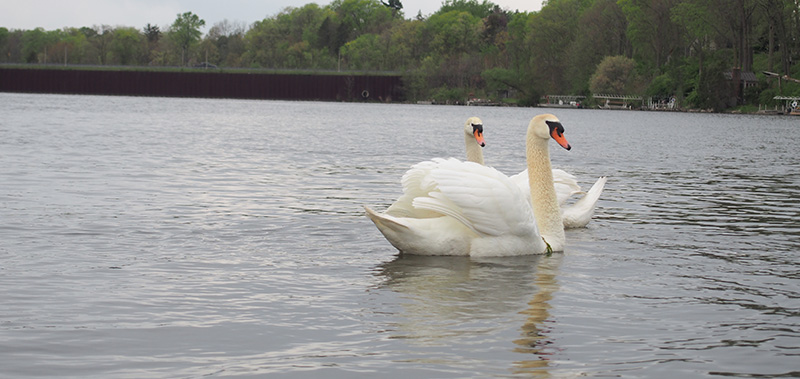
People should not feed mute swans. Feeding any wildlife makes the animals feel safe and encourages them, to remain in the area. If a bird feeder is available and mute swans are in the area, the feeder will likely also attract mute swans. To discourage mute swans, consider taking the feeder down for two to three weeks to encourage mute swans to disperse. Signs can be installed where mute swans are present to communicate that feeding of mute swans is not allowed. Signs are most successful if they describe the negative effects of feeding mute swans and list rules and consequences of feeding mute swans, and when the rules against feeding are enforced.
Abatement
Non-lethal abatement techniques are methods used to frighten and discourage mute swans from an area. These techniques are used for immediate relief and are not long-term solutions. These approaches generally send mute swans to other places where they will continue to reproduce and have destructive impacts. Following local ordinances, abatement techniques can be audial, visual, and/or physical. .
Non-lethal management will only be as effective as the amount of effort used. Tactics must be used repetitively and unpredictably as soon as mute swans appear in the area. Mute swans are much more difficult to frighten after they feel comfortable in a location. If mute swans are fed by people, these practices are not effective.
The following techniques may be used to disperse mute swans, where safe and legal to do so. Check local ordinances and laws before using techniques. No permits are required.
- Audial Devices
- Air horns
- Whistles
- Blank pistols
- Specialized projectiles (bangers, screamers, and whistlers)
- Cracker shells from a shotgun
- Firecrackers
- Propane cannons
- Visual Devices
- Predator decoys
- Scarecrows
- Hand-held green lasers
- Physical
- Dogs (chasing only)
- Chase boats
- Nest destruction (before laying eggs)
- Temporary exclusion methods to discourage use of nesting locations (permits required on public waters)
Permits
Abatement techniques are not a form of mute swan population control. Rather, these methods send the mute swans to another area to be a problem. Other options are available for managing mute swan populations.
The DNR will issue free Nuisance Wild Animal Control permits to lake or homeowner associations to legally take mute swans, render eggs incapable of hatching, or destroy nests on public lakes and properties. Resident landowners and tenants do not need a permit from the DNR to take mute swans that are causing damage or posing a health or safety threat to people or domestic animals on land or private water that they own or lease. Check local ordinances and laws before acting and follow them.
- Nest and Egg Destruction
Nest removal can be carried out at any time so long as no eggs are present. A permit is not needed. Repeatedly destroying nests can encourage breeding mute swans to relocate, build a new nest, or nest later in the season. It is advisable and most effective to start nest removal as soon as swans are seen scouting nesting locations. Nest construction may last for several weeks, and the first egg may be laid less than 24 hours after the nest is constructed. Once the first egg is laid in a nest, verify below if a permit is needed from Indiana DNR before taking further nest removal action.
A resident landowner can remove nests and their eggs from their own private property without a permit or permission from Indiana DNR at any time. For swan nests with eggs on commonly held or shared property, a government authority, lake association or local property owners association should seek a free permit through Indiana DNR to destroy nests that have eggs in them. The eggs must be destroyed by individuals approved by the permittee. A permit can only be issued to someone with legal authority at the given property (e.g., HOA, Property Manager, Parks Director, etc.).
Once a permit is obtained, egg treatment or nest destruction can occur. Be cautious if attempting to conduct these activities without some form of protection. Mute swans are aggressive during the nesting period and may attack a person who comes close to their nest. Timing of egg destruction is important to ensure humane treatment of eggs. If you are unsure how long a mute swan has been incubating eggs, use the “float test.” Take the eggs and put them in a bucket with at least 6 inches of water. Young eggs that are not well developed will sink. These eggs should be addled and returned to the nest for additional incubation and checked again in another week. Eggs that are further along in development will float. Eggs that float without tilting can be addled and removed from the nest. Eggs that are floating and tilting are likely on the verge of hatching and should be placed back in the nest for removal once they eggs hatch.
When dealing with a nest with newly laid eggs, a person who has eggs on private property or who has obtained a permit for public areas may either shake each egg for at least 60 seconds (until they hear a sloshing sound), puncture the large end of the egg with a sharp object, or coat the egg with 100% corn oil. All these methods, collectively known as addling, will prevent eggs from developing, and they will not hatch. Addled eggs should be placed back into the nest so that the mute swan will continue to incubate the eggs. If the eggs are removed or broken early in the incubation period, then the mute swan may re-nest and lay more eggs.
- Removal of Birds
An aggressive egg destruction initiative will at best maintain the current mute swan population level. As a result, the ecological damage and the human and wildlife conflicts that mute swans cause will continue. Removing mute swans from where they have established populations is the only way to lessen their negative impact.
Mute swans can be legally taken by a resident landowner or tenant on property or a pond that they own or lease without a permit, following local ordinances.
For mute swans in public spaces, public waters, or spaces with multiple landownerships, a free, Nuisance Wild Animal Control permit must be secured to lethally take mute swans. The lake association, local property owners’ association, or landowner group can seek a permit through Indiana DNR to euthanize the adults (and young if present). The swans must be euthanized by individuals approved by the permit and community. A permit can only be issued to someone with legal authority at the property in question (HOA, property manager, etc.). Because mute swans are an invasive species and can create conflicts, the DNR recommends euthanizing mute swans instead of relocating them.