The forest ecosystems of Indiana are areas where trees dominate the plant community, forming an unbroken covering canopy. The Indiana growing season and annual rainfall favor trees more than other vegetation in many areas, and the soil and temperature conditions tend to accommodate broad-leafed deciduous trees like beeches, elms, hickory, and oaks over needled evergreens such as pines. While forest lands dot the landscape in northern Indiana, larger blocks of woodlands encompass the hillier geography of central and southern Indiana. The state’s forests host wildlife species like cerulean warblers (Setophaga cerulea), southern flying squirrels (Glaucomys volans), white-tailed deer (Odocoileus virginianus), and many species of toads and frogs. Plant life includes many vines and ferns such as Virginia creepers (Parthenocissus quinquefolia) and lady ferns (Athryrium filix-femina). Species of Greatest Conservation Need that use forests include green salamander (Aneides aeneus), ruffed grouse (Bonasa umbellus), and Indiana bat (Myotis sodalis).
Areas classified as forest ecosystems in Indiana in 2024.
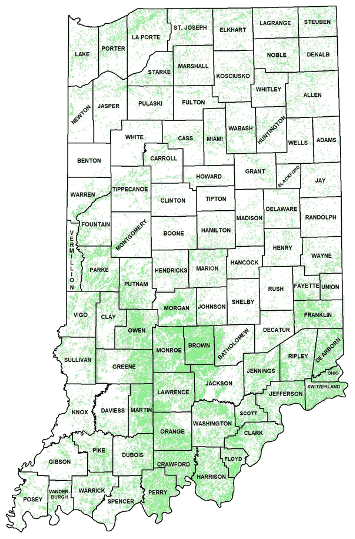
Indiana forests provide environmental, economic, and social benefits supporting the health of Indiana wildlife and citizens. They facilitate important processes involving plants, soil, and the atmosphere. Forests filter pollutants from the air and water and contribute to climate stability. Healthy trees and soils act as long-term carbon storage, reducing the amount of carbon dioxide in the air. This not only provides cleaner air but also slows the rate of warming. Trees provide shade for animals and people and release heat at night via transpiration of water, helping manage temperatures. In terms of economic benefits, Indiana forests support a thriving timber industry. The state is the top producer of hardwood furniture in the United States and a leader in the production of upholstered furniture, kitchen cabinets, and countertops. The robustness of this important economic sector depends on the continued health and growth of the forested ecosystems.
Timber overharvesting and land use change, starting in the mid-1800s and continuing into the 20th century, disturbed natural forest lands, leaving some abandoned and eroded. Replanting has produced different forest types than those that dominated in the 1700s, as structural and compositional changes have altered the species of trees and the amount of sunlight provided within forested ecosystems. Altered shade tolerance leads to limited germination, low survival of new seedlings, and the less dense forest ecosystems we see today.
Currently, Indiana forests cover around 21% of the state’s land area, which changed little from 2014-2024. Despite early destruction of forest ecosystems, research shows that they have grown recently, with an average growth-to-removal ratio of 2.2 from 2012-2018. From 1967 to 2019, timberland in Indiana increased from 3.9 to 4.6 million acres, and from 1986-2018 the net volume of live trees quadrupled from 2.6 to 10.9 billion cubic feet. Recent increases in forested ecosystems are due to a reversion of farmland to forest.
Forest ecosystems are at risk from fragmentation and parcelization related to limited and incompatible management. Incompatible management practices may include clearcutting without reforestation, unsustainable logging, misinformed infrastructure development, and fire suppression. Outcomes of such practices are deforestation, soil exposure and erosion, greenhouse gas release, and invasive species encroachment. Although management programs exist for forest ecosystems, their long-term involvement has declined, limiting the proactive management practices available to protect the ecosystems. These programs are particularly important because 83% of total Indiana forestland is privately owned.
Forest ecosystems are also at risk of damage from invasive and problematic native species. Insects such as spotted lanternfly (Lycorma delicatula), box tree moth (Cydalima perspectalis), emerald ash borer (Agrilus planipennis), Asian long-horned beetle (Anoplophora glabripennis), and spongy moth (Lymantria dispar) pose serious threats. Repeated attacks from these species may lead to eventual weakening of forest infrastructures and decreased tree survival. Spongy moth (Lymantria dispar) is the most serious forest pest in Indiana, feeding on oak trees until near or complete defoliation. As the number of invasive species increases, so does the pressure on forest ecosystems. These ecosystems may also be affected by changes in climate patterns discussed in this supplemental report.
Additional pressures affecting forest ecosystems in Indiana can be explored here.
Conservation professionals highlighted multiple opportunities for reducing pressures in forest ecosystems. The first is to develop a consistent, coordinated public campaign for better forest management. Public awareness of management practices and their value, as well as mismanagement consequences, presents a key opportunity for forest management improvement. Combating misinformation is a viable first step in preventing the continuation of mismanagement practices. Following this effort with increased messaging regarding forest conservation will encourage positive practice adoption by the public, contractors, and landowners. Staying up to date on research and current initiatives will promote continued involvement in conservation actions, creating a culture of forest protection.
The second opportunity is to inform conservation professionals about existing conservation programs. To support conservation professionals, a core team of partner organizations may be established with goals to release timely communication about forest management and combat misinformation. Through collaboration and communication, the most applicable programs may be shared with various stakeholder groups, supporting their continued education on forest conservation and management. Methods of information sharing may include webinars, summits, and virtual trainings.
The final opportunity is to incentivize private landowners to conserve state-listed species. Increased research on private forest land can facilitate the development of individualized management plans that benefit landowners and their forest ecosystems. Because Indiana forests are largely privately owned and operated, the management of these ecosystems falls largely on contractors and landowners. Creating meaningful connections with and incentivizing those who adopt these practices will further increase involvement in species conservation actions. Funds for management work will need to come from the federal level, encouraging the expansion of current incentive programs and access to such programs.