
AMERICAN CROW (Corvus brachyrhynchos)
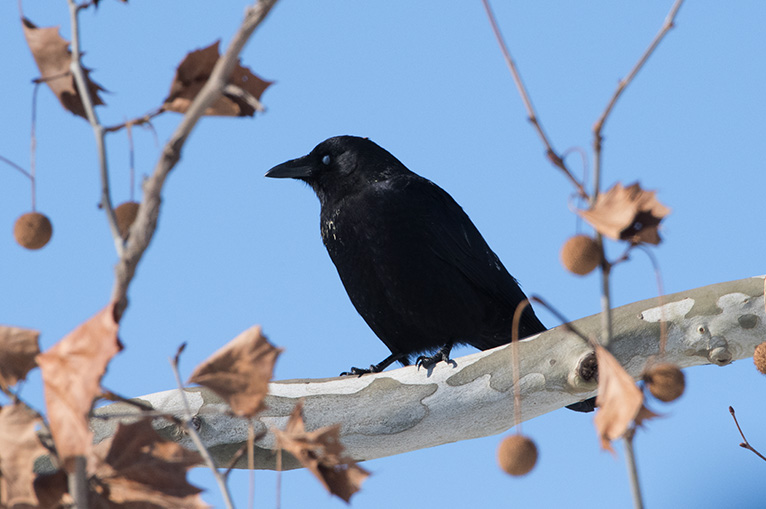
Credit: Brendan Kearns
General Characteristics
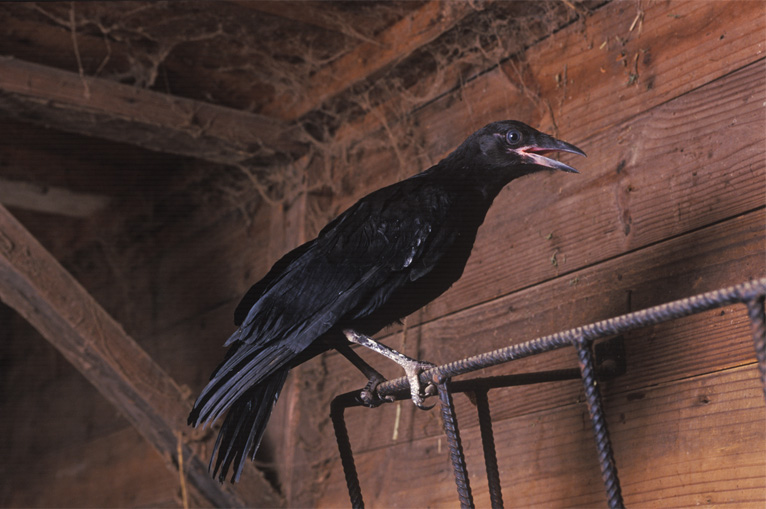
- American crows are 17 to 21 inches long and coal-black in color.
- Male and female crows look alike.
- The crow call is a loud caw.
- Crows are highly intelligent. They can recognize individual people and use tools.
- Crows are social birds that typically live in family groups. In winter, they sometimes join large roosts at night to help find food, attract a mate, and remain safe and warm.
- Crows usually use the same roost each night, often in a heavily treed area. These roosts can range from hundreds to millions of birds, and if roosts are formed in an urban area, the mess and noise can bring crows into conflict with people.
- Crows have only a few predators, including eagles, hawks, owls, raccoons, canids (e.g., dogs, coyotes, etc.) and humans.
- The average lifespan of a crow is 4 to 6 years, though some have been documented into their teens.
Food Habits
- Crows are not picky eaters and will eat insects, grubs, spiders, snails, fish, frogs, snakes, eggs, nestling birds, and cultivated fruits, nuts, and vegetables, especially corn. They also scavenge dead animals and garbage.
- Crows will post a sentinel to alert the other feeding birds of danger.
Distribution and Abundance
Crows are found throughout Indiana in habitat that mixes open fields and woodlands, such as farmland, orchards, wooded stream corridors, city parks, landfills, and residential neighborhoods.
Reproduction
- Crow nests are usually built at least 15 feet off the ground in tall trees but may be placed in lower shrubs when tall trees are lacking.
- Nesting may occur as early as February and run through May.
- Nests are 1½ to 2 feet in diameter and are constructed from twigs. They are lined with plant fibers, mosses, hair, twine, cloth, and other soft material.
- Both sexes build the nest and take care of the four to five young (brood).
- Crows in northern climates usually have one brood per year.
- Previous broods help their parents raise new young for a year or more before breeding themselves.
Disease
- Crows have been found to carry transmissible gastroenteritis. Histoplasmosis is a concern under their roosts, where droppings accumulate. West Nile Virus has been found in crows.
Prevention and Control
If crows become a nuisance, there are several responses that may help.
- Exclusion
- Keep lids tightly secured on garbage cans and keep cans upright by fastening to a post. Trash cans may also be placed in tight-fitting bins, a shed, or a garage. Put garbage cans out for pickup in the morning. Don’t leave trash bags out without the protection of a can.
- Protect fruit crops with 4-inch mesh bird netting tied at the base of the shrub or tree to prevent crows from gaining access from below. Netting can be purchased from hardware stores, garden centers, or farm supply stores in a variety of sizes.
- Harassment
- Visual scare devices such as pie tins hung in trees, Mylar scare tape, scarecrows, and eye-spot balloons can help move crows to another location, though the relief may be only temporary.
- Lighting the interior of the roost with bright fluorescent lights may discourage crows.
Lasers can be pointed a couple of feet in front of the bird and moved toward them. Lasers have been proven to work well in low light situations. Crows seem to be easier to scare when in flight. - Audio scare devices include hazing with pyrotechnics such as cracker shells, blanks, propane cannons, and/or firecrackers. Scaring should stop at darkness, or the crows will become accustomed to the sounds. Be sure to check local ordinances before using pyrotechnics.
- Spraying crows with water from a high pressure hose (some cities have used a firehose) has worked. One recent innovation is a motion sensor combined with a sprinkler that attaches to a spray hose. When a crow comes into its range, a sharp burst of water is sprayed at the bird. This device appears to be effective by combining a physical sensation with a startling stimulus.
- Modify the Night Roost
- Modifying the structure of the crows’ night roost can discourage the birds from using it. This includes thinning up to 50% of roost tree branches or removing trees from dense groves to reduce the availability of perch sites and open the remaining trees to the weather.
- Lethal Control
- Crows are regulated under state and federal laws; however, a person may shoot crows without a permit if the crows are committing or about to commit depredation upon ornamental trees, agricultural crops, livestock, or wildlife, or are concentrated in numbers and in a manner that constitutes a health hazard or nuisance. There is also a hunting season for crows.
- Large-scale chemical strategies should be undertaken with the guidance of the U.S. Department of Agriculture Wildlife Services.