
- County antlerless bag limits (CABL) reduced in 7 counties for 2025-2026
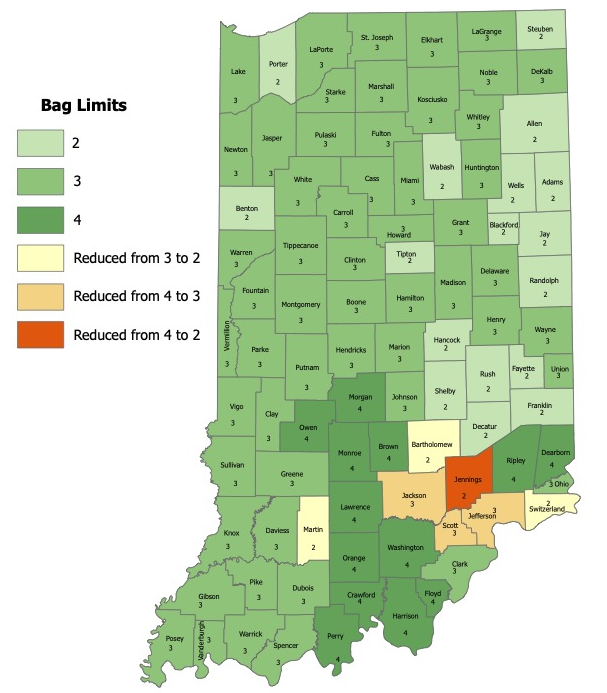
As of Sept. 26, 2025, a significant epizootic hemorrhagic disease (EHD) event is affecting Bartholomew, Jackson, Jefferson, Jennings, Martin, Scott and Switzerland counties. Jennings County’s antlerless bag limit will be reduced from four antlerless deer to two antlerless deer for the upcoming hunting season. Jackson, Scott, and Jefferson counties’ antlerless bag limit will be reduced from four antlerless deer to three antlerless deer per county for the upcoming hunting season. Bartholomew, Martin, and Switzerland counties’ antlerless bag limit will be reduced from three antlerless deer to two antlerless deer per county for the upcoming hunting season. More information.
In 2025, the Indiana Natural Resources Commission (NRC) adopted a new rule converting the County Bonus Antlerless Quota system to a County Antlerless Bag Limit. Previously, in a county with a County Bonus Antlerless Quota of 3, hunters could take up to 6 antlerless deer. This occasionally led to a misunderstanding that the number posted for the County Bonus Antlerless Quota map was the total number of antlerless deer that could be harvested. In response, Indiana DNR worked to clarify the antlerless harvest system so that a single number was provided stating the number of antlerless deer that could be harvested with any legal equipment within that county, now called the County Antlerless Bag Limit.
The County Antlerless Bag Limit is the total number of antlerless deer that can be harvested in a given county during youth, firearms (only with the use of a multi-season antlerless license), archery, and muzzleloader seasons combined. Additional antlerless deer can be harvested if there is a deer reduction zone present or if there are special organized hunts occurring in that county such as state park management hunts, draws on public land, and military lands. The County Antlerless Bag Limit can be filled using archery licenses, muzzleloader licenses, or the multi-season antlerless license. The multi-season antlerless license can be used in youth, archery, firearms, and muzzleloader seasons only.
Firearms licenses cannot be used to harvest antlerless deer. Firearms licenses are “buck only.”
Hunters must use the equipment that is legal during the season that is being hunted. The multi-season antlerless license may be used in any county, but you may not take more than the county bag limit for antlerless deer in any specific county. You cannot exceed the statewide antlerless bag limit of 6 for the entire state.
The map on the right indicates county bag limits for antlerless deer; however, bag limits may change in the event of a disease outbreak prior to deer hunting season, so be sure to check the bag limit in the weeks before the season begins.
Multi-season antlerless licenses may be used on public land, including DNR-managed Fish & Wildlife areas, but they cannot be used on a DNR-managed Fish & Wildlife area and some other DNR properties to harvest an antlerless deer with a firearm during firearms season. This includes using muzzleloaders during firearms season. The multi-season antlerless license may be used during firearms season if you are hunting with archery equipment. See a list of properties below where the multi-season antlerless license cannot be used to harvest an antlerless deer during firearms season.
Antlerless deer harvested with the deer license bundle must be used toward the bag limit for antlerless deer in that county where the deer was harvested.
The bag limits for archery and muzzleloader seasons have been removed. This means you can now use archery and muzzleloader licenses to harvest all your antlerless deer. For instance, if you want to harvest all 6 antlerless deer statewide with an archery license, you can now do so; however, you still must comply with each county’s antlerless bag limit.
County Antlerless Bag Limits are determined using a variety of population indicators such as trends in deer population estimates, hunter harvest success rate trends, deer observation rates, crop damage reports, deer-vehicle collision rates, and hunter surveys that measure individual satisfaction level with deer populations in each county.
2025-2026 County Antlerless Bag Limits
Beginning Oct. 8, the bag limits have been adjusted because of EHD in Bartholomew, Jackson, Jefferson, Jennings, Martin, Scott, and Switzerland counties.
Statewide Antlerless Bag Limit
In addition to creating a County Antlerless Bag Limit, the NRC has also established a Statewide Antlerless Bag Limit of 6 antlerless deer. Hunters cannot exceed 6 antlerless deer during the regular deer hunting seasons including youth, firearms, archery, and muzzleloader seasons, regardless of the licenses or exemptions used. Hunters must also comply with the number of antlerless deer that can be harvested in each county.
This Statewide Antlerless Bag Limit does not apply to the Deer Reduction Zones, or properties with special hunts, including the draws for hunting military and federal lands and the state park management hunts.