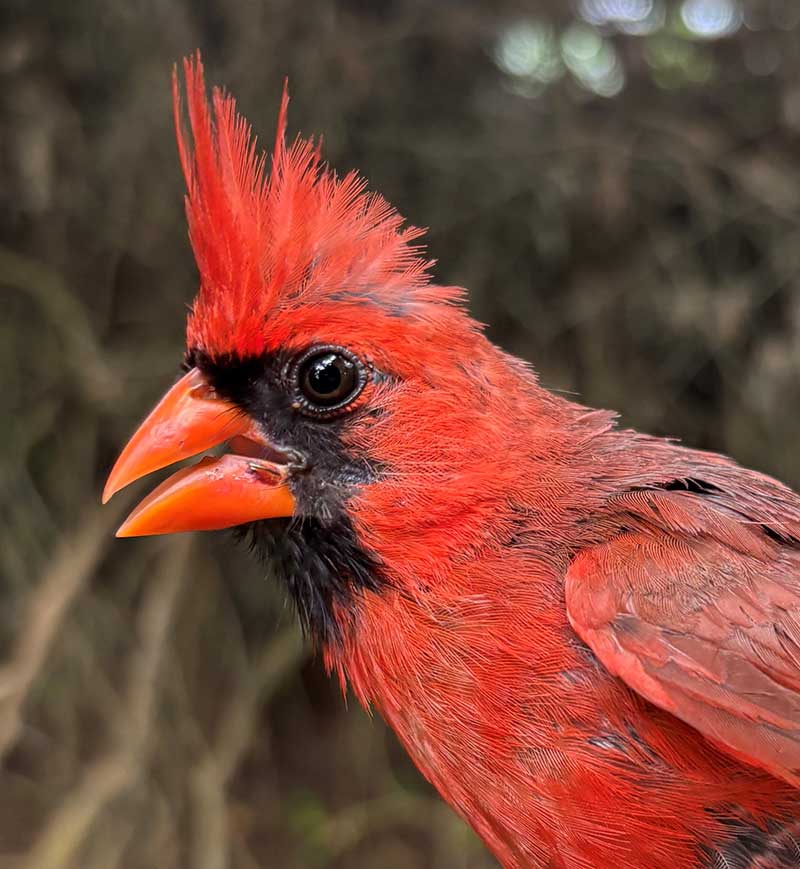
 Named for the red hat and robes of a church prince, the Northern cardinal was chosen as the official state bird in 1933. Commonly seen by Indiana residents along hedgerows, wood margins, and roadsides, the cardinal is the only red bird with a crest in the United States.
General characteristics
- Smaller than a robin, the Northern cardinal (Cardinalis cardinalis) is 8 to 9 inches long from the tip of its bill to the tip of its tail.
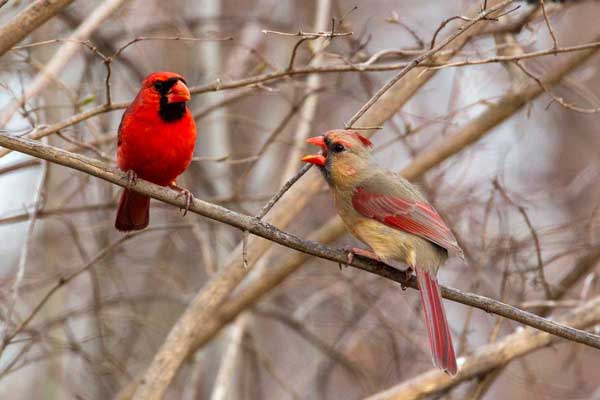
- Adult male cardinals are all red except for the black mask at the base of the bill.
- Adult female cardinals have an olive-gray back, dull reddish wings and crest, and soft pink-brown underparts.
- A stout, coral-red bill and dark red feet are features of both the female and male.
- Immature cardinals wear a plumage browner and duller than an adult female. Unlike the adult bills which are bright reddish-orange, immature bills are blackish. Young cardinals will molt by the fall and gain their adult plumage by winter.
- Both males and females are talented singers, and their most common song is a loud, whistled cheer, cheer, cheer, cheer.
Habitat
- A common sight in both rural and urban settings, cardinals are found in backyards as well as woodland borders. They often roost in dense shrubs and red cedar trees and will forage along roadsides.
- For nesting, the cardinal prefers dense thickets, shrubs, or saplings no more than 10 feet high in an open woodland area.
Distribution and abundance
- Cardinals are located across the entire Hoosier State, with the largest population found throughout central Indiana, although winter counts reveal a low population of cardinals in northwestern Indiana.
- The cardinal is non-migratory; however, the bird will often wander widely during the winter. In areas where there is an abundance of food, it is not unusual to see 30 or more in a flock.
- Cardinals have been present in Indiana for a long time. In the 1800s, the cardinal was sought after as a prized cage bird. Hardy, beautiful, and a good singer, the bird lived well in captivity when cared for properly. Today, the cardinal is protected throughout the United States, and its brilliant color and vibrant song brightens many drab winter days.
Breeding behavior
- A cardinal is rarely seen without its mate. They remain together throughout the year, but during the winter months, the bond may be relaxed.
- Nest building begins in late March or early April. As the female weaves the nest with bark strips, rootlets, and grass, the male follows her around singing his most vibrant tune.
- Courtship behavior includes the male feeding the female during the two weeks she is incubating eggs.
- The average number of eggs laid by the female is three or four. The eggs are greenish or bluish-white with brown spots.
- The cardinal's breeding season is quite long, and eggs have been found from April to September.
- While the female prepares for a second brood, the male will care for the fledglings, feeding them a variety of insects. The male's instinct to feed young birds is so strong that he has been seen stuffing food down the throats of fledglings of other species.
Food habits
- Cardinals eat a wide variety of food consisting mainly of insects, seeds, grains, and fruits. Some of their favorites include pokeberry, poison ivy fruit, elm buds, box elder seeds, ragweed seeds, sunflower seeds, and corn.
- In winter, cardinals will frequent backyard feeders and forage with mixed flocks of dark-eyed juncos, American tree sparrows, purple finches, Eastern towhees, and other seed-eating species.
Why is a bird attacking my windows?
- This is common behavior in songbirds, especially cardinals. During the spring and summer months, changing daylength triggers hormonal changes that increase a bird’s aggressiveness towards other birds. When a bird sees its reflection, it thinks it's an intruder and tries to drive it from its territory.
- The best solution is to block the reflection. Once the bird cannot see itself, it will stop attacking the reflection.
- For windows, cover the reflection by applying temporary window clings or films, taping up newspaper or cardboard, or hanging outdoor curtains outside of the window. The key is the window treatment must be in front of the glass (not inside the house).
- For vehicle mirrors, tie a plastic grocery bag or place a sock over the mirror.
- As nesting hormones wane with seasonal changes, the behavior will temporarily cease. However, it may occur again in spring. Unfortunately, removing the individual bird is not a permanent solution, as another individual with this behavior will often take its place.
Why is that cardinal bald?
- Northern cardinals sometimes molt their head feathers all at once or in big patches. This is rare but normal. They are not sick.
- Northern cardinals have dark gray skin. They may look strange when they are missing their head feathers.
- Some bald-headed cardinals are juveniles undergoing their first molt.
- Baldness may be the result of feather mites, lice, or nutritional deficiency.
- Bald-headed cardinals are usually seen in summer. Their feathers will grow back in a few weeks.
- Besides cardinals, blue jays are another commonly reported “bald-headed bird.”