Walleye

Sauger

Saugeye
Walleye (Sander vitreus) and sauger (Sander canadensis) are members of the perch family. Walleye-sauger hybrids (commonly called saugeye) can rarely occur where the species overlap in the wild but are more commonly created in hatcheries to meet a specific management need.
Walleye are the fifth most popular sport fish in Indiana (2022 Licensed Angler Survey). However, their natural reproduction is limited in Indiana, so stocking takes place annually in Hoosier waters to meet management objectives and diversify fishing opportunities.
Annual state-supported walleye stocking:
- 25 million fry (<1 inch; ~7 to 10 days old)
- 410,000 fingerlings (1-2 inches; ~30 days old)
- 60,000 fall fingerlings (5-7 inches; ~6 months old)
Sauger populations are concentrated in large rivers such as the Ohio and Wabash and are primarily maintained though natural reproduction.
Saugeye populations are maintained through stocking. They can tolerate more turbid water than walleye, provide additional biological control for abundant prey species, and enhance angling opportunities. Currently, the annual stocking request is 1.1 million fry and 117,000 fingerlings.
The large, opaque eyes of these species are efficient at gathering light. They tend to retreat to deep, dark water during the day and move into shallower areas,5 to10 feet, to feed at night. They tend to prefer rock or gravel bottoms, drop off areas, and points. Standing timber areas in reservoirs can be a good place to fish for walleye or saugeye in midsummer.
In rivers, the tailwaters behind dams can be popular locations to fish for these species. However, fishing in tailwaters depends greatly on the discharge from dams and migration of fish. Fishing can be excellent from March through May and October through November. Many reservoir tailwaters provide ample shore-fishing areas and multiple species to target.
Life History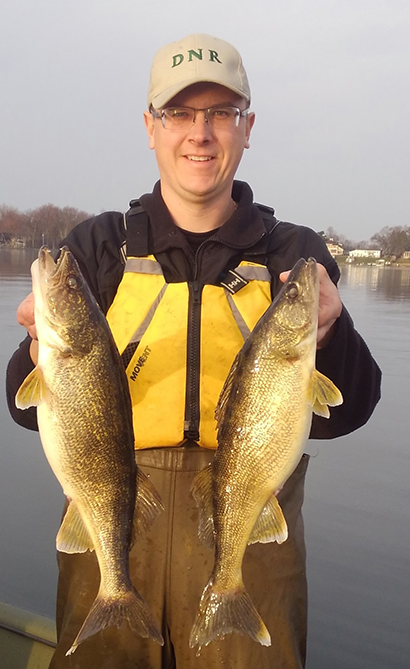
Walleye are mostly olive or gold in color, with a large black spot at the rear edge of the spiny dorsal fin and a white edge to the anal and tail fins. Typically, walleye reach 14 inches between 2 and 3 years and 16 inches between 3 and 4 years. The current state record is a tie of 14 lbs, 4 oz, caught from the Tippecanoe and Kankakee rivers.
Sauger are typically a darker olive to brown in color, with dark saddles across their back, scattered dark bars with a clear membrane on a spiny dorsal, and a small light-colored edge on the anal and tail fins. Sauger are common in larger rivers, especially the Ohio and Wabash rivers. Sauger growth from the Ohio River averaged 12 inches at two years old and 16 inches at three years old. The current state record of 6 lbs, 1 oz, was caught in the Tippecanoe River.
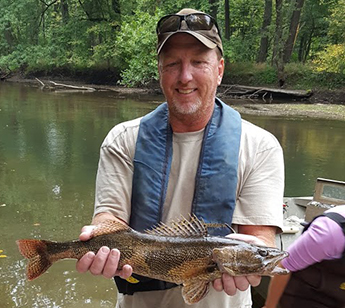 Saugeye have a mix of the coloration of walleye and sauger, typically olive to gold, with faint saddles, dark bars or spots and dusky membrane on the spiny dorsal fin, and a white edge on the anal and tail fins. Saugeye are rare in wild populations; the majority are bred artificially in hatcheries. Stocked saugeye generally have better survival and growth in warm, turbid lakes where walleye had been stocked in the past with poor results. Saugeye growth is typically 14 inches by 2 years old and can reach 20 inches between 5 and 6 years old. The current state record is 8 lbs, 8 oz, caught in Scottsburg Reservoir.
Research
DNR biologists monitor the populations of these important fish through seasonal evaluation surveys in the spring and fall. During the spring, biologists use large nets to capture fish as they move along the shore looking for places to spawn. A broader size range, including larger adults, is captured to examine growth and abundance. The fall surveys target the fish stocked in the previous and current years to determine survival and abundance. These evaluations determine if the stocking was successful. Both evaluations allow biologists to monitor the lake’s walleye or saugeye population and progress towards the lake’s goals.
In 2008 and 2009, Indiana DNR studied the movements of walleye at Monroe Lake using radio telemetry. A radio tag was surgically implanted in walleye. DNR tracked the tagged fish throughout the entire lake. Find out more information about the tracking project at:
- Walleye Tracking at Monroe Lake
- Indiana Walleye Strategic Plan 2019-2023
Stocking
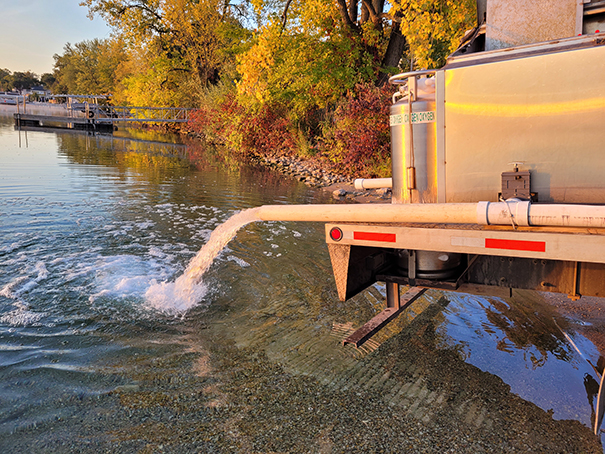 Since walleye natural reproduction is limited in Indiana, most of their populations are maintained through stocking. Walleye are stocked in lakes, reservoirs, and rivers throughout the state.
To allow this process to happen, Indiana fisheries staff collect about 30 million walleye eggs from Brookville Lake each spring. This results in about 25 million fry (<1 inch; 7 to 10 days old), 410,000 fingerlings (1-2 inches; ~30 days old), and 30,000 advanced fingerlings (5-7 inches; ~6 months old). Additional fall fingerlings are purchased from a commercial fish supplier to supplement stocking requests. Fish stocking permits are issued for several lakes where privately funded stockings occur.
Indiana’s saugeye are a cross between female walleye eggs from Brookville Lake and male sauger milt collected from the Ohio River. Several locations are stocked with an annual request of 1.1 million fry and 117,000 fingerlings. Sauger are not typically produced at state hatcheries, with the most recent stockings occurring in the Tippecanoe and White rivers to bolster populations.
| Species | Daily Bag Limit | Minimum Size |
| Walleye, Walleye-Sauger Hybrid (Saugeye), Sauger |
6, any combination of walleye, walleye-sauger hybrid, and sauger |
For Walleye: 14 inches south of SR 26; 16 inches north of SR 26 Ohio River: 14 inches for walleye, saugeye, and sauger |
Exceptions
Walleye taken from public waters (lakes, rivers, and streams) south of State Road 26 must be 14 inches or longer. Walleye taken from all public waters north of State Road 26 must be 16 inches in length or longer, except for:
- Bass Lake (Starke County) and Wolf Lake (Lake County); minimum size 14 inches
- Lake George (Steuben County); minimum size 15 inches
- Wall Lake (LaGrange County); minimum size 16 inches with a daily bag limit of two
There is no minimum size requirement for saugeye on all state waters, except for:
- Huntingburg Lake (Dubois County), Glenn Flint (Putnam County), and Sullivan Lake (Sullivan County), where saugeye must be 14 inches in length or longer.
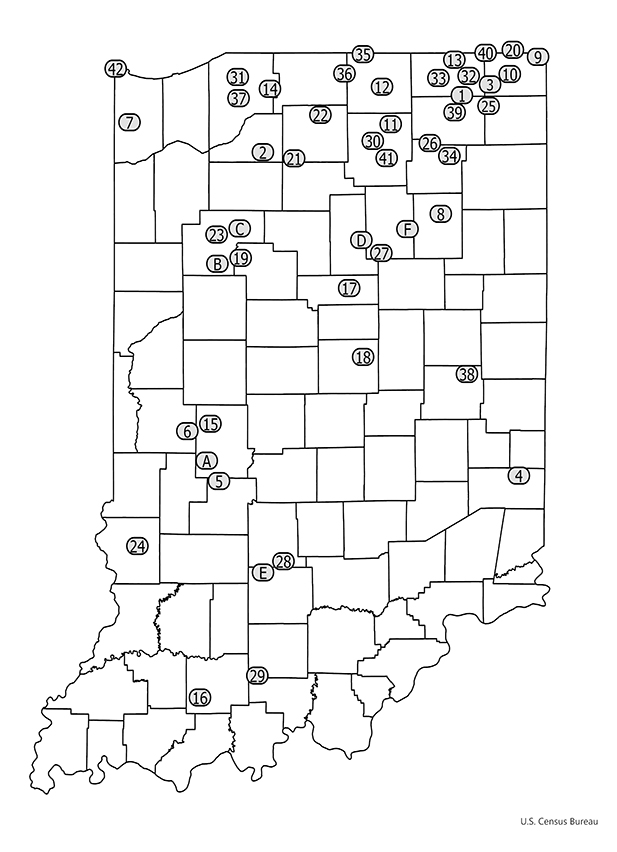
- Adams Lake (LaGrange County) Walleye
- Bass Lake (Starke County) Walleye
- Big Turkey (Steuben and LaGrange counties) Walleye
- Brookville Lake (Franklin and Union counties) Walleye
- Cagles Mill Lake (Putnam and Owen counties) Walleye
- Cecil M Harden Lake (Parke County) Saugeye
- Cedar Lake (Lake County) Saugeye
- Clare Lake (Huntington County) Saugeye
- Clear Lake (Steuben County) Walleye
- Crooked Lake (Steuben County) Walleye
- Dewart Lake (Kosciusko County) Walleye
- Elkhart River (Elkhart) Walleye
- Fish Lake (LaGrange) Walleye
- Fish Lakes (LaPorte County) Walleye
- Glenn Flint Lake (Putnam) Saugeye
- Huntingburg Lake (Dubois) Saugeye
- Kokomo Reservoir (Howard County) Walleye
- Koteewi Park Lake (Hamilton) Saugeye
- Lake Freeman (White and Carroll counties) Walleye
- Lake George (Steuben County) Walleye
- Lake Maxinkuckee (Marshall County) Walleye
- Lake of the Woods (Marshall County) Walleye
- Lake Shafer (White County) Walleye
- Lake Sullivan (Sullivan) Walleye
- Little Turkey Lake (LaGrange County) Walleye
- Loon Lake (Noble County) Walleye
- Mississinewa Lake (Wabash County) Walleye
- Monroe Lake (Brown and Monroe counties) Walleye
- Patoka Lake (Orange, Dubois and Crawford counties) Walleye
- Pike Lake (Kosciusko County) Walleye
- Pine Lake (LaPorte County) Walleye
- Pretty Lake (LaGrange County) Walleye
- Royer Lake (LaGrange County) Walleye
- Shriner Lake (Whitley County) Walleye
- Simonton Lake (Elkhart County) Walleye
- Joseph River (St. Joseph County) Walleye
- Stone Lake (LaPorte County) Walleye
- Summit Lake (Henry County) Walleye
- Sylvan Lake (Noble County) Walleye
- Wall Lake (LaGrange County) Walleye
- Winona Lake (Kosciusko County) Walleye
- Wolf Lake (Lake County) Walleye
Fisheries biologists have also improved walleye populations in the tailwaters below dams at:
- Cagles Mill Reservoir
- Lake Freeman (Sauger as well)
- Lake Shafer
- Mississinewa Reservoir
- Monroe Lake
- Salamonie Reservoir