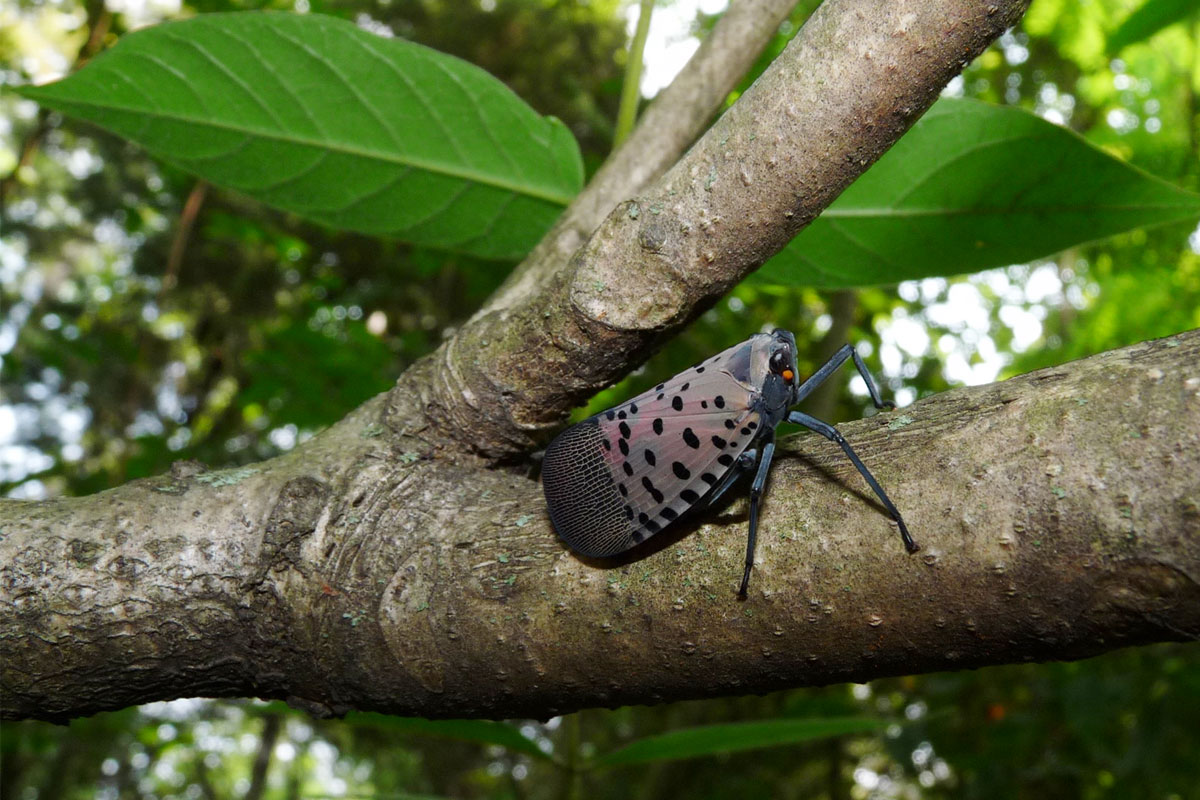
Spotted lanternfly is a major pest of concern across most of the United States. This insect is native to China and parts of India, Vietnam, Japan, and Taiwan. It was first identified as an invasive species in 2004 in South Korea and is now a major pest there. Spotted lanternfly was first detected in the United States in Pennsylvania in 2014.
In July 2021, a population of spotted lanternfly (Lycorma delicatula) was identified in Indiana in Switzerland County, near the Ohio River. Since then, populations have been found in Huntington, Elkhart, St. Joseph, and Porter counties. DEPP and USDA continue to conduct surveys to ascertain the extent and source of these infestations as well as determine what management strategies will be implemented.
Why is spotted lanternfly a problem?
Adults and nymphs have piercing-sucking mouthparts and feed on the vascular tissue of leaves, petioles, young shoots, branches and trunks of its hosts. Adults and older nymphs may feed in large populations. This extensive feeding results in oozing wounds on woody tissue and wilting and death of branches.
The spotted lanternfly can be spread long distances by people who move infested material. If allowed to spread, this pest could have serious impact on the grape, hops, orchard and logging industries in the United States.
Videos

Reporting
Suspected finds should be reported to the Indiana Department of Natural Resources using the online reporting form. Additionally, you can call 866-NO EXOTIC (866-663-9684) or email DEPP@dnr.IN.gov. Please leave your name, contact number and detailed information about what you are reporting. Photos are always appreciated. By notifying us of a potential pest problem you provide an invaluable service to the DNR and our natural resources.
Connecticut
- The Connecticut Agricultural Experiment Station spotted lanternfly information
- If you suspect you have found SLF in Connecticut, snap a picture of it and fill out the SLF Reporting Form.
Delaware
- Delaware Department of Agriculture spotted lanternfly information
- If you suspect you have found SLF in Delaware, snap a picture of it and fill out the SLF Reporting Form.
Illinois
- Illinois Department of Agriculture spotted lanternfly information
- If you suspect you have found SLF in Illinois, snap a picture of it and report it to lanternfly@illinois.edu.
Kentucky
Maryland
- Maryland Department of Agriculture spotted lanternfly Information
- If you suspect you have found SLF in Maryland, snap a picture of it and fill out the SLF Reporting Form.
Massachusetts
- Massachusetts Department of Agricultural Resources spotted lanternfly information
- Report SLF in Massachusetts with the SLF Reporting Form.
Michigan
- Michigan Invasive Species Program spotted lanternfly information
- Report SLF in Michigan with the Eyes in the Field reporting form.
New Jersey
New York
- New York State Department of Agriculture and Markets spotted lanternfly information
Report SLF sightings in New York online.
North Carolina
- North Carolina Department of Agriculture & Consumer Services spotted lanternfly information
- Report SLF in North Carolina online with the SLF Reporting Form.
Ohio
- Ohio State Department of Agriculture spotted lanternfly quarantine information
- Report SLF sightings in Ohio on the Ohio Plant Pest Reporter.
Pennsylvania
- Pennsylvania Department of Agriculture spotted lanternfly website
- Report SLF sightings in Pennsylvania online.
Rhode Island
- Rhode Island Department of Environmental Management spotted lanternfly Information
- Report SLF in Rhode Island with the SLF Sighting Report Form.
Tennessee
- Tennessee Department of Agriculture spotted lanternfly information
- Report SLF in Tennessee online with the Report a Pest application.
Virginia
West Virginia
Identification
This insect is a planthopper with a distinctive wing pattern. Wings are held downward and folded when the insect is at rest. The forewings, which are visible in the resting position, are greyish with black spots and the wing tips show a network of veins. Part of the hind wings is red with black spots and the remainder is white and black. Adults are approximately one inch long from the head to the end of the folded wings. The abdomen is yellowish with black bands. Adults may not be seen flying (as they are weak flyers) but will likely be seen hopping or crawling.
Brownish-yellow seed-like eggs are laid in masses of 30-50. Eggs are laid in four to seven columns approximately an inch long and covered with a whitish gray waxy layer. As it ages, the waxy layer turns grayish brown and has the appearance of cracked mud.
Nymphs emerge in April or May and have four instars or growth stages. The first three instars are black with white spots. The fourth instar retains the white spots but has a red and black body with red wing pads. The first to fourth instar ranges in size from a 1/8 of an inch to a little over a half inch long.
The nymphs will climb into trees shortly after they emerge. They will drop off the trees when they encounter a physical obstacle or disturbance from the wind and start climbing up again. Fourth instar nymphs develop into adults in late June or early July. Adults continue to feed on plant tissues. Mating and egg deposition begin in September and continue until a hard frost.
Spotted lanternfly overwinters as an egg on the bark of trees, firewood, rocks, outdoor furniture, equipment, vehicles, or anything that is stored outside. This is especially a risk for items outside during that egg laying period. There is one generation per year.
Where to monitor
The spotted lanternfly has a recorded host list of over 100 species, primarily woody species. Their preferred host is tree of heaven (Ailanthus altissima) which is a common invasive species in Indiana. Grape and walnut are also strongly preferred by this insect.
Inspection of areas and objects near tree of heaven should be a priority since this is a preferred host tree. Smooth surfaces are preferred for egg laying. Egg masses may be in sheltered locations or in crevices on trees or outdoor objects. Nymphs and adults tend to cluster at the base of trees or lower trunk during the day and are more active at dusk or early evening. Infested trees may have honeydew and sooty mold to the point where the base of the tree and surrounding ground appear black. Honeydew may attract ants, bees and wasps, especially in the fall.
Inspection of articles such as logs, firewood, other tree parts, decorative grapevines, any outdoor household articles, and vehicles coming from infested areas will assist in reducing the spread of this invasive pest.
Managing Spotted Lanternfly (SLF)
Spotted lanternfly (SLF) nymphs and adults can be managed using a variety of methods. Always begin with the least severe option that provides effective control.
Managing Nymphs and Adults
- Physical removal: When populations are low, nymphs and adults can be controlled simply by swatting or stomping on them when found.
- Tree of heaven removal: Eliminating preferred hosts can reduce SLF numbers on your property. Tree of heaven is invasive and provides little ecological value.
- Low-toxicity sprays: Horticultural oils and insecticidal soaps can suppress nymphs and adults. These products have limited residual activity and may need to be reapplied throughout the season.
- Contact insecticides: Products containing bifenthrin, carbaryl, or malathion may be applied as spot treatments against nymphs and adults. Multiple applications may be necessary.
- Systemic insecticide treatments with dinotefuran or imidacloprid can be used as trunk sprays, trunk injections, or soil drenches, depending on the label, and provide more prolonged protection.
Managing Egg Masses
Destroying egg masses in the late fall and winter helps reduce nymph populations the next year. Options include:
- Crushing/Scraping: Scrape egg masses with a putty knife to firmly squash them, killing the eggs inside.
- Oil treatments: Applying horticultural oil during winter or before spring bud break can also kill eggs.
Special Management Notes for Indiana
- Licensed Applicators
Some of the products recommended for spotted lanternfly management in Indiana may only be applied by certified commercial pesticide applicators or require specialized equipment such as trunk injection systems or high-capacity sprayers. Always verify that the person applying restricted-use products is properly licensed under Indiana Pesticide Use laws. - Pollinator Protection
Protect Indiana’s pollinators by avoiding applications of systemic insecticides (such as soil drenches or trunk injections) when trees or shrubs are in bloom. Also be cautious when treating sites where nearby flowering plants or groundcovers could take up pesticides and expose pollinators. - Label Compliance
In Indiana, pesticide applications must comply with the product label and state regulations. The crop, site, or use pattern must be clearly listed on the label for your intended application site (ornamental, landscape, forest, etc.). Remember: The label is the law.