
The job duties and responsibilities of a Forensic Scientist are the following:
- Conduct analysis on evidence (various depending on discipline):
- Crime Scene Investigations
- Serological tests to identify and analyze body fluids, tissues and various types of related matter
- DNA analysis
- Digital Forensic Examinations
- Drug identification
- Hand writing comparisons and questioned document examinations
- Examination of firearms and firearms related evidence
- Latent fingerprint development and comparisons
- Polygraph Examinations
- Examination and determination of physical, microscopic, and compositional characteristics of physical evidence such as fibers, paint, glass, and ignitable liquids.
- Communicate analytical procedures, methodology, and conclusions to various representatives of the criminal justice system including court testimony as an expert witness.
- Participate in a proficiency testing program.
- Assist in calibration and maintenance of laboratory instruments.
- Participate in training and continuing education programs.
- Prepare laboratory case notes and written reports.
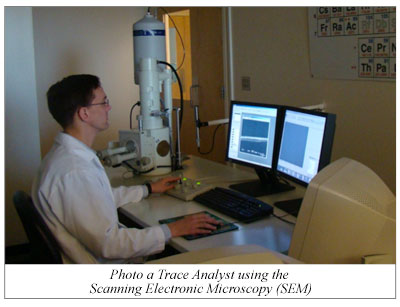
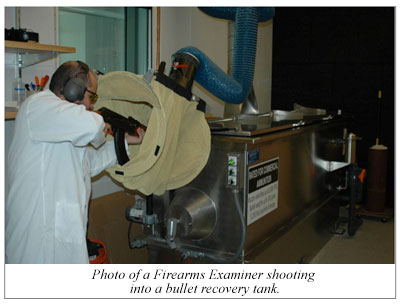
The educational requirements for a Forensic Scientist are as follows:
Crime Scene Investigation
- Baccalaureate degree or higher with natural science, forensic science, and/or criminal justice courses.
Digital Forensic Examination
- Baccalaureate degree or higher in digital/cyber forensics or computer science.
DNA Analysis
- A Baccalaureate degree in biology, chemistry, or forensic science.
- Must have successfully completed the following college courses: Genetics, Biochemistry, Molecular Biology and Statistics.
Drug Analysis and Microanalysis
- A Baccalaureate degree in a natural science or forensic science that includes a minimum of one semester of physics and one year or equivalent in each of general chemistry, organic chemistry, and analytical chemistry/instrumental methods including lecture and associated laboratory classes.
Firearms Examination, Latent Prints Comparisons and Questioned Documents Analysis
- A Baccalaureate degree with science courses.
Polygraph Examination
- Baccalaureate degree or five years’ experience as a polygraph examiner having graduated from a polygraph school accredited by the American Polygraph Association.
The general job requirements and essential functions for a Forensic Scientists are as follows:
- Basic knowledge of the theory and practical operation of a variety of scientific instrumentation and analytical techniques.
- Ability to communicate clearly in English both orally and in writing with scientific and non-scientific personnel.
- Must have the ability to differentiate colors as evidenced by medical certification.
- Must possess a valid Indiana State Driver’s License.
- Ability to travel by aircraft.
- Ability to attend training at alternate locations for extended periods of time.