
The Honorable Joseph E. Kernan
Governor of the State of Indiana
Room 206, The Statehouse
Indianapolis, IN 46204
October 1, 2003
Dear Governor Kernan:
After serving the State of Indiana for the past five years on the Gaming Commission, it has been a pleasure to return to the Horse Racing Commission and reacquaint myself with all aspects of the horse racing industry.
The year 2002 was a landmark year with Indiana's second pari-mutuel track, Indiana Downs in Shelby County, grand opening in December. This fine facility holds the promise of growth and opportunity for all racing breeds.
As in the past, the Commission continues to focus its energies on diligently regulating the pari-mutuel industry. The results of our regulatory efforts, along with statistics of interest, are highlighted in this report.
I look forward to working with my fellow commissioners to continue to maintain our strong regulatory presence. I am confident that we will continue to grow and further strengthen this unique and important industry.
I am grateful to have the opportunity to serve you, the public and all the fine people in Indiana's horse racing industry.
Respectfully submitted,
Richard Darko, Chairman
Indiana Horse Racing Commission
Table of Contents
- Commission and Staff
- Year in Review
- Live Racing at Hoosier Park
- Indiana Downs Statistics
- Distribution of the Wagering Dollar
- State Revenues
- Total In-State Handle
- Breakdown of Handle by Location
- Purses Paid
- Occupational Licensing
- Equine Drug Testing
- Human Drug Testing
- Thoroughbred Breed Development Program
- Standardbred Breed Development Program
- Quarter Horse Breed Development Program
- Blood Gas Analysis Program
- Riverboat Revenue
- 2003 Live Racing Dates Standardbred
- 2003 Live Thoroughbred Racing Dates
Indiana Horse Racing Commission
Commissioners | |
|
Richard Darko Alan Armstrong Janet Bozzelli Richard "Pete" Beck K. Clay Smith. |
Chairman * (2004) Vice-Chairman * (2003) Secretary * (2005) Member * (2005) Member * (2006) |
| * Term expires September 1st of year indicated. | |
Staff | |
|
Joe Gorajec Deena Pitman Robert Smith Wendi Samuelson-Dull Jessica Larkins Jacki Brown Shirley Murphy Pat Adams |
Executive Director Assistant Executive Director Director of Security Controller Director of Standardbred Racing Thoroughbred Development Director Licensing Supervisor Investigator |
To further assist the Commission with its regulatory responsibilities, the following individuals provided professional or technical service at Hoosier Park and Indiana Downs during the 2002 racing season. | |
| Standardbred Judges Timothy Schmitz, Presiding Judge William Perkins, Associate Judge Richard Williams, Associate Judge John Eddy, Associate Judge | Thoroughbred Stewards Gary Wilfert, Senior State Steward Mike Manganelo, Associate Steward Jim Higginbottom, Associate Steward |
| Commission Veterinarian David Younts, D.V.M. Sallie Cosgrove, D.V.M. | Veterinary Technicians Stephanie Adams Claudia Shaff | Racing Inspectors Paul Clark Karla Vaughn |
| Standardbred Breed Development Advisory Committee Ernest M. Gaskin, Chair Henry B. Blackwell, II Nat Hill, IV | Thoroughbred Breed Development Advisory Committee Jake Fredrick, Chair Mari Hulman George Rich Richey |
| Standardbred Advisory Board | Quarter Horse Breed Development | |
|
Richard Link Vic Losure Nancy Sabatini |
Michael Thompson Randy Dever Jeff Henson, Chair | Advisory Committee Shirley Tresner, Chair James Carmicael, D.V.M. |
| Jessica Larkins, ExOfficio Member | Michael Renihan | |
Year In Review
On December 6th Indiana Downs becomes the States' second pari-mutuel track. The customer friendly facility opens its 19-day inaugural harness meet to rave reviews.
February
- On February 21, 2002 at the Harness Tracks of America's annual convention in Las Vegas, Harness Horse Youth Foundation Executive Director, Ellen Taylor, is honored with the association's prestigious Distinguished Service Award.
June
- Executive Director, Joe Gorajec, issues two Preliminary Reports against Indianapolis Downs charging the track failed to disclose its relationship with a consultant during the process of two applications for a race track permit. The reports recommend 1.2 million dollars in fines.
- Governor O'Bannon appoints Richard J. Darko as Chairman of the Commission upon the resignation of Nick Stein. Darko returns to the Racing Commission after serving with the distinction (1989-1997) as an original member of the panel.
- On July 2nd the Commission approves Indiana Downs' first satellite facility application for a license in Evansville.
December
- On December 16th the Commission approves a settlement agreement regarding the two Preliminary Reports issued to Indiana Downs in June. In the settlement Indiana Downs agrees to violating Commission regulations and to the payment of $400,000 in fines and $150,000 in attorney fees. Indiana Downs also apologizes to the Commission Executive Director, Joe Gorajec.
Live Racing At Hoosier Park
Standardbred
| Number of Dates | 90 |
| Total Handle | $4,246,902 |
| Average Daily Handle | $47,188 |
| Total Attendance | 73,970 |
| Average Daily Attendance | 822 |
Thoroughbred and Quarter Horse
| Number of Dates | 68 |
| Total Handle | $4,227,736 |
| Average Daily Handle | $62,173 |
| Total Attendance | 65,760 |
| Average Daily Attendance | 967 |
Combined Standardbred,
Thoroughbred and Quarter Horse
| Number of Dates | 158 |
| Total Handle | $8,474,638 |
| Average Daily Handle | $53,637 |
| Total Attendance | 139,730 |
| Average Daily Attendance | 884 |
The statistics above represent attendance and handle at Hoosier Park on live racing only. Additional wagering on Hoosier Park's live racing at Indiana OTB's is as follows - Standardbred ($1,848,147), Thoroughbred ($1,745,403) totaling ($3,593,550).
Indiana Downs Statistics
Standardbred Live Racing
| Number of Dates | 19 |
| Total Handle | $704,961 |
| Average Daily Handle | $37,103 |
Standardbred Simulcasting Export
| Number of Dates | 19 |
| Total Handle | $3,238,138 |
| Average Daily Handle | $170,428 |
Standardbred Simulcasting Import
| Number of Dates | 25 |
| Total Handle | $289,306 |
| Average Daily Handle | $11,572 |
Thoroughbred Simulcasting
| Number of Dates | 25 |
| Total Handle | $567,098 |
| Average Daily Handle | $22,684 |
All Breeds - Simulcast and Import
| Number of Dates | 25 |
| Total Handle | $856,404 |
| Average Daily Handle | $34,256 |
Distribution of the Wagering Dollar
The following is a breakdown of the distribution of all monies wagered at Hoosier Park and its satellite facilities and Indiana Downs:
Hoosier Park | Indiana Downs | |
| Returned to Bettors | $115,553,592.54 | $1,244,475.85 |
| Track Share | $18,124,846.15 | $176,359.65 |
| Purses Earned | $7,555,785.79 | $99,216.00 |
| Pari-Mutuel Tax | $4,023,480.22 | $31,227.30 |
| Breakage | $773,228.30 | $10,086.20 |
State Revenues
The following are the direct state revenues collected in accordance with the pari-mutuel statute IC 4-31:
Hoosier Park | Indiana Downs | |
| Pari-Mutuel Tax | $4,023,480.22 | $31,227.30 |
| Track Reimbursement for Officials | $289,061.94 | $49,232.79 |
| Admission Tax | $10,577.80 | $804.80 |
| Fines and Civil Penalties Paid | $33,350.00 | $1,850.00 |
| Track Permit and License Fees | $8,000.00 | $6,000.00 |
| Total Revenue | $4,364,469.96 | $95,050.58 |
The direct revenue received by the State of Indiana exceeded the cost of regulation. Indiana Horse Racing Commission operating expenditures for calendar year 2002 were $1,270,208.01.
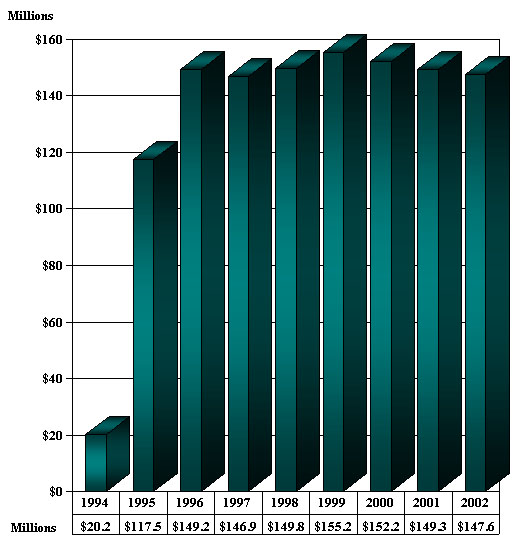
Total In-State Handle
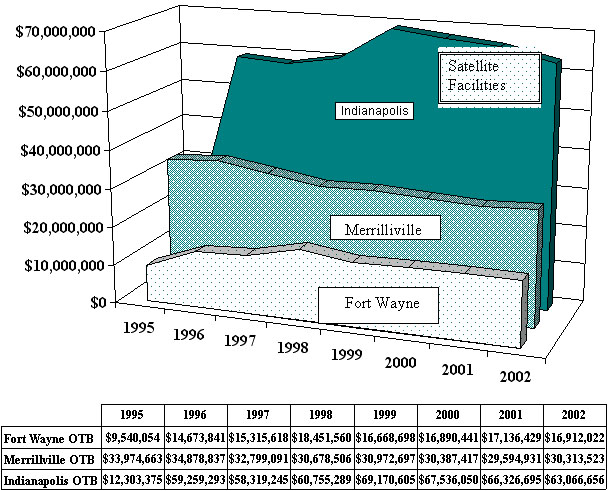
Breakdown of Handle by Location
Purses Paid
Standardbred | Hoosier Park | Indiana Downs* |
| 2002 | $ 13,464,500 | $1,601,900 |
| 2001 | $ 11,631,350 | n/a |
| 2000 | $ 10,877,500 | n/a |
| 1999 | $ 11,960,800 | n/a |
| 1998 | $ 12,186,805 | n/a |
| 1997 | $ 9,558,420 | n/a |
| 1996 | $ 5,608,176 | n/a |
| 1995 | $ 3,593,180 | n/a |
Total | $78,880,731 | $1,601,900 |
| * Live racing was not conducted at Indiana Downs prior to 2002. | ||
Thoroughbred | Hoosier Park* |
| 2002 | $12,062,500 |
| 2001 | $11,771,781 |
| 2000 | $11,035,875 |
| 1999 | $12,600,200 |
| 1998 | $11,468,830 |
| 1997 | $ 8,703,640 |
| 1996 | $ 5,942,589 |
| 1995 | $ 2,673,058 |
| * Live thoroughbred racing was not conducted at Indiana Downs in 2002. | |
Occupational Licensing
Pursuant to IC 4-31-6 and 71 IAC 5-1-1, all persons participating in pari-mutuel racing under the jurisdiction of the Commission are required to be licensed. The licensing process is the backbone of the Commission's regulatory efforts. Each prospective licensee is fingerprinted. The Federal Bureau of Investigation (FBI) and the Indiana State Police provide the Commission with criminal histories of all applicants. The Commission may refuse or deny the application for licensure of any person whose criminal or racing violation record is contrary to the public's best interest.
2002 | ||||
Category | Count | Category | Count | |
| Owner, Standardbred | 2,167 | Vendor/Contractor | 44 | |
| Owner, Thoroughbred | 1,815 | Asst. Trainer, Standardbred | 37 | |
| Groom | 1,223 | Farrier | 33 | |
| Track Employee | 538 | Authorized Agent, Thoroughbred | 32 | |
| Stable Name | 463 | Trainer, Quarter Horse | 29 | |
| Owner/Trainer, | 414 | Authorized Agent, Standardbred | 28 | |
| Owner/Trainer/Driver | 324 | Owner/Trainer, Quarter Horse | 28 | |
| Trainer, Thoroughbred | 305 | Pony Rider | 27 | |
| Vendor Employee | 262 | Racing Official | 26 | |
| Pari-Mutuel Clerk | 240 | Jockey Agent | 25 | |
| Owner/Trainer, Standardbred | 218 | Gate Crew | 19 | |
| Driver/Trainer | 155 | Valet | 14 | |
| Trainer, Standardbred | 153 | Other | 13 | |
| Jockey | 131 | Apprentice Jockey | 11 | |
| Track Security | 126 | Veterinarian | 11 | |
| Driver | 124 | Track Management | 6 | |
| Owner, Quarter Horse | 113 | Vet. Assistant | 5 | |
| Asst. Trainer, Thoroughbred | 94 | Farrier's Assistant | 3 | |
| Exercise Rider | 56 | Outrider | 3 | |
| Commission Staff | 50 | Asst. Trainer, Quarter Horse | 2 | |
Total Licenses Issued: 9,367 | ||||
SUMMARY | 1994 | 1995 | 1996 | 1997 | 1998 | 1999 | 2000 | 2001 | 2002 |
| Licenses Issued | 1,922 | 5,269 | 6,292 | 7,152 | 7,806 | 7,877 | 7,808 | 8,191 | 9,365 |
| Probationary Licenses Issued | 21 | 54 | 53 | 68 | 80 | 70 | 89 | 113 | 107 |
| Licenses Refused | 16 | 10 | 29 | 26 | 21 | 2 | 9 | 16 | 13 |
Equine Drug Testing
Pari-mutuel horse racing can succeed as a legitimate major league sport only if its races are perceived by the wagering public to be honest, competitive contests, free from manipulation by man or drugs. With the exception of furosemide (salix) and phenylbutazone (bute), under regulatory restrictions, state law and Commission rules prohibit the presence of any drug in horses racing at a pari-mutuel track. The Commission's drug detection program is one of the nation's most comprehensive and its laboratory, one of the most respected in the racing industry.
Truesdail Laboratory in Tustin, California, serves as the primary testing laboratory for the Indiana Horse Racing Commission. Truesdail Lab has been a leader in racing chemistry and drug-related research for over 50 years. The following table indicates, by breed, the number of samples analyzed and the number of positive tests reported. In each instance, the offending horse was disqualified and placed last. In accordance with the pari-mutuel statute, all purse money earned is ordered returned and redistributed.
| Breed | Race Date | Urine | Blood | Positive Tests |
| Standardbred | 109 | 2289 | 2568 | 10 |
| Thoroughbred | 70 | 1375 | 1569 | 7 |
| Totals | 179 | 3664 | 4137 | 17 |
The table below represents a further breakdown, by breed, of the name and types of drugs reported by the laboratory.
| Number of Violations | ARCI | ||
| Standardbred | Thoroughbred | Drug Classification | Type |
| 5 | Banamine (Class 4) | non-steroidal anti-inflammatory | |
| 1 | Methocarbarnol (Class 4) | muscle relaxant | |
| 4 | 7 | Bute (Overage) | non-steroidal anti-inflammatory |
Human Drug Testing
Commission regulations provide that a licensee or an applicant for licensure may be required, if reasonable suspicion exists, to submit to a drug test. Commission rules require a minimum suspension of thirty (30) days for a positive test for an illegal drug.
Human Drug Testing | 1994 | 1995 | 1996 | 1997 | 1998 | 1999 | 2000 | 2001 | 2002 |
| Number of Samples Tested | 1 | 14 | 15 | 33 | 24 | 32 | 16 | 18 | 32 |
| Number of Positive Tests | 3 | 8 | 14 | 12 | 19 | 6 | 9 | 6 |
Breed Development Programs
Overview
Pursuant to IC 4-31-11, breed development funds have been established to promote the breeding of horses while stimulating the agri-business sector of the state's economy. Standardbred, thoroughbred and quarter horse breed development advisory committees make recommendations to the Commission regarding the distribution of these monies.
The Indiana bred program is funded by the Breed Development Fund established in the Indiana pari-mutuel statute. The Breed Development Fund consists of breakage (the difference in the rounding off of pari-mutuel payoffs), outs (all uncashed tickets), and the riverboat admissions tax allocation. The Indiana Horse Racing Commission receives 65 cents for every admission on an Indiana riverboat. Twenty (20) percent of the 65 cents goes into the Breed Development Fund. The Breed Development Fund is divided forty-eight (48) percent to the Indiana Thoroughbred Breed Development Fund and forty-eight (48) percent to the Standardbred Breed Development Fund and four (4) percent to the Quarter Horse Breed Development Fund.
Thoroughbred
The mission of the Thoroughbred Development Advisory Committee is to register thoroughbred horses for the Indiana bred program and provide incentives and awards to three important elements of the Indiana thoroughbred industry: the owner, the breeder and the stallion owner. The intent of these incentives and awards is to promote investment of capital into the Indiana economy (via thoroughbred breeding, racing and related agri-business) and maximize the positive impact to the state's economy. The incentives reward risk, and the awards reward success on the racetrack…through winning!
For foals of 1998 and the future, "Indiana bred" is defined as any thoroughbred foaled in the State of Indiana whose dam was registered with the IHRC and entered the State of Indiana by December 1 of the year prior to foaling. The mare must remain in Indiana continuously until foaling. The resulting foal will then be registered as an Indiana bred. In the event a mare entered the State of Indiana and was registered with the IHRC after December 1 of the year prior to foaling, the foal (which must be foaled in Indiana) will be eligible to be registered as an Indiana bred only if said mare was bred back to a registered Indiana stallion after foaling in Indiana.
2002 Distribution of Awards
| Purse Supplements | $ 1,360,000 |
| Owners Awards | 1,289,413 |
| Breeders Awards | 1,076,500 |
| Stallion Owner Awards | 92,723 |
| Out-of-State Awards | 73,555 |
| Total: $3,892,191 | |
Breed Development Programs
Standardbred
The Standardbred Breed Development Program continued with a lucrative program at Hoosier Park in 2002 that included a series of Late Closing events, the GENESIS Series and the Indiana Sires Stakes and Indiana Sired Late Closing Events at Indiana Downs. Indiana Sired Late Closing events, Indiana Sires Stakes, Indiana sired overnights, GENESIS Series, and the Indiana Sired Mini Series awarded $5,934,893 in purse money. The Breed Development program has provided an opportunity for the Indiana Sires Stakes to become one of the industry's premier programs. The Indiana Sires Stakes program reached record levels for 2002, with finals for three year olds growing above $100,000, and the program awarding $2,215,706 in purses to Indiana Sired horses. The success of the Indiana Standardbred Breed Development Program during 2002 has resulted in over 6.5 million dollars paid in purses at Hoosier Park to Indiana Sired horses and premium prices received for Indiana sired yearlings at the Indiana sales. More than 1,911 broodmares were bred to registered Indiana stallions in 2002, assuring continuous growth of our State's Standardbred industry.
The successful Indiana Sired Fair Circuit Program was continued for the county and state fair. During 2002, the two-tier racing system that was successfully implemented into this program during 2001 was continued, giving horses more racing option at the county fair level. This two-tier racing system was also continued into the "Fall Classic Racing Program" which in it's fourth year, gave Indiana sired horses an opportunity to race after the completion of the Indiana State Fair and Hoosier Park. Through these continued efforts, the Standardbred Breed Development Program is developing and promoting a fast growing and high quality Standardbred industry in the state of Indiana.
2002 Distribution of Awards
| Purse supplements -Hoosier Park | $ 2,155,650 |
| Purse supplements - Indiana Downs | 125,300 |
| Purse supplements - County Fairs | 499,730 |
| Purse supplements - State Fair | 280,000 |
| Purse supplements - Fall Classic | 219,320 |
| Indiana Sired & Breeder Awards | 359,450 |
| Total: $3,639,450 | |
Breed Development Programs
Quarter Horse
The Indiana Quarter Horse Breed Development Committee was established in November of 1999 with the first breed development races occurring in the fall of 2000. Shirley Tresner, James Carmichael, DVM and Michael Renihan were the first to be named to the committee appointed by Governor Frank O'Bannon.
The purpose of the committee is to register Quarter Horses for the Indiana bred, foaled, and owned programs and provide incentives and awards for race horse owners, breeder and stallion owners. The intent of these incentives and awards is to promote investment of capital into the Indiana economy. In 2002, $172,460 was given in purse supplements and awards at Hoosier Park.
2002 Distribution of Awards
| Purse Supplements | $ 120,000 |
| Owners Awards | 31,675 |
| Breeders Awards | 18,382 |
| Stallion Owner Awards | 2,403 |
| Total: $ 172,460 | |
2002 Breed Development Fund Revenue
| Breed | Breakage | Outstanding Tickets * | Riverboat Revenue | Total |
| Standardbred | 394,922.23 | 329,864.34 | 2,319,928.74 | 3,044,715.31 |
| Thoroughbred | 394,918.39 | 329,864.34 | 2,319,928.74 | 3,044,711.47 |
| Quarter Horse | N/A | 27,488.67 | 100,000.00 | 127,488.67 |
| Total | 789,840.62 | 687,217.35 | 4,739,857.48 | 6,216,915.45 |
Blood Gas Analysis Program
The purpose of the Blood Gas Analysis (BGA) program is to deter and detect the practice of "bicarbonate loading" or what is known in the racing business as "milkshaking." This practice generally entails giving a horse a large quantity of an alkaline substance, usually baking soda, prior to a race. The alkaline substance neutralizes the lactic acid that is produced during exercise and, as a consequence, delays the onset of fatigue. Research has demonstrated that this practice induces some horses to race faster times. Bicarbonate loading can give a horse an unfair competitive edge and thus compromise the integrity of the sport. This practice is strictly prohibited by the rules of the Commission.
The BGA Program is operated by the Commission in a small laboratory located in the paddocks at Hoosier Park and Indiana Downs. Blood samples of selected horses are analyzed prior to the race on a state-of-the-art blood gas analysis machine. Each sample is analyzed by a certified lab technician.
Riverboat Revenue
The statute permitting riverboat gaming in Indiana earmarks sixty-five (65) cents of the three dollar admission tax to the pari-mutuel horse racing industry. These funds are distributed to various segments of the racing industry in accordance with Commission rule 71 IAC 12-2-15.
2002 Riverboat Revenue Allocation to Racing From Admission Tax (65 cents)
| Purses | $ 9,479,714.98 | ||
| Standardbred | $4,639,857.49 | ||
| Thoroughbred | $4,639,857.49 | ||
| Quarter Horse | $ 200,000.00 | ||
| Tracks | 9,479,714.98 | ||
| Hoosier Park | $9,331,262.64 | ||
| Indiana Downs | 148,452.34 | ||
| Breed Development | 4,739,857.48 | ||
| Standardbred | $2,319,928.74 | ||
| Thoroughbred | $2,319,928.74 | ||
| Quarter Horse | $100,000.00 | ||
| Total | $23,699,287.44 |
(Distribution Formula: Pursuant to 71 IAC 12-2-15, riverboat revenue is allotted 40% to purses, 40% to the tracks and 20% to breed development funds.)
2003 Live Racing Dates Standardbred
Download the 2003 Standardbred Racing Calendar