
About Regional Arts PartnersRegional Arts Partners work alongside the Indiana Arts Commission to promote and expand participation in the arts in Indiana. The partners provide broad local access to arts services and funding opportunities and provides services that include, but are not limited to, grants making and information and referral. Reasons to reach out to your Partner:
Contact information for each partner can be found below (scroll down). Click the image to the right to expand. | 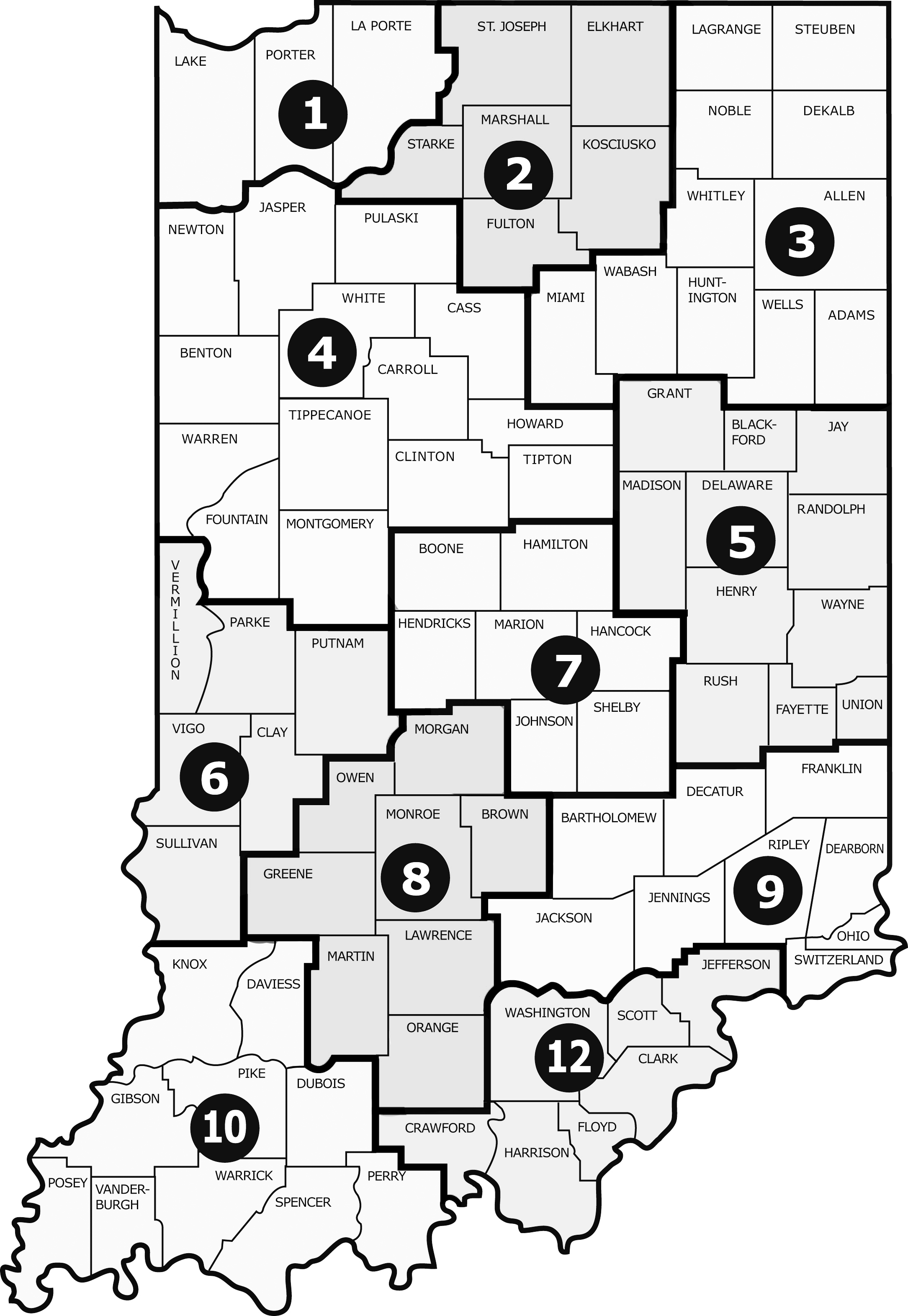 | |
- Region 1 (Greater Gary Area) - South Shore Arts
Serves: Lake, La Porte, Porter
South Shore Arts
1040 Ridge Road
Munster, IN 46321
(219) 836-1839, ext. 100Emerald Walker, Regional Arts Coordinator
emerald@southshoreartsonline.org - Region 2 (Greater South Bend Area) - Community Foundation of St. Joseph County
Serves: Elkhart, Fulton, Kosciusko, Marshall, Starke, St. Joseph
Community Foundation of St. Joseph County
205 W. Jefferson Boulevard, Suite 610
P.O. Box 837
South Bend, IN 46601
(574) 232-0041Kayla Myers, Senior Program Officer
kayla@cfsjc.orgClare Ramel, Program Officer
clare@cfsjc.org - Region 3 (Greater Fort Wayne Area) - Arts United of Greater Fort Wayne
Serves: Adams, Allen, Dekalb, Huntington, Lagrange, Miami, Noble. Steuben, Wabash, Wells, Whitley
Arts United of Greater Fort Wayne, Inc.
300 E. Main Street, 2nd Floor
Fort Wayne, IN 46802
(260) 424-0646Rachel Jones, Director of Development
rjones@artsunited.org - Region 4 (Greater Lafayette Area)- The Arts Federation
Serves: Benton, Carroll, Cass, Clinton, Fountain, Howard, Jasper, Montgomery, Newton, Pulaski, Tippecanoe, Tipton, White
The Arts Federation
638 North Street
Lafayette, IN 47901
(765) 423-2787Tetia Lee, Chief Executive Officer
tetia@theartsfederation.org - Region 5 (Greater Muncie Area) - Community Foundation of Randolph County
Serves: Blackford, Delaware, Fayette, Grant, Henry, Jay, Madison, Randolph, Rush, Union, Wayne
Community Foundation of Randolph County
120 W Washington St.
Winchester, IN 47394
(765) 584-9077 ext 205Braydee Euliss, Regional Arts Partner
beuliss@randolphcountyfoundation.org - Region 6 (Greater Terre Haute Area) - Arts Illiana
Serves: Clay, Parke, Putnam, Sullivan, Vermillion, Vigo
Arts Illiana
23 North 6th St.
Terre Haute, IN 47807
(812) 235-5007Jon Robeson, Executive Director
jonrobeson@aol.comSherri Wright, Associate Director*
sherri@artsilliana.org*Sherri Wright is the primary contact for the Regional Arts Partnership.
- Region 7 (Greater Indianapolis Area) - Noblesville Creates
Serves: Boone, Hamilton, Hancock, Hendricks, Johnson, Marion, Shelby
Noblesville Creates
107 South 8th Street
Noblesville, IN 46060
grants@noblesvillecreates.org - Region 8 (Greater Bloomington Area) - Indiana University Arts and Humanities Council
Serves: Brown, Greene, Lawrence, Martin, Monroe, Morgan, Orange, Owen
Indiana University Arts and Humanities Council
Cook Center for Public Arts & Humanities
750 E. Kirkwood Ave., Bloomington, IN 40705Natalia Almanza
Internal Programs Coordinatorregion8@iu.edu
(812) 856-0963 - Region 9 (Greater Columbus Area) - Columbus Area Arts Council
Serves: Bartholomew, Dearborn, Decatur, Franklin, Jackson, Jennings, Ohio, Ripley, Switzerland
Columbus Area Arts Council
431 Sixth Street
Columbus, IN 47201
(812) 376-2539Kimberly I. Ann, Operations Manager
kimberly@artsincolumbus.org - Region 10 (Greater Evansville Area) - Evansville Vanderburgh Public Library
Serves: Daviess, Dubois, Gibson, Knox, Perry, Pike, Posey, Spencer, Vanderburgh, Warrick
Evansville Vanderburgh Public Library
200 SE Martin Luther King Jr. Blvd
Evansville, Indiana 47713 - Region 12 (Greater New Albany Area) - Indiana University Arts and Humanities Council
Serves: Clark, Crawford, Floyd, Harrison, Jefferson, Scott, Washington
Indiana University Arts and Humanities CouncilCook Center for Public Arts & Humanities
750 E. Kirkwood Ave., Bloomington, IN 40705Gerard Pannekoek
Programs and Operations Coordinatorregion12@iu.edu
(812) 855-7700