

Conservation Efforts of Middle Eel River Watershed Initiative lead to Dam Removal in North Manchester and Liberty Mills, IN
One of the great success stories for the local Soil & Water Conservation Districts in the Eel River watershed is the strong and diverse partnerships that have developed around a coalition led by Manchester University in the Middle Eel River Watershed Initiative. Through this diverse team of partners, including Kosciusko, Miami and Wabash County SWCDs, all those involved have been able to leverage their own resources and expertise toward the success of the initiative. With over twenty-four organizational partners, it might even be a misnomer for it to be called an initiative. It seems the Middle Eel is many initiatives in one and after four years of its existence it is up and coming as a mainstay to organizations of its kind in Northwest Indiana.
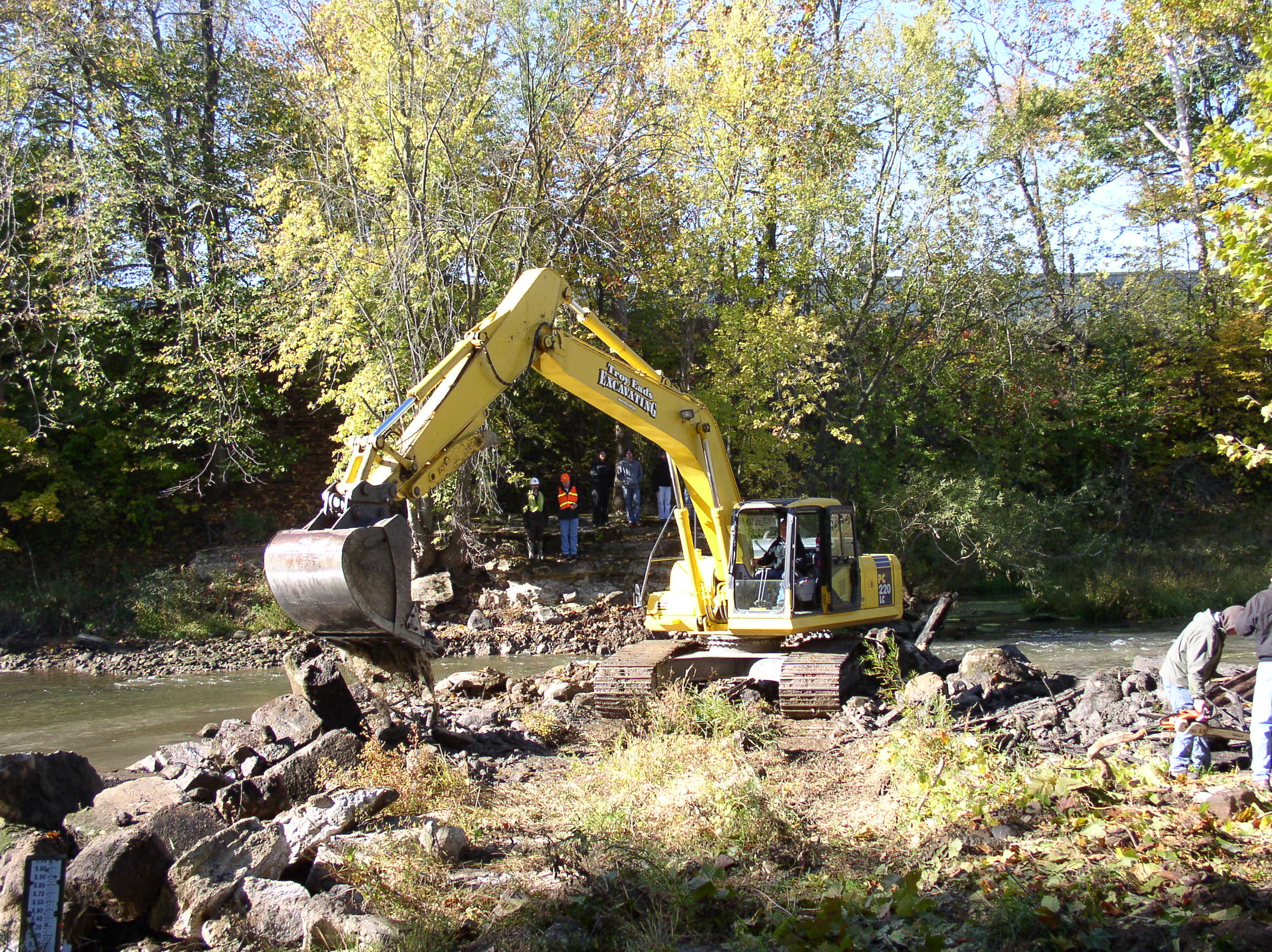
Recently, the most telling of the initiative’s achievements is the removal of crib dams along the Eel River at Liberty Mills and North Manchester, Indiana, both located in Wabash County. Manchester University was able to apply for grant funding with the US Fish and Wildlife Service and the Ohio River Basin Fish Habitat Partnership. In mid 2012 the initiative was informed they were awarded $120,000 in funding to remove the dams. Along with the negative ecological impacts that lower head dams produced for the fish and aquatic communities, both dams were breached and in such disrepair that they posed hazards to public safety as well. So as a result of the efforts of the Middle Eel River Watershed Initiative the dams were removed on October 11th and 12th ,2012 by Troy Eads Excavating, Inc. As the excavator chipped away at the North Manchester dam, the old growth white oak beams were unearthed showing the original wooden dam that was built in the 1879 by Henry Arnold and Daniel Strauss to power a flour mill. The dam was said to have been rebuilt sometime after its original construction and went from owner to owner throughout the 1900s. In 1923 the mill burned down and then was purchased by the Northern Indiana Power Company in 1929 to eliminate any hydropower competition in the area. Since then mill site and dam have been given back to the town with the condition that they would not be used for generating power. The Liberty Mills dam was also built in sometime during the 19th century to power a mill and over the years was abandoned to its state of disrepair. After both dams were removed in October, it didn’t take long for the stream height to stabilize and reestablish itself. Even within the first couple hours the difference in stream height was strikingly evident at different points along the Eel River. Over the course of the next couple years, the initiative is excited to be able to document the ecological improvements the dam removal will bring to the river through their comprehensive approach to water quality and biological monitoring that they have already established along the Eel River.