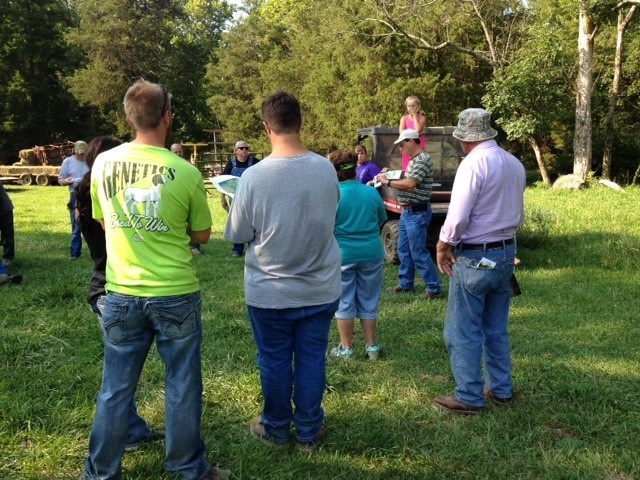


Hay wagon rides and a picnic by the pasture field were enjoyed by 27 participants at the August 10, 2017 event. As we observed the different pastures for cattle and goats, Robert Zupancic NRCS Grazing Specialist reviewed the soil samples that had been taken earlier and the landowners’ pasture management.
The farms of Pat Larr and Scott Hiler were highlighted in our recent Pasture Walk. As we began at the Hiler farm, Scott described his rotational grazing technique routines. Every two days, the family moves their cows from one of 13 paddocks into another. With transportable water troughs and feeding racks, the livestock can utilize each foraging area without over-grazing a particular area. The herd can forage at a higher level, thus ingesting less numbers of parasites, and the forage growth is maximized by encouraging desirable plants. The 50 gallon water trough tanks are kept at 25 gallons so the summer heat doesn’t make the drinking water less palatable. In the winter months, two Heavy Use Area Protection regions with compacted lime over rocks and liner are used to lessen the mud and soil erosion. Later, the resulting accumulation of manure/treaded hay/lime mixture is applied to his pasture fields resulting in less additional fertilizer and lime that needs to be bought and spread on his farm.
Enjoying the beautiful weather and short hay ride to Pat Larr’s farm, we viewed different fence materials used in her rotational grazing. With different locations for the grazing paddocks, getting water to the livestock must be addressed. Livestock should be excluded from streams, ponds, wetlands and ditches to ensure animal performance and maintain good herd health. Damage to the riparian zone from the destabilizing of the vegetation, bed and banks of the watercourse and the contamination of the water from pathogens and excessive nutrients should be avoided. Watering facilities for her goat herd were discussed. Since the hydrant is fed by an underground water line, the conversation was focused on what type of pipe to use for water supply. The Pex pipe is meant to be used in house construction and not necessarily underground. If using rolled plastic pipe, the PSI 160 or greater should be used. If using PVC, then Schedule 40 can be used. If a garden hose is used for the short distances not greater than 200 feet, keep the hose in the shade. Keeping the herd well fed and with ample drinking water is key to a healthy farming operation.