

Since 2008 the Middle Eel River Watershed has been the focus of an innovative conservation effort. The work, which the Miami County Soil and Water Conservation District (SWCD) has been a part of, has successfully demonstrated collaboration across federal and state natural resource agencies, Manchester College, and the agricultural community.
The unifying mission of this effort is to reduce soil erosion, in-stream suspended sediment, export of nutrients (nitrogen and phosphorus), and off-site movement of E. coli while maintaining or improving agricultural productivity. This effort has been successful because of a holistic approach of inclusion and innovation.
The conservation success is due to $2.2 million Mississippi River Basin Initiative (MRBI) grant partnered with a 319 nonpoint source pollution $1 million grant. The partners for these grants include: Manchester College, NRCS, IDNR, IDEM, and the soil and water conservation districts of Wabash, Miami, and Kosciusko counties.
The middle Eel River Watershed includes 30 miles of the river from North Manchester to Mexico (IN), and covers nearly 170,000 acres. The 319 grant provides a scientifically sound approach to monitoring three areas of the Eel River with automatic water samplers and detailed biological monitoring. Additionally, monitoring of bacteria, nutrients and biology is conducted in all of the major tributaries of the study area.
The land use in the middle Eel River is about 88 percent agricultural and most of the first order streams have been modified for drainage. Much of the riparian vegetation has been removed or restricted to narrow bands along either side of streams. According to historical accounts the water ran clear even during high flow conditions and 71 species of fishes in the Eel River. Today the species list includes only 46. There are also nearly 30 species of freshwater mussels documented in the Eel. Of these, three species are extirpated and nine species are either state/federally endangered or threatened. Even at low flow conditions the river no longer runs clear.
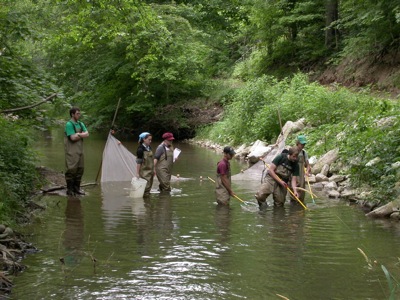
Since 2009 the 319 nonpoint source pollution grant funded the development of a watershed management plan and water quality monitoring program for the Middle Eel River Watershed. The monitoring program was developed and implemented by scientists and students at Manchester College beginning in May 2009. The public outreach program includes yearly canoe floats, river clean-ups and field days. 2011 marks the first year for the cost-share program with land owners.
In Miami County, four USDA contracts were approved for 2010 which totaled $272,407. The Miami SWCD utilized Clean Water Indiana grant funds to hire a technician. The four Miami county contracts will result in 1,244 acres of no-till, cover crops, nutrient management and pest management.
Miami County SWCD counts these programs among our biggest conservation successes with efforts reaching as far as the Gulf of Mexico.
The unifying mission of this effort is to reduce soil erosion, in-stream suspended sediment, export of nutrients (nitrogen and phosphorus), and off-site movement of E. coli while maintaining or improving agricultural productivity. This effort has been successful because of a holistic approach of inclusion and innovation.
The conservation success is due to $2.2 million Mississippi River Basin Initiative (MRBI) grant partnered with a 319 nonpoint source pollution $1 million grant. The partners for these grants include: Manchester College, NRCS, IDNR, IDEM, and the soil and water conservation districts of Wabash, Miami, and Kosciusko counties.
The middle Eel River Watershed includes 30 miles of the river from North Manchester to Mexico (IN), and covers nearly 170,000 acres. The 319 grant provides a scientifically sound approach to monitoring three areas of the Eel River with automatic water samplers and detailed biological monitoring. Additionally, monitoring of bacteria, nutrients and biology is conducted in all of the major tributaries of the study area.
The land use in the middle Eel River is about 88 percent agricultural and most of the first order streams have been modified for drainage. Much of the riparian vegetation has been removed or restricted to narrow bands along either side of streams. According to historical accounts the water ran clear even during high flow conditions and 71 species of fishes in the Eel River. Today the species list includes only 46. There are also nearly 30 species of freshwater mussels documented in the Eel. Of these, three species are extirpated and nine species are either state/federally endangered or threatened. Even at low flow conditions the river no longer runs clear.
Since 2009 the 319 nonpoint source pollution grant funded the development of a watershed management plan and water quality monitoring program for the Middle Eel River Watershed. The monitoring program was developed and implemented by scientists and students at Manchester College beginning in May 2009. The public outreach program includes yearly canoe floats, river clean-ups and field days. 2011 marks the first year for the cost-share program with land owners.
In Miami County, four USDA contracts were approved for 2010 which totaled $272,407. The Miami SWCD utilized Clean Water Indiana grant funds to hire a technician. The four Miami county contracts will result in 1,244 acres of no-till, cover crops, nutrient management and pest management.
Miami County SWCD counts these programs among our biggest conservation successes with efforts reaching as far as the Gulf of Mexico.