

The mission of the Huntington County Soil and Water Conservation District is to educate and provide assistance to landowners in the wise use of conservation practices that protect the soil, water quality and other natural resources.
Over the past three years the District has partnered with Blackford, Jay and Wells Counties, along with the Army Corp of Engineers, to do water sampling in the Salamonie River. A large amount of blue-green algae in the river and Salamonie Reservoir sparked the need to sample the river from Salamonia in Jay County to the east side of the reservoir in Huntington County. Through these samplings we have found areas that need conservation practices installed to help reduce the amount of nutrients entering the tributaries to the Salamonie River and the river itself.
Since the Salamonie Watershed is not a priority area for other state and federal funding for conservation programs, the Blackford, Huntington, Jay and Wells County SWCDs secured a Clean Water Indiana Watershed grant to provide cost share funding to landowners to install conservation practices to help reduce excess nutrients entering the streams and river. We have also been approved for a 319 Nonpoint Source Management Program Grant to develop a Watershed Management Plan for the Lower Salamonie River Watershed and to develop a cost-share program that will fund Best Management Practices (BMP). Partners in this grant include Blackford, Grant, Wabash and Wells County SWCDs, along with Taylor University’s Department of Earth and Environmental Science, and Purdue Extension Service. Other parthers include the Huntington County Tourism Bureau, Health Department, County Commissioners, Drainage Board, Indiana Department of Natural Resources and The Nature Conservancy.
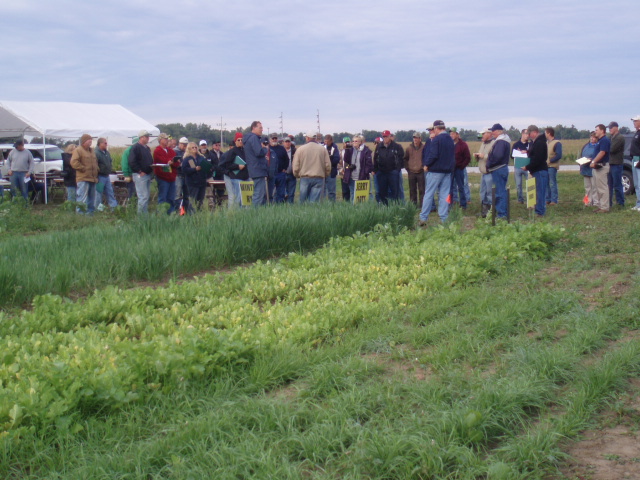
In our continued effort to protect our soil from erosion and excess nutrients flowing into our rivers and streams, we hosted a field day in September promoting the use of cover crops. Landowners and operators that attended the field day were able to view a cover crop test plot that was seeded with several varieties of cover crops. Guest speakers provided information about the benefits of cover crops, methods of seeding and management of them and how to determine the best variety to seed on their farms. Funding through a Clean Water Indiana Grant was used to provide incentive payments to landowners for seeding cover crops on their farms.
The Huntington County Soil and Water Conservation District is committed to promoting the installation of conservation practices in the urban, rural and agriculture sectors that will protect the environment for future generations.
Over the past three years the District has partnered with Blackford, Jay and Wells Counties, along with the Army Corp of Engineers, to do water sampling in the Salamonie River. A large amount of blue-green algae in the river and Salamonie Reservoir sparked the need to sample the river from Salamonia in Jay County to the east side of the reservoir in Huntington County. Through these samplings we have found areas that need conservation practices installed to help reduce the amount of nutrients entering the tributaries to the Salamonie River and the river itself.
Since the Salamonie Watershed is not a priority area for other state and federal funding for conservation programs, the Blackford, Huntington, Jay and Wells County SWCDs secured a Clean Water Indiana Watershed grant to provide cost share funding to landowners to install conservation practices to help reduce excess nutrients entering the streams and river. We have also been approved for a 319 Nonpoint Source Management Program Grant to develop a Watershed Management Plan for the Lower Salamonie River Watershed and to develop a cost-share program that will fund Best Management Practices (BMP). Partners in this grant include Blackford, Grant, Wabash and Wells County SWCDs, along with Taylor University’s Department of Earth and Environmental Science, and Purdue Extension Service. Other parthers include the Huntington County Tourism Bureau, Health Department, County Commissioners, Drainage Board, Indiana Department of Natural Resources and The Nature Conservancy.
In our continued effort to protect our soil from erosion and excess nutrients flowing into our rivers and streams, we hosted a field day in September promoting the use of cover crops. Landowners and operators that attended the field day were able to view a cover crop test plot that was seeded with several varieties of cover crops. Guest speakers provided information about the benefits of cover crops, methods of seeding and management of them and how to determine the best variety to seed on their farms. Funding through a Clean Water Indiana Grant was used to provide incentive payments to landowners for seeding cover crops on their farms.
The Huntington County Soil and Water Conservation District is committed to promoting the installation of conservation practices in the urban, rural and agriculture sectors that will protect the environment for future generations.