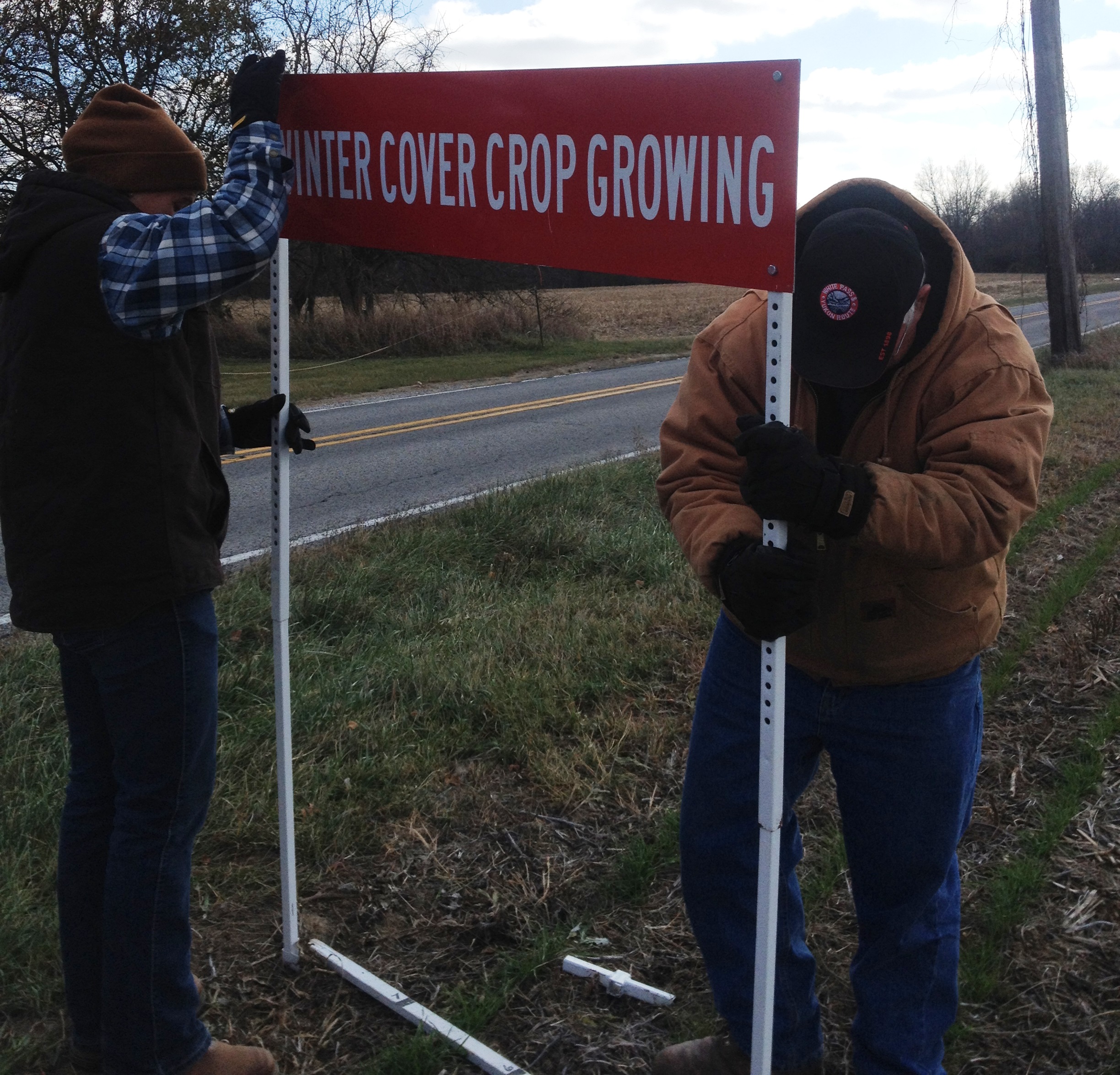


In the fall of 2014, Hendricks County SWCD installed six sets of signs highlighting cover crops. In the style of the old Burma Shave advertisements, each set of five signs featured one of three rhymes about using cover crops in the winter. The last sign in each set had the SWCD’s full name. The signs were posted along US 36 west of Danville, SR 39 south of Danville, and SR 236 north of Danville in the center of the county, US 40 west of Stilesville in the southwest corner of the county, and CR 1000 E near St. Malachy Catholic Church and Maloney Road in the northeast corner of the county, in partnership with the landowners who voluntarily agreed to participate in the program. The signs remained in place until April when SWCD staff and supervisors removed them.
The objective of the sign program was to bring attention to the use of cover crops to anyone traveling on these roads, whether a rural landowner, suburban homeowner, farmer, or the general public traveling through the county. An article about the signs and the benefits of cover crops was featured in The Hendricks Communicator- the SWCD quarterly newsletter, as well as in the Hendricks County Republican newspaper. Several people called the SWCD office to let the staff know they had seen the signs. Putnam County SWCD inquired about where the signs were made as they are considering a similar program.
The sign program was suggested by Jack Nelson, SWCD chairman, and included in the annual plan of work as a method to promote conservation practices in the county to farmers and highlight those practices to non-farmers. The signs were funded with the SWCD’s annual budget, costing $1883.00. While the signs themselves did not provide a direct environmental impact, they served to educate the public (another key component of the district’s annual plan of work) about the environmental benefits of cover crops, such as prevention of soil erosion, excess nutrients uptake and storage, increasing organic matter, and improving water quality.
The signs also served to promote the SWCD to non-traditional customers as well as to county officials. The work of the SWCD tends to go unnoticed yet benefits everyone. Many non-traditional customers call the district after a problem has developed, rather than in a pro-active manner, unlike farmers working with a conservation plan for long-term land management. The SWCD intends to use the signs again this winter, preferably in different fields, but still on the main roads through the county, giving the district opportunities to work with a new set of landowners and potentially reach different members of the public.