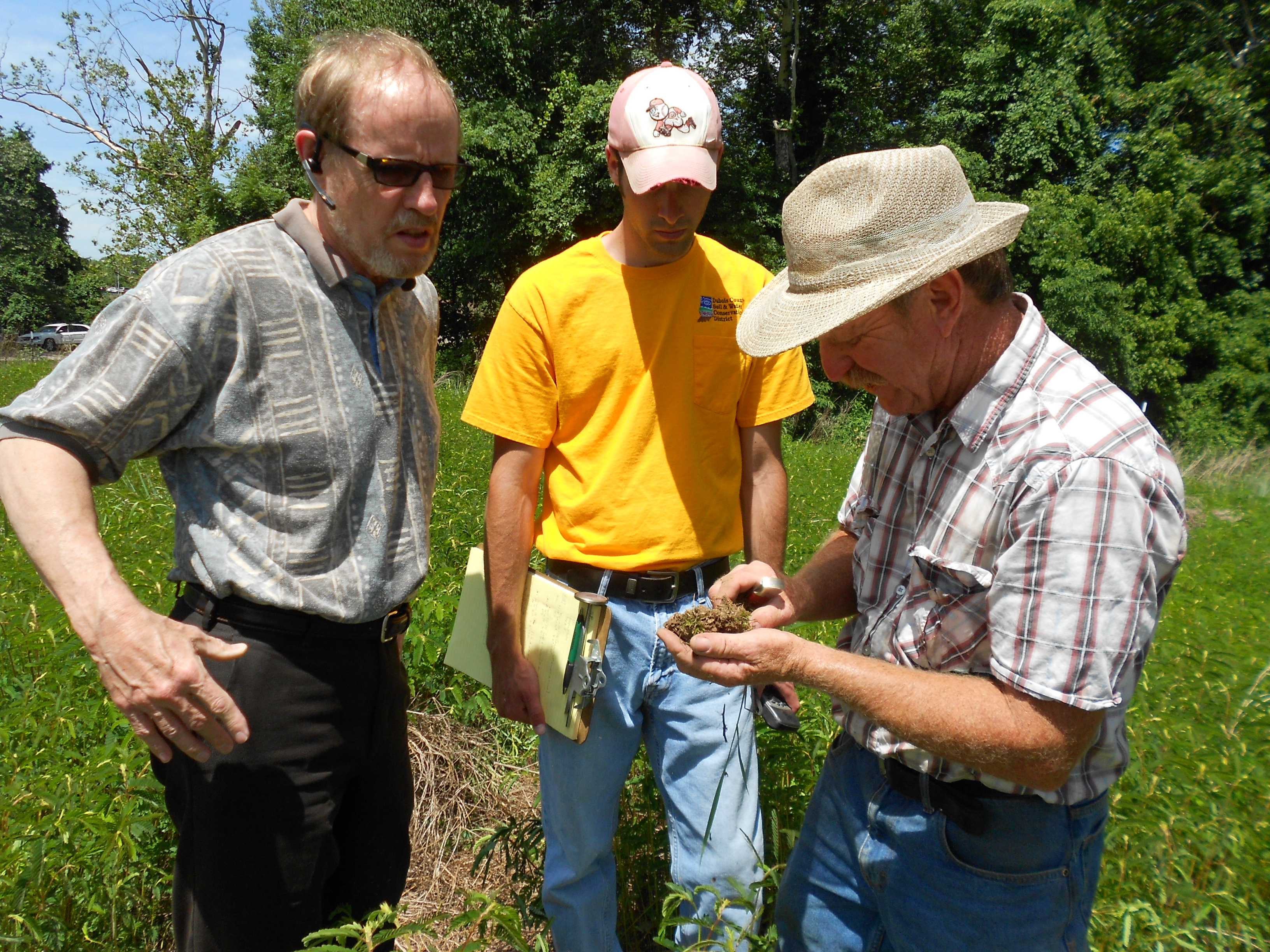


SWCD and Vincennes University Jasper Campus Form Unique Partnership to Manage University Cropland
The Dubois County Soil & Water Conservation District and Vincennes University Jasper Campus have formed a unique partnership to test agricultural techniques that can improve the health and productivity of soil while allowing cleaner water runoff. Titled the VUJC Land Stewardship Initiative, the five-year partnership will use about 40 acres of crop land on the VU Jasper Campus for demonstrations of no-till and cover crop principles. In addition, the forest, lawn areas, and water courses will be managed to benefit the overall natural resource health of the VU property.
The Vincennes University Land Stewardship Initiative was born early in 2012, when the partnership was drafted between the SWCD and VUJC officials. A Land Stewardship Initiative steering committee was formed, led by Alan Smock, Vice Chair of the SWCD. The steering committee set three goals for the Initiative:
1. Improve the natural resources;
2. Develop a respected research and education center;
3. Develop a sustainable organizational structure to ensure ongoing programming.
“It’s very rare that a ‘win’ for the producer is also a ‘win’ for the consumer, said Alan Smock, Initiative Chair. “The producer benefits from reduced costs of tillage, inputs, etc., and the community benefits from clean water from the reduced nutrient runoff and erosion. The Land Stewardship Initiative offers a unique opportunity to demonstrate how improving soil health benefits the entire community.”
In traditional farming, the land is plowed before planting, loosening the soil and destroying its natural structure, making it more prone to erosion by wind and water. In no-till planting, the soil structure is left undisturbed and the seeds are inserted into channels cut in the surface. Soil with its natural structure intact allows the new crop roots to utilize channels left by roots and earthworms. The more natural soil also has a larger population of beneficial microorganisms.
Once living plants are removed the biological activity of the soil decreases.
Newer techniques that the partnership will demonstrate include planting cover crops following the harvest of a no-tilled cash crop. The winter cover crops will help hold the soil in place, add nutrients and increase the biological activity of microbes. Studies have shown that soils with increased microbial activity will often grow better crops the following year. Utilizing cover crops also reduces the amount of weeds that grow in a field after the crop has been removed.
The Initiative’s steering committee hit the ground running in January, drafting documents and, with the guidance of the SWCD Supervisors, assumed the full management of the crop land. The steering committee and SWCD planted and harvested the cash crops, weathered the drought along with all of the area farmers, and installed soil conservation practices on the crop land in the fall. The group also sowed cover crops using a no-till drill, as well as aerially applying the cover crop seed utilizing the services of an airplane.
“Our partnership is an excellent opportunity for VUJC to team up with experts in environmental science to demonstrate the newest techniques by which farmers can increase productivity while improving soil and water quality. This educational initiative is in keeping with the mission of the University to disseminate information through classes, field days and demonstrations that use the campus land as a laboratory,” said Alan Johnson, Dean of the VU Jasper Campus.
The USDA’s Natural Resources Conservation Service (NRCS) was pleased to offer the services of its Indiana Soil Health Team to assist the Land Stewardship Initiative’s steering committee. The NRCS, a traditional partner of the Soil and Water Conservation District, will provide some of the technical expertise needed in the development and management of the Initiative. Bart Pitstick, Dubois County’s District Conservationist with the NRCS believes that “the practices we hope to demonstrate with this Initiative will be applicable to every crop field in the county”.
Other participants in the Initiative include the Purdue Cooperative Extension Service and the Indiana Department of Agriculture, among others. The partnership is still being developed, and new steering committee members and partners for the Initiative are being recruited.
The mission of the Dubois County SWCD is to promote to all citizens, both agricultural and non-agricultural, the vital benefits of protecting and preserving all natural resources. Judi Brown, SWCD Executive Director said, “Forming this partnership with VUJC provides us a wonderful opportunity to do some hands-on farm management, and experiment with more innovative farming practices that improve the soil and water quality. We feel that our experience with various cover crops and farm management methods will allow us to assist our local farmers even more than we have ever been able to in the past.”
During the five-year Land Stewardship Initiative, the project will strive to improve the overall soil health of the cropland acres at VUJC. Other goals are to address several areas were gully erosion is present, and to stabilize the stream banks on the property. The SWCD is reviewing the existing woodland on the campus and will develop a management plan in cooperation with IDNR Division of Forestry.
The Land Stewardship Initiative’s Steering Committee members are committed to making the campus an environmental showcase and laboratory, and look forward to many successful projects to showcase.