

The Clinton County Soil and Water Conservation District (CCSWCD), in cooperation with a variety of partners, works to improve the quality of life in Clinton County and beyond by providing natural resources education and outreach, as well as technical and financial assistance through various conservation programs.
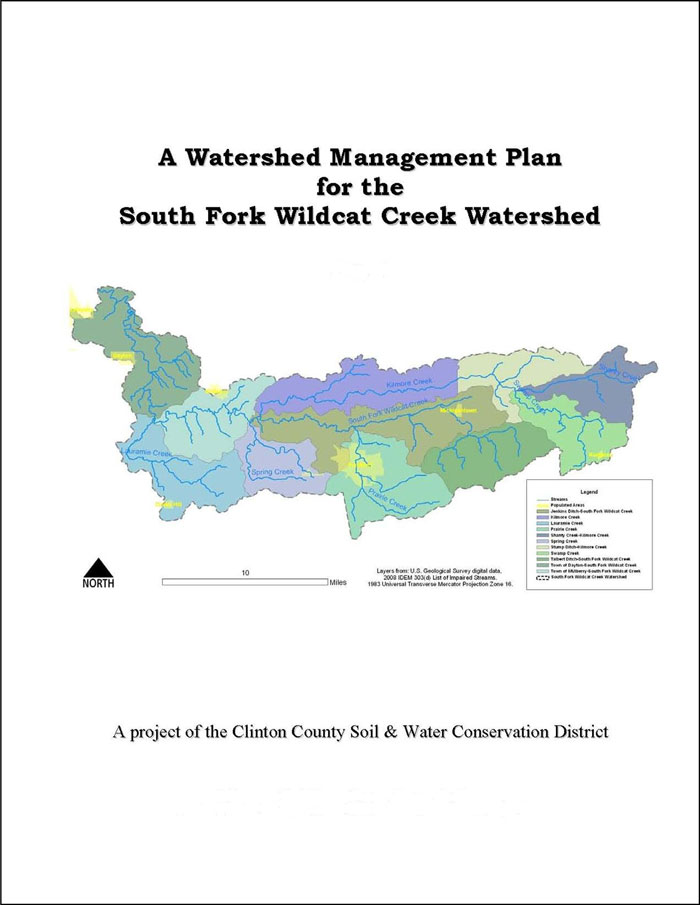
One such program involves the South Fork Wildcat Creek Watershed, which drains a large portion of Clinton County as well as smaller areas of Howard, Tippecanoe, and Tipton Counties. With financial support from the U.S. Environmental Protection Agency and Indiana Department of Environmental Management, the South Fork Wildcat Creek Watershed Management Plan was completed in late 2012 after three years of public input and planning meetings. This comprehensive plan characterizes water quality impairments such as excessive sediment and E.coli bacteria throughout the South Fork Wildcat Watershed and establishes a framework for addressing these impairments through targeted conservation practice implementation and education.
Another watershed-based project that the CCSWCD is participating in is part of the U.S. Department of Agriculture’s Mississippi River Basin Initiative (MRBI). This project is led by the Greater Wabash River Resource Conservation & Development Council, a 501(c)3 organization consisting of local area Soil and Water Conservation Districts (SWCDs), Purdue Cooperative Extension Service educators, and community leaders. The primary intent is to reduce sediment and nutrient runoff from targeted drainage areas of the Wildcat Creek Watershed to the Gulf Coast. After three years, this project has provided technical and/or financial assistance to more than 80 landowners, bringing increased conservation to almost 60,000 acres. Current models show that these installed conservation practices have kept almost 12,900 tons of sediment, 39,800 pounds of phosphorus, and 12,400 pounds of nitrogen from polluting our waters.
The CCSWCD is also involved in multiple on-farm research projects evaluating conservation practices within agricultural settings. One effort is the Indiana On-Farm Network. The Indiana On-Farm Network looks to empower producers with tools and field-level data to optimize their nitrogen management. The CCSWCD works with local producers to setup field trials using tools such as aerial imagery and nitrate-stalk testing. Collected data is then reviewed on a local scale to provide producers with field-level information they can use to improve nutrient management and efficiency, thus reducing nutrient runoff into the environment. Currently, the CCSWCD has worked with 17 local producers to establish almost 1,600 acres of on-farm trials.
Another on-farm research project which CCSWCD is participating in looks to quantify the potential benefits cover crops may provide with nutrient capture and soil health. This project is funded by the Indiana State Department of Agriculture through the Clean Water Indiana program. In conjunction with other surrounding counties, the CCSWCD has established nine on-farm research plots evaluating two different cover crop treatments and one control plot. Tests will be carried out on each plot to document changes over time in soil chemistry, nutrient uptake by cover crops, and cover crop biomass. This project will look to provide information to local producers about the use of cover crops in a no-till or strip-till cropping systems.
One such program involves the South Fork Wildcat Creek Watershed, which drains a large portion of Clinton County as well as smaller areas of Howard, Tippecanoe, and Tipton Counties. With financial support from the U.S. Environmental Protection Agency and Indiana Department of Environmental Management, the South Fork Wildcat Creek Watershed Management Plan was completed in late 2012 after three years of public input and planning meetings. This comprehensive plan characterizes water quality impairments such as excessive sediment and E.coli bacteria throughout the South Fork Wildcat Watershed and establishes a framework for addressing these impairments through targeted conservation practice implementation and education.
Another watershed-based project that the CCSWCD is participating in is part of the U.S. Department of Agriculture’s Mississippi River Basin Initiative (MRBI). This project is led by the Greater Wabash River Resource Conservation & Development Council, a 501(c)3 organization consisting of local area Soil and Water Conservation Districts (SWCDs), Purdue Cooperative Extension Service educators, and community leaders. The primary intent is to reduce sediment and nutrient runoff from targeted drainage areas of the Wildcat Creek Watershed to the Gulf Coast. After three years, this project has provided technical and/or financial assistance to more than 80 landowners, bringing increased conservation to almost 60,000 acres. Current models show that these installed conservation practices have kept almost 12,900 tons of sediment, 39,800 pounds of phosphorus, and 12,400 pounds of nitrogen from polluting our waters.
The CCSWCD is also involved in multiple on-farm research projects evaluating conservation practices within agricultural settings. One effort is the Indiana On-Farm Network. The Indiana On-Farm Network looks to empower producers with tools and field-level data to optimize their nitrogen management. The CCSWCD works with local producers to setup field trials using tools such as aerial imagery and nitrate-stalk testing. Collected data is then reviewed on a local scale to provide producers with field-level information they can use to improve nutrient management and efficiency, thus reducing nutrient runoff into the environment. Currently, the CCSWCD has worked with 17 local producers to establish almost 1,600 acres of on-farm trials.
Another on-farm research project which CCSWCD is participating in looks to quantify the potential benefits cover crops may provide with nutrient capture and soil health. This project is funded by the Indiana State Department of Agriculture through the Clean Water Indiana program. In conjunction with other surrounding counties, the CCSWCD has established nine on-farm research plots evaluating two different cover crop treatments and one control plot. Tests will be carried out on each plot to document changes over time in soil chemistry, nutrient uptake by cover crops, and cover crop biomass. This project will look to provide information to local producers about the use of cover crops in a no-till or strip-till cropping systems.