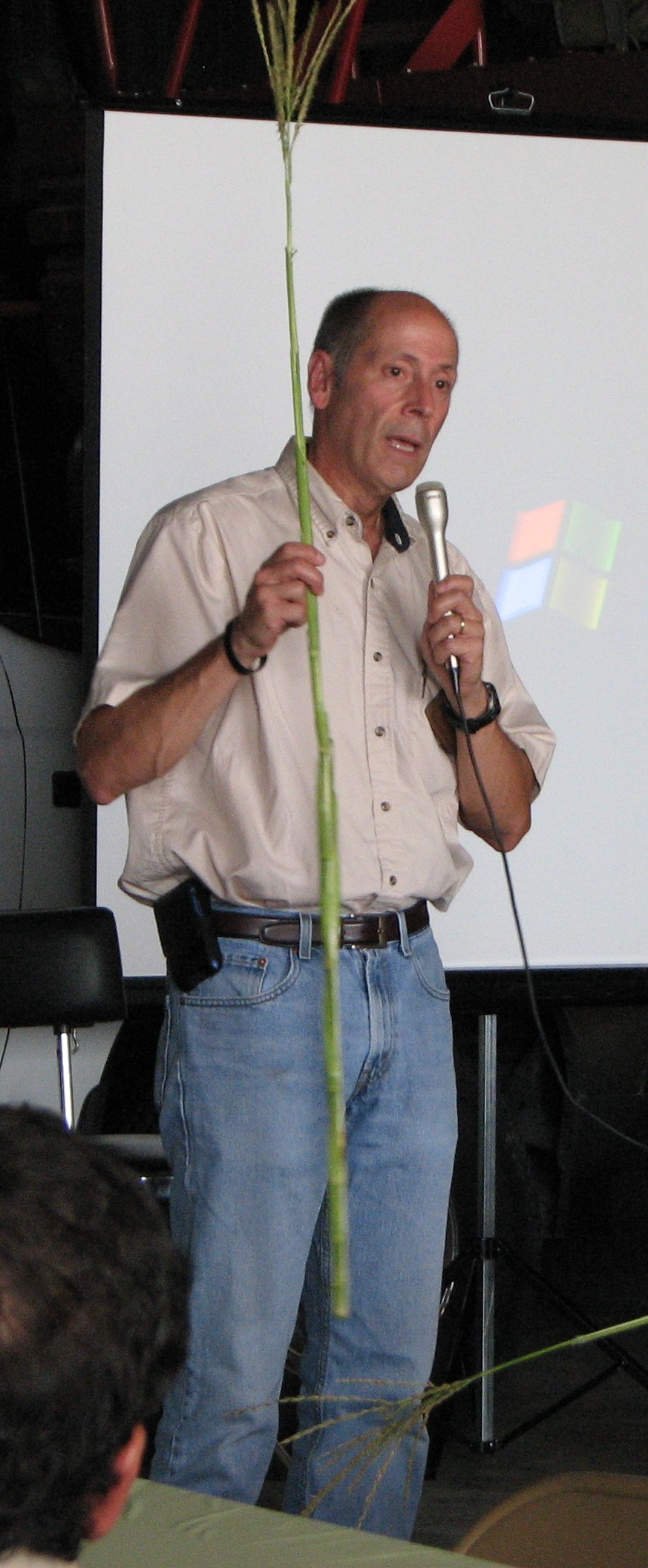


The Bartholomew County SWCD hosted a nutrient management workshop in July at Hawclif Farms in Hope, Indiana. The SWCD would like to give a special thanks to Paul Ketner & Nathan Lykins for letting us use their farm for this workshop.
At the workshop, attendees learned about the following: Fundamentals of Soil Testing and Interpretation by Steve Dlugosz (Winfield Solutions), Nitrogen & Phosphorus Management by Jim Camberato (Purdue Nutrient Specialist), Reasons for Nutrient Management on Your Farm by Hans Kok (Indiana Conservation Cropping Systems Initiative), and the On Farm Network by Jordan Seger (ISDA). Mike Ferree from the Purdue Extension Office also spoke about the Nitrate test on corn stalks along with a few key points that allowed farmers to receive their Private Applicator Recertification Points.
The topics were focused around managing nutrients on the farm in a drought year. Jim Camberato talked about how the dry soils slow the Potassium uptake into the crops, and also how the loss of Nitrogen during a drought is negligible, because of virtually no runoff. With many corn fields being chopped up and not harvested, the Nitrogen and Phosphorus that the plant took up will be released back into the soil as the plant decomposes. This may mean that farmers will have to put on less fertilizer. However, the amount that will accumulate as a result of the plant decomposition is not easy to predict. It is vital that a farmer has a soil test completed to determine how much of Nitrogen (N), Phosphorus (P), and Potassium (K) to add to the field. During a drought year, the soil samples may give misleading results for Potassium and pH during dry years, making N, P, & K application amounts difficult to determine.
Hans Kok spoke about the importance of cover crops and no-till in improving soil health. He stated, “We aren’t farming Grandpa’s farm anymore.” The meaning behind this is that the soil that was on the farm during our grandparents’ generation is no longer there. When we bust up the topsoil and don’t protect it, it gets washed away along with all of the nutrients that were in it. He emphasized, “We need to protect our soil for future generations.” Farmers are doing a lot already and many have already put conservation practices in place. As a matter of fact, “We have an extremely high production rate with some of the poorest quality soils in the world.”
Approximately 75 people were in attendance.
At the workshop, attendees learned about the following: Fundamentals of Soil Testing and Interpretation by Steve Dlugosz (Winfield Solutions), Nitrogen & Phosphorus Management by Jim Camberato (Purdue Nutrient Specialist), Reasons for Nutrient Management on Your Farm by Hans Kok (Indiana Conservation Cropping Systems Initiative), and the On Farm Network by Jordan Seger (ISDA). Mike Ferree from the Purdue Extension Office also spoke about the Nitrate test on corn stalks along with a few key points that allowed farmers to receive their Private Applicator Recertification Points.
The topics were focused around managing nutrients on the farm in a drought year. Jim Camberato talked about how the dry soils slow the Potassium uptake into the crops, and also how the loss of Nitrogen during a drought is negligible, because of virtually no runoff. With many corn fields being chopped up and not harvested, the Nitrogen and Phosphorus that the plant took up will be released back into the soil as the plant decomposes. This may mean that farmers will have to put on less fertilizer. However, the amount that will accumulate as a result of the plant decomposition is not easy to predict. It is vital that a farmer has a soil test completed to determine how much of Nitrogen (N), Phosphorus (P), and Potassium (K) to add to the field. During a drought year, the soil samples may give misleading results for Potassium and pH during dry years, making N, P, & K application amounts difficult to determine.
Hans Kok spoke about the importance of cover crops and no-till in improving soil health. He stated, “We aren’t farming Grandpa’s farm anymore.” The meaning behind this is that the soil that was on the farm during our grandparents’ generation is no longer there. When we bust up the topsoil and don’t protect it, it gets washed away along with all of the nutrients that were in it. He emphasized, “We need to protect our soil for future generations.” Farmers are doing a lot already and many have already put conservation practices in place. As a matter of fact, “We have an extremely high production rate with some of the poorest quality soils in the world.”
Approximately 75 people were in attendance.